Catalog of British Columbiana and Pacific Northwest Americana
The Encyclopedia Cascadia Catalog indexes mostly non-fiction literature covering the Pacific Northwest coast of North America, with an emphasis on British Columbia, Idaho, Oregon, and Washington State.
| Catalog Title | Published |
|---|---|
|
The boundary hunters surveying the 141st meridian and the Alaska Panhandle by Lewis Green 
Lewis Green’s The Boundary Hunters: Surveying the 141st Meridian and the Alaska Panhandle provides a diplomatic and spatial history of the International Boundary Commission survey that established the official border between British Columbia, Yukon, and Alaska following the 1903 dispute settlement. Green chronicles the physical feats of Canadian and American survey crews climbing glaciated Coast Mountain peaks and surveying rugged coastal valleys. The volume details police and customs posts along overland pack routes such as Pleasant Camp on the Dalton Trail, exploring mineral exploration at Rainy Hollow, river transit around Bennett, and the isolated mining enclave along the Tulsequah and Taku rivers. xiv, 214 pages : illustrations, maps, portraits ; 24 cm Desiderata
|
1982 |
|
The Boiseans at home by Arthur A. Hart 
To own a fine house is a mark of success, and Boiseans of earlier times were no different from those of today in recognizing this. This volume is a collection of short essays that aim to capture the flavor of the life and times of some of the families that played a significant part in Boise s history. 86 pages : illustrations, portraits ; 20 cm Desiderata
|
1992 |
|
The Boise Massacre on the Oregon Trail attack on the Ward party in 1854 and massacres of 1859 by Donald H. Shannon 
Only some half-dozen of the adverse encounters between Indians and emigrants on the Oregon and California Trails can be termed "massacre". The Ward Party Massacre that occurred on the Boise river is one of those unfortunate, and often overlooked events. Author Donald H. Shannon explores the relations between the peoples of the "Snake Country" of Southern Idaho, Shoshoni, Northern Paiutes, Bannocks and Emigrants, in a attempt to describe the environment that led to several of the most violent conflicts that occurred along the Oregon and California trails. xi, 287 pages : illustrations, maps ; 23 cm. Non-circulating [ 1 ]
|
2004 |
|
The Bohemia story by Wally Hunter
Wally Hunter's The Bohemia Story chronicles the rise and operations of the Bohemia Lumber Company, deeply rooting its narrative in the heavily forested landscapes of western Oregon. The historical account centers on Lane County, specifically detailing the bustling mill operations and logging camps that thrived in Cottage Grove and along the banks of the Row River in Culp Creek. Through the lens of this pioneering timber venture, the book maps the rugged foothills of the Oregon Cascades where the extraction of timber fueled the region's mid-century economy. Ultimately, the text provides a vivid geographic snapshot of how these specific inland Oregon valleys were transformed into vital, bustling hubs of the Pacific Northwest's logging industry. 61 pages map Non-circulating [ 1 ]
|
1969 |
|
The Blues natural history of the Blue Mountains of northeastern Oregon and southeastern Washington by Robert J. Carson (Author, Photographer), Duane Scroggins (Photographer), Bill Rodgers (Photographer), David Frame (Photographer), Kevin R. Pogue (Photographer), Dave Powell (Photographer), Michael E. Denny (Photographer), Merrylynn Denny (Photographer), Clare Carson (Photographer), Donald Snow, Scot 
The Blue Mountains, stretching south of Walla Walla into central Oregon, are one of the Pacific Northwest's iconic mountain ranges. Formed by successive periods of volcanic activity, home to diverse forest and grassland ecosystems, and rich in wildlife, the Blues have long held a special fascination for all who live in and recreate in the range's embrace. Now the Blues' unique natural history is the subject of this new book – the first volume ever to take its readers deep into the story of the range’s creation and history. In geological parlance, the Blue Mountains are a long anticlinal ridge composed mostly of basalt flows, stretching from Clarno, Oregon to Clarkston, Washington. Here, Carson has combined scholarly and elegant writings with the outstanding photography from more than a dozen contributors. The book includes a foreword by Don Snow, an afterword by Scott Elliott, and poems by Katrina Roberts and Janice King. Duane Scroggins, Bill Rodgers, and many others have contributed hundreds of magnificent photographs that draw readers into this incredible region. vii, 208 pages : illustrations (chiefly color), maps (chiefly color) ; 23 x 29 cm Desiderata
|
2018 |
|
The birth, death, and resurrection of Fairhaven by George Hunsby
The birth, death, and resurrection of Fairhaven chronicles the grueling industrial boom, speculative collapse, and gradual civic reclamation of a coastal maritime enclave situated along the steep, heavily timbered shores of Bellingham Bay in northwestern Washington. Hunsby details how the region's formidable physical barriers—specifically the towering, impenetrable stands of old-growth coastal rainforest, the sheer, rocky sandstone bluffs plunging directly into the tidal wash, and the rugged, isolating ridges of the Chuckanut Mountains—strictly dictated the margins of early human survival, speculative urban planning, and aggressive resource extraction. By mapping the immense physical labor required to blast precarious railway grades through solid coastal bedrock, strip massive timber from the precipitous slopes, and forcibly engineer sprawling deepwater wharves and heavy brick commercial blocks directly into the unyielding hillside, the narrative highlights the monumental effort necessary to anchor a permanent industrial boomtown in this demanding maritime environment. The profound geographic isolation from established southern rail hubs initially forced these remote speculators and laborers into an absolute reliance on the perilous marine highway, completely anchoring their fleeting commercial existence and early economic survival to the coastal timber and coal trade, and the precise tidal topography of the bay. Ultimately, this local historical record serves as a deeply localized spatial history, demonstrating how the extreme coastal geography, immense physical labor, and shifting maritime realities of this Pacific Northwest frontier fundamentally shaped the fiercely resilient, economically volatile, and distinctly terrain-dependent character of Fairhaven's dramatic urban lifecycle. 101 leaves, 7 unnumbered leaves of plates : illustrations ; 22 cm Non-circulating [ 1 ]
|
1975 |
|
The Birdcages British Columbia's First Legislative Buildings, 1859-1957 by Robert Ratcliffe Taylor 
Revealing a little-known chapter in the history of Victoria, British Columbia, The Birdcages, the province's first legislative buildings, were built 1859-1864, the formative, tumultuous time of the Gold Rushes. Constructed on the site of the present Legislature, they were built amid controversy and derided for their style. The brainchild of Governor James Douglas, they resembled, according to journalist/politician Amor de Cosmos, "something between a Dutch toy and a Chinese pagoda." Readers will discover how civil servants and politicians felt about them as a workplace and what the general public thought about them as civic architecture. The career of their designer, the mysterious Hermann Otto Tiedemann, one of Victoria's vivid early "characters," is recounted as are the contributions of local contractors and tradesmen. The site of events of national importance until their demise in 1898, the Birdcages reflected the history, character, and heritage of Victoria and played an important role in the developing political traditions of the province and the young Dominion of Canada. A place for political demonstrations and community celebrations, the House of Assembly was where the MLAs debated joining Confederation, granting the vote to women, and excluding Asian immigrants. Based on personal memoirs and letters, government documents, photographs and plans, this book will interest both students and adults, history buffs and professional historians Desiderata
|
2020 |
|
The Biology and management of red alder by David E. Hibbs, Dean S. DeBell, Robert F. Tarrant 
Only a few years ago, red alder, the major hardwood species in the Northwest, was regarded as a weed to be eradicated with herbicides. Today, red alder provides the raw material for a thriving industry, producing fine furniture, specialized veneers and plywoods, and paper products. In addition to its economic values, red alder has unique biological values that are proving vital in efforts to improve forest management. This timely study presents a synthesis of current knowledge about the biology and management of red alder. The first section covers topics in the basic biology of alder, while the second section offers principles and practices of alder management. The book's 34 contributors provide current and comprehensive information that will allow forest managers to weave red alder into the improved forest management systems demanded by an increasingly well-informed public. xi, 256 pages : illustrations ; 29 cm Desiderata
|
1994 |
|
The big woods logging and lumbering, from bull teams to helicopters by Ellis Lucia
The big woods logging and lumbering, from bull teams to helicopters examines the relentless industrial timber extraction across the vast, heavily corrugated mountain ranges and deep coastal rainforests of the Pacific Northwest. Lucia details how the region's immense spatial scale—specifically the towering canopies of old-growth Douglas fir, the precipitous alpine slopes, and the plunging river canyons—strictly dictated the margins of resource extraction and drove the rapid evolution of logging technology. By mapping the transition from early, mud-bound bull teams navigating the lowland riparian corridors to complex aerial yarding operations scaling the unyielding higher elevations, the narrative highlights how the rugged, shifting terrain demanded increasingly sophisticated methods of harvest. Ultimately, this industrial record serves as a macro-level spatial history, demonstrating how the extreme vertical geography and dense botanical magnitude of this forest frontier fundamentally shaped the highly mechanized, terrain-conquering character of the regional timber industry. 22 pages : illustrations ; 27 cm Desiderata
|
1975 |
|
The big run life aboard a salmon seiner by Ray Fadich 
"The mighty salmon runs that worked their way through Puget Sound each season on their way to British Columbia's Fraser River provided a way of life for fishermen in the Pacific Northwest for more than a century. Commercial gillnetters and purse seiners pursued millions of Sockeye salmon each season hoping to harvest a portion of the massive schools of fish that migrated through the region each season. It was demanding, and often dangerous work, but the knowledgeable captain and crew could hit it big by being in the right place at the right time to capitalize on this natural bonanza. In 1958, when captain Nick Foreigner Barhanovich hired greenhorn Ray Fadich to work as a skiffman on Barhanovich's purse seiner, The Emancipator, Fadich had little clue of what that fishing season would hold for him. As the newest member of the Emancipator's crew Fadich had to deal with a steep learning curve, days of backbreaking physical labor, and the practical jokes and daily initiation into the brotherhood of the commercial fisherman that came with the territory."--Amazon iii, 89 pages : illustrations, map ; 28 cm Desiderata
|
2020 |
|
The big blow the story of the Pacific Northwest's Columbus Day storm by Ellis Lucia 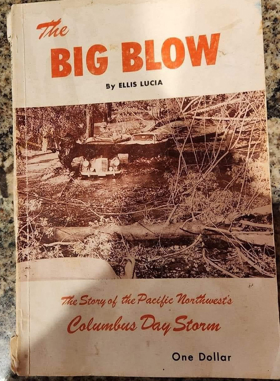
Ellis Lucia’s The Big Blow: The Story of the Pacific Northwest's Columbus Day Storm chronicles the catastrophic 1962 extratropical cyclone that violently reshaped the region's physical and cultural landscape. The gripping narrative maps the storm's devastating trajectory as it roared northward from the coast, tearing through the fertile Willamette Valley of Oregon and battering the densely populated Puget Sound corridor of Washington. Lucia details the unprecedented destruction inflicted upon coastal timberlands and inland agricultural basins, extending its fury all the way into the coastal communities of southern British Columbia to leave billions of board feet of shattered forests in its wake. By documenting the widespread infrastructural collapse across these interconnected states and provinces, the book captures the terrifying vulnerability of the broader Pacific Northwest geography to extreme oceanic weather systems. 80 pages illustrations, map 23 cm. Desiderata
|
1967 |
|
The best of Chief Dan George by Dan George, Helmut Hirnschall 
This book combines the two best sellers My Heart Soars & My Spirit Soars in one volume, 63 poems fully illustrated, eloquently illustrated throughout by Helmut Hirnschall. Included in this edition is the Lament for Confederation by Chief Dan George. Poetic and spiritual, this book has a universal message to all people. Chief Dan George was an accomplished performer, poet, philosopher, champion of Native peoples and loving patriarch of a large family. Chief Dan George was an accomplished performer, poet, philosopher, champion of first Nations peoples, loving patriarch of a large family, was born in 1899 on a Salish Band reserve on Burrard Inlet, in North Vancouver, one of twelve children of the chief. His given name was Teswahno, meaning thunder coming up over the land from the water. Like most native children at that time, under the influence of the Catholic Church, and in need of white culture's education, he went to a residential school at the age of five, so as not to be separated from his cherished older brother Harry. The next eleven years were difficult ones, being distanced from family, culture, language and customs. Schooling ended at sixteen, and he went immediately into the forest to harvest trees. At nineteen, in an arranged marriage, he and sixteen year old Squamish girl, Amy, entered into a devoted union of fifty-two years duration. They had eight children, six of whom survived into adulthood. Dan worked as a long-shoreman off and on for the next twenty-seven years, during frequent strikes supplementing his income with hunting and lumbering, until he had a serious accident on the docks in 1947, which damaged a hip and leg. In the forties, with his children and a cousin, who billed themselves as Dan George and His Indian Entertainers, he played for dances three or four nights a week throughout British Columbia. Traveling and sleeping in a covered truck, they would spend the summers picking hops and performing country and western music, with the kids doing special requests for extra money. Dan's instrument was the bass fiddle. He always remembered those years as the happiest times in his life. During the fifties, he was occupied with the duties of chief for his band. In the early 1960s, CBC TV was producing a series called Caribou Country. When an actor fell ill, the search was on to find a replacement for a character called Ol' Antoine. Through a fateful series of connections, Chief Dan tested for, and won, the part. With no formal training, he slipped into an instinctive way of acting that won him much acclaim, though initially he had to overcome a measure of hesitation and doubt. Having his two sons in the acting world was a major support, as was Amy's whole-hearted encouragement. Chief Dan gained further national recognition in 1967 with his now famous speech, The Lament for Confederation, which he read at the Centennial celebration in Vancouver. That same year, he came to the attention of the playwright, George Ryga, who was working on his powerful drama, The Ecstasy of Rita Joe. Their meeting resulted in the full development of the character of Rita Joe's father, which Chief Dan played, first at the Playhouse in Vancouver, and then two years later at the National Arts Centre in Ottawa, to glowing reviews. He also appeared in the Royal Winnipeg Ballet production based on the play. In 1973, he would recreate the part in Washington, D.C. for overflow audiences. When an episode of Paul St. Pierre's Caribou Country was brought by a Hollywood studio, Chief Dan got a call to test for the character Ol' Antoine in the Walt Disney movie, Smith. He easily got the part, and so began a film career that reached its peak with his legendary performance of the role of Old Lodgeskins, in Arthur Penn's film Little Big Man, with Dustin Hoffman, in 1970. For the first time, natives were seen without the stereotypical bias that the film industry had reflected for the first seventy years of its history. Chief Dan received the New York Film Critic's Award and the National Society of Film Critic's Award, as well as an Oscar nomination for the depth and sincerity of that characterization. For the last ten years of his life, he was in demand as a spokesperson for native people, and as an actor, musician, writer, speechmaker. He even toured for a year with the rock bank, Fireweed. Many awards came to him, including an honorary Doctor of Laws from Simon Fraser University. His highest aim was always for better understanding by white people of his culture and his people, and he pursued this with determination, wisdom and courage. He died in Vancouver in 1981. 126 pages : illustrations ; 22 cm Desiderata
|
2004 |
|
The best loved boat The Princess Maquinna by Ian Kennedy 
"Built in 1913, the Canadian Pacific Railway's ship Princess Maquinna steamed up and down the rugged west coast of Vancouver Island in summer and winter, calm weather and storms, for over forty years, and has become one of the most beloved boats in BC's maritime history. Princess Maquinna, sometimes referred to as the "Ugly Princess" but most often "Old Faithful," transported Indigenous people, settlers, missionaries, loggers, cannery workers, prospectors and travellers of all kinds up and down Vancouver Island's rugged and dangerous west coast, stopping at up to forty ports of call on her seven-day run. The Princess Maquinna faithfully served as the lifeline for all those who lived on the west coast of Vancouver Island before it became accessible by roads. Because of this strong connection she became the "Best Loved Boat" in BC's maritime history. Kennedy recounts battles through eighty-knot gales along the exposed coastline sailors called "The Graveyard of the Pacific," and reveals the bigotry that forced Indigenous and Chinese passengers to remain on the foredeck of the ship while other passengers sheltered from the elements inside. He brings the history of this beloved ship to life with rich detail, recalling a time when this remote part of British Columbia was alive with mines, canneries and now-forgotten settlements."-- Provided by publisher viii, 239 pages : illustrations, map ; 24 cm Desiderata
|
2023 |
|
The best loved boat The Princess Maquinna by Ian Kennedy 
"Built in 1913, the Canadian Pacific Railway's ship Princess Maquinna steamed up and down the rugged west coast of Vancouver Island in summer and winter, calm weather and storms, for over forty years, and has become one of the most beloved boats in BC's maritime history. Princess Maquinna, sometimes referred to as the "Ugly Princess" but most often "Old Faithful," transported Indigenous people, settlers, missionaries, loggers, cannery workers, prospectors and travellers of all kinds up and down Vancouver Island's rugged and dangerous west coast, stopping at up to forty ports of call on her seven-day run. The Princess Maquinna faithfully served as the lifeline for all those who lived on the west coast of Vancouver Island before it became accessible by roads. Because of this strong connection she became the "Best Loved Boat" in BC's maritime history. Kennedy recounts battles through eighty-knot gales along the exposed coastline sailors called "The Graveyard of the Pacific," and reveals the bigotry that forced Indigenous and Chinese passengers to remain on the foredeck of the ship while other passengers sheltered from the elements inside. He brings the history of this beloved ship to life with rich detail, recalling a time when this remote part of British Columbia was alive with mines, canneries and now-forgotten settlements."-- Provided by publisher 1 online resource (viii, 239 pages) : illustrations, map Desiderata
|
2023 |
|
The Beer Baron of Boise the life of John Lemp, millionaire brewer of frontier Idaho by Herman W. Ronnenberg 
Although he arrived in America penniless, John Lemp became the most successful brewer in the history of Idaho. As befits a business leader of the Gem state, he cut a multitude of other facets into his personal and professional identity. As an early Idaho businessmen, his story gives insights into the early development of the state and, particularly, of Boise. This biography could be interpreted as fitting into the literature of various individual businessmen in the West. xxv, 436 pages : illustrations, maps ; 24 cm Desiderata
|
2008 |
|
The beadworkers stories by Beth H. Piatote 
A woman teaches her niece to make a pair of beaded earrings while ruminating on a fractured relationship. An eleven-year-old girl narrates the unfolding of the Fish Wars in the 1960s as her family is propelled to its front lines. A Nez Perce-Cayuse family is torn apart as they debate the fate of ancestral remains in a moving revision of the Greek tragedy Antigone. Told with humor, subtlety, and spareness, the mixed-genre works of Beth Piatote’s first collection draw on Indigenous aesthetics and forms to offer a powerful, sustaining vision of Native life.. Beth Piatote's luminous debut collection opens with a feast, grounding its stories in the landscapes and lifeworlds of the Native Northwest, exploring the inventive and unforgettable pattern of Native American life in the contemporary world. 195 pages ; 22 cm Desiderata
|
2019 |
|
The ballad of Ginger Goodwin & Kitimat two plays for workers by Elaine Ávila 
"Two epic labour plays, based on true events, by the acclaimed author of Fado: The Saddest Music in the World. In The Ballad of Ginger Goodwin, discover how Canada got the eight-hour day - and in Kitimat, visit the fastest declining town in Canada, whose residents are suddenly offered a deal by Big Oil. The plays, performed from Los Angeles, California, to Lisbon, Portugal, are the recipient of many awards, including the Mellon Foundation Environment Arts Commission, and Best New Play, Audience Favourite, Best Production Awards from the Victoria Fringe and Victoria Critics Circle. The Ballad of Ginger Goodwin With a cast playing everyone from a radical socialist to an Italian laundress to a scientist-industrialist, The Ballad of Ginger Goodwin is about the dreams of immigrants, coal and smelter workers in Canada and the Pacific Northwest, and the battle for workers' rights. Featuring music of the period, including a new ballad by composer/activist Earle Peach, the play recreates the events surrounding the mysterious death of Albert "Ginger" Goodwin, who, through a strike at a Canadian zinc smelter in Trail, BC, brought the WWI British war machine to a halt. Kitimat Kitimat, British Columbia: an industry town in glorious wilderness finds itself the centre of international controversy when the town is asked to vote no or yes on an upcoming oil pipeline project. As election day approaches, the residents of Kitimat struggle to decide between economic prosperity or protection of the natural world. The Ballad of Ginger Goodwin: Cast of 2 women and 3 men Kitimat: Flexible, between 6 and 16 actors"-- Provided by publisher xi, 161 pages : illustrations ; 22 cm Desiderata
|
2023 |
|
The Atlin gold rush by Ronald Johnson
Ronald Johnson’s The Atlin Gold Rush chronicles the sudden northward diversion of stampeders to extreme northwestern British Columbia during the 1898 Klondike stampede. Johnson documents how initial placer discoveries by Fritz Miller and Kenneth McLaren on Pine Creek triggered the immediate platting of the Atlin townsite directly along ancestral Taku River Tlingit lands. The text traces the establishment of early commercial avenues, recording the installation of massive hydraulic flumes, ditch networks, and floating dredge infrastructure that re-engineered the drainage systems of Pine, Spruce, and McKee creeks. Johnson details the social development of the frontier community through boom and decline, documenting the growth of satellite mining camps at Surprise and Boulder City and the lake transport docks at Scotia Bay that sustained the district’s industrial extraction. 88 pages : illustrations, maps, portraits ; 23 cm Desiderata
|
1980 |
|
The art of ceremony voices of renewal from indigenous Oregon by Rebecca J. Dobkins (Author, Photographer) 
"The practice of ceremony offers ways to build relationships between the land and its beings, reflecting change while drawing upon deep relationships going back millennia. Ceremony may involve intricate and spectacular regalia but may also involve simple tools, such as a plastic bucket for harvesting huckleberries or a river rock that holds heat for sweat. The Art of Ceremony provides a contemporary and historical overview of the nine federally recognized tribes in Oregon, through rich conversations with tribal representatives who convey their commitments to ceremonial practices and the inseparable need to renew language, art, ecological systems, kinship relations, and political and legal sovereignty. Vivid photographs illuminate the ties between land and people at the heart of such practice, and each chapter features specific ceremonies chosen by tribal co-collaborators, such as the Siletz Nee Dosh (Feather Dance), the huckleberry gathering of the Cow Creek Umpqua, and the Klamath Return of C'waam (sucker fish) Ceremony. Part of a larger global story of Indigenous rights and cultural resurgence in the twenty-first century, The Art of Ceremony celebrates the power of Indigenous renewal, sustainable connection to the land, and the ethics of responsibility and reciprocity between the earth and all its inhabitants"-- Provided by publisher xix, 261 pages : illustrations (chiefly color), color maps ; 24 cm. Desiderata
|
2022 |
|
The archaeology of Manila galleons in the American continent the wrecks of Baja California, San Agustín, and Santo Cristo de Burgos (Oregon) by Scott S. Williams , Roberto Junco 
This is the first book devoted to the topic of Manila galleon shipwrecks; previous research on Manila galleons either has focused on the economics of the Manila galleon trade or has been limited to reports of the galleon wreck sites in the western Pacific salvaged for their cargoes. All three North American shipwrecks are protected under the historic preservation laws of the United States or Mexico, and each shipwreck site has been investigated by professional archaeologists seeking to answer research questions posed in peer-reviewed research designs. The majority of Manila galleon wrecks are found in the western Pacific and were salvaged by treasure hunters rather than recovered by archaeologists. The three North American shipwrecks represent the most protected Manila galleon archaeological sites, so their potential for future archaeological research is higher than for many of the extant shipwrecks of the western Pacific ix, 100 pages : illustrations (chiefly color), maps ; 24 cm Desiderata
|
2021 |
|
The Arbutus/Madrone files reading the Pacific Northwest by Laurence Ricou 
A lively and perceptive new look at twentieth-century Pacific Northwest writing, The Arbutus/Madrone Files explores the dynamics of this cross-border region using resonant quotations, poetry, song lyrics, and art to demonstrate and enhance author Laurie Ricou's critical readings and ideas. The Arbutus/Madrone Files is a wide-ranging, deeply felt meditation on the land, people, and literature of the U.S. and Canadian Pacific Northwest, gathered into twelve thematic essays or "files," including the Island File, Salmon File, Woodswords File, Sasquatch File, and, of course, the Rain File. A longtime student of literary regions, Ricou moves in this book from a scholarly perspective toward more personal and lyrical reflections about what constitutes "home" and "region." He explores the work of such Northwest authors as Emily Carr, H.L. Davis, David Guterson, Jack Hodgins, John Keeble, Ken Kesey, Joy Kogawa, Ursula Le Guin, John Okada, Kim Stafford, and David Wagoner, among others. This unique, stylishly written book will appeal to Pacific Northwest book-lovers interested in exploring the region's rich homegrown literature and art, and will be of great interest to scholars and students of regional literature, eco-criticism, and Pacific Northwest culture. xv, 239 pages : illustrations (some color), maps ; 23 cm Desiderata
|
2002 |
|
The apple of his eye the Sorrento Centre story by Dorothy Barker, Norma Hlina, Derek Arnold
Dorothy Barker, Norma Hlina, and Derek Arnold’s The Apple of His Eye: The Sorrento Centre Story documents the agricultural foundation, community evolution, and institutional reinvention of the South Shuswap lakeshore. The chronicle outlines how pioneer promoter T.G. King acquired lakefront benches in 1910, naming the settlement after the Italian resort town and subdividing the terrain into commercial apple orchards that attracted English gentry families. The authors detail how early orchardists established cooperative packing houses, water flumes, and transport connections through the Notch Hill railway station, while building close civic ties with neighboring settlements in Blind Bay, Balmoral, and Eagle Bay. The narrative traces the eventual collapse of the commercial fruit industry during the Great Depression and the subsequent mid-century conversion of the historic King estate into an enduring ecumenical conference, cultural, and educational centre. 112 pages : illustrations, portraits ; 22 cm Desiderata
|
1982 |
|
The American West and its interpreters essays on literary history and historiography by Richard W. Etulain 
Distinguished historian Richard W. Etulain brings together a generous selection of essays from his sixty-year career as a specialist on the US West in this essential volume. Each essay provides an invaluable overview of the rise of western literary history and historiography--including insightful evaluations of individual historians--revealing summaries of regional literature and discussions of western stories yet to be told. Together these writings furnish readers with useful considerations of important subjects about the American West. All those interested in the American West and its interpreters will find these illuminative moments of literary history and historiography especially appealing xiii, 311 pages ; 23 cm Desiderata
|
2023 |
|
The Alpine lakes by Ed Cooper, Bob Gunning, Brock Evans, David Brower, Harvey Manning
The Alpine lakes examines the fierce environmental conservation campaign and high-altitude wilderness advocacy situated within the deeply glaciated, granite-studded macro-geography of Washington's Central Cascade Range. Cooper, Evans, Manning, and their co-authors detail how the region's formidable alpine topography—specifically the razor-sharp, glaciated peaks of the high Cascades, the immense concentration of fragile, high-elevation tarns, and the dense, old-growth valleys heavily targeted by timber interests—strictly dictated the margins of aggressive industrial logging, early mining intrusions, and the subsequent mobilization of intense wilderness preservation. By mapping the visual and political effort to shield this rugged, immensely scenic high country from encroaching resource extraction, leveraging the region's severe topography and its critical proximity to the expanding Seattle metropolis to forge a massive citizen-led wilderness defense, the narrative highlights how this specific fragile, high-altitude geography anchored a profoundly fierce, modern environmental battleground. Ultimately, this visual and environmental record serves as a localized spatial history, demonstrating how the severe topographic extremes, pristine alpine hydrology, and vital urban proximity of this Pacific Northwest landscape fundamentally shaped the highly contested, preservation-driven character of the Alpine Lakes region. 128 pages : color illustrations ; 36 cm Non-circulating [ 1 ]
|
1971 |
|
The adventures and sufferings of John R. Jewitt, captive of Maquinna by John R. Jewitt, Hilary Stewart 
The Adventures and Sufferings of John R. Jewitt, Captive of Maquinna, originally published in 1815 and expertly annotated and illustrated by Hilary Stewart in 1987, is a classic maritime captivity narrative set on the rugged coast of Vancouver Island. The book recounts the harrowing two-year ordeal of an English blacksmith who survived an 1803 attack on his trading ship and was integrated into the Nuu-chah-nulth First Nation under Chief Maquinna. Ultimately, enhanced by Stewart’s detailed ethnographic drawings and historical context, it serves as an invaluable firsthand account of early European contact and traditional Indigenous life in the Pacific Northwest. 192 pages : illustrations ; 24 x 27 cm Non-circulating [ 1 ]
|
1987 |