Catalog of British Columbiana and Pacific Northwest Americana
The Encyclopedia Cascadia Catalog indexes mostly non-fiction literature covering the Pacific Northwest coast of North America, with an emphasis on British Columbia, Idaho, Oregon, and Washington State.
| Catalog Title | Published |
|---|---|
|
José Narváez the forgotten explorer : including his narrative of a voyage on the northwest coast in 1788 by Jim McDowell 
Even during his lifetime (1768-1840) was Narvaez forgotten, dying in poverty and obscurity in the Mexico he adopted as home in preference to his native Spain, but fortunately not during the high tides of his adventures in the 1780s and 1790s. Here is what is known about his voyages along the northwest coast of North America investigating the Russian movement into Alaska and searching for the Northwest Passage, and about the subsequent fate of his accounts of them. c. Book News Inc 189 pages : illustrations, maps ; 24 cm. Non-circulating [ 2 ]
|
1998 |
|
Terra Pacifica people and place in the northwest states and western Canada by Paul W. Hirt 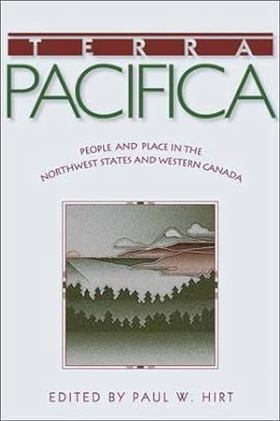
"Ten widely-recognized historians from the United States and Canada present thought provoking insights about society, culture, and change in the great, resource-laden Northwest. Essays examine early Spanish exploration of the Northern coast; the long-term relationship of a fragile Canadian union with its powerful southern neighbor; regional novelists and literature; important aspects of black and white immigration; the iconography of nuclear energy; and the continuing interaction of the region's many Indian reservations with the dominant society's economic, conservation, and legal institutions."--BOOK JACKET xvii, 223 pages : illustrations, map ; 24 cm Non-circulating [ 1 ]
|
1998 |
|
Salt Spring the story of an island by Charles Kahn 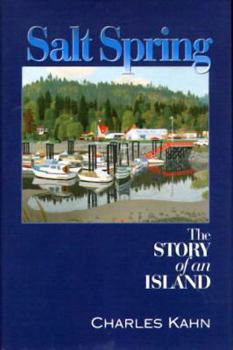
The largest of BC's southern Gulf Islands, beautiful Salt Spring Island has long been a favoured holiday destination and a prized real-estate area for those in search of an idyllic rural residence. Now available in trade paper, Salt Spring: The Story of an Island chronicles the island's rich history from the days when Coast Salish people inhabited Salt Spring's shores, through some 150 years of settlement by many diverse groups. Because of the island's rugged geography, the early story of Salt Spring is largely the story of hard-working people in small isolated communities industriously carving farms out of rough terrain. Many of the settlers who followed came to find a place where they could live their lives free of the constraints of most societies. This was as true for the African-Americans, many of whom were among the first non-aboriginal settlers to arrive in 1859, as it was for those fleeing conventional middleclass life and for Americans seeking to avoid the Vietnam War. And it's true of almost every new islander who arrives today with a unique personal dream. 344 pages : illustrations, maps, portraits ; 24 cm Non-circulating [ 1 ]
|
1998 |
|
Hudson's Bay to Haro Strait books on Western Canada and the Pacific Northwest : a collectors' guide by G. J. Kim Whale 
A comprehensive reference bibliography on Western Canada, including important works on the Arctic, the Klondike, Hudson's Bay, and some nautical titles relating to that area, with descriptions and price guide to approximately 1,800 of the most important books. 1,754 books described with pricing guidance. 316, xii ; 24 cm. Non-circulating [ 1 ]
|
1998 |
|
Afloat in time by James Sirois 
James Sirois’s Afloat in time explores the unique mobile resilience and profound environmental adaptation of early industrial communities within the remote coastal canyons and deep fjords of central British Columbia. The narrative illustrates how the demanding maritime realities of this isolated topography—defined by labyrinthine ocean channels, towering temperate rainforests, and the centralized pulp-mill hub of Ocean Falls—required immense physical ingenuity and constant, shared adaptation from early "gyppo" logging families who lived and operated entirely on water. By detailing the complex transition from traditional land-based settlements to an entire industrial enterprise and childhood conducted on shifting log rafts, the text highlights how the region's resource-driven economy relied heavily on tight-knit, cooperative community networks. Ultimately, the autobiographical account demonstrates that patiently navigating these severe maritime conditions and collaboratively sustaining the intricate, floating infrastructure of the logging frontier were essential steps in forging the rugged, enduring cultural identity of British Columbia's coastal working communities. 271 p., [28] p. of plates : ill., geneal. table, map, ports. ; 22 cm. Non-circulating [ 1 ]
|
1998 |
|
The natural history of Puget Sound country by Arthur R. Kruckeberg 
Reveals the natural history of the Puget Sound region. This book begins with a discussion of how the ice ages and vulcanism shaped the land and examines the natural attributes of the region - flora and fauna, climate, special habitats, life histories of key organisms - as they pertain to the ecosystem. It contains over three hundred photographs. Winner of the Pacific Northwest Booksellers Award. Bounded on the east by the crest of the Cascade Range and on the west by the lofty east flank of the Olympic Mountains, Puget Sound terrain includes every imaginable topograhic variety. This thoughtful and eloquent natural history of the Puget Sound region begins with a discussion of how the ice ages and vulcanism shaped the land and then examines the natural attributes of the region―flora and fauna, climate, special habitats, life histories of key organisms―as they pertain to the functioning ecosystem. Mankind's effects upon the natural environment are a pervasive theme of the book. Kruckeberg looks at both positive and negative aspects of human interaction with nature in the Puget basin. By probing the interconnectedness of all natural aspects of one region, Kruckeberg illustrates ecological principles at work and gives us a basis for wise decision-making. The Natural History of Puget Sound Country is a comprehensive reference, invaluable for all citizens of the Northwest, as well as for conservationists, biologists, foresters, fisheries and wildlife personnel, urban planners, and environmental consultants everywhere. Lavishly illustrated with over three hundred photographs and drawings, it is much more than a beautiful book. It is a guide to our future. xxiv, 468 pages : illustrations, maps ; 25 cm Non-circulating [ 1 ]
|
1998 |
|
Indianola a community memoir by Sarah M. Berry, Joan R. Henderson, Indianola Beach Improvement Club History Committee 
Authored by Sarah M. Berry and Joan R. Henderson alongside the Indianola Beach Improvement Club History Committee, Indianola: A Community Memoir chronicles the evolution of the historic waterfront enclave on Washington’s Kitsap Peninsula. The book traces the area’s transformation from an indigenous gathering place and a 20th-century mosquito-fleet resort destination into a tight-knit, fiercely protective seasonal and year-round community. Drawing on archival photographs, diaries, and local records, the text preserves the distinct social traditions and ferry-dependent isolation that shaped generations of cabin owners and residents. A keen insight drawn from the work is how recreational enclaves foster a unique brand of communal preservation; by relying on shared infrastructure like community docks and improvement clubs, residents turned their collective isolation into a deliberate tool for shielding their waterfront heritage from rapid commercial overdevelopment. 128 pages : illustrations, maps ; 21 x 27 cm Non-circulating [ 1 ]
|
1998 |
|
They came to six rivers the story of Cowlitz County by Virginia Urrutia, Cowlitz County Historical Society 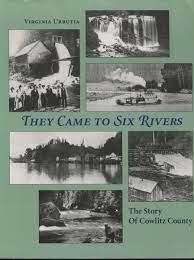
Though Cowlitz County is one of the smallest counties in Washington state, its past has been richly textured by the six rivers that flow through it: The Columbia, Kalama, Lewis, Coweeman, Toutle and Cowlitz rivers. Rivers throughout history have given rise to civilizations, so it is not surprising that Cowlitz County's rivers have lured settlers and industries. But each of these rivers had its own appeal, its own convenience or difficulty of settlement, its own methods of logging or fishing, its own vessels and bridges, and even its own scenery; each thus offered its own unique possibilities to the people who came here. Virginia Urrutia has taken these six strands and deftly woven them together with narratives of families, communities, governments, agriculture, industries, and events, creating a colorful and entertaining tapestry that will reward the attention of any reader, from the most casual tourist to the most knowledgeable citizen of the region. Book contains map of region and is illustrated with 100 photographs 223 pages : illustrations, map, portraits ; 29 cm Non-circulating [ 1 ]
|
1998 |
|
Indians in the making ethnic relations and Indian identities around Puget Sound by Alexandra Harmon 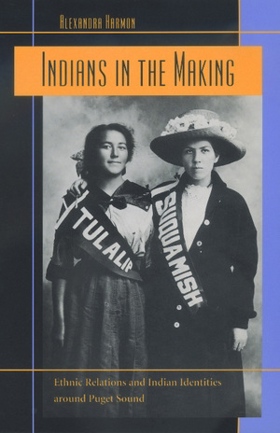
In the Puget Sound region of Washington state, indigenous peoples and their descendants have a long history of interaction with settlers and their descendants. Indians in the Making offers the first comprehensive account of these meetings, from the land-based fur trade of the 1820s to the Indian fishing rights activism of the 1970s. Thoroughly researched and theoretically sophisticated, this history shows how notions of Indian identity - both Indian and non-Indian - changed as relations changed. In the Puget Sound region of Washington state, indigenous peoples and their descendants have a long history of interaction with settlers and their descendants. Indians in the Making offers the first comprehensive account of these interactions, from contact with traders of the 1820s to the Indian fishing rights activism of the 1970s. In this thoroughly researched history, Alexandra Harmon also provides a theoretically sophisticated analysis that charts shifting notions of Indian identity, both in native and in nonnative communities. During the period under consideration, each major shift in demographic, economic, and political conditions precipitated new deliberations about how to distinguish Indians from non-Indians and from each other. By chronicling such dialogues over 150 years, this groundbreaking study reveals that Indian identity has a complex history. Examining relations in various spheres of lifelabor, public ceremony, marriage and kinship, politics and law. Harmon shows how Indians have continually redefined themselves. Her focus on the negotiations that have given rise to modern Indian identity makes a significant contribution to the discourse of contemporary multiculturalism and ethnic studies. xii, 393 pages : illustrations, maps ; 24 cm. Desiderata
|
1998 |
|
Mainstays women who shaped BC by Cathy Converse 
We all know that there have been women in British Columbia since the early days, and they were not just ironing shirts and baking bread. They organized unions, won elections, started schools and hospitals and became judges, scientists, artists and doctors. BC has benefited from a long tradition of energetic women who have had an impact on the province as we know it. The twenty women profiled in this book didn't all succeed in everything they attempted, but they were flexible, saw what needed to be done and just did it. xi, 212 pages : illustrations, portraits ; 22 cm Desiderata
|
1998 |
|
Raising the roof creating the Kibbie Dome at the University of Idaho by Peter Johnson 
Construction of the University of Idaho's Kibbie Dome, which won the American Society of Civil Engineer's Outstanding Structural Achievement Award for 1976, demonstrates what can be accomplished within a framework of limited budgets and tight timelines. The proposed structure would have a 400 foot clear span, with a clearance above the field equivalent to a twelve-story building. 61 pages : illustrations (some color) ; 25 cm Desiderata
|
1998 |
|
Governor Smylie remembers by Robert E. Smylie 
"Robert E. Smylie was born in Marcus, Iowa, in 1914 and first came to Idaho as a student at what was then the College of Idaho in Caldwell. Subsequently he worked his way through law school at George Washington University in Washington, D.C., served in the Coast Guard during World War II, married, and came back to Idaho in 1947 first as Assistant Attorney General and then Attorney General."--BOOK JACKET. "In 1954 Robert E. Smylie decided to run for governor, was elected, and served in that office until 1967. During his three terms in office, Governor Smylie could count among his many achievements an increase in the minimum wage, a five-day work week for state employees, creation of the Department of Commerce, a massive state highway construction program, promotion of the interests of business, land, and water within Idaho, serving as chair of the Western Governor's Association, the establishment of the state park system, and the introduction of a state sales tax to fund education."--BOOK JACKET xv, 234 pages : illustrations ; 24 cm Desiderata
|
1998 |
|
Peace at heart an Oregon country life by Barbara Drake 
Many dream of leaving the city for a new life in the country. Few follow that dream. In 1987, Barbara Drake and her husband sold their home in Portland and moved to a farm in western Oregon's Yamhill Valley. Home was now a modest white house, an old red barn, and a small vineyard. In Peace at Heart, Barbara Drake reflects on ten years of country living and on the happiness that this rural landscape has brought her. Weather, seasons, plants, and especially animals figure prominently in these stories. The constant company of animals-domestic and wild-on the farm inspires what Drake calls "the sacramental character of country life." In essays on birthing lambs, keeping bees, raising geese, and making wine, Drake combines gentle humor, practical advice, and deep respect for the work and the land. This rich gathering of observations and meditations-on everything from border collies and Oregon mud to picking wild apples-captures the ordinary joys and everyday blessings of country life. Finalist for the Oregon Book Award, 1998 xiv, 176 pages ; 23 cm Desiderata
|
1998 |
|
Propagation of Pacific Northwest native plants by Robin Rose, Caryn E. C. Chachulski, Diane L. Haase 
Increasing awareness of the beneficial role of native plants in promoting healthy ecosystems has generated new interest in propagation techniques. Native plants have been recognized as a crucial component of land management, especially after fires or other disturbances, and are widely used in habitat conservation efforts. In addition, native plants are increasingly desirable for landscaping and gardening. Propagation of Pacific Northwest Native Plants, the first publication of its kind, provides propagation information on nearly one hundred and forty native plants. Designed for use by both nursery professionals and home gardeners, this working manual presents the most current and comprehensive information in this emerging field. Drawn from forestry and agricultural journals, as well as gardening and horticultural handbooks and personal sources, the techniques presented here offer invaluable direction to the many who wish to grow native plants. The book is divided into four plant sections: shrubs, trees, forbs, and grasses. In addition to propagation techniques, the species accounts feature physical descriptions and information on habitat and geographic range. Abundant line drawings and an illustrated glossary help to ensure accurate use of this important new resource. viii, 248 pages : illustrations ; 26 cm Desiderata
|
1998 |
|
An editor for Oregon Charles A. Sprague and the politics of change by Floyd J. McKay 
In chronicling the life of Oregon governor and newspaper editor Charles A. Sprague, Floyd McKay guides readers through the politics and journalism of twentieth-century Oregon. Sprague's remarkable career, writes McKay, "is in effect the life of a state through Depression, war and recovery, and into the era of Tom McCall and the Oregon Story." Newspaperman Charles Sprague, a progressive Republican, had lived in Oregon for only thirteen years when he became the surprise victor of the 1938 gubernatorial race. Although a capable governor, Sprague gained greater prominence during his forty-year tenure as editor and publisher of The Oregon Statesman in Salem. McKay examines the influence of Sprague's involvement in the Progressive politics of Theodore Roosevelt, his return to Republican orthodoxy, and his later emergence as a spokesman for liberal positions on race and justice, an evolution shaped by his governorship and service at the United Nations. Sprague's decisions -and later atonements- concerning ultra-patriotism in World War I and internment of Japanese Americans in World War II reveal an editor and governor torn by issues of his day. A major contribution to Oregon political history, An Editor for Oregon also offers a valuable look at one Oregon newspaper and its role in the community during the middle part of this century. x, 342 pages : illustrations ; 24 cm Desiderata
|
1998 |
|
The Wallowas coming of age in the wilderness by William Ashworth 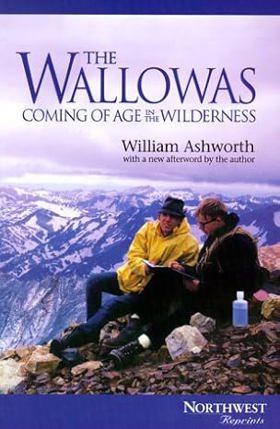
Part adventure story and part spiritual memoir, William Ashworth's The Wallowas recounts a young man's search for the challenges and the solace that the wilderness offers. It's the story of how as a student at Whitman College, Ashworth discovered the Wallowa Mountains in remote northeast Oregon. From that time on, the Wallowas were an obsession. Weekends and vacations were dedicated to exploring a rugged country roughly the size of Los Angeles and home to 126 peaks, each over 8,000 feet high. In language vivid and precise, Ashworth describes as he and a coterie of climbing buddies attempt ascents of Eagle Cap, Pete's Point, Sacajaweja, and the Matterhorn. Climbing and camping in summer rain and winter blizzards, they face the challenge of the Wallowa high country and the humility it teaches. The book tracks the author's coming of age in the wilderness from a need to conquer mountains to an awareness of the redemptive qualities found in these wild places and the need to preserve the last of them. "We need wilderness not only for what it can do for us but for what it can mean to us," writes Ashworth. "We need the wilderness — to grow up in." Twenty years after its original publication, the Oregon State University Press is pleased to introduce William Ashworth's classic memoir to a new generation of readers. 174 pages : 1 map ; 23 cm. Desiderata
|
1998 |
|
Mammals of the Pacific Northwest from the coast to the high Cascades by Chris Maser 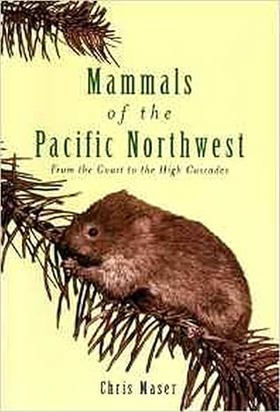
This remarkable book offers an intimate look at the life histories and habitats of mammals in the Pacific Northwest, from the coast to the high Cascades. In introducing the region's mammals, Chris Maser combines current scientific knowledge with personal accounts and anecdotes drawn from over a quarter century of fieldwork in Oregon. The book covers the natural history of 89 mammals in Oregon, 70 in Washington, 67 in British Columbia, and 83 in Northern California. For each species of mammal, the book provides a physical description and detailed information on distribution, habitat, and behavior. A keen observer of animal life, Maser relates his own encounters in the wild-from a rare, firsthand description of how shrews hunt and kill their prey to a tour of a mountain beaver's burrow-to help readers better understand the animals he has come to know. Maser delves into the secrets of how mammals live and explores the dynamic relationships between the mammals of the Pacific Northwest and their habitats. Intended for general readers and students, Mammals of the Pacific Northwest provides a fascinating natural history of the region's wildlife. The book is illustrated with over 100 photographs of mammals and their tracks, dens, nests, and young. 406 pages : illustrations ; 26 cm Desiderata
|
1998 |
|
Spirit of the Siskiyous the journals of a mountain naturalist by Mary Paetzel, Jacqueline Elliott, Lee Webb 
For 25 years, Mary Paetzel roamed the Siskiyou Mountains of southwest Oregon, tracking rare plants and insects. A rugged land of peaks, canyons, and rushing rivers, the Siskiyous are renowned for their unusual plant life. A self-taught naturalist, Paetzel first came to these mountains as a pollen contractor for a pharmaceutical company. Traversing logging roads in an old Volkswagen bus and hiking the high country with her beloved dog Sal, Paetzel came to know the Siskiyous — their wildflowers, butterflies, bees and wasps, lichens, and birds — as few ever have. Mary Paetzel recorded her wilderness experiences in a series of illustrated journals. Spirit of the Siskiyous gathers the best of these writings along with selections of Paetzel's paintings and drawings into a single volume. An important natural history of the Siskiyou Mountains, the book also documents a unique personal journey through a little-known, but fascinating, landscape. Although at times outspoken in her criticism of the Forest Service, Paetzel later worked for the agency conducting species surveys in the Siskiyou National Forest. During this time, she discovered a rare colony of Mariposa copper butterflies and was instrumental in establishing several protected botanical sites. It's to make readers aware of the fragile beauty of the Siskiyous and the urgent need to protect these wild places that Mary Paetzel has made her private journals — with their keen observations, fine wit, and demonstrated love of the land — available in this remarkable book. xxviii, 164 pages : illustrations (some color) ; 26 cm Desiderata
|
1998 |
|
Exploring Oregon's historic courthouses by Kathleen M. Wiederhold 
Courthouses are often overlooked as significant historical sites, perhaps because they are "working" buildings open to the public. As this informative and entertaining guide proves, however, Oregon courthouses are fascinating places to explore aspects of the state's history. For this first guide to Oregon's historic courthouses, Kathleen Wiederhold traveled extensively throughout the state visiting courthouses and talking to county officials and local residents. What she discovered were buildings rich in historical meaning and significance. This book explains these buildings and tells their stories, from political drama to salty local lore. The author introduces twenty-one courthouses in towns and cities from Astoria to Enterprise. Each profile includes a look at the county seat, past and present; a history of the courthouse; a detailed description of the building as it stands today; and tips on what to see. Exploring Oregon's Historic Courthouses combines local histories and their intriguing anecdotes with valuable information on the state's architectural heritage and old and new photographs of these venerable structures. It offers visitors and readers new opportunities to encounter history and historic architecture in the guise of these living buildings. xv, 289 pages : illustrations ; 22 cm Desiderata
|
1998 |
|
Green afternoons Oregon gardens to visit by Amy Houchen 
With Green Afternoons in hand, travelers, gardeners, and plant enthusiasts now have an exciting new guide to more than six dozen gardens throughout western and central Oregon and southwestern Washington. In her tour of the region, Amy Houchen uses the word "garden" broadly to include not only traditional gardens but also plantings of interest in such places as parks, college campuses, farms, and community gardens. Along with providing detailed descriptions of Oregon's best known and best loved gardens, Green Afternoons introduces readers to such unlikely but rewarding spots as an arboretum at a freeway rest area and climbing roses dressing up the cyclone fence around a ballfield. Arranged geographically, the garden listings include seasons of interest, directions, whether plants are labeled, a section on background and history, and a description of what to see. Indexes by plant name and topic allow for ease in locating plant specialties and such features as gardens for the blind and composting exhibits. Also included is information on holding weddings and listings of special events. From the Hulda Klager Lilac Gardens in Woodland and the International Rose Test Garden in Portland's Washington Park to Shore Acres in Coos Bay and the Sunriver Botanical Garden, Green Afternoons offers an informative and easy-to-use guide for locating and learning about the region's most beautiful gardens. iv, 250 pages : illustrations, maps ; 22 cm Desiderata
|
1998 |
|
Kirtland Cutter architect in the land of promise by Henry Matthews, Kirtland Kelsey Cutter 
In the early years of the twentieth century, Spokane was singled out for praise in the West for the quality of its architecture and the impressive way it had rebuilt after the devastating fire of 1889. Major credit for the city's distinctive character was extended to Kirtland Kelsey Cutter for his "rare architectural force and genius for design." His remarkable career, stretching from the Gilded Age to the Great Depression, allows a fascinating study of the evolution of an eclectic form of architecture that was an inevitable response to rich regional and historical influences during a time of transition from frontier settlements to modern city. Cutter's influence was felt beyond Spokane--in Seattle, other areas of Washington, and in Oregon, Idaho, and Montana. He was also responsible for buildings in the East and even for one in England. After financial problems ended his career in the Northwest, he began anew at age sixty-three in southern California, and worked there as an architect until his death in 1939 at age seventy-nine. Henry Matthews presents a comprehensive study of the whole body of Cutter's work, with ample photographs and illustrations. The book is based on exhaustive research in both the Northwest and California, revealing the influences on Cutter and his associates, the processes at work in the design and construction of the buildings, and the relations between the architect and the many people who commissioned his work. Particularly useful to Matthews's research was a collection of 290 sets of drawings, as well as office accounts, letters, and books from Cutter's library--materials acquired by the Eastern Washington State Historical Society. He also was able to interview former assistants and clients, who provided valuable insights on the architect and the way Cutter worked. In addition, many of the architect's residences, hotels, clubs, and commercial buildings are still standing. This book adds significantly to an understanding of Western urban and regional history. But Cutter's experimentation in many styles and the imaginative nature of his work make for a study that goes beyond regional limits and sheds light on national trends. x, 438 pages : illustrations, plans, portraits ; 26 cm Desiderata
|
1998 |
|
Native Arts of the Columbia Plateau The Doris Swayze Bounds Collection of Native American Artifacts by Susan E. Harless, Orr Staff High Desert Museum Mbend 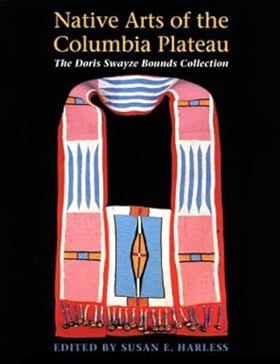
Colorfully beaded handbags, superbly tanned and decorated deerskin shirts, finely woven baskets, exquisitely beaded and fringed horse trappings -- these distinctive Native arts of the Columbia River Plateau have been overshadowed in the public eye by the arts of the Northwest Coast, Great Plains, and American Southwest. But Indians in the region where present-day Washington, Oregon, and Idaho share boundaries have for centuries combined function and beauty in the items they made for even the most mundane of uses, and their traditional arts are still vital today. This book brings overdue recognition to the artistry and craftsmanship of the Plateau Indians by focusing on the remarkable collection amassed by the late Doris Swayze Bounds, a banker in Hermiston, Oregon, who grew up with and deeply loved Native people and their culture. She was loved in return, and many of the nearly 1,000 Plateau items in her collection came to her as gifts from her Indian friends, who expressed their respect and affection through the time-honored tradition of gift-giving. Exposed to Euro-Americans relatively late, the Plateau Indians managed to retain many of their traditional lifeways of fishing, hunting, and gathering, as well as a vigorous ethic of generosity and respect for others. The pieces in the Bounds collection, which date mainly from the 1870s to the 1960s, reflect all these aspects of Plateau culture. They range from sturdy baskets made to hold roots or berries to elaborately beaded elkhide “tail dresses” worn on festive occasions. In five essays, both Native and non-Native experts describe the art styles and the uses and cultural meanings of the items; two other recount Doris Bound’s life, collecting practices, and relationships with Native Americans. The essays are handsomely illustrated with items from the Bounds collection. This book offers and introduction to this visually stunning art tradition. Desiderata
|
1998 |
|
Glimpses of the past oral histories from Naselle by Ruth Busse Allingham, Pacific County Historical Society (Wash) 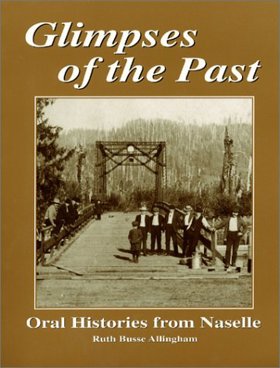
A collection of forty oral history interviews conducted by Ruth Busse Allingham with residents of the rural Naselle Valley in Washington State. Between 1890 to 1990, this largely immigrant community was mainly comprised of Finnish and other Scandinavian immigrants 216 pages : illustrations, maps ; 28 cm Non-circulating [ 1 ]
|
1998 |
|
Revelstoke history and heritage by Ruby M. Nobbs
Ruby M. Nobbs’s Revelstoke: History and Heritage serves as the authoritative municipal history of the strategic mountain crossroads situated at the confluence of the Columbia and Illecillewaet rivers. The volume chronicles the town’s rapid emergence from a raucous 1880s railhead construction camp known as "Farwell" into the preeminent administrative, maintenance, and division point for the Canadian Pacific Railway through the Selkirk and Monashee mountains. Nobbs details how railway infrastructure, steamship docks connecting to the Arrow Lakes, and hard-rock smelter ventures were mapped over traditional Sinixt and Secwépemc river routes. The narrative examines civic development across the Columbia River into the adjacent community of Big Eddy, early hydro developments, and the establishment of Mount Revelstoke National Park, capturing the physical resilience of a major Canadian mountain division town. x, 230 pages : illustrations, maps, portraits ; 23 cm Desiderata
|
1998 |
|
The story of the Grey Canal water and the making of the North Okanagan by David Dendy
David Dendy’s The Story of the Grey Canal: Water and the Making of the North Okanagan provides an indispensable historical geography and engineering study of the monumental irrigation network that transformed the arid benches surrounding Vernon. Dendy traces the construction of the fifty-kilometer gravity-fed ditch, flume, and siphon system between 1906 and 1914, which diverted water from Duteau Creek in the Monashee highlands to irrigate thousands of acres of semi-arid bunchgrass country. The work illustrates how access to controlled water engineered the transition from extensive cattle rangeland into productive, high-density fruit orchards across Coldstream, Vernon, Spallumcheen, Lavington, and the hills overlooking Okanagan Landing. Richly documented with construction blueprints and archival photographs, the book captures the critical role of corporate hydraulic engineering in shaping the regional landscape. 88 pages : illustrations, maps ; 28 cm Desiderata
|
1998 |