Catalog of British Columbiana and Pacific Northwest Americana
Encyclopedia Cascadia Catalog contains book titles of mostly non-fiction Pacific Northwest Coast of North America Titles (primarially British Columbia, Idaho, Oregon and Washington State) in an easy-to-understand title catalog. If you see a link with this badge ONLINE CIRC it means that there is an online institution that provides free access to that title. In some cases there may be more than one institution hosting the title digitally.
| Catalog Title | Published |
|---|---|
|
Rolls of certain Indian tribes in Oregon and Washington by Glen Cameron Adams, Charles E. McChesney, Herbert C. Taylor, F. A. Hazeltine 
Published by Shorey Book Store and compiled from historical government records by editors including Glen Cameron Adams, Charles E. McChesney, Herbert C. Taylor, and F. A. Hazeltine, Rolls of Certain Indian Tribes in Oregon and Washington compiles critical nineteenth and early twentieth-century federal census rolls and allotment records for Pacific Northwest Indigenous groups. The volume preserves official documentation detailing tribal member names, family lineages, and demographic shifts during an era of aggressive federal assimilation and reservation-boundary reductions. By gathering these scattered archival enumerations into a single reference text, it serves as a vital genealogical and historical ledger for regional tribes. A keen insight drawn from the work is how bureaucratic instruments like federal census rolls acted as legal mechanisms of dispossession; while ostensibly created to manage annuity distributions and land allotments, these documents simultaneously codified colonial control over native bodies by reducing complex ancestral communities into rigid, state-administered categories. 1 volume (various pagings) : illustrations, facsimile, portraits ; 26 cm CIRC [ 1 ]
|
2002 |
|
Wenatchee Valley images of North Central Washington by Rufus Woods, World Publishing Company, Quebecor Books 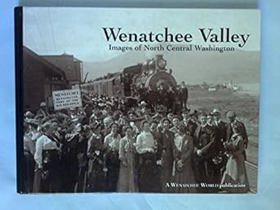
This is a photographic history of North Central Washington. Hundreds of people from the region brought photographs and the history behind the photograph. The best photos were compiled to represent the history of the region. The photographs start in the 1880s and continue until about 1959 iv, 155 pages : chiefly illustrations ; 19 x 26 cm CIRC [ 1 ]
|
2002 |
|
Puyallup a pioneer paradise by Lori Price, Ruth Anderson, Ezra Meeker Historical Society 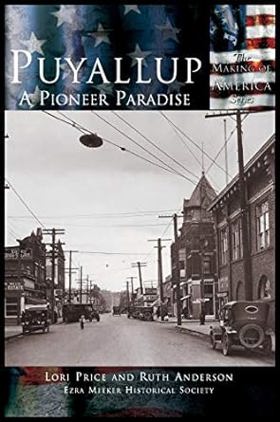
For many early Americans, native and immigrant, Puyallup was much more than simply a destination in Western Washington, but was a fulfillment of a dream, a vision of prosperity and opportunity. The lush valley region along the Puyallup River provided both beauty and bounty, sustaining countless generations and a variety of cultures, from the early American Indians to the later European explorers and settlers. Within this untamed wilderness, a group of hardy and self-reliant pioneers began the great task of carving a livelihood, and through their extraordinary efforts, created a lasting monument to their courage and determination-the city of Puyallup. Puyallup: A Pioneer Paradise chronicles the story of the city's evolution from the indigenous tribe that once populated the valley to the post-World War II building boom that attracted thousands of new residents. Readers travel across several centuries of change as the country of the "Generous People," or Puyallup tribe, succumbed to the unyielding waves of new people, such as the colonists of the Hudson's Bay Company, the stalwart Naches Pass Immigrants, and scores of later men and women searching for the promise of land. This unique volume traces the city's varied history, including its once-prominent agricultural traditions in hops, berries, flowers, fruits, vegetables, and Christmas trees, and remembers a host of its colorful characters, citizens like Ezra Meeker and J.P. Stewart, who worked tirelessly to promote Puyallup's development and supplied much of the land and leadership necessary for its growth. 160 pages : illustrations, map ; 25 cm CIRC [ 1 ]
|
2002 |
|
The storage box of tradition Kwakiutl art, anthropologists, and museums, 1881-1981 by Ira Jacknis 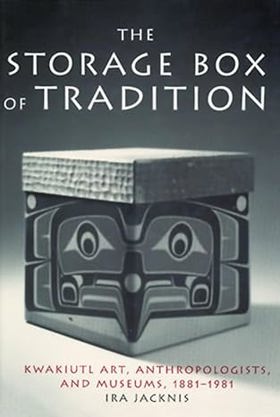
This unique study investigates the effects of the long interaction between anthropologists and the Kwakwaka'wakw (or Kwakiutl) peoples of coastal British Columbia. Beginning with Franz Boas, anthropologists have written extensively about the rich material culture of the Kwakwaka'wakw and have long collected their intricately detailed storage boxes, totem poles, and elaborate ceremonial wear. But how did the relationship between these two groups contribute to transform both ordinary and ritual objects into ethnological specimens, and then to works of art proudly displayed in museums? This expansive books is an anthropology of anthropology. Ira Jacknis identifies not only the effects of cross-cultural exchanges but also examines anthropology itself as a cultural process. He considers as well how museums define and present Native art and how their choices in turn influence current Native artists. The book offers a valuable collection of 131 halftones, ranging from nineteenth-century ethnographic photographs to catalog images from the American Museum of Natural History to documentary photographs taken by Jacknis in the 1980s. Together with Jacknis's close account of this classic chapter in anthropological history, they vividly show how the "anthropological encounter" is in fact an extraordinarily complex and fluid relationship. xvi, 463 pages : illustrations ; 24 cm. CIRC [ 0 ]
|
2002 |
|
Making Native space colonialism, resistance, and reserves in British Columbia by Cole Harris 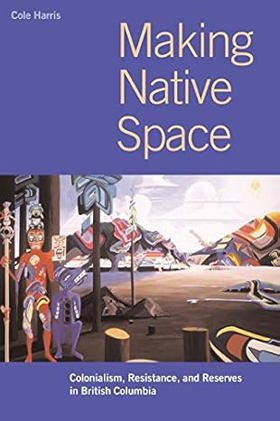
This elegantly written and insightful book provides a geographical history of the Indian reserve in British Columbia. Cole Harris analyzes the impact of reserves on Native lives and livelihoods and considers how, in light of this, the Native land question might begin to be resolved. The account begins in the early 19th-century British Empire and follows Native land policy and Native resistance to it in British Columbia from the Douglas treaties in the early 1850s to the formal transfer of reserves to the Dominion in 1938. Making Native Space clarifies and informs the current debate on the Native land question. It presents the most comprehensive account available of perhaps the most critical mapping of space ever undertaken in British Columbia the drawing of the lines that separated the tiny plots of land reserved for Native people from the rest. xxxi, 415 pages, 16 unnumbered pages of plates : illustrations, maps ; 23 cm CIRC [ 0 ]
|
2002 |
|
In the middle and on the edge the Twin Falls region of Idaho by James R. Gentry, College of Southern Idaho, Twin Falls Centennial Commission 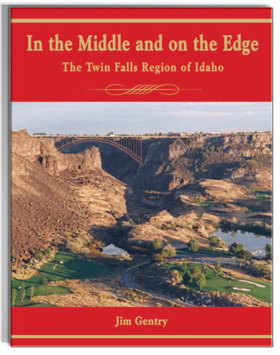
Dr. Jim Gentry arrived in Twin Falls in 1969 at the age of 23 to begin teaching history at the College of Southern Idaho. Having lived in five other states, Jim was glad to have found "his home". That love encouraged historical research and an ongoing fastination with local history. This book illustrates a concept that took shape early in Jim's study; that this region was in the middle and on the edge even before Twin Falls was founded in 1904 xvi, 413 pages : illustrations, maps ; 23 cm CIRC [ 1 ]
|
2003 |
|
Twin Falls centurybook, 1904-2004 by Mary J. Inman 
Published to commemorate the city's centennial, Twin Falls Centurybook, 1904–2004 by Mary J. Inman chronicles the dramatic transformation of a windswept southern Idaho sagebrush desert into a thriving agricultural oasis. The book details the monumental irrigation engineering projects spearheaded by visionary developers like Stanley Milner and I.B. Perrine, who harnessed the Snake River to turn thousands of arid acres into fertile farmland. Through archival photographs, local biographies, and municipal records, the text captures the tenacity of early homesteaders who built a bustling community from the ground up. A keen insight drawn from the work is how planned irrigation settlements inverted the traditional timeline of frontier town-building; rather than organic towns gradually attracting infrastructure, Twin Falls was deliberately engineered into existence on paper before the water even arrived, proving that modern high-desert agriculture is an artifact of sheer corporate and hydraulic will. v, 226 pages : illustrations, maps ; 22 cm CIRC [ 1 ]
|
2003 |
|
The history of Montpelier, Idaho from 1864 to 1925 by McKay A. Rich 
There have been many histories written on the great movements of American History and most states have had their histories, but almost endless localities have been neglected. Yet it is in the localities that we find the great stories and problems of the states, nations, and world in their embryonic stages. There is no better place to begin a realization of the heritage of America than in the story of one's own locality. It is for these reasons that I have chosen to write this paper upon the history of Montpelier, Idaho. i, 187 pages : illustrations ; 23 cm CIRC [ 1 ]
|
2003 |
|
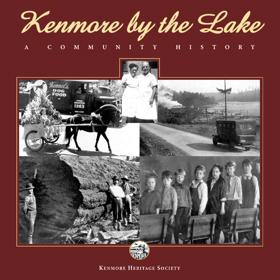
Kenmore by the lake a community history by Priscilla Droge, Terri Malinowski, Kenmore Heritage Society (Kenmore, Wash)
|
2003 |
|
The journals of Lewis and Clark by Meriwether Lewis , William Clark , Frank Bergon
In 1803, when the United States purchased Louisiana from France, the great expanse of this new American territory was a blank-not only on the map but in our knowledge. President Thomas Jefferson keenly understood that the course of the nation's destiny lay westward and that a national "Voyage of Discovery" must be mounted to determine the nature and accessibility of the frontier. He commissioned his young secretary, Meriwether Lewis, to lead an intelligence-gathering expedition from the Missouri River to the northern Pacific coast and back. From 1804 to 1806, Lewis, accompanied by co-captain William Clark, the Shoshone guide Sacajawea, and thirty-two men, made the first trek across the Louisiana Purchase, mapping the rivers as he went, tracing the principal waterways to the sea, and establishing the American claim to the territories of Idaho, Washington, and Oregon. Together the captains kept a journal, a richly detailed record of the flora and fauna they sighted, the Indian tribes they encountered, and the awe-inspiring landscape they traversed, from their base camp near present-day St. Louis to the mouth of the Columbia River. In keeping this record they made an incomparable contribution to the literature of exploration and the writing of natural history. With 2003 marking the beginning of the Lewis and Clark expedition bicentennial celebration, this journal is now reissued in a beautiful new Penguin Classics package xlvi, 505 pages : illustrations, maps ; 20 cm CIRC [ 1 ]
|
2003 |
|
Great and minor moments in Oregon history an illustrated anthology of illuminating glimpses into Oregon's past from prehistory to the present by Dick Pintarich
Published by Dick Pintarich, Great and Minor Moments in Oregon History: An Illustrated Anthology of Illuminating Glimpses into Oregon's Past from Prehistory to the Present offers a compelling mosaic of state history that deliberately bypasses standard dry chronology in favor of vivid, overlooked vignettes. The book compiles short essays and rare illustrations spanning geological prehistory, early indigenous life, eccentric frontier characters, and twentieth-century turning points. By interspersing major milestones with quirky historical footnotes, the text paints a remarkably human portrait of how the state's distinct cultural landscape actually evolved. A keen insight drawn from the work is how regional history is best understood through its narrative friction; by giving equal weight to forgotten local anomalies and grand political events, the anthology demonstrates that a state's true character is forged not just by its headline heroes, but by the myriad eccentricities of everyday people colliding with an untamed environment. xix, 527 pages : illustrations, maps ; 22 cm CIRC [ 1 ]
|
2003 |
|
Oregon's promise an interpretive history by David Peterson del Mar 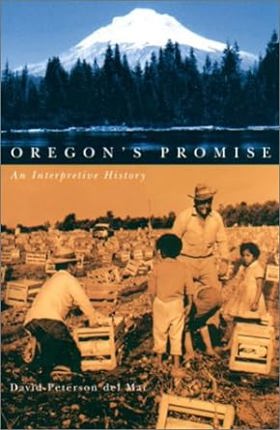
A concise and compelling general history, Oregon's Promise explores familiar and neglected people and movements in the state's history, while challenging readers to view Oregon's past, present, and future in a new way. The words "Oregon history" conjure up images of Lewis and Clark and rugged pioneers. In Oregon's Promise, David Peterson del Mar shows that the explorers' impact was both different from and less significant than commonly assumed, and that the state's settlers were much more varied, contentious, complicated, and interesting than conventional heroic stereotypes would suggest. The book's many themes revolve around Peterson del Mar's consideration of how Oregonians have attempted to build a prosperous and just society. He examines both the traditional center of Oregon history and its often overlooked margins-the people who have struggled to be included in Oregon's promise. The author is both a respected historian and an engaging writer, with a talent for explaining Oregon's past in a way that will appeal to all readers, from natives to newcomers, from students to scholars. 314 pages : illustrations, maps ; 23 cm CIRC [ 1 ]
|
2003 |
|
Moscow living and learning on the Palouse by Julie R. Monroe 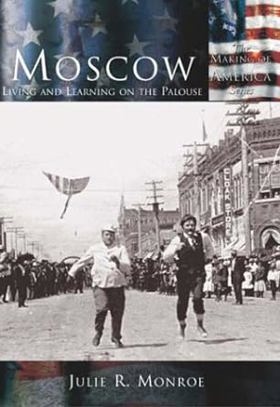
Published in local editions by Julie R. Monroe, Moscow: Living and Learning on the Palouse explores the unique cultural and historical evolution of this iconic north-central Idaho college town. The book chronicles Moscow's transition from a nascent pioneer settlement into the intellectual hub of the rolling Palouse hills, deeply shaped by the establishment of the University of Idaho in 1889. Through archival photographs and engaging community narratives, the text highlights the enduring interplay between agricultural grit and academic ambition. A keen insight drawn from the work is how isolated university towns create distinct cultural islands; by placing a major institution of higher learning in the middle of a vast, conservative farming economy, Moscow fostered a rare hybrid society where agrarian pragmatism and progressive intellectualism perpetually collide and shape each other. 160 pages : illustrations ; 25 cm. CIRC [ 0 ]
|
2003 |
|
Black Diamond mining the memories by Diane Olson, Cory Olson, Black Diamond Historical Society 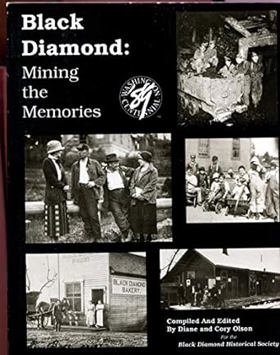
Published by Diane Olson, Cory Olson, and the Black Diamond Historical Society, Black Diamond: Mining the Memories chronicles the rich, coal-fuelled history of a historic Washington company town situated in the shadow of the Cascade foothills. The book draws on extensive archival photographs, oral histories, and company records to detail the dangerous underground labor, multi-ethnic immigrant communities, and daily hardships of families who worked the rich seams for the Pacific Coast Company. Through these intimate vignettes, the text preserves the vanishing social fabric of a bustling industrial hub that once supplied coal across the entire Puget Sound. A keen insight drawn from the work is how company-owned mining towns functioned as isolated, corporate-feudal microcosms; by controlling everything from housing to currency, the coal company engineered a fragile social stability that ultimately fractured the moment laborers sought independent political and economic autonomy. xvi, 274 pages : illustrations, map ; 28 cm CIRC [ 1 ]
|
2003 |
|
Coos Bay Plundertown, USA by Al Sandine 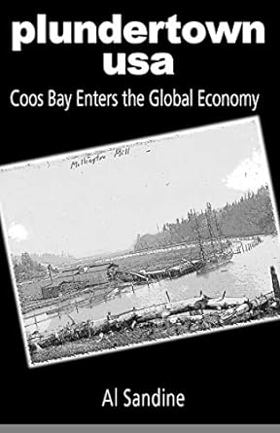
Published in local editions by Al Sandine, Coos Bay Plundertown, USA is a blistering polemical history examining the corporate exploitation and environmental degradation of Oregon’s largest coastal port. The book chronicles how powerful timber and industrial interests, in collusion with local political figures, systematically gutted the region's natural resources and bypassed community oversight to maximize short-term profits. Through sharp critique and detailed local documentation, the text exposes the severe economic and ecological fallout left in the wake of unchecked industrial ambition. A keen insight drawn from the work is how resource-dependent towns are frequently treated by outside corporate forces as disposable sacrifice zones; the narrative reveals that "plundertown" status is not an accidental policy failure, but the predictable end-result of an extractive economic model that privatizes public wealth while socializing long-term environmental ruin. 175 pages : illustrations, maps, portraits ; 22 cm CIRC [ 1 ]
|
2003 |
|
When coal was king Ladysmith and the coal-mining industry on Vancouver Island by John Roderick Hinde 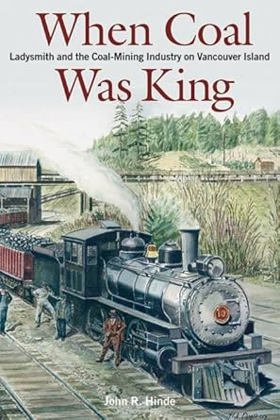
"When Coal Was King illuminates the origins of the 1912-14 strike by examining the development of the coal industry on Vancouver Island, the founding of Ladysmith the experience of work and safety in the mines, the process of political and economic mobilization, and how these factors contributed to the development of identity and community. While the Vancouver Island coal industry and the strike have been the focus of a number of popular histories, this book goes beyond to emphasize the importance of class, ethnicity, gender, and community in creating the conditions for the emergence and mobilization of the working-class population. Informed by current academic debates on the matter and within the discipline, this readable history takes into account extensive archival research, and will appeal to historians and others interested in the history of Vancouver Island."--Jacket viii, 276 pages : illustrations, maps ; 24 cm CIRC [ 0 ]
|
2003 |
|
West Coast adventures shipwrecks, lighthouses, and rescues along Canada's west coast by Adrienne Mason 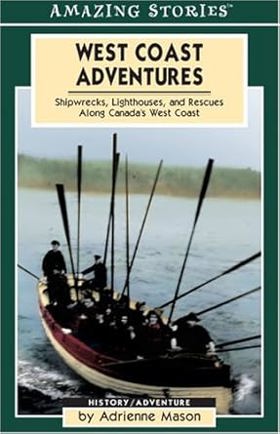
The stories of the sailors, lighthouse keepers, and linemen who have weathered the infamous west coast storms. The southwest coast of Vancouver Island is a reef-studded stretch, notorious for dramatic winter storms and thick cloaks of summer fog. Many ships have found themselves well off course, even lost, during sudden storms. This book tells the stories of the sailors, lighthouse keepers, and linemen who have weathered these west coast storms. 107 pages : illustrations, map ; 22 cm. CIRC [ 0 ]
|
2003 |
|
Dreaming in the rain how Vancouver became Hollywood North by Northwest by David Spaner 
Vancouver is now North America’s third largest center for film and television production, recently witnessing the filming of Halle Berry’s Catwoman and Will Smith’s I, Robot, among others. But Vancouver has been hosting filmmakers for years, coming into its own in the early 1970s when Robert Altman, Warren Beatty and Julie Christie made McCabe and Mrs. Miller and Mike Nichols, Jack Nicholson and Candice Bergen filmed Carnal Knowledge. Dreaming in the Rain tells the story of how Vancouver became North by Northwest, from its early days as a Hollywood studio backlot to its becoming home to a vibrant indigenous scene that is among the most acclaimed, provocative, independent filmmaking communities anywhere. 236 pages : portraits ; 23 cm CIRC [ 0 ]
|
2003 |
|
Potlatch people Indian lives & legends of British Columbia by Mildred Valley Thornton 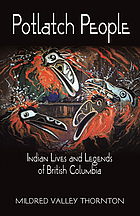
"Mildred Valley Thornton had an abiding passion which she pursued with almost missionary fervor throughout her life - the preservation of Canada's Native culture. For over fifty years she dedicated herself to that purpose through the medium of her paintings, writings and lectures. During the course of her career, Mildred not only painted the portraits of many prominent and historical Native Canadians, but she assembled an accompanying catalogue of anecdotes, folklore and legends, which today provide a unique chronicle of a vanished age. This publication is a collection of both Thornton's colorful portraits and the fascinating story behind each one."--pub. desc 317 pages : illustrations (some color) ; 22 cm CIRC [ 0 ]
|
2003 |
|
Idaho's historic trails from Lewis & Clark to railroads by Martin Potucek 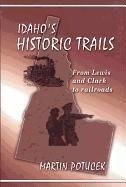
This is the story of trails blazed by early explorers, miners, and soldiers and provides travel tips for modern-day explorers. Idaho s Historic Trails includes modern maps of roads and trails and information about interesting side trips. Includes Lewis & Clark's route and the Oregon Trail (and South Alternate.) xx, 166 pages : illustrations, maps ; 23 cm CIRC [ 0 ]
|
2003 |
|
Shoshoni pony by Carol Lynn MacGregor, Dick Lee (Illustrator) 
An overview of how horses came to be used by various peoples in the American West, particularly the Shoshoni Indians, discussing the difference that horses made in their lives 32 pages : illustrations (some color) ; 22 cm CIRC [ 0 ]
|
2003 |
|
Carlton Stone's Hillcrest a history of Vancouver Island's Hillcrest Lumber Company by Ian MacInnes 
Carlton Stone left his Essex home to follow the sea when he was fourteen and two decades later found a life’s work amid the trees of Vancouver Island, British Columbia. From his little four-man Doupe Road sawmill near Duncan grew an enterprise that once employed 500 men and ranked third among the Island’s lumber producers. 132 p. : ill., ports. ; 22 cm. CIRC [ 0 ]
|
2003 |
|
Restoration of Puget Sound rivers by David R. Montgomery, University of Washington Center for Water and Watershed Studies, Society for Ecological Restoration Northwest Chapter Spring Meeting (2000 : Seattle, Wash) 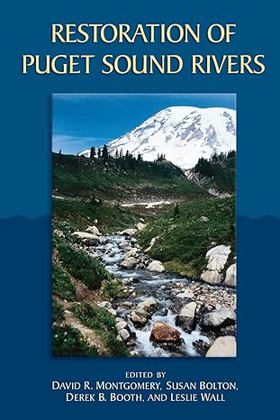
The recent listing of Pacific salmon under the Endangered Species Act has led to substantial interest in the scientific basis for river restoration in the Pacific Northwest. Millions of dollars in state and federal funding have been programmed for habitat restoration efforts to stem the decline of salmon populations in the region. This volume addresses the need for a solid understanding of fluvial processes and aquatic ecology in order to predict both river and salmonid response to restoration projects. In the Pacific Northwest, as in most regions of the United States, we are still learning about the processes that create habitat and river structure, how those processes influence aquatic ecosystems, and how to gauge the response of river systems to both land-use changes and restoration efforts. River systems are still responding to historic changes, and degraded habitat may not be restored successfully if natural conditions are not well understood, particularly if massive changes in watershed hydrology or other processes are the root cause. These issues faced in the development of regional river restoration programs are by no means unique to the Northwest, and so the initiation of a regional program of river restoration provides an opportunity to evaluate the state of river restoration in general. The eighteen chapters of Restoration of Puget Sound Rivers--presented by the region’s experts at a symposium of the Society for Ecological Restoration--examine geological and geomorphological controls on river and stream characteristics and dynamics, biological aspects of river systems in the region, and the application of fluvial geomorphology, civil engineering, riparian ecology, and aquatic ecology in efforts to restore Puget Sound Rivers. This volume will be of interest to geomorphologists, aquatic biologists, civil engineers, planners, and all those interested in the interface of science and policy in addressing one of the fundamental environmental challenges of the twenty-first century. v, 505 pages : illustrations, maps ; 23 cm CIRC [ 0 ]
|
2003 |
|
Distant corner Seattle architects and the legacy of H.H. Richardson by Jeffrey Karl Ochsner, Dennis Alan Andersen 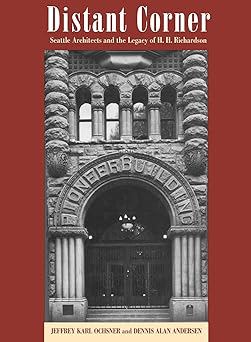
On the afternoon of 6 June 1889, a fire in a cabinet shop in downtown Seattle spread to destroy more than thirty downtown blocks covering 116 acres. Disaster soon became opportunity as Seattle’s citizens turned their full energies to rebuilding: widening and regrading streets, laying new water pipes and sewer lines, promulgating a new building ordinance requiring construction in the commercial core, and creating a new professional fire department. A remarkable number of buildings, most located in Seattle’s present-day Pioneer Square Historic District, were permitted within a few months and constructed within a few years of the Great Seattle Fire. As a result, the post-fire rebuilding of Seattle offers an extraordinarily focused case study of late-nineteenth-century American urban architecture. Seattle’s architects, seeking design solutions that would meet the new requirements, most often found them in the Romanesque Revival mode of the country’s most famous architect, Henry Hobson Richardson. In October 1889, Elmer Fisher, Seattle's most prolific post-fire architect, specifically cited the example of H. H. Richardson in describing the city's new buildings. In contrast to Victorian Gothic, Second Empire, and other mid-nineteenth-century architectural styles, Richardson’s Romanesque Revival vocabulary of relatively unadorned stone and brick with round-arched openings conveyed strength and stability without elaborate decorative treatment. For Seattle’s fire-conscious architects it offered a clear architectural system that could be applied to a variety of building types - including office blocks, warehouses, and hotels - and ensure a safer, progressive, and more visually coherent metropolitan center. Distant Corner examines the brief but powerful influence of H. H. Richardson on the building of America’s cities, and his specific influence on the architects charged with rebuilding the post-fire city of Seattle. Chapters on the pre-fire city and its architecture, the technologies and tools available to designers and builders, and the rise of Richardson and his role in defining a new American architecture provide a context for examining the work of the city’s architects. Seattle's leading pre- and post-fire architects - William Boone, Elmer Fisher, John Parkinson, Charles Saunders and Edwin Houghton, Willis Ritchie, Emil DeNeuf, Warren Skillings, and Arthur Chamberlin - are profiled. Distant Corner describes the new post-fire commercial core and the emerging network of schools, firehouses, and other public institutions that helped define Seattle’s neighborhoods. It closes with the sudden collapse of Seattle’s economy in the Panic of 1893 and the ensuing depression that halted the city’s building boom, saw the closing of a number of architects’ offices, and forever ended the dominance of Romanesque Revival in American architecture. With more than 200 illustrations, detailed endnotes, and an appendix listing the major works of the city's leading architects, Distant Corner offers an analysis of both local and national influences that shaped the architecture of the city in the 1880s and 1890s. It has much to offer those interested in Seattle’s early history, the building of the city, and the preservation of its architecture. Because this period of American architecture has received only limited study, it is also of importance for those interested in the influence of Boston-based H. H. Richardson and his contemporaries on American architecture at the end of the nineteenth century. xii, 409 pages : illustrations ; 29 cm CIRC [ 0 ]
|
2003 |
|
"Another day in paradise" island memories from the thirties and forties by James K. Long 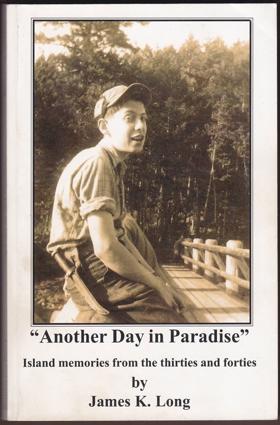
Childhood memories of Orcas Island in the 1930's and 1940s. Published in local editions, James K. Long’s “Another Day in Paradise”: Island Memories from the Thirties and Forties captures the nostalgic, slower-paced rhythms of rural island life during an era defined by isolation and self-reliance. Drawing on personal reminiscences and local lore, the book details the distinct daily routines of farming, community gatherings, and maritime travel in the Pacific Northwest before the arrival of modern bridges and high-speed ferries. Through vivid anecdotal storytelling, the author preserves a vanishing world where neighbors depended entirely on one another to weather economic hardship and geographic seclusion. A keen insight drawn from the work is how the ironic title reframes historical isolation; by contrasting the physical hardships of Depression-era island existence with the deep sense of communal belonging it forged, the narrative reveals that true paradise on the frontier was never about untouched luxury, but rather the profound human connection born from shared vulnerability. 62 p. : ill. ; 25 cm. CIRC [ 1 ]
|
2003 |