King County County
King County was originally named after William Rufus King who was Vice-President when the Washington Territory was created. In 1986, a motion was introduced to change the namesake to Martin Luther King, Jr. On February 24, 1986, the King County Council passed Council Motion 6461 five votes to four setting forth the historical basis for the renaming of King County in honor of Martin Luther King, Jr. Because only the state can charter counties, this change was not made official until April 19, 2005, when the Governor signed Senate Bill 5332 into law.
Mapped Location
King County: The mapped location is an approximation and should not be used for navigation or wayfinding.
Information
General information on King County
- Feature Type: County
- County Seat: City of Seattle
- Established: Wednesday, December 22, 1852
Official, historical, colloquial and alternative toponyms for King County
A brief list of names that this geographic feature has been named
| Name | Description |
|---|---|
| King County | Official |
Origin Notes and History of King County
References to King County that document the origin of its place name

KING COUNTY was created by the Oregon Territorial Legislature by an act dated December 22, 1852, and named in honor of William R. King, of Alabama, who had been elected Vice President of the United States. He died before being inaugurated.
Related Catalog Titles
A Bibliography for King County, County
Seattle in the Great Depression a history of business, labor, and politics drawn from local chronicles by Bruce A. Ramsey

Capturing stories from Seattle newspapers and other sources, this narrative history traces a turbulent decade that scarred a generation and defined years of policy and culture—from the city’s real estate depression, savings and loan failures, and waterfront Hooverville, to its political fights over unemployment assistance, intense business rivalries, union growth, and more.
260 pages, illustrations, notes, bibliography
CIRC [ 0 ]
Maritime names of Washington by Richard W. Blumenthal

Maritime Names of Washington is a wonderful companion if you are a boating enthusiast or simply curious about Washington’s maritime history. This book is a scholarly study on the origins of place names for our coastal and inland waters. It covers every name that appears on current nautical charts, from the Pacific Coast to the Strait of Juan de Fuca, the San Juans, and Puget Sound from Port Townsend to Olympia. It includes every named island, bay, point, inlet, pass, harbor, rock, channel, strait, canal, peninsula, sound, and shoal. The book also features many local and historical names that are not shown on the charts. The manuscript generally identifies the individual who named the place, when, why, and for whom. It also identifies the chart where the name first appeared and the early settlement history of many places. The manuscript is richly annotated and uses many quotes from the observations of our earliest explorers to give readers a glimpse of what Puget Sound country looked like 200+ years ago. Each of our early explorations is discussed in detail as they relate to individual place names. The book contains 170 pictures and 44 historical nautical charts from 1790 to 1900 that show many of the names
ix, 501 pages : illustrations, maps, charts ; 26 cm
CIRC [ 1 ]
A sound defense military sites, lighthouses, and memorials of Puget Sound by Nancy L. McDaniel

"A Sound Defense" is a comprehensive description of military sites of Puget Sound. Military historical sites in the twelve counties (Whatcom, Skagit, Snohomish, San Juan, Island, King, Pierce, Thurston, Mason, Kitsap, Clallam and Jefferson) are described with an emphasis on the unique things which happened there. Over 150 pictures and maps are included. Nancy McDaniel, Colonel, USAF, MSC (Retired) is a Washington State native and brings a love of the area and combines that with a perspective on the contributions that the military has had on Western Washington. "A Sound Defense" describes blockhouses built during the Indian conflicts. It addresses "The Pig War" and the politics of the international relationships which helped establish the boundaries of the United States. Forts built to protect Puget Sound as a result of the decisions of the Endicott Board are described along with the personalities of the commanders and personnel who were assigned there. Long forgotten installations established to provide early warning of approaching enemy aircraft are prominent in this comprehensive book. Lighthouses throughout the area are highlighted with the inclusion of historical photos and stories of early lightkeepers. Most importantly, "A Sound Defense" recognizes the contributions of military personnel throughout the years by the inclusion of memorials and facilities dedicated to recognizing their service to the country.
xvi, 365 pages : illustrations, maps ; 23 cm
CIRC [ 1 ]
Upriver voices tales of Skykomish by Nancy Cleveland, Anne Sekor, Jim Ojala, Skykomish Historical Society
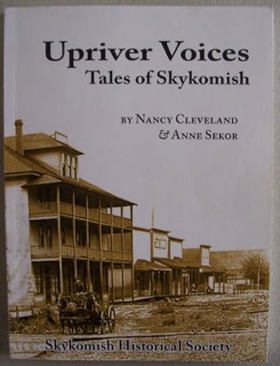
Published by the Skykomish Historical Society, Upriver Voices: Tales of Skykomish compiles local oral histories, archival photographs, and pioneer recollections to chronicle the dramatic evolution of the upper Skykomish River valley in Washington. The narrative captures the raw realities of a rugged mountain frontier shaped by the timber industry, the grueling construction of the Great Northern Railway, and the sheer grit required to carve isolated hamlets out of the Cascade foothills. Through the preserved voices of loggers, railway workers, and families, the volume documents the social fabric and daily hardships of a transient industrial community. A keen insight drawn from the text is how its grassroots, multi-author preservation approach exposes the fragile permanence of mountain boomtowns; by centering the firsthand accounts of ordinary workers rather than corporate boardrooms, the book illustrates how the relentless cycles of resource extraction left behind tight-knit communities defined just as much by communal resilience as by corporate transience.
166 pages : illustrations ; 20 cm
CIRC [ 1 ]
Seattle & King County. Volume III gateway to the Pacific Northwest by Troy Wolff
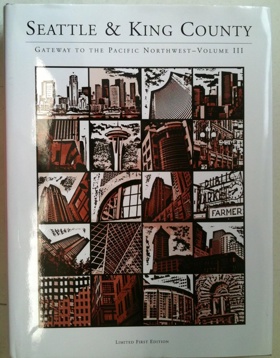
Published in 2008 and edited by Judith Gouldthorpe, Troy Wolff’s Seattle & King County: Gateway to the Pacific Northwest—Volume III offers a richly illustrated local history chronicling the modern development, neighborhoods, and civic milestones of Washington's most populous region. The volume combines historical overviews with localized profiles of communities, businesses, and prominent figures who shaped the greater Puget Sound area at the turn of the 21st century. Through its extensive photographic archives and narrative vignettes, the book documents how a timber-and-shipping outpost evolved into a major global metropolitan hub. A keen insight drawn from the text is how contemporary regional histories often function as curated civic time capsules, consciously celebrating corporate and community achievements while neatly glossing over the socio-economic tensions and gentrification pressures accompanying rapid urban expansion.
296 pages : illustrations (some color) ; 31 cm
CIRC [ 1 ]
Madison Park remembered by Jane Powell Thomas
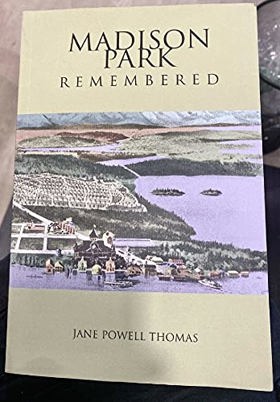
Published in local editions by Jane Powell Thomas, Madison Park Remembered captures the intimate neighborhood history and evolution of one of Seattle’s most historic lakeside communities. The book traces the area's transformation from a native transit route and late 19th-century recreational resort accessible by cable car into a vibrant residential enclave nestled along the shores of Lake Washington. Through a rich collection of archival photographs and personal reminiscences, the text preserves the vanishing daily rhythms of neighborhood cottages, local parks, and lakeside streetcar culture. A keen insight drawn from the work is how urban lakeside neighborhoods function as historical micro-ecosystems; by tracking how a recreational getaway morphed into an affluent urban suburb, the narrative reveals how Seattle's rapid geographic expansion was fundamentally propelled by the public desire to escape industrial city life while still retaining metropolitan proximity.
170 pages : illustrations, maps ; 23 cm
CIRC [ 1 ]
Black Diamond mining the memories by Diane Olson, Cory Olson, Black Diamond Historical Society
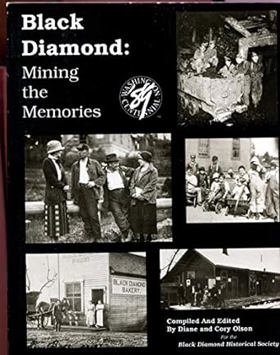
Published by Diane Olson, Cory Olson, and the Black Diamond Historical Society, Black Diamond: Mining the Memories chronicles the rich, coal-fuelled history of a historic Washington company town situated in the shadow of the Cascade foothills. The book draws on extensive archival photographs, oral histories, and company records to detail the dangerous underground labor, multi-ethnic immigrant communities, and daily hardships of families who worked the rich seams for the Pacific Coast Company. Through these intimate vignettes, the text preserves the vanishing social fabric of a bustling industrial hub that once supplied coal across the entire Puget Sound. A keen insight drawn from the work is how company-owned mining towns functioned as isolated, corporate-feudal microcosms; by controlling everything from housing to currency, the coal company engineered a fragile social stability that ultimately fractured the moment laborers sought independent political and economic autonomy.
xvi, 274 pages : illustrations, map ; 28 cm
CIRC [ 1 ]
A point in time a history of Yarrow Point, Washington by Suzanne Knauss, Charles Pierce LeWarne, King County (Wash). Office of Cultural Resources, Yarrow Point History Project Committee (Wash), King County Landmarks and Heritage Commission (Wash)
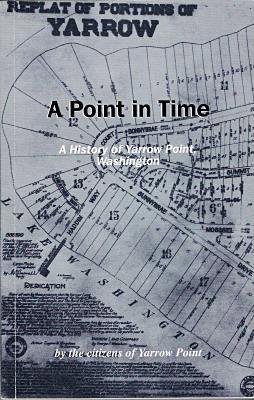
Published through collaborative efforts by the Yarrow Point History Project Committee, King County Office of Cultural Resources, and historians like Suzanne Knauss and Charles Pierce LeWarne, A Point in Time: A History of Yarrow Point, Washington chronicles the transformation of a quiet Lake Washington peninsula from a rugged wilderness into an exclusive residential enclave. The book traces the area's evolution from its early logging days and seasonal strawberry farms into a suburban sanctuary shaped by ferry access and the eventual construction of the floating bridges. Through local archives, oral histories, and photographs, the text details how residents deliberately cultivated a private, close-knit community while remaining tethered to the economic engine of nearby Seattle. A keen insight drawn from the work is how geographical isolation on a peninsula can be aggressively repurposed as a tool for modern exclusivity; by leveraging its distinct peninsular geography and limiting major thoroughfares, Yarrow Point successfully transformed a natural barrier into a socioeconomic filter that insulated its inhabitants from rapid urban sprawl.
174 pages : illustrations, maps ; 22 cm
CIRC [ 1 ]
The Sky Valley. Volume 2 a photographic history by Buddie Williams

Authored by local historian Buddie Williams, The Sky Valley, Volume 2: A Photographic History continues the visual documentation of Washington's rugged Skykomish River corridor through a rich collection of historic photographs and archival ephemera. The volume captures the dramatic transformation of towns like Index, Sultan, and Startup as they evolved from raw logging camps and mining outposts into established, tight-knit communities framed by the Cascade Mountains. Through vintage images of steam locomotives, timber mills, high-water floods, and local school children, the text portrays the relentless daily labor required to carve civilization out of a steep, flood-prone river valley. A keen insight drawn from the work is how visual archives of mountain valleys expose the inherent fragility of industrial frontier settlements; the recurring imagery of swollen rivers and swept-away bridges reminds readers that human infrastructure in the Pacific Northwest was always engaged in a precarious, high-stakes negotiation with an overwhelmingly powerful natural topography.
28 pages : illustrations ; 26 cm
CIRC [ 1 ]
Seattle's totem poles by Viola E. Garfield
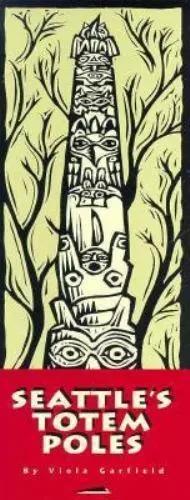
This book tells the history of the Seattle Totem Pole, located in Pioneer Square, including its abduction from its Tlinglit village by Seattle businessmen. The present cedar pole is a duplicate of the original, which was taken down after suffering damage from age and vandals. The book's second section explains Northwest Indian symbols used in poles and carvings seen around the area. Descriptions and photos of several area totem poles are included along with maps showing where other totem poles are located in the Greater Seattle area.
64 pages : illustrations, maps ; 28 x 11 cm
CIRC [ 1 ]
There is only one Enumclaw pioneer history and early years by Louise Ross Poppleton
Authored by local historian Louise Ross Poppleton, There Is Only One Enumclaw: Pioneer History and Early Years chronicles the establishment and agricultural development of the plateau community nestled beneath Mount Rainier in western Washington. The book draws on early homestead records, family journals, and vintage photographs to trace how rugged pioneers cleared dense timberlands to build dairy farms and small-town institutions at the gateway to the Cascades. Through these localized archives, the text preserves the grit and mutual dependence required to tame a damp, heavily forested frontier. A keen insight drawn from the work is how geographical positioning at the foot of a major mountain pass shaped the town's unique identity; by acting as the mandatory staging ground for travelers and resource extraction moving into the high country, Enumclaw forged an enduring commercial resilience rooted entirely in its role as a transitional hub between wilderness and civilization.
v, 123 pages : illustrations, maps ; 28 cm
CIRC [ 1 ]
The pioneers of Lake View a guide to Seattle's early settlers and their cemetery by Robert L. Ferguson
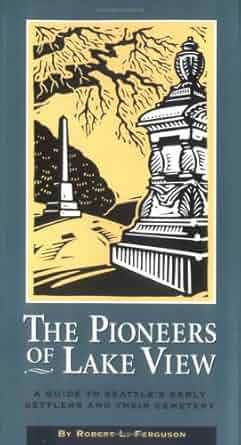
Authored by regional historian Robert L. Ferguson, The Pioneers of Lake View: A Guide to Seattle's Early Founders and Their Cemetery provides a compelling biographical and historical tour of Lake View Cemetery, the final resting place for many of the Emerald City's most prominent 19th-century figures. The book connects the physical monuments and headstones to the turbulent lives of the lumber barons, politicians, and ordinary settlers who laid the foundational infrastructure of frontier Seattle. Through meticulous research into pioneer genealogies, the text unearths the personal triumphs and tragedies hidden beneath manicured urban turf. A keen insight drawn from the work is how historic urban cemeteries function as subterranean archives of class stratification and civic myth-making; by examining who was granted prominent burial plots versus who was relegated to unmarked ground, the book reveals how city founders carefully engineered their own posthumous legacies to sanitize the brutal corporate ruthlessness of early Pacific Northwest capitalism.
119 pages : illustrations ; 20 cm
CIRC [ 1 ]
Lakelure a tale of Medina, Washington by Junius Rochester
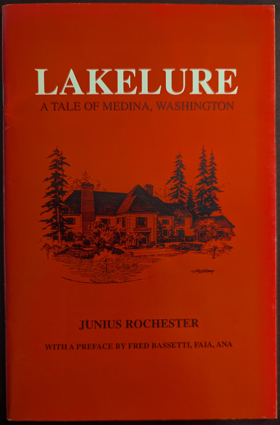
Published by local historian Junius Rochester, Lakelure: A Tale of Medina, Washington chronicles the colorful transformation of an exclusive eastern shore community along Lake Washington. The book traces Medina's evolution from a dense, stump-strewn wilderness and early 20th-century strawberry-farming enclave into one of the most affluent residential suburbs in the Pacific Northwest. Through historical photographs and engaging local archives, the text captures the summer-resort origins of families who fled the urban clamor of Seattle via the historic mosquito fleet ferries long before the floating bridges spanned the lake. A keen insight drawn from the work is how suburban wealth in the Seattle region repurposed geographical sanctuary into exclusivity; the transition of Medina from a quiet agrarian refuge into a fortress of tech barons and elites illustrates how pristine lakeside isolation is ultimately commodified and walled off from the very metropolitan core it once sought to escape.
ii, 42 pages : illustrations ; 23 cm
CIRC [ 1 ]
Queen Anne, community on the hill by Kay Frances Reinartz
Published in local editions by Kay Frances Reinartz, Queen Anne: Community on the Hill chronicles the rich neighborhood history and architectural evolution of one of Seattle’s most prominent geographic landmarks. The book traces the area's transformation from a dense evergreen forest and native camp into an affluent residential streetcar suburb offering sweeping vistas of Elliott Bay and the Cascade Mountains. Through archival photographs, diaries, and municipal records, the text captures the daily lives of early residents who shaped the hill's distinct community identity amidst rapid urban growth below. A keen insight drawn from the work is how topographical isolation can preserve a distinct community consciousness within an expanding metropolis; by literally rising above the industrial grit and commercial clamor of downtown Seattle, Queen Anne Hill allowed its residents to curate an architectural enclave that visually and socially equated geographic elevation with civic prestige.
viii, 231 pages : illustrations, maps ; 28 cm
CIRC [ 1 ]
Slough of memories recollections of life in Bothell, Kenmore, North Creek, Woodinville, 1920-1990 by Fred Klein, Northshore History Boosters
Slough of Memories: Recollections of Life in Bothell, Kenmore, North Creek, Woodinville, 1920-1990, compiled by Fred Klein and the Northshore History Boosters, is a detailed historical account of Washington State's Northshore communities. Published in 1992, the book relies on firsthand personal accounts, historical records, and photographs to trace the area's development along the Sammamish River, which was historically referred to locally as a slough. The narrative captures the everyday lives, cultural shifts, and economic growth of the region over a seventy-year span, documenting its gradual transformation from quiet rural agricultural outposts into bustling Seattle suburbs.
ix, 211 pages : illustrations, maps ; 28 cm
CIRC [ 1 ]
Naval Station Puget Sound at Sand Point by Dennis Stuhaug, United States Department of the Navy Morale, Welfare and Recreation Department

Published by the Department of the Navy alongside local author Dennis Stuhaug, Naval Station Puget Sound at Sand Point chronicles the fascinating military and aviation heritage of Seattle’s historic waterfront base. The book details the facility's evolution from a vital 1920s naval air station—famous as a key stop for the 1924 round-the-world flight—into a crucial World War II training and logistics hub. Through archival photographs and military records, the text captures how the installation served as a dynamic nexus between civilian urban life and naval defense along Lake Washington. A keen insight drawn from the work is how the transformation of military bases into public parks reflects the shifting priorities of modern cities; as Sand Point was decommissioned and turned into Magnuson Park, it demonstrated how post-industrial urban spaces are reclaimed to heal the ecological and social splits left behind by military-industrial expansion.
104 pages : illustrations (1 color), portraits (1 color) ; 29 cm
CIRC [ 0 ]
Little history of North Bend-Snoqualmie, Washington by Jack R. Evans
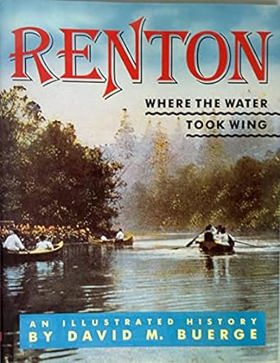
Renton, where the water took wing an illustrated history by David M. Buerge, Cynthia Barker, Nada Oakley
Growing up with Lake Forest Park the early decades in "North Seattle" : Vol II by Barbara L. Drake Bender
Seattle in the 1880s by David M. Buerge, Stuart R. Grover , Historical Society of Seattle and King County (Publisher)
Van Olinda's history of Vashon-Maury Island by Van Olinda, O.S., Roland N. Carey
Bellevue, its first 100 years by Lucile Saunders McDonald, Bellevue Friends of the Library
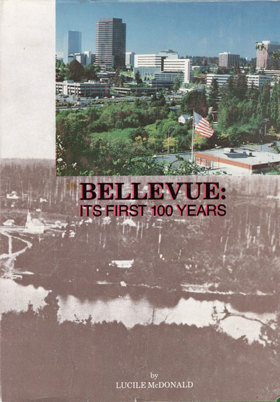
The consummate authority on the history of Bellevue, McDonald's book chronicles the struggles of its early settlers, mid-century small-town suburbanites and the establishment of the state's leading edge-city of the 20th century. It is a homey folksy narrative laced with abundant names, anecdotes and pictures that provide a charming read and an excellent historic educational tool. Includes references and index.
[6], 151, [1] pages : illustrations, facsimile, maps, portraits ; 26 cm
CIRC [ 1 ]
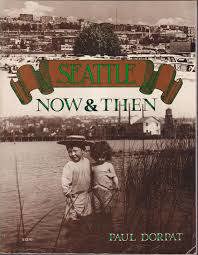
Seattle now & then by Paul Dorpat
Growing up with Lake Forest Park the early decades in "North Seattle" : Vol I by Barbara L. Drake Bender
Seattle Leschi diary by Wade Vaughn, Leschi Improvement Council
Highlights of Seattle's history illustrated by James R. Warren, William R. McCoy , Historical Society of Seattle and King County (Publisher)
The past at present in Issaquah, Washington by Edwards R. Fish
Seattle's black Victorians, 1852-1901 by Esther Hall Mumford
"...looks at black life in 19th century Seattle from many angles. The combination of newspaper files, county records, and oral history gives a density to the historical picture." John Berry, Seattle Sun -- Back cover
235 pages : illustrations, facsimiles, map, portraits ; 22 cm
CIRC [ 0 ]
The Lake Washington story a pictorial history by Lucile Saunders McDonald
A physical and social history of Lake Washington, the 20 mile long body of water that forms the greater part of the eastern boundary of Seattle
160 pages : illustrations ; 28 cm
CIRC [ 1 ]
Profanity Hill by Irene Burns Miller
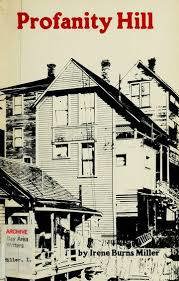
In Profanity Hill, Irene Burns Miller recounts her 1940 experience as the sole relocation supervisor tasked with clearing a decaying Seattle neighborhood to make way for the Yesler Terrace public housing project. The book details her daily interactions with the area's diverse and marginalized residents, including sex workers, immigrants, and impoverished families who were facing eviction despite the city having almost no rental vacancy. Through personal anecdotes, Miller highlights the stark power dynamics and emotional toll of dismantling a tightly knit, albeit crumbling, community in the name of urban progress. Ultimately, the narrative chronicles the complete displacement of the neighborhood's original inhabitants to pave the way for a newly constructed vision of public housing.
iv, 139 pages : illustrations ; 22 cm
CIRC [ 1 ]
The Past remembered a Vashon-Maury Island student-community project by Marj Watkins , Garland Norin
History of Vashon-Maury Islands by O. S. Van Olinda
Westward to Alki the story of David and Louisa Denny by Gordon R. Newell
Renton from coal to jets by Morda C. Slauson , Ethel Telban , Clark Petersen (Designer), Joann Morgan (Contributor), Renton Historical Society (Publisher, Contributor)
An American Revolution Bicentennial Project
[6], 183, [4] pages, 31 unnumbered pages of plates : illustrations, maps, portraits ; 23 cm
CIRC [ 1 ]
Seattle, past to present by Roger Sale
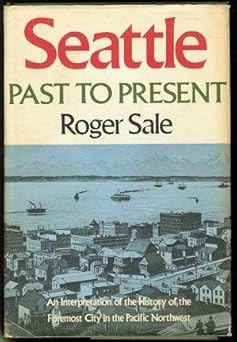
Seattle, Past to Present, interprets the history of the foremost city in the Northwest and traces the implications of that history for the city's present and future. In the process Seattle emerges not as a rough, half-formed frontier town but as a soft city of streets and houses, middle-class in aspiration and achievement; Roger Sale asks how it came to be that way. Roger Sale’s Seattle, Past to Present has become a beloved reflection of Seattle’s history and its possible futures as imagined in 1976, when the book was first published. Drawing on demographic analysis, residential surveys, portraiture, and personal observation and reflection, Sale provides his take on what was most important in each of Seattle’s main periods, from the city’s founding, when settlers built a city great enough that the railroads eventually had to come; down to the post-Boeing Seattle of the 1970s, when the city was coming to terms with itself based on lessons from its past. Along the way, Sale touches on the economic diversity of late nineteenth-century Seattle that allowed it to grow; describes the major achievements of the first boom years in parks, boulevards, and neighborhoods of quiet elegance; and draws portraits of people like Vernon Parrington, Nellie Cornish, and Mark Tobey, who came to Seattle and flourished. The result is a powerful assessment of Seattle’s vitality, the result of old-timers and newcomers mixing both in harmony and in antagonism.
xx, 273 pages, 12 unnumbered leaves of plates : illustrations ; 24 cm
CIRC [ 0 ]
Our foundering fathers the story of Kirkland by Arline Ely, Kirkland Public Library
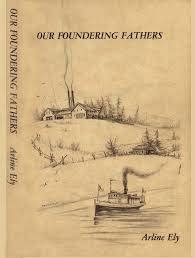
A short history of Kirkland, Washington written by an editor of a Puget Sound magazine. 128 pages, including index. Includes many historic pictures and local stories
128 pages, 28 unnumbered leaves of plates : illustrations ; 23 cm
CIRC [ 1 ]
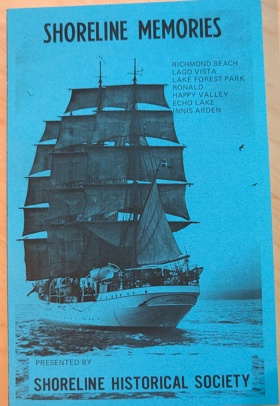
Shoreline memories Volume 1 by Shoreline Historical Society
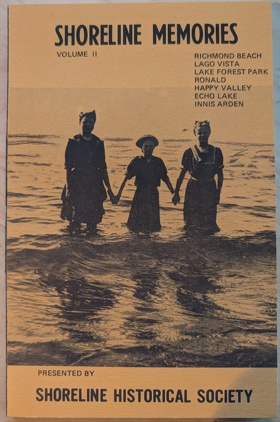
Shoreline memories Volume 2 by Shoreline Historical Society
Pig-tail days in old Seattle by Sophie Frye Bass
ONLY SOME TWELVE DECADES have passed since the first small band of settlers dug clams along the beach and built their cabins at Alki Point where Seattle, Washington, had its beginning. When the men came from Alki, after sounding the harbor and finding good anchorage for ships, they staked their claims on February 15, 1852, built their cabins on tiny patches of land they had cleared in the forest, and then began the survey through the heavy timber for the future great city. Seattle's streets still carry many of the names of those first settlers-or names bestowed by them-and in the following pages are the historically true, and often amusing, stories of the early days of these streets-how they looked, who walked along them; all the friendly, gossipy beginnings, recalled by the granddaughter of Arthur Armstrong Denny, founder and surveyor of the city.
[4], 191, [1] pages : illustrations, maps (on lining papers) ; 23 cm
CIRC [ 1 ]
A history of the Snoqualmie Valley by Ada Snyder Hill
Union Bay, the life of a city marsh by Harry Wentworth Higman, Earl J. Larrison , Edmund J. Sawyer (Illustrator)
When Seattle was a village by Sophie Frye Bass
Four wagons west the story of seattle by Roberta Frye Watt
Published in 1931 by Roberta Frye Watt—the granddaughter of city founder Arthur A. Denny—Four Wagons West: The Story of Seattle is a deeply nostalgic, familial hagiography chronicling the pioneer origins of the Pacific Northwest’s largest metropolis. The text traces the Denny Party’s grueling overland migration, their iconic 1851 landing at Alki Point, and the subsequent establishment of the first sawmills and civic institutions on Elliott Bay. Writing the city’s history as a cherished family heirloom, Watt relies heavily on pioneer diaries and ancestral lore, detailing the pioneers' paternalistic relationship with Chief Seattle and their defense of the settlement during the Puget Sound War of 1856. The book ultimately functions to cement the original white founding families as the undisputed moral and civic aristocracy of the region.
A keen insight drawn from the work is how the narrative weaponizes maternal pioneer nostalgia and domestic intimacy to sanitize the aggressive mechanics of urban colonial expansion. By framing the establishment of Seattle not as a calculated, capitalist enterprise of land speculation, but as a cozy, inevitable, and divinely guided family triumph, Watt successfully domesticates the violent dispossession of the Duwamish people. This historiographical maneuver effectively reduces Indigenous sovereignty to a romanticized backdrop, transforming figures like Chief Seattle into tragic, benevolent props who seemingly exist only to willingly bequeath the landscape to its "destined" white inheritors. Consequently, the text allows the city's pioneer elite to legally and morally absolve themselves of the ongoing, systemic erasure of the region's original inhabitants.
CIRC [ 1 ]
Related Online Resources
RCW 36.04.170: King county.
"King county is renamed in honor of the Reverend Doctor Martin Luther King, Jr."
WEB LINK
King County
- Adams
- Adelaide
- Adelaide
- City of Algona
- Alki
- Allentown
- Ames Lake
- Arcadia
- Ashwood
- Atkinson
- City of Auburn
- Avondale
- Bagley Junction
- Bandera
- Baring
- Barneston
- Bayne
- Bayne Junction
- Beacon Hill
- Beaumont
- Town of Beaux Arts Village
- City of Bellevue
- Belltown
- Belridge
- Benson Hill
- Berrydale
- Bethel Park
- Beverly Park
- Biloxi
- Birch
- Bitter Lake
- City of Black Diamond
- Blue Ridge
- Boddy
- Boise
- Boulevard Park
- Briarcliff
- Briarcrest
- Broadview
- Bryant
- Bryn Mawr
- Buenna
- City of Burien
- Burton
- Camelot
- Campton
- Carlton Park
- City of Carnation
- Cedar Falls
- Cedar Grove
- Cedar Mountain
- Cedar Park
- Cedarhurst
- Chautauqua
- Chelsea
- Cherokee Bay Park
- Christopher
- Clyde
- City of Clyde Hill
- Coal Creek
- Coalfield
- Columbia City
- Colvos
- Cottage Lake
- Cougar Hills
- Cove
- City of Covington
- Cowley
- Crossroads
- Cumberland
- Danville
- Day City (historical)
- Denny Creek
- Denny Regrade
- City of Des Moines
- Dilworth
- Dockton
- Dorre Don
- Dunlap
- Durham
- City of Duvall
- Duwamish
- East Hill
- East Renton Highlands
- East Seattle
- Eastland
- Echo Lake
- Edgewater (historical)
- Edgewick
- Elliott
- Ellisport
- Ellisville
- Endolyne
- City of Enumclaw
- Ernies Grove
- Evansville
- Evergreen
- Factoria
- Fairwood
- Fall City
- Fauntleroy
- City of Federal Way
- Feriton
- Fern Heath
- Firloch
- Five Corners
- Fortuna
- Foy
- Franklin
- Garcia
- Georgetown
- Glen Acres
- Glendale
- Green Lake
- Green River
- Gregory Heights
- Grotto
- Harbor Heights
- Harman Heights
- Hawthorne Hills
- Hazelwood
- Henrys
- High Point
- High Valley
- Highlands
- Highlands Park
- Highline
- Hillman City (historical)
- Hilltop
- Hobart
- Holly Park
- Hollywood
- Hollywood Hill
- Hongking (historical)
- Humphrey
- Town of Hunts Point
- Inglesea
- City of Issaquah
- Jovita
- Juanita
- Junction
- Kanaskat
- Kanaskat Junction
- Kangley
- Kenilworth
- City of Kenmore
- Kennydale
- City of Kent
- Kenwood
- Kerriston
- City of Kirkland
- Kitts Corner
- Klahanie
- Krain
- Kummer
- Lake Desire
- City of Lake Forest Park
- Lake Heights
- Lake Marcel
- Lake Morton
- Lake Park
- Lakeland
- Lakeridge
- Lakewood
- Lakota
- Landsburg
- Latona
- Latona (historical)
- Lavilla
- Lawton
- Lawtonwood
- Lemolo
- Lester
- Lisabeula
- Lowman Beach Park
- Luana Beach
- Lucerne
- Madrona
- Magnolia Beach
- Magnolia Bluff
- Manitou
- Mann
- Manzanita
- Maple Hills
- City of Maple Valley
- Maple Valley Heights
- Maplewood Heights
- Matthews Beach
- Maury
- May Creek
- Maywood
- McGilvara
- McMicken Heights
- McVan
- Meadowbrook
- City of Medina
- Mercer Heights
- City of Mercer Island
- Mercer Island Town
- Meridian
- Meridian Heights
- Metum
- Midlakes
- Mileta
- Miller River
- Mint Grove
- Mirror Lake
- Mirrormont
- Mirrormount Estates
- Montlake
- Moorland
- Moorlands
- Mount Baker
- Mount View
- Naco
- Nagrom
- Newaukum
- City of Newcastle
- Newport Hills
- Newport Shores
- Noble
- Nordrum (historical)
- City of Normandy Park
- North Beach
- City of North Bend
- North Broadway
- North College Park
- Northgate
- Northrup
- Novelty
- Olympic Hills
- One Hundred One Pines
- Orchard Grove
- Osceola
- Oskams Corner
- Overlake
- City of Pacific
- Page
- Palmer
- Palmer Junction
- Paramount Park
- Parkwood
- Phinney Ridge
- Pinehurst
- Pines
- Pleasant Hill
- Pontiac
- Portage
- Portage Bay
- Preston
- Raeco
- Ragnar
- Rainier Beach
- Rainier Valley
- Ravenna
- Ravensdale
- City of Redmond
- Redondo
- City of Renton
- Ridgecrest
- Riverbend
- Riverton
- Roanoke
- Rockdale
- Ronald
- Roosevelt
- Rose Hill
- Rosehilla
- Ross (historical)
- Roxbury Heights
- City of Sammamish
- Sand Point
- Seahurst
- City of SeaTac
- City of Seattle
- Selleck
- Seola Beach
- Seward Park
- Shawnee
- Shore Acres
- City of Shoreline
- Shorewood
- Town of Skykomish
- Skyway
- Snoose Junction
- City of Snoqualmie
- Snoqualmie Falls
- Snyders Corner
- Somerset
- South Park
- South Seattle
- Southern Heights
- Spring Beach
- Spring Beach
- Spring Glen
- Stampede
- Star Lake
- Stevens
- Stillwater
- Stuart
- Stuck
- Summerhurst
- Summit
- Sunnydale
- Sunset Village
- Tahlequah
- Tahoma
- Tamill
- Tanner
- The Highlands
- Thomas
- Timberlane
- Tokul
- Trude
- City of Tukwila
- University District
- University Village
- Upper Mill
- Upper Preston
- Van Asselt
- Vasa Park
- Vashon
- Vashon Heights
- Veazie
- Vermontville (historical)
- Victory Heights
- Wabash
- Wayne
- West Woodland
- White
- White Center
- Wilderness
- Willows
- Windermere
- City of Woodinville
- Woodridge
- Wynaco
- Town of Yarrow Point
- York
- Youngstown
- Zenith
Political Boundaries
Last updated: 2025-09-23