City of Vernon Regional District of North Okanagan, British Columbia
City - A populated place with legally defined boundaries, incorporated as a city municipality under the provincial Municipal Act. NE side of Okanagan Lake, Osoyoos Division Yale Land District
Mapped Location
City of Vernon: The mapped location is an approximation and should not be used for navigation or wayfinding.
Information
General information on City of Vernon
- Feature Type: Incorporated
Official, historical, colloquial and alternative toponyms for City of Vernon
A brief list of names that this geographic feature has been named
| Name | Description |
|---|---|
| City of Vernon | Official |
Origin Notes and History of City of Vernon
References to City of Vernon that document the origin of its place name
Incorporated as a City municipality 30 December 1892; Vernon (City) confirmed in the 17th Report of the Geographic Board of Canada, 31 March 1922, and 7 February 1951 on 82 L/SW.
Until 1885 when the CPR was completed to the coast, trains from the east ran only as far as this place; passengers then travelled via sternwheeler to 19 landings on Okanagan Lake, or by wagon road to Kamloops thence to the Interior or the coast. Priest Valley Post Office opened 1 November 1884; renamed Vernon Post Office 1 November 1887.
See also the municipality's own internet site. Link through www.civicnet.gov.bc.ca
Originally known as Priests Valley, then as Centreville and finally the name was changed to the present one in the '80's after Forbes G. Vernon (some-time BC Minister of Mines) and his brother Charles, both of whom owned large properties in the district. (17th Report of the Geographic Board of Canada, 1922, quoting information provided by C. Lafroy, postmaster).
Formerly Priest's Valley because, after Okanagan Mission was established in 1860, the priests had an out-station here; also [formerly known as] Forge Valley because of a blacksmith's shop on the roadside at Price Ellison's farm. The Post Office name was changed to Vernon 1 November 1887, after Forbes George Vernon, chief commissioner of lands and works for British Columbia, who with his brother, Charles, both British Army officers, came to BC in 1863. They mined at Cherry Creek in 1864 and held land in partnership with D.F. Houghton, including the famous Coldstream Ranch of which F.G. Vernon eventually became the sole owner. (12th Report of the Okanagan Historical Society, 1948, citing Ok. 6:138-140, 284; GB 18). See also Akrigg's British Columbia Place Names.
Related Catalog Titles
A Bibliography for City of Vernon, Regional District of North Okanagan, British Columbia
The most difficult of our camps Vernon Internment Camp, 1914-1920 by Don McNair , Lawrna Myers , Carol Brown , Vivian Elgie , Jerry Thompson , Vernon & District Family History Society (Publisher)
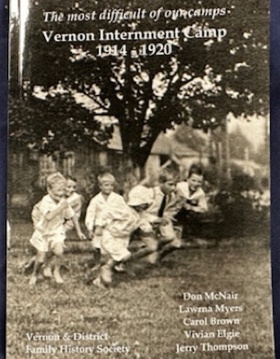
Authored by researchers from the Vernon & District Family History Society, The Most Difficult of Our Camps: Vernon Internment Camp, 1914–1920 presents a comprehensive examination of Canada's First World War internment operations. The volume meticulously documents the experiences of over one thousand "enemy aliens"—including men, women, and children of Austro-Hungarian, German, and Ottoman descent—detained in British Columbia's interior. Utilizing archival photographs, official correspondence, and detailed biographical sketches, the authors illuminate daily life within the camp and its associated regional work projects. Ultimately, the text contributes a vital socio-historical perspective to the broader discourse on state-sponsored detention, civil liberties, and wartime governance in Canada
389 pages : illustrations (some colour), colour maps ; 23 cm
CIRC [ 0 ]
Vernon internment camp, 1914-1920 by Don McNair
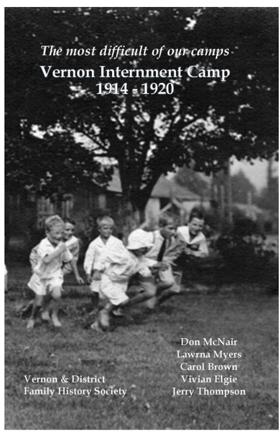
Researched and written by members of the Vernon & District Family History Society, this book concerns the internment camp that operated in Vernon B.C. during and after World War I. In that time, over 1000 ‘enemy aliens’ from the then AustroHungarian, German, and Ottoman empires passed through its gates. Vernon Internment Camp was one of largest in the country and one of only two camps that interned women and children. In the estimation of the Officer Commanding Internment Operations in Canada, Vernon’s was “the most difficult of our camps.” The book takes you into the lives of the internees and guards with numerous biographical sketches, great photographs from local, national and international sources, details of camp life, and the reactions of Vernon's citizens. There is also information about the neighbouring ‘work camps’ at Mara, Edgewood and Monashee, where prisoners were forced to build roads through the wilderness.
27 pages : illustrations, maps ; 27 cm
CIRC [ 0 ]
Regional District of North Okanagan
- City of Armstrong
- Ashton Creek
- Beachcomber Bay
- Blue Springs
- Cherryville
- District of Coldstream
- Creighton Valley
- City of Enderby
- Grandview Bench
- Grindrod
- Hullcar
- Hupel
- Kedleston
- Kingfisher
- Lavington
- Village of Lumby
- Mabel Lake
- Mara
- Okanagan Landing
- Shuswap Falls
- Silver Star
- District of Spallumcheen
- Trinity Valley
- City of Vernon
Political Boundaries
Last updated: 2023-10-01