City of Port Angeles Clallam County, Washington
Mapped Location
City of Port Angeles: The mapped location is an approximation and should not be used for navigation or wayfinding.
Information
General information on City of Port Angeles
- Feature Type: Incorporated
Official, historical, colloquial and alternative toponyms for City of Port Angeles
A brief list of names that this geographic feature has been named
| Name | Description |
|---|---|
| City of Port Angeles | Official |
| Port Angeles | Official |
Origin Notes and History of City of Port Angeles
References to City of Port Angeles that document the origin of its place name
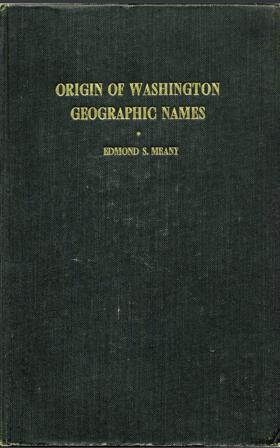
PORT ANGELES, county seat of Clallam County. The name originated with the Spaniards in 1791, Captain Francisco Eliza named the peculiar harbor "Porto de Nuestra Senora de los Angeles; " in 1792, Captains Galliano and Valdes contracted it to "Porto de los Angeles." Captain Vancouver shortened it still further in 1792 and gave the form now in use. In 1852, the United States Coast Survey charted it as "False Dungeness" from its resemblance to New Dungeness nearby. The long sandspit which makes the harbor is called Ediz Hook, probably from Yennis, Clallam Indian word, meaning "good place." See Ediz Hook.
A Selected Bibliography of City of Port Angeles, Clallam County, Washington
A compilation of essential readings detailing the history, geography, and culture of the region.
Port Angeles, U.S.A. by John D. McCallum, Lorraine Wilcox Ross , James Warner Bellah (Writer of introduction)

John D. McCallum and Lorraine Wilcox Ross’s Port Angeles, U.S.A. chronicles the pioneer and industrial evolution of a remote maritime settlement strategically sheltered behind the protective, miles-long sand spit of Ediz Hook on the northern coast of the Olympic Peninsula. The narrative maps how the towering, heavily glaciated barrier of the Olympic Mountains and the impenetrable density of the surrounding temperate rainforest initially strangled overland transit, forcing early settlers and massive logging operations to rely entirely on the deep-water harbor and the volatile aquatic highway of the Strait of Juan de Fuca for economic survival. By detailing the transition from an isolated pioneer outpost to a booming, mill-driven seaport, the book illustrates how mastering this unique marine topography and leveraging a natural oceanic breakwater were the absolute prerequisites for establishing a thriving timber metropolis on an otherwise unforgiving coastal frontier.
197 pages, 32 unnumbered pages of plates : illustrations, map (on lining papers), portraits ; 24 cm
Non-circulating [ 1 ]
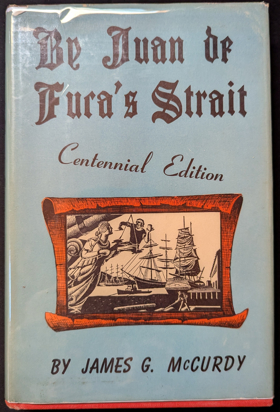
By Juan de Fuca's strait pioneering along the northwestern edge of the continent by James G. McCurdy
In this provocative and illuminating book, Marianna Torgovnick explores the psychology of our profound attraction to cultures we call "primitive." Whether located in Africa, the South Pacific, or the American Southwest, the primitive has become synonymous in the Western imagination with a range of emotions and experiences thought to be lost in modern life: reverence for the land and for nature; strong communal bonds; sexual plentitude; and, perhaps most intriguing, and ecstatic sense of connection to the universe and the life force. Torgovnick investigates the numerous ways we have turned toward the primitive out of spiritual hunger for such deeply human experiences - a hunger that could once be satisfied within the West's own mystical traditions but that often no longer can be. Brilliantly encompassing religion, art, psychology, literature, and other aspects of our culture, Primitive Passions offers new insight into our ideas of spirituality and gender, and, ultimately, into the hidden but vital parts of ourselves
312 pages frontispiece (map), illustrations (including portraits, facsimiles) 22 cm
Non-circulating [ 1 ]
Clallam County
- Agnew
- Beaver
- Bell Hill
- Blyn
- Carlsborg
- Clallam Bay
- Classet
- Coville
- Crane
- Crescent
- Disque
- Dungeness
- Elwha
- City of Forks
- Happy Valley
- Jamestown
- Joyce
- King Hill
- La Push
- Little Oklahoma
- Lower Elwha
- Maple Grove
- Midway
- Mora
- Mount Pleasant
- Neah Bay
- Old Royal
- Old Town
- Olympic Hot Springs
- Ovington
- Ozette
- Piedmont
- City of Port Angeles
- Port Crescent
- Port Williams
- Pysht
- Quillayute
- R Corner
- Ramapo
- Rena
- River Road
- Sappho
- Sekiu
- City of Sequim
- Shadow
- Shuwah
- Snug Harbor
- Tsoo-Yess
- Twin
- Waatch
- Washington Harbor
- Whiskey Bend
- Windy Arm
Political Boundaries
Last updated: 2025-09-23