Catalog of British Columbiana and Pacific Northwest Americana
Encyclopedia Cascadia Catalog contains book titles of mostly non-fiction Pacific Northwest Coast of North America Titles (primarially British Columbia, Idaho, Oregon and Washington State) in an easy-to-understand title catalog. If you see a link with this badge ONLINE CIRC it means that there is an online institution that provides free access to that title. In some cases there may be more than one institution hosting the title digitally.
| Catalog Title | Published |
|---|---|
|
Sacajawea's people the Lemhi Shoshones and the Salmon River country by John W. W. Mann 
"John W.W. Mann offers an absorbing and richly detailed look at the life of Sacajawea's people before their first contact with non-Natives, their encounter with the Lewis and Clark Expedition in the early nineteenth century, and their subsequent confinement to a reservation in northern Idaho near the town of Salmon. He follows the Lemhis from the liquidation of their reservation in 1907 to their forced union with the Shoshone-Bannock tribes of the Fort Hall Reservation to the south. He describes how for the past century, surrounded by more populous and powerful Native tribes, the Lemhis have fought to preserve their political, economic, and cultural integrity. His compelling and informative account should help to bring Sacajawea's people out of the long shadow of history and restore them to their rightful place in the American story."--Jacket 1 online resource (xxiii, 258 pages) : illustrations, maps CIRC [ 1 ]
|
2004 |
|
Sacajawea of the Shoshones by Della Gould Emmons 
Fictionalized life of the Shoshone woman who guided the Lewis and Clark Expedition 316 pages ; 21 cm CIRC [ 1 ]
|
1943 |
|
S.S. Beaver the ship that saved the West by Derek Pethick
|
1970 |
|
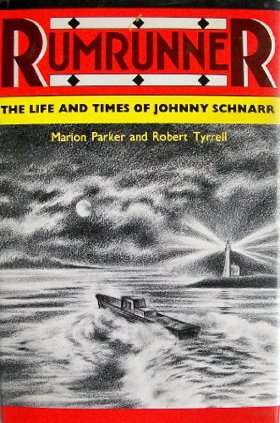
Rumrunner the life and times of Johnny Schnarr by Marion Parker, Bob Tyrrell
|
1988 |
|
Rum-runners and renegades whisky wars of the Pacific Northwest, 1917-2012 by Rich Mole 
On October 1, 1917, prohibition came into effect in the province of British Columbia. Washington and Oregon had gone dry the previous year. The ban on liquor sales led to deadly conflict and legal chaos in the Pacific Northwest, and the legacy of those booze battles continues into the 21st century. Rich Mole introduced readers to West Coast prohibitions pioneer years in Scoundrels and Saloons: Whisky Wars of the Pacific Northwest, 18401917. In Rum-runners and Renegades, he recounts the wild and wacky—and sometimes tragic—results of later prohibition laws through the exploits of both prohibitionists and prohibition-busters, among them Jonathan Rogers, a wealthy Vancouver builder and prohibition leader; the Billingsley brothers, a quartet of handsome bootleggers from Seattle; and enterprising Johnny Schnarr, Victorias number-one rum-runner. From vicious marine hijackers and bedeviled police to corrupt politicians and frustrated drinkers on both sides of the border, this is an action-filled account of liquor and lawlessness on the West Coast. 142 pages : illustrations, portraits ; 22 cm. CIRC [ 0 ]
|
2013 |
|
Rufus Woods, the Columbia River & the building of modern Washington by Robert E. Ficken 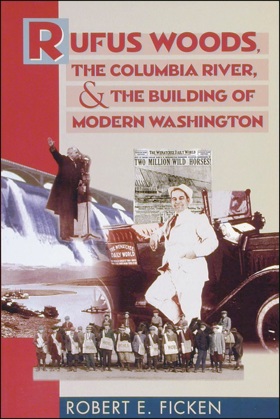
Rufus Woods, for more than forty years the publisher of the Wenatchee Daily World, has often been called the "High Priest of the Columbia River." No person deserves the title more. From the editorial platform of the World, Woods tirelessly promoted Wenatchee and north central Washington. For decades he pegged his brightest hopes for the region's future on a huge Columbia River dam in the isolated Grand Coulee region. From 1918 through Grand Coulee's completion in 1941, Woods enthusiastically promoted the largest dam-building project in American history xvi, 312 pages, 16 unnumbered pages of plates : illustrations, map portraits ; 24 cm CIRC [ 1 ]
|
1995 |
|
Royal family of the Columbia Dr. John McLoughlin and his family by Alberta Brooks Fogdall
|
1978 |
|
Rough house a memoir by Tina Ontiveros 
"A story of growing up in turmoil, Rough House recounts a childhood divided between a charming, mercurial, abusive father in the forests of the Pacific Northwest, and a mother struggling with poverty in The Dalles. It is also a story of generational trauma, especially for the women - a story of violent men and societal restrictions, of children not always chosen, and frequently raised alone. Tracing her childhood through the working class towns and forests of Washington and Oregon, Ontiveros explores themes of love and loss, parents and children, and her own journey to a different kind of adulthood"-- Provided by publisher 187 pages : illustrations ; 23 cm CIRC [ 0 ]
|
2020 |
|
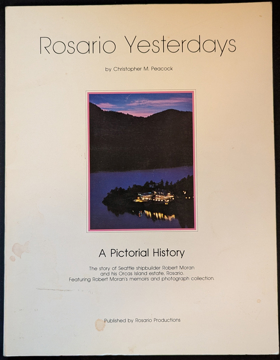
Rosario yesterdays a pictorial history by Christopher M. Peacock, Robert Moran
|
1985 |
|
Roots & reflections South Asians in the Pacific Northwest by Amy Pradip Bhatt , Nalini Iyer , Deepa Banerjee, South Asian Oral History Project, University of Washington Libraries 
Immigrants from South Asia first began settling in Washington and Oregon in the nineteenth century, but because of restrictions placed on Asian immigration to the United States in the early twentieth century, the vast majority have come to the region since World War II. Roots and Reflections uses oral history to show how South Asian immigrant experiences were shaped by the region and how they differed over time and across generations. It includes the stories of immigrants from India, Pakistan, Bangladesh, and Sri Lanka who arrived from the end of World War II through the 1980s. xxvi, 273 pages : illustrations ; 23 cm CIRC [ 0 ]
|
2014 |
|
Rooted Chinese Canadian stories in Burnaby by Burnaby Village Museum (Publisher) 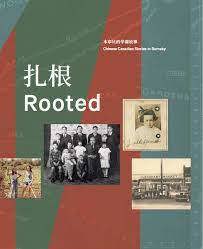
"From the late 1800s to the present day, Chinese Canadians have made Burnaby into a more vibrant and livable city. Rooted: Chinese Canadian Stories in Burnaby brings together a collection of diverse stories and photographs from the community, celebrating the legacy and contributions of Burnaby’s Chinese Canadian community spanning over a century. This coffee-table book features oral histories and interviews with descendants of multigenerational family farms, green grocers, corner stores, restaurants, and places of worship. Also included are archival research and community perspectives on anti-Asian racism, community activism, courage, and resilience."-- Provided by publisher pages cm CIRC [ 0 ]
|
2023 |
|
Room at the inn historic hotels of British Columbia’s Southern interior by Glen Mofford , Karla Decker 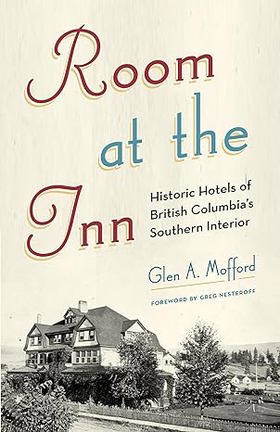
"A fully illustrated social history profiling forty historic hotels spread over five regions of the southern interior of British Columbia, covering the time period of the 1890s to 1950s. Room at the Inn reveals the long-forgotten histories of British Columbia’s early hospitality industry, through the riveting stories of the men and women who built, ran, and frequented hotels, hostelries, resorts, and roadhouses in the southern Interior. From the Similkameen town of Keremeos to Spences Bridge at the confluence of the Thompson and Nicola Rivers, east to the Alberta border along the Trans-Canada Highway, and south to the Canada–US border, the history of these hotels mirrors the history of BC’s mining towns and boom-bust economy of the late nineteenth and early twentieth centuries, as waves of prospectors, settlers, and eventually tourists shaped the culture of the province that we know today. Of the forty historic hotels profiled in this book, all contributed to their communities in various ways. They provided more than just a roof over the heads of weary travellers; they were often the sites of live entertainment, places where community members could meet and socialize. Some even doubled as makeshift hospitals during wildfires and floods. Through colourful anecdotes, meticulous research, and fascinating archival photography, Room at the Inn transports readers to a bygone era and pays tribute to the pioneers, entrepreneurs, and hard-work men and women who built and operated these historic accommodations."-- Provided by publisher xi, 323 pages : illustrations, map, portrait ; 22 cm CIRC [ 0 ]
|
2023 |
|
Romantic Vancouver Island Victoria yesterday and today by Dorothy Abraham
|
1968 |
|
Rolls of certain Indian tribes in Oregon and Washington by Glen Cameron Adams, Charles E. McChesney, Herbert C. Taylor, F. A. Hazeltine
Published by Shorey Book Store and compiled from historical government records by editors including Glen Cameron Adams, Charles E. McChesney, Herbert C. Taylor, and F. A. Hazeltine, Rolls of Certain Indian Tribes in Oregon and Washington compiles critical nineteenth and early twentieth-century federal census rolls and allotment records for Pacific Northwest Indigenous groups. The volume preserves official documentation detailing tribal member names, family lineages, and demographic shifts during an era of aggressive federal assimilation and reservation-boundary reductions. By gathering these scattered archival enumerations into a single reference text, it serves as a vital genealogical and historical ledger for regional tribes. A keen insight drawn from the work is how bureaucratic instruments like federal census rolls acted as legal mechanisms of dispossession; while ostensibly created to manage annuity distributions and land allotments, these documents simultaneously codified colonial control over native bodies by reducing complex ancestral communities into rigid, state-administered categories. 1 volume (various pagings) : illustrations, facsimile, portraits ; 26 cm CIRC [ 1 ]
|
2002 |
|
Rogues, buffoons & statesmen by Gordon R. Newell
|
1975 |
|
Rogue River War speech of Dr. A.G. Henry, of Yamhill, delivered before the citizens of Corvallis, on the evening of Dec. 3d, 1855 by Anson G. Henry
Delivered by pioneer physician and politician Anson G. Henry, Rogue River War Speech captures a fiery public address given in Corvallis, Oregon, in December 1855 to rally support for military action against Indigenous tribes during the height of the Rogue River Wars. The speech plays upon frontier anxieties, detailing alleged atrocities and framing the violent subjugation of local native populations as an urgent, righteous defense of American settlers. Through contemporary rhetorical appeals, the text preserves the raw, unmasked political panic and racial animosity that drove territorial policy during the Pacific Northwest's Indian wars. A keen insight drawn from the work is how wartime rhetoric deliberately inverted the roles of aggressor and victim; by casting preemptive military campaigns of displacement as defensive humanitarian rescue missions, pro-war leaders successfully mobilized civilian volunteers and legitimized state-sanctioned violence under the banner of civic protection. 41 pages : illustrations ; 19 cm CIRC [ 1 ]
|
1995 |
|
Roche Harbor by Richard Walker 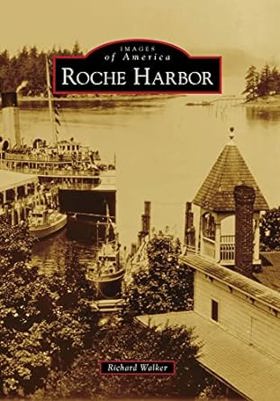
Working with Roche Harbor archivists as well as owners of private photo collections, Walker has selected more than 200 images and written text to illustrate the visual history of Roche Harbor and the people who have lived there 127 pages : chiefly illustrations ; 24 cm. CIRC [ 1 ]
|
2009 |
|
Robert Newell's Memoranda travles in the teritory of Missourie : travle to the Kayuse War : together with A report on the Indians south of the Columbia River by Robert Newell , Dorothy Johansen , Lawton Kennedy (Book designer, Printer), Champoeg Press (Publisher) 
Robert Newell (1807-1868) was an American Mountain Man and 'Doctor' who settled in Oregon and was involved in Indian Affairs of the Oregon Territory. He served as a peace commissioner in the Cayuse War keeping the Nez Perce neutral during the conflict. He settled in Oregon after 1840 and had 3 wives with 16 children and served in the Territorial Government and later the State Government. 159 pages, 2 unnumbered leaves of plates (1 folded) : illustrations, maps ; 27 cm CIRC [ 0 ]
|
1959 |
|
Robert Brown and the Vancouver Island Exploring Expedition by Robert Brown, John Hayman 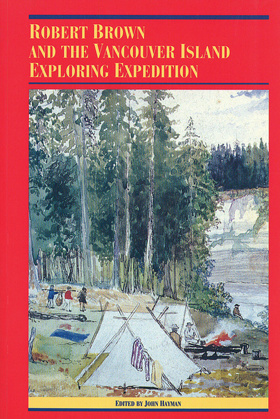
Robert Brown, a twenty-one-year-old Scotsman, arrived on Vancouver Island in 1863 for the purpose of collecting seeds, roots, and plants for the Botanical Association of Edinburgh. Relations with his employer quickly deteriorated, however, and when the opportunity arose in 1864 to head the Vancouver Island Exploring Expedition, Brown eagerly accepted the position as its commander. During the four and a half months of the expedition, Brown kept a journal which is published here for the first time. It is remarkable for its record of life on Vancouver Island over a century ago and its description of the island's pristine wilderness as well as for its proposals for future economic development. The accounts of agricultural settlements at Cowichan, Chemainus, and Comox and of the coal-mining town of Nanaimo are among the earliest available. The Vancouver Island Exploring Expedition did not venture north of Comox, but it crossed the island at several points, often by new routes, and in the process left its mark by giving place names to several locations. The expedition's most celebrated achievement was the discovery of gold at Leech River, named after the second-in-command, which resulted in a short but sensational gold rush. Robert Brown was exceptionally interested in the way of life of the native people. His entries on land reserve policies and on the failure to settle land claims are especially pertinent today. Excerpts from his related writings, among them one of the earliest records of a potlatch (at Alberni) and a collection of Indian myths and legends display an appreciation unusual at that time. Most of the known drawings of the expedition by Frederick Whymper, the travelling artist, are included in the book and give a contemporary view of many of the sites the expedition encountered. A checklist of Brown's other writings on the northwest coast completes the book. xiii, 211 pages : illustrations ; 23 cm CIRC [ 1 ]
|
1991 |
|
Roaring days Rossland's mines and the history of British Columbia by Jeremy Mouat 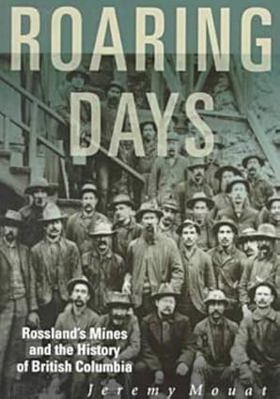
In the 1890s, the name of Rossland was on every investor’s lips. Known at one time as the new Johannesburg, this small town in southeastern British Columbia was the most important mining centre in the region. Apparently possessed of vast quantities of ore, the town’s mines seemed to promise wealth for all, and Rossland grew dramatically throughout the decade. By the early 1900s, it was the province’s fourth largest centre. During that time, hard rock mining changed from a loosely structured pioneer activity to a fully fledged industry that relied on sophisticated technology, a complex corporate infrastructure, and economies of scale. Despite these advances, Rossland’s success was shortlived. A bitter strike in 1901 signalled the beginning of the Golden City’s slow decline. Nearby Trail, originally a subsidiary of Rossland’s mining industry, soon surpassed its neighbour in size and importance.. Roaring Days explores the history of the mining industry in British Columbia. Mouat examines the many different aspects of mining, from work underground to corporate strategies, and he also brings to life the unique individuals who were a part of this history--the miners who toiled long hours in semi-darkness, the hardy citizens who built a bustling town out of the wilderness, and the wealthy mine owners and corporate entrepreneurs whose wealth exceeded all expectations. --From publisher's description xviii, 236 pages : illustrations, maps ; 23 cm CIRC [ 0 ]
|
1995 |
|
Roadside history of Oregon by Bill Gulick 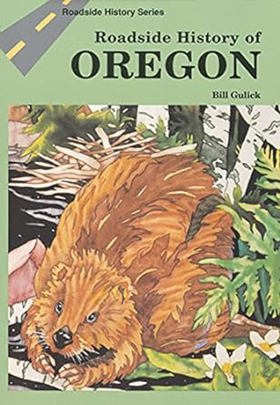
A historical guide of Oregon that includes information on historic sites, notable people, significant events, and places to visit along its highways xi, 430 pages : illustrations, maps ; 24 cm. CIRC [ 1 ]
|
1991 |
|
Roadside history of Idaho by Betty B. Derig 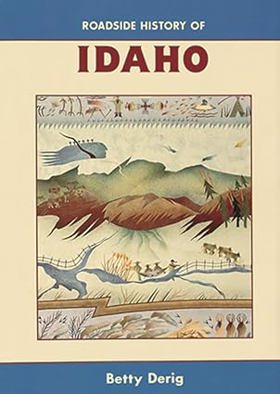
The best way to enjoy Idaho's rich heritage is to visit the sites where history happened. Roadside History of Idaho makes you feel like you've got a native guide at hand as it transports you to those places through well-researched, well-told stories and vivid historical photographs xx, 362 pages : illustrations, maps ; 24 cm. CIRC [ 1 ]
|
1996 |
|
Roadside guide to the Olympic Peninsula by Christopher Chapman 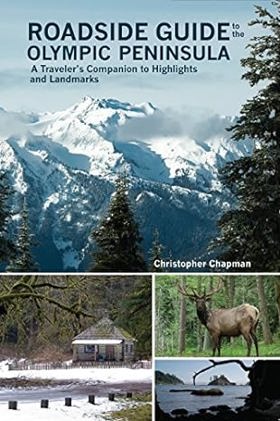
The Olympic Peninsula is more than just big trees and scenic coastlines. Layered on this rich landscape are unique animals and plants, extraordinary geology, histories of Native Americans that go back thousands of years, exploits of famed European explorers, and the hard work of the early pioneers. Roadside Guide to the Olympic Peninsula is your complete guidebook as it weaves all this together while escorting you around the Peninsula.“Indispensable in the car for your next Peninsula road trip. "I learned tons and couldn’t wait to get to the next stop in Chapman’s journey. Will make anyone’s travels on the Peninsula richer and more rewarding.” —Lynda V. Mapes, author of A River Reborn and Breaking The Lower Elwha Klallam Tribe and the Unearthing of Tse-whit-zen Village."This book, with its wealth of history, geology and nature, is the must have resource for the Olympic peninsula. Whether you spend a day, or a lifetime, this is the book you will refer to over and over again." —Rob Sandelin, Naturalist, teacher and author of Field Guide to the Cascades and Olympics."Christopher Chapman’s Roadside Guide to the Olympic Peninsula brings the geography, geology, and natural and human history -- as well as some of the mystery and magic -- of the Olympic Peninsula into clear and immediate focus. It is a “must-have” roadside reference for visitors to this lovely and dynamic landscape." —Tim McNulty, author of Olympic National A Natural History Book.The Book contains a complete listing of phone numbers and addresses of Ranger Stations, Government Information Centers, Visitor and Chambers of Commerce, Campground Managers, Museums and Tribes. Along with all the Audubon Society resources, the list of the most prevalent bird species and where to find them and the complete list of the National and State Registered Historic Landmarks for the Peninsula. xiii, 318 pages : illustrations, maps ; 23 cm CIRC [ 1 ]
|
2014 |
|
Roadside geology of southern British Columbia by William Henry Mathews, J. W. H. Monger 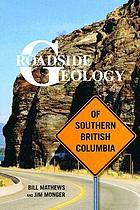
Southern British Columbia, from the northern tip of Vancouver Island to the Alberta border east of Golden, spans the Canadian Cordillera, a mountainous region with a tumultuous geologic history that continues to evolve with every volcanic eruption, landslide, and earthquake. Introductory sections of this guidebook interpret the geologic complexity of four regions-Vancouver Island, the Coast, the Interior Plateaus, and the Columbia and Rocky Mountains-and thirty-one road guides describe the xi, 403 pages : illustrations, maps ; 23 cm. CIRC [ 0 ]
|
2005 |
|
Roadside geology of Idaho by P. K. Link , Shawn Willsey , Keegan L. Schmidt 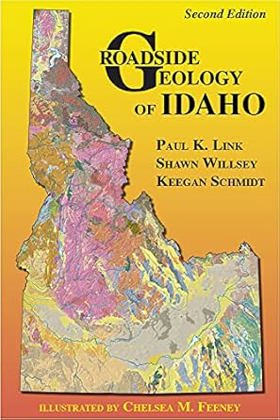
"Learn about the remarkable geologic diversity of the Gem State with the completely revised, full-color edition of Roadside Geology of Idaho. Excellent graphics, spectacular photographs, and straightforward writing describe and interpret the rocks and landscapes visible outside your car window, whether you're speeding across the Snake River Plain or following a narrow canyon enroute to a weekend getaway. The authors, a trio of experienced field geologists, guide you to outcrops and roadcuts where you can stretch your legs and expand your minds. The rocks of Idaho span a vast chunk of Earth's long-lived history and tell stories with many plot twists. Time and time again, geologic processes transformed the landscape-mountains grew to towering heights only to be leveled by erosion, vast lakes drained in massive floods when ice and sediment dams failed, and lava poured into river valleys, creating new dams. With this book as their travel companion, residents and visitors alike are sure to understand and appreciate Idaho's sprawling plains, forested hills, and deep canyons in a completely new"-- Provided by publisher xiii, 384 pages : illustrations (chiefly color), color maps ; 23 cm. CIRC [ 0 ]
|
2021 |