Catalog of British Columbiana and Pacific Northwest Americana
Encyclopedia Cascadia Catalog contains book titles of mostly non-fiction Pacific Northwest Coast of North America Titles (primarially British Columbia, Idaho, Oregon and Washington State) in an easy-to-understand title catalog. If you see a link with this badge ONLINE CIRC it means that there is an online institution that provides free access to that title. In some cases there may be more than one institution hosting the title digitally.
| Catalog Title | Published |
|---|---|
|
Coos Bay the pioneer period, 1851-1890 by Stephen Dow Beckham 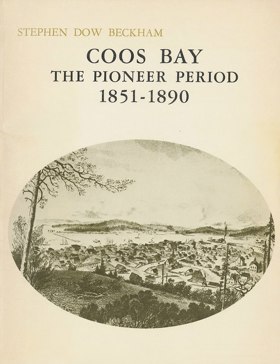
Study of the Coos Bay region focusing on the years 1851-1890. During this period a little known estuary on the southwest coast of Oregon became a thriving center for lumbering, shipbuilding, coal mining, and agriculture. This work is not intended to be a complete local history of Coos Bay, however the author examines those events and undertakings that have had special significance in the development of the area. v, 70 pages illustrations 28 cm CIRC [ 1 ]
|
1973 |
|
Cooperatives across clusters lessons from the cranberry industry by Anil Hira , Paul David Gottlieb , Neil Reid , Stephan J. Goetz , Elizabeth A. Dobis , Oregon State University Press (Publisher) 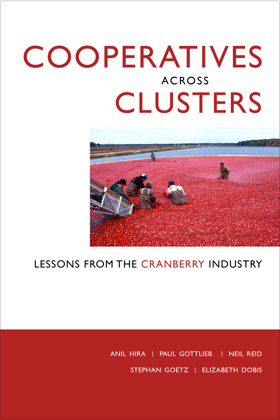
"Most agricultural production is of commodity or undifferentiated products. Producers suffer from a roller-coaster ride of price swings, over- or under-production, weather and pest threats, and the inability of family famers to capture anything beyond a small percentage of the final price. Cooperatives Across Clusters provides lessons from the cranberry industry, a commodity product organized mostly into family farms in seven different clusters around North America. The industry is remarkable in that it's substantially organized around one large cooperative, Ocean Spray. The authors examine how the cooperative came to be, the challenges of coordination and industry leadership across the diverging clusters, and the lessons for cooperation for other agricultural industries. The book provides a multi-layered contribution to agricultural economics. First, it examines location decisions and what factors supersede growing conditions to allow industries to arise around production. Second, it explores pathways available for farmers to try to overcome, through cooperative organization, the natural boom-bust cycles of commodity price swings. Third, it looks at how cooperative decisions are made, and the challenges of providing industry leadership, including research and development and collective marketing, through a cooperative that faces continual defections and new problems. Finally, through in-depth historical, statistical, and field research, it provides a comprehensive study of the cranberry industry and suggests ways farmers can grow the industry. Agricultural policymakers, farmers, industry specialists, and researchers of agriculture and clusters more generally will find this to be an important and informative new resource."-- Provided by publisher xvi, 216 pages : illustrations, maps ; 23 cm CIRC [ 0 ]
|
2024 |
|
Cool North wind Morley Nelson's life with birds of prey by Stephen Stuebner 
A freelance wildlife writer offers a biography of the life and work of Morley Nelson, a passionate defender of American birds of prey whose advocacy for conservation laws, as well as his achievements in the field of falconry, nature films, raptor rehabilitation, and related work are covered in the book, along with his years of WWII service as a company commander in the elite 10th Mountain Division in the Italian Alps. B & w photos, with a few in color xx, 429 pages : illustrations (some color) ; 24 cm CIRC [ 0 ]
|
2002 |
|
Conversations with Khahtsahlano, 1932-1954 by August Jack Khahtsahlano , James Skitt Matthews (Compiler) 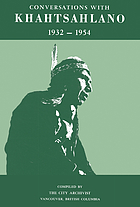
"Conversations with Khahtsahlano, 1932-1954 contains twenty-two years of conversations between Sḵwx̱uwú7mesh Chief X̱ats'alanexw, a.k.a. Chief August Jack Khahtsahlano, and Major J.S. Matthews. Originally published in 1955 by the Vancouver City Archives, Conversations with Khahtsahlano received a limited publication and is reproduced here in facsimile. Chief X̱ats'alanexw's reminiscences travel as far back as 1881. He recounts neighbourhood tales, the Traditional Stories he grew up with, local genealogies, cultural histories, and detailed accounts of practices for everything from fishing sturgeon to building houses. Knowledgeable and forthcoming, Chief X̱ats'alanexw's recollections weave a meticulous tapestry. After centuries of violent erasure of Indigenous world views, here is a rare first-hand account detailing traditional life of the Coast Salish peoples, an insightful record rich with art, diagrams, maps, letters, and photographs. Chief X̱ats'alanexw's observations give shape to the social and physical changes of the region, and offer an illuminating glimpse into so-called Vancouver in its infancy. Conversations with Khahtsahlano is an essential text that brings history indelibly to life."-- Provided by publisher 444 pages : illustrations, maps ; 21 cm CIRC [ 0 ]
|
2022 |
|
Continental reckoning the American West in the age of expansion by Elliott West 
"Elliott West lays out the main events and developments that together describe and explain the emergence of the American West and situates the birth of the West in the broader narrative of American history between 1848 and 1880"-- Provided by publisher xxxiii, 628 pages, 38 unnumbered pages of plates : illustrations, maps ; 24 cm. CIRC [ 0 ]
|
2023 |
|
Contested empire Peter Skene Ogden and the Snake River expeditions by John Phillip Reid 
"Do law and legal procedures exist only so long as there is an official authority to enforce them? Or do we have an unspoken sense of law and ethics?" "To answer these questions, John Phillip Reid's Contested Empire explores the implicit notions of law shared by American and British fur traders in the Snake River country of Idaho and surrounding areas in the early nineteenth century. Both the United States and Great Britain had claimed this region, and passions were intense. Focusing mainly on Canadian explorer and trader Peter Skene Ogden, Reid finds that both sides largely avoided violence and other difficulties because they held the same definitions of property, contract, conversion, and possession." "In 1824, the Hudson's Bay Company directed Ogden to decimate the fur-bearing animal population of the Snake River country, thus making the region a "fur desert." With this mandate, Great Britain hoped to neutralize any interest American furtrappers could have in the area. Such a mandate set British and American fur men on a collision course, but Ogden and his American counter-parts implicity followed a kind of law and procedure and observed a mutual sense of property and rights even as the two sides vied for control of the fur trade." "Failing to take legal culture into consideration, some previous accounts have depicted these conflicts as mere episodes of lawless frontier violence. Reid expands our understanding of the West by considering the unspoken sense of law that existed, despite the lack of any formalized authorities, in what has otherwise been considered a "lawless" time."--Jacket xiii, 258 pages : illustrations, maps ; 24 cm CIRC [ 1 ]
|
2002 |
|
Contested boundaries a new Pacific Northwest history by David J. Jepsen, David J. Norberg 
An engaging, contemporary look at the themes, events, and people that have shaped the history of the Pacific Northwest over the last two centuries xxi, 392 pages : illustrations, map, portraits ; 26 cm CIRC [ 1 ]
|
2017 |
|
Constructing a democracy the history, law, and politics of redistricting in Oregon by Norman R. Williams , Oregon State University Press (Publisher) 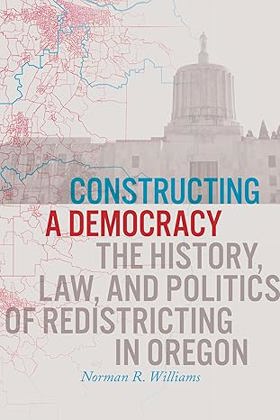
"Every ten years, states go through the process of redistricting: choosing how to divide up and apportion their state and federal legislative districts. How the districts are drawn can determine which party wins the district and therefore controls the legislature or Congress. Although the process may be different in every state, the questions are the same: Who draws the maps? Who can prevent gerrymandering? What power do legislatures, governors, courts, and political parties have to influence the process and the outcomes? In Constructing a Democracy, legal scholar Norman Williams presents a comprehensive history of legislative and congressional redistricting in Oregon. Because redistricting impacts the representativeness of the ensuing legislative body, Oregon's constitutional framers, legislators, and courts alike have understandably focused on developing legal rules to constrain the redistricting process. Williams is primarily interested in identifying and understanding the scope of those rules: What legal constraints have existed over time? How aggressively have the courts enforced those restraints? How have political actors undertaken the redistricting task in light of the various rules and the judicial pronouncements regarding those constraints? The redistricting process in Oregon has not drawn national attention the way it has in states like North Carolina and Pennsylvania. But the process in Oregon is notable in several ways, including an early attention to malapportionment, the use of the initiative to reform the process, and the impact of women leaders on the redistricting process. The Oregon process, however, has also notably lagged behind other states, particularly in considering issues of race and minority representation and preventing gerrymandering."-- Provided by publisher ix, 362 pages : map ; 23 cm CIRC [ 0 ]
|
2023 |
|
Conquest and catastrophe the triumph and tragedy of the Great Northern Railway through Stevens Pass by T. Gary Sherman, Washington State Library Rare Publications Collection 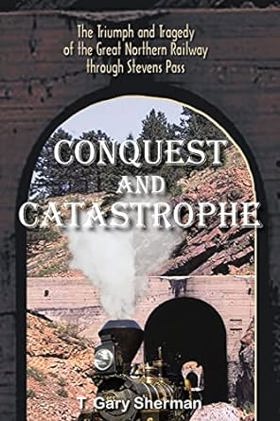
Published by the Washington State Library Rare Publications Collection, Conquest and Catastrophe: The Triumph and Tragedy of the Great Northern Railway Through Stevens Pass by T. Gary Sherman details the epic, perilous engineering feat of pushing a transcontinental railroad through the rugged Cascade Mountains. The book chronicles James J. Hill's ambitious drive to conquer the treacherous terrain of Stevens Pass, balancing the immense economic triumph of connecting the Midwest to Puget Sound against the staggering human and environmental toll. Through archival records and striking photographs, the text recounts deadly avalanches—such as the infamous 1910 Wellington disaster—and the relentless labor required to tame an unforgiving alpine landscape. A keen insight drawn from the work is how corporate hubris on the industrial frontier often blinded railway leaders to ecological realities, demonstrating that treating raw mountain passes as mere engineering obstacles carried a devastating human cost. xiii, 243 pages : illustrations, maps ; 23 cm CIRC [ 1 ]
|
2004 |
|
Conquering the last frontier by Thomas T. Aldwell
|
1950 |
|
Connecting the Kootenays the Kootenay Lake ferries : a hundred years of service, 1921-2020 by Michael A. Cone 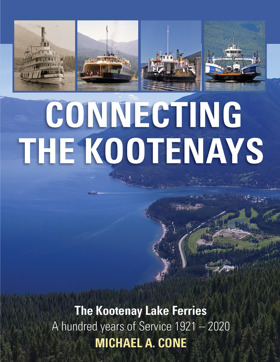
Connecting the Kootenays: The Kootenay Lake Ferries is the authoritative history of a century of ferry service across Kootenay Lake. Historian Michael A. Cone follows the service from its genesis in 1921, when it first linked the East and West Kootenays together as part of the visionary Southern Trans-Provincial highway, right up until its 100th anniversary in 2020, when the existing two-ferry operation is on the verge of turning another page with the introduction of a new ‘electric ready’ ferry with state-of-the-art technology. The story starts with coal-fired CPR sternwheelers – graceful and luxurious in their accommodations – carrying automobiles between Kuskanook and Nelson and then progresses to a ferry service owned and operated by the Provincial Government. From 1931 until 1947, the ferry ran between Fraser’s Landing and Gray Creek. In the post-War boom, the route was shortened to what it is today. For the next 73 years, Kootenay Lake ferries have crossed between Balfour and Kootenay Bay, always ready to provide a safe, convenient, sometimes vital year-round link to the communities they serve, regardless of how bad the weather is. Michael Cone’s book chronicles the changes that have taken place over the century, from transformations in ferry designs and docking facilities, improvements in navigation techniques, evolution in crew uniforms and safety, to privatization of operations, revised scheduling and, not to forget, the removal of the ferry tolls in 1963. Over the years the operation has altered to keep pace with the changes in public taste, ranging from demands for shorter routes and less congestion, and improved on board and terminal conveniences, to changes in automobile styling, including the advent of RVs and larger commercial trucks. Connecting the Kootenays: The Kootenay Lake Ferries is a local history book you’ll want to curl up and read. It is filled with colourful first-hand accounts from crew members who were there, with black and white and period colour photos, many of which will be new for even the most ardent Kootenay historians. xii, 354 pages : illustrations (some colour), maps ; 28 cm CIRC [ 0 ]
|
2022 |
|
Confederacy of ambition William Winlock Miller and the making of Washington Territory by William L. Lang 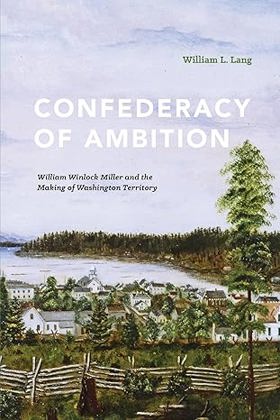
The promise of opportunity drew twenty-seven-year-old Illinois schoolteacher William Winlock Miller west to the future Washington Territory in 1850. Like so many other Oregon Trail emigrants Miller arrived cash-poor and ambitious, but unlike most he fulfilled his grandest ambitions. By the time of his death in 1876, Miller had amassed one of the largest private fortunes in the territory and had used it creatively in developing the region’s assets, leaving a significant mark on the territory’s political and economic history. Appointed Surveyor of Customs at the newly created Port of Nisqually in 1851, Miller was the first federal official north of the Columbia River. Two years later he helped organize the new territory‘s Democratic Party and quickly became a political and financial confidant of governor Isaac Stevens. His involvement in the Indian conflict in 1855–56, a term in the territorial legislature, and his bankrolling of key politicians made him the territory’s most effective political networker. His role as a “hip-pocket banker” in a region without established banks made him a powerful financial broker and a major player in territorial affairs. But in his pursuit of success Miller compromised another ambition he carried west from Illinois. He postponed marriage and family until only a few years before his death and agonized about relationships with his family in Illinois. His experience reminds us that the pioneer settlement era was a period of social dislocation and that public economic and political success could mask personal disappointment. Lang’s biography takes readers into the heart of Washington territorial politics, where alliances often hinged more on mutual economic interest than political principles and nearly all agreed that government should encourage ambitious and energetic men. In this world, Lang argues, Miller succeeded because he parlayed his talents in camaraderie politics and sharp-pencil business affairs with an unabashed mining of governmental opportunities. William Lang’s account of William Winlock Miller and the first quarter century of Washington’s history offers a new view of the pioneer era, emphasizing that the West was developed in large measure by men like Miller who manipulated government and its resources to their own and the region’s advantage. xiii, 310 pages : illustrations, map ; 23 cm CIRC [ 0 ]
|
2014 |
|
Comrades of the quest an oral history of Reed College by John Sheehy 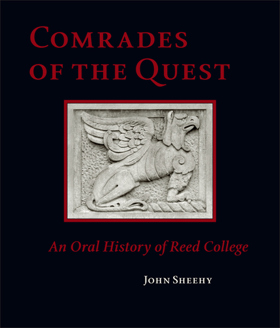
Visionary. Iconoclast. Rebel. William Trufant Foster set out in 1911 to launch the “ideal college,” and succeeded in building an intellectual liberal arts powerhouse that over the next one hundred years would perpetually seek to break the hard crust of custom and orthodoxy. Foster’s quest for excellence and truth generated a steady yield of students – ranging from poet Gary Snyder to muckraker Barbara Ehrenreich to Apple founder Steve Jobs – who left Reed College eager to challenge society’s dominant paradigms. Comrades of the Quest chronicles the colorful cultural and social history of this band of young and fiercely unorthodox West Coast intellectuals, and of the institution that nurtured them. Drawing from interviews with more than 1,400 people and from unpublished memoirs stretching back to the college’s first decades, John Sheehy weaves together a riveting story told from first-hand perspectives of this unique community’s ongoing efforts to bring Foster’s vision to life. With a punch considerably mightier than its weight, the Reed community undertakes an arduous journey through the political and educational developments of the past century— from the progressive education movement in the 1910s, the general education programs between the two world wars, scientific methodology in the 1950s, political relevance in the 1960s, theories of structuralism and deconstruction in the 1970s, the cultural wars in the 1980s, political correctness in the 1990s, to ideological bias in the 2000s—while keeping its founding ideals largely intact. At a time when America is struggling to sustain its innovative edge, Reed College remains an iconic model, equipping students with a rigorous set of skills and attitudes possible for questioning status quo thinking in a rapidly changing world. Its story, populated with a rich cast of characters, and marked by intense focus, demanding social freedom, and unconventional creativity, is no customary college history, but rather an intellectual thriller of American idealism played out against the hard world of social, religious, and political conformity, ascending great heights and persevering through near-fatal confrontations. 561 pages : illustrations ; 27 cm CIRC [ 0 ]
|
2012 |
|
Competitive struggle America's western fur trading posts, 1764-1865 by R. G. Robertson 
Competitive Struggle recounts the 101-year history of Americas western fur trade: from the founding of St. Louis in 1764 through 1865, the demand for beaver pelts and buffalo robes spawned a competitive fervor that enveloped mountain men, fur trading companies, national governments, and Native Americans.The book includes a series of easy-to-read flowcharts showing the evolution of the various fur companies. Extensive endnotes, an index, a glossary of terms, and a list of modern-day trading post replicas and their photographs make Competitive Struggle a musthave reference on America s fur trade. xxi, 330 pages : illustrations, maps ; 23 cm CIRC [ 0 ]
|
2012 |
|
Company, crown and colony the Hudson's Bay Company and territorial endeavour in western Canada by Stephen A. Royle 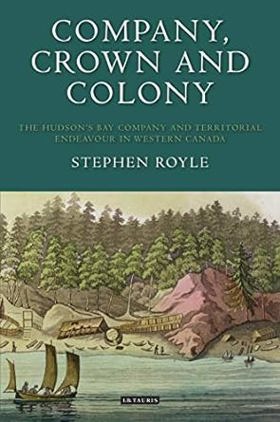
Trading companies played a vital role in colonial endeavour. The great English, Dutch and French merchant companies took the risks of trade and travel in a dangerous world, opening up trading routes to the Farthest corners of the globe. The Hudson's Bay Company was just such an enterprise. Established under a charter granted by Charles II in 1670, with Prince Rupert, the king's cousin, as one of its directors, the company was granted 4m square kilometres of what was to become Canada, over which huge territory they were given sole trading rights 304 pages : illustrations, maps ; 24 cm CIRC [ 1 ]
|
2011 |
|
Company town Potlatch, Idaho, and the Potlatch Lumber Company by Keith Petersen, Latah County Historical Society (Publisher) 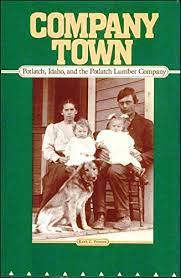
Company Town: Potlatch, Idaho, and the Potlatch Lumber Company by Keith Petersen is a 1987 historical study published in association with the Latah County Historical Society that examines one of the American West's most meticulously planned corporate communities. The book chronicles the establishment and daily life of the lumber town, detailing the Weyerhaeuser syndicate's paternalistic control over its workers' housing, commerce, and social institutions from 1905 until the town's privatization in the 1950s. Ultimately, it serves as a compelling case study of industrial capitalism, labor relations, and the unique socio-economic dynamics that defined early 20th-century timber operations in the Pacific Northwest. xix, 284 pages, 32 unnumbered pages of plates : illustrations ; 24 cm CIRC [ 1 ]
|
1987 |
|
|
1952 |
|
Coming home to Nez Perce country the Niimíipuu campaign to repatriate their exploited heritage by Trevor James Bond 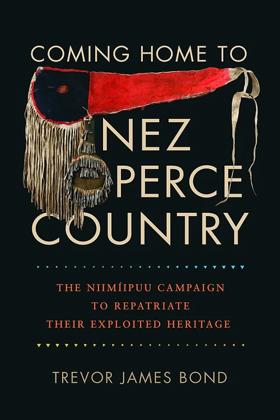
Missionary Henry Spalding shipped two barrels of "Indian curiosities" to Ohio in 1847. The author delves into the story of the exquisite Nez Perce shirts, dresses, baskets, and horse regalia, the tribe's grassroots campaign to restore their exploited cultural heritage, and the ethics of acquiring and selling Native cultural history- In 1847, two barrels of “Indian curiosities” were shipped by missionary Henry Spalding to Dr. Dudley Allen in Kinsman, Ohio. The items inside included exquisite Nez Perce shirts, dresses, baskets, and horse regalia—some decorated with porcupine quills and others with precious dentalium shells and rare elk teeth. Donated to Oberlin College in 1893 and transferred to the Ohio Historical Society (OHS) in 1942, the Spalding-Allen Collection languished in storage until Nez Perce National Historic Park curators rediscovered it in 1976. The OHS loaned most of the artifacts to the National Park Service, where they received conservation treatment and were displayed in climate-controlled cases. Josiah Pinkham, Nez Perce cultural specialist, notes that they embody “the earliest and greatest centralization of ethnographic objects for the Nez Perce people. You don’t have a collection of this size, this age, anywhere else in the world.” Twelve years later, the OHS abruptly recalled the collection, but after public pressure and extended negotiations, agreed to sell the articles to the Nez Perce at their full appraised value of $608,100 and a six-month deadline. The tribe formed the Nez Perce Heritage Quest Alliance and mounted a brilliant grassroots fundraising campaign. One day before the deadline, they met their goal. The author draws on interviews with Nez Perce experts and extensive archival research to tell the Spalding-Allen Collection story. He also examines the ethics of acquiring, bartering, owning, and selling Native cultural history, as Native American, First Nation, and Indigenous communities continue their efforts to restore their exploited cultural heritage from collectors and museums—pieces that are living, breathing, intimately connected to their home region, and inspirational for sustaining cultural traditions.- Provided by publisher 206 pages : illustrations (chiefly color) ; 23 cm CIRC [ 0 ]
|
2021 |
|
Comin' in over the rock a storyteller's history of Cannon Beach by Peter Lindsey 
An anecdotal history of Cannon Beach, Oregon, written by someone who has been there for sixty years. Witness the beginnings, the character and the characters of this timeless ocean community. 170 pages : illustrations ; 23 cm CIRC [ 1 ]
|
2016 |
|
Columbia's river the voyages of Robert Gray, 1787-1793 by J. Richard Nokes 
Covers the voyages of Robert Gray from 1787 to 1793 along the Pacific Northwest coast. The two voyages of the American Robert Gray, one began in 1787 and the other in 1790. In 1787, he was captain of the sloop Lady Washington, and entailed trade and discovery in the Pacific Northwest. He switched to captaining the Columbia which he took back to Boston by crossing the Pacific to China, thus becoming the first American to circumnavigating the globe. In 1790 he sailed the Columbia from Boston, around Cape Horn and up the west coast of South and North Americas to the Pacific Northwest. xviii, 352 pages : illustrations, maps ; 24 cm CIRC [ 1 ]
|
1991 |
|
Columbia River Gorge railroads by D. C. Jesse Burkhardt 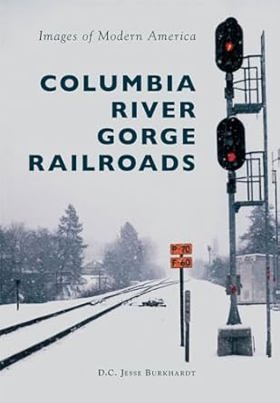
The Columbia River Gorge is a land of scenic wonder, revered by tourists for its beauty and by recreationalists for its fishing, windsurfing, hiking, and rafting. The region is also a major transportation corridor, home to two vital east-west railroad routes: Burlington Northern Santa Fe on the Washington side of the Columbia River and Union Pacific on the Oregon side. Every day, dozens of freight trains, as well as Amtrak passenger trains, snake along on opposite banks of the wide river, and rail operations have become an integral part of the heartbeat of the gorge. The colorful images in this work celebrate the art and magic of the trains that move goods and passengers through this striking, rugged landscape 95 pages : color illustrations, color maps ; 24 cm. CIRC [ 0 ]
|
2016 |
|
Columbia River Gorge history. Volume two by Jim Attwell 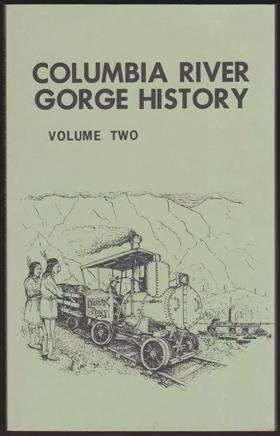
Contents: Continuation of Volume 1; The Native Indians; Homesteaders and Settlers; Early Roads; Early Transportation; and, Pioneer Stories. 210 pages : illustrations, maps ; 22 cm CIRC [ 1 ]
|
1975 |
|
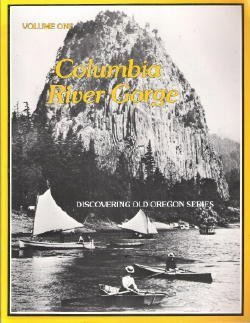
Columbia River Gorge history. Volume one by Jim Attwell 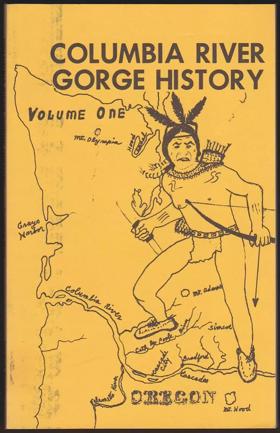
This is some of the history of the early days in the Columbia River Gorge. The Indians were her many, many moons before the white people came, but they left no written history. This writer did not come with the first explorers so must depend on some of the history left by them, however he was a descendant of some of the early settlers and friends of others, who have given him stories which he wishes to pass on. -- Amazon 150 pages : illustrations, maps ; 21 cm CIRC [ 1 ]
|
1974 |
|
Columbia River Gorge by Marty Sherman, Joyce Herbst, Kathy Johnson
|
1984 |
|
Columbia Highlands exploring Washington's last frontier by Craig Romano, James Johnston (Illustrator) 
The beauty of the Columbia Highlands is subtle. It's measured by rays of sunlight filtering through a cathedral forest of ancient pines; a golden hillside teeming with deer; in the soft breezes that whistle through shiny snags. It's cherished for its vastness, its lack of human intervention, its rejuvenating properties, and its abundant wildlife. Columbia Highlands is a portrait of this-little known corner of the American West. It reveals its function as an important wildlife bridge between the Rockies and the Cascades for animals- including wolves, bears, moose, and lynx-who must roam to survive. It reveals the surprising coalition of people- hunters, hikers, loggers, business owners, Native people, and more-united in their love of the land and working to protect and restore it. Theirs is a new kind of conservation plan, one that preserves the health of the ecosystem while sustaining a viable rural economy and lifestyle 124 pages : illustrations (chiefly color), color maps ; 23 cm CIRC [ 1 ]
|
2007 |