Regional District of Alberni-Clayoquot Regional District
The Alberni-Clayoquot Regional District, established in 1967, is situated in the heart of Vancouver Island with one of the most dramatic and majestic landscapes.
Mapped Location
Regional District of Alberni-Clayoquot: The mapped location is an approximation and should not be used for navigation or wayfinding.
Information
General information on Regional District of Alberni-Clayoquot
- Feature Type: Regional District
- Regional District Administrative Centre: City of Port Alberni
- Established: Thursday, April 21, 1966
Official, historical, colloquial and alternative toponyms for Regional District of Alberni-Clayoquot
A brief list of names that this geographic feature has been named
| Name | Description |
|---|---|
| Regional District of Alberni-Clayoquot | Official |
A Selected Bibliography of Regional District of Alberni-Clayoquot, Regional District
A compilation of essential readings detailing the history, geography, and culture of the region.
Escape to Clayoquot Sound finding home in a wild place by John Dowd , Bea Dowd

Twenty years ago, two empty-nesters with a love of the outdoors stumbled upon a vacant beach house on a small island in Clayoquot Sound, part of an off-grid, ten-acre stretch nestled within a provincial park reserve. Our Stolen Years in Clayoquot Sound is an extended love letter to this place, chronicling the decade John and Bea Dowd spent as year-round caretakers of the property. Told with humour and heart in alternating voices, and lavishly illustrated throughout with stunning natural photography, this book a story of joyful solitude, of living in harmony with wildlife and respecting the forces of nature. It is about the fleeting definition of home and family, and about creating community in the wilderness. Above all, it is a tribute to an achingly beautiful, fragile place.
309 pages : color illustrations ; 26 cm
Desiderata
Long Beach wild a celebration of people and place on Canada's rugged western shore by Adrienne Mason
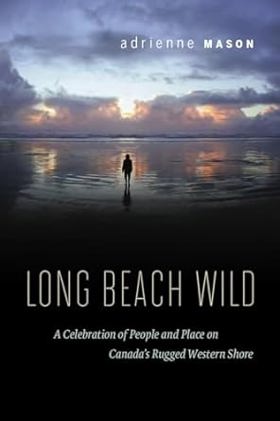
Each year, more than a million people visit the spectacular sweep of sand that stretches along Vancouver Island's west coast between Tofino and Ucluelet to watch waves crash ashore on a series of beaches-essentially one long beach separated by small rocky headlands, a shoreline steps away from howling wolves and towering red cedars. In Long Beach Wild: A Celebration of People and Place on Canada's Rugged Western Shore , local resident Adrienne Mason uses her intimate knowledge of the area and a selection of historic and contemporary photos to explore the region's rich natural and cultural history
215 p. : ill., maps, ports. ; 23 cm.
Non-circulating [ 1 ]
Possessing Meares Island a historian's journey into the past of Clayoquot Sound by Barry M. Gough
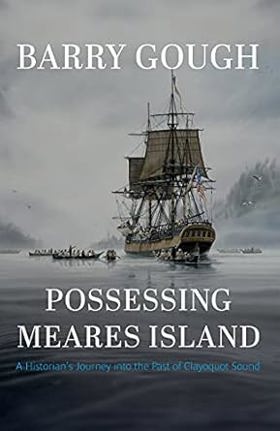
"A fascinating account that links early maritime history, Indigenous land rights, and modern environmental advocacy in the Clayoquot Sound region by award-winning author and historian Barry Gough. Centred on Meares Island, located near Tofino on Vancouver Island's west coast, Possessing Meares Island weaves a unique history out of the mists of time by connecting eighteenth century Indigenous-colonial trade relations to more recent historical upheavals. Gough invites readers to enter a dramatic epoch of BC's coastal history and watch the Nuu-chah-nulth nations spearhead the maritime sea otter trade, led by powerful chiefs like Wickaninnish and Maquinna. Eventually, Meares Island declines into an economic backwater due to overhunting the sea otter, the bloody Clayoquot War of 1855, and most importantly, the proxy of empire--the Hudson's Bay Company--establishing colonial roots in nearby Victoria. Caught up in the tides of change, the Oregon Treaty of 1846 ushers in a new era as the island is officially declared property of the British Crown. Gough bridges the gap between centuries as he describes how the Nuu-chah-nulth Tribal Council draw on this complicated history of ownership to invoke their legal claim to the land and defend the majestic wilderness from the indiscriminate clear-cut saw. Possessing Meares Island will not only appeal to history buffs, but to anyone interested in a momentous triumph for Indigenous rights and environmental protection that echoes across the nation today."-- Provided by publisher
xxv, 230 pages, 8 pages of plates : illustrations, maps ; 24 cm
Desiderata
Port Alberni more than just a mill town by Jan Peterson

Any community that has ever been labelled a mill town carries both the promise of prosperity and the constant threat of collapse, its fortune hinging on a single industry whose performance is as much related to the whims of a global economy as it is to the abundance of a key natural resource. The people of Port Alberni, located deep in Vancouver Islands Alberni Valley, know all too well the highs and lows that come with such a label. Jan Peterson, who lived in Port Alberni for two of the towns most tumultuous decades and worked as a reporter for the Alberni Valley Times, describes how the towns people persevered through three decades of boom and bust, developed a vibrant arts and sporting community, and strived to make life better under any circumstances. From the prosperous 1970s, when Port Alberni earned the reputation of forestry capital of Canada, to the decline of the industry in the 1980s, when economic uncertainty signalled a need for diversification, to the environmental protests in nearby Clayoquot Sound, which polarized the community, Port Alberni tells the story of Port Alberni from a perspective that is rarely heard. Through fascinating interviews and meticulous historical research, Peterson captures the heart and soul of a town so often defined by dollars and cents.
264 pages, 16 unnumbered pages of plates : illustrations, maps, portraits ; 22 cm.
Non-circulating [ 1 ]
Tofino and Clayoquot Sound a history by Margaret Horsfield , Ian Kennedy
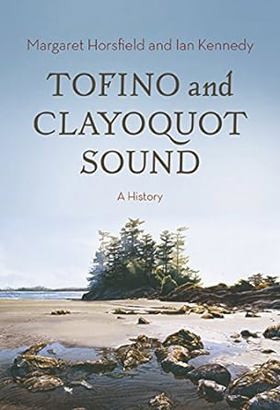
"Tofino and Clayoquot Sound delves into all facets of the region's history, bringing to life the chronicle that started with the dramatic upheavals of geological formation and continues to the present day. The book tours through the history of the Hesquiaht, Ahousaht and Tla-o-qui-aht as well as other nations that inhabited the area in earlier times. It documents the arrival of Spanish, British and American traders on the coast and their avid greed for sea otter pelts. It follows the development of the huge fur seal industry and its profound impact on the coast. It tracks the establishment of reserve lands and two residential schools. The coming of World War II is discussed, as is the installation of a large Air Force base near Tofino, which changed the town and area dramatically. From here the story spirals into the post-road period. With gravel and asphalt came tourism, newcomers, the counter-culture of the 1960s, the establishment of Pacific Rim National Park and, of course, surfing. The book also addresses logging—which became the main industry in the area—and its questionable practices, going into detail about the "War in the Woods"—the world-famous conflict and largest mass arrest in Canadian history." -- Amazon.com viewed August 3, 2020
xvi, 622 pages : illustrations, maps, portraits ; 24 cm.
Non-circulating [ 1 ]
Voices from the Sound chronicles of Clayoquot Sound and Tofino, 1899-1929 by Margaret Horsfield
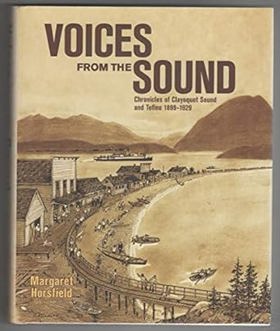
"Remarkable characters from Clayoquot Sound jostle for attention in Voices from the Sound. Storekeepers and sealers, prospectors and priests, schoolchildren, settlers and native people - in the early decades of the twentieth century, their lives intersected in the small world and vast distances of Vancouver Island's remote west coast. Now the voices of these people can be heard once again, in chatty and revealing detail. They come alive, just as cantankerous or eccentric, pitiable or brave as they were in their own lifetimes
365 pages : illustrations, maps, portraits ; 27 cm
Non-circulating [ 1 ]
Chasing Clayoquot a wilderness almanac by David Pitt-Brooke
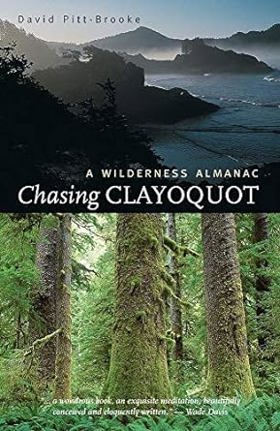
In the manner of Thoreau, naturalist David Pitt-Brooke meditates on one of Earth’s last untouched places Vancouver Island’s fabled Clayoquot Sound. This area came to prominence during Clayoquot Summer,” a 1993 protest that resulted in 800 arrests but also halted the region's destruction by logging. Clayoquot Sound encompasses every imaginable landscape, from alpine tundra to old-growth temperate rain forest. Like Barry Lopez did with the north inArctic Dreams, Pitt-Brooke approaches this wild, magical place by taking readers on an unforgettable journey for each month of the year.Chasing Clayoquot is a profound and political trip through an extraordinary environment
287 pages : illustrations, maps, portrait ; 23 cm
Non-circulating [ 1 ]
The wild edge Clayoquot, Long Beach & Barkley Sound by Jacqueline Windh
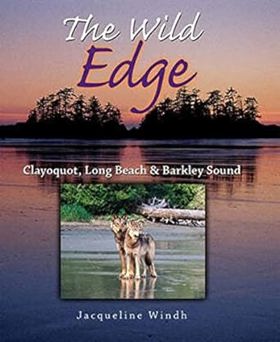
"The Pacific Rim region of Vancouver Island - including the Clayoquot wilderness, Long Beach, Barkley Sound and the communities of Tofino, Ucluelet and Port Alberni - has become one of western Canada's prime tourist destinations, drawing over a million visitors a year." "This photographic study of the region will go far toward revealing its legendary charms both to actual visitors and armchair travellers. Author Jacqueline Windh has spent ten years photographing the Clayoquot-Pacific Rim area in all its seasons and moods, studying its history and getting to know its people. In The Wild Edge: Clayoquot, Long Beach & Barkley Sound, she shares her findings in images and words, supplementing her unforgettable scenic photographs with a light-hearted but informative text that blends history and science with essential visitor guidance."--BOOK JACKET
167 pages : color illustrations, map ; 29 cm
Non-circulating [ 1 ]
Alberni prehistory archaeological and ethnographic investigations on Western Vancouver Island by Alan D. McMillan, Denis E. St Claire, Alberni Valley Museum
Settling Clayoquot by Bob Bossin
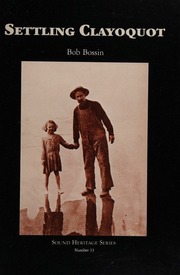
Bob Bossin’s Settling Clayoquot provides a detailed documentary and oral history chronicling late-nineteenth- and early-twentieth-century non-Indigenous settlement along the remote west coast of Vancouver Island. Utilizing settler journals, store ledgers, and archival accounts, the text examines how early mercantile outposts, cannery operations, and homesteads—anchored around locales such as Stubbs Island (Clayoquot) and Tofino Inlet—were superimposed directly onto the ancient maritime territories, seasonal harvesting grounds, and canoe corridors of the Nuu-chah-nulth nations, particularly the Tla-o-qui-aht, Ahousaht, and Hesquiaht. Bossin emphasizes the profound logistical isolation of this exposed Pacific coastline, demonstrating how early storekeepers, sealers, and homesteaders were entirely dependent on interdependent alliances and day-to-day trade with Nuu-chah-nulth communities for open-water canoe transport, subsistence provisions, and navigational expertise. Ultimately, the narrative captures the fragile transition from a collaborative coastal trade nexus to a regulated colonial resource frontier, illustrating how pioneer maritime infrastructure relied upon the established Indigenous marine geography of Clayoquot Sound.
Sound heritage series, no. 33
iv, 76 pages : illustrations ; 27 cm.
Non-circulating [ 1 ]
Place names of the Alberni Valley by Helen Ford, Dorrit MacLeod, Gene Joyce
Place names of the Alberni Valley explores the linguistic footprint and early pioneer settlement etched into the deeply carved, heavily timbered interior of central Vancouver Island. Ford, MacLeod, and Joyce detail how the region's formidable physical barriers—specifically the sheer, towering peaks of the Vancouver Island Ranges and the long, treacherous, fjord-like trench of the Alberni Inlet—strictly dictated the establishment of early resource extraction camps and permanent communities. By mapping the historical origins behind local toponyms and the immense physical labor required to penetrate these dense, old-growth rainforests, the narrative highlights how the absolute necessity of securing deepwater maritime anchorages at the head of the inlet permanently anchored the precise locations of the valley's settlements. The profound geographic isolation from the island's more accessible eastern seaboard initially forced early homesteaders and massive timber syndicates into a complete reliance on the deepwater marine highway for their commercial survival and global export. Ultimately, this toponymic record serves as a deeply localized spatial history, demonstrating how the complex, deeply indented aquatic topography and immense forested valleys of this Pacific Northwest island inherently shaped the resilient, strictly maritime and timber-dependent footprint of the Alberni frontier.
84 pages, [1] folded leaf of plates : map ; 22 cm
Non-circulating [ 1 ]
Barkley Sound a history of the Pacific Rim National Park area by R. Bruce Scott
Barkley Sound a history of the Pacific Rim National Park area examines the deep maritime heritage and rugged coastal settlement situated along the storm-battered western edge of Vancouver Island. Scott details how the region's formidable coastal macro-geography—specifically the labyrinthine, island-choked waters of the sound, the dense, impenetrable temperate rainforests, and the treacherous, reef-strewn outer coast notoriously known as the Graveyard of the Pacific—strictly dictated the margins of indigenous Nuu-chah-nulth maritime culture, early European fur trading, and precarious pioneer outposts. By mapping the evolution of these isolated shores from complex indigenous whaling and fishing hubs into scattered commercial sealing stations, shipwreck lifesaving trails, and eventual protected parklands, the narrative highlights how this specific rugged environment anchored a profound and often fatal reliance on the unrelenting ocean. Ultimately, this regional record serves as a localized spatial history, demonstrating how the immense oceanic exposure, unforgiving navigational hazards, and rich marine ecology of this Pacific Northwest coastline fundamentally shaped the highly resilient, maritime-bound character of Barkley Sound.
278 pages illustrations, facsimile, maps, portraits 23 cm
Non-circulating [ 1 ]
Related Online Resources
Alberni-Clayoquot Regional District
The Alberni-Clayoquot Regional District is situated in the heart of Vancouver Island with one of the most dramatic and majestic landscapes.
WEB LINK
Regional District of Alberni-Clayoquot
- Aa-at-sow-is
- Ahousat
- Alberni
- Anaqtl'a
- Arrowview Heights
- Bamfield
- Beaver Creek
- Boat Basin
- Cameron Heights
- Cha cha tsi tsi us
- Chap-is
- Chenatha
- Chequis
- Cherry Creek
- Chetarpe
- Chumata
- Clayoquot
- Clutus
- Deekyakus
- Dochsupple
- Dookqua
- Ecoole
- Estevan Point
- Franklin Camp
- Great Central
- Green Cove
- Hesquiat
- Hi'tatis
- Hiina'is
- Hitacu
- Hoo-ii
- Hosmatqts'os
- Hot Springs Cove
- Hu'ul
- K'oxsinqii
- Kakawis
- Kiikiixink'ok
- Kiix aa
- Kiix-in
- Kildonan
- Kleecoot
- Kliikliihuwis
- Klit-kle-mah-ah
- Kookswees
- Kwinaquth
- Kwisitis
- Maalth-sit
- Macoah
- Maht'ii'as
- Marktosis
- Nahmint
- Nuchaquis
- Nuumaqimyis
- Opitsat
- Ots'oo-a
- City of Port Alberni
- Port Albion
- Port Desire
- Sachawil
- Sachsa
- Sahara Heights
- Salmon Beach
- Sarita
- Shitlthmaq-is
- Sproat Lake
- Stewardson Inlet
- Tl'aaniiwa'a
- Tl'isnachis
- Tl'itsnit
- Tlakmaqis
- Tloohat-a
- District of Tofino
- Ts'axq'oo-is
- Ts'iispoo-a
- District of Ucluelet
- Uuts
- W'aayi
- Wihat'a
- Yaashitquo-a
- Yarksis
- Yuuhluth
Political Boundaries
Last updated: 2025-09-23