Catalog of British Columbiana and Pacific Northwest Americana
The Encyclopedia Cascadia Catalog indexes mostly non-fiction literature covering the Pacific Northwest coast of North America, with an emphasis on British Columbia, Idaho, Oregon, and Washington State.
| Catalog Title | Published |
|---|---|
|
Dryden's history of Washington by Cecil P. Dryden 
Cecil P. Dryden’s Dryden's History of Washington provides a comprehensive geographic and historical overview of the state's development from early exploration to modern industrialization. The narrative sweeps across the diverse landscapes of the region, tracing maritime discoveries along the jagged coastlines of Puget Sound and mapping the vital fur trade routes established at Fort Vancouver along the lower Columbia River. Dryden also details the arduous overland pioneer migrations and subsequent agricultural booms that transformed the arid plains and fertile valleys of eastern Washington, particularly around Walla Walla and the Inland Empire. By chronicling the transition of these untamed coastal rainforests and eastern high deserts into a unified political entity, the book captures the expansive environmental diversity that shaped this cornerstone of the Pacific Northwest. 412 pages illustrations, map 23 cm Non-circulating [ 1 ]
|
1968 |
|
Dreaming in the rain how Vancouver became Hollywood North by Northwest by David Spaner 
Vancouver is now North America’s third largest center for film and television production, recently witnessing the filming of Halle Berry’s Catwoman and Will Smith’s I, Robot, among others. But Vancouver has been hosting filmmakers for years, coming into its own in the early 1970s when Robert Altman, Warren Beatty and Julie Christie made McCabe and Mrs. Miller and Mike Nichols, Jack Nicholson and Candice Bergen filmed Carnal Knowledge. Dreaming in the Rain tells the story of how Vancouver became North by Northwest, from its early days as a Hollywood studio backlot to its becoming home to a vibrant indigenous scene that is among the most acclaimed, provocative, independent filmmaking communities anywhere. 236 pages : portraits ; 23 cm Desiderata
|
2003 |
|
Dreamers, skeptics, and healers the story of BC's medical school by Wendy Cairns , John Cairns , David Ostrow , Gavin Stuart 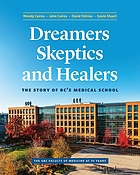
"A legacy of care. Hailed as one of the world's top-ranked medical schools, the UBC Faculty of Medicine is globally recognized as a leader in medical education and health sciences research. In celebration of its 70th anniversary, this richly illustrated history is an inspiring reflection on the Faculty's rise from humble beginnings to its standing today as a beacon of excellence. This beautifully illustrated book documents the history of the UBC Faculty of Medicine, from its creation to the present day. Tracing the trials, tribulations, and triumphs of the many people who strove to first bring the Faculty into existence, and then to ensure its success, it is a testament to their work in transforming aspiration into reality. Unlikely though it may seem today, the UBC Faculty of Medicine's creation was threatened from the moment British Columbia entered Confederation in 1871. Proposals for a provincial medical school encountered myriad challenges. There was no university until 1915, and it took eight decades from the early dream to enrollment of the first medical students. And yet, establishing the medical school was only the first of many milestones reached despite great odds. Today, the Faculty's medical undergraduate program is the fourth largest in North America. Its faculty members have garnered numerous illustrious awards--including the Nobel Prize. Its province-wide, distributed undergraduate and postgraduate program, established in 2004 as the first of its kind in Canada, is developing a new generation of doctors, bringing health education to remote regions and communities, and enhancing the quality of health care. And its researchers continue to make breakthroughs in the priority areas of precision health, cancer, brain and mental health, heart and lung health, population health, and chronic diseases as well as across the breadth of health and life sciences."-- Provided by publisher xvii, 210 pages : illustrations, color and black and white ; 26 cm Desiderata
|
2021 |
|
Dreamers on the trail of the Nez Perce by Martin Stadius 
In 1877 Nez Perce warriors fought U.S. troops to a standstill, during the 1,200-mile epic retreat toward Canada. Martin Stadius tells the story as he follows the Nez Perce National Historic Trail. Stadius' crisp, entertaining writing style makes Dreamers more than a history book. xx, 437 pages : illustrations ; 24 cm Desiderata
|
1999 |
|
Drawing lines in the forest creating wilderness areas in the Pacific Northwest by Kevin R. Marsh 
Drawing boundaries around wilderness areas often serves a double purpose: protection of the land within the boundary and release of the land outside the boundary to resource extraction and other development. In Drawing Lines in the Forest, Kevin R. Marsh discusses the roles played by various groups—the Forest Service, the timber industry, recreationists, and environmentalists—in arriving at these boundaries. He shows that pragmatic, rather than ideological, goals were often paramount, with all sides benefiting. After World War II, representatives of both logging and recreation use sought to draw boundaries that would serve to guarantee access to specific areas of public lands. The logging industry wanted to secure a guaranteed supply of timber, as an era of stewardship of the nation's public forests gave way to an emphasis on rapid extraction of timber resources. This spawned a grassroots preservationist movement that ultimately challenged the managerial power of the Forest Service. The Wilderness Act of 1964 provided an opportunity for groups on all sides to participate openly and effectively in the political process of defining wilderness boundaries. The often contentious debates over the creation of wilderness areas in the Cascade Mountains in Oregon and Washington represent the most significant stages in the national history of wilderness conservation since World War II: Three Sisters, North Cascades and Glacier Peak, Mount Jefferson, Alpine Lakes, French Pete, and the state-wide wilderness acts of 1984. xv, 227 pages, 16 unnumbered pages of plates : illustrations, maps ; 24 cm. Desiderata
|
2007 |
|
Dragonflies and damselflies of Oregon a field guide by Cary Kerst, Steve Gordon 
Growing interest in watching and identifying dragonflies and damselflies has sharpened the need for an authoritative resource like Dragonflies and Damselflies of Oregon, a definitive field guide devoted solely to dragonflies and damselflies found in the state. Cary Kerst and Steve Gordon include information on identification, as well as biology and behavior, using common terms useful to the novice and experienced enthusiast alike. The book features stunning color photographs of male and female of all species currently known in Oregon, along with helpful illustrations and charts with important identification characteristics. Dragonflies and Damselflies of Oregon presents the life cycle and larval habits of dragonflies and damselflies, along with photographs of the larvae of families. The Oregon range for each species is mapped, and the size range of adults is provided in text and illustration. The book also includes a description of the best sites in Oregon to observe these amazing insects, a useful tool for viewing uncommon species in spectacular settings. Dragonflies and Damselflies of Oregon is an essential reference for Odonatists, entomologists, birders, butterfly watchers, fishermen, wetland experts, naturalists, gardeners, artists, photographers, and all outdoor enthusiasts. xi, 304 pages : color illustrations, maps ; 22 cm. Desiderata
|
2011 |
|
Draft environmental impact statement for Madrona Point, Eastsound, Washington July 1982 by San Juan County (Wash)., Northwest Building Corporation 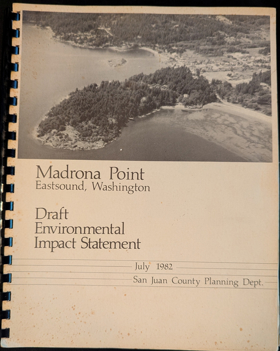
Platting of a 29.67 acre subdivision on Madrona Point, adjacent to the unincorporated town of Eastsound, into eleven single family lots (approx. 9 acres) five tracts for multi-family housing (approx. 3-1/2 acres) to contain 30 dwelling units in four- and five-unit buildings, and two larger tracts for future development subject to binding site plan approval (approx. 10-3/4 acres), intended for 61 multi-family dwellings in two- and four-unit buildings. In addition, four community recreation tracts will be established. On one of the community tracts a small caretaker's residence would be constructed, bringing the total of proposed residential units to 103. 241 pages : illustrations, maps ; 28 cm Non-circulating [ 1 ]
|
1982 |
|
Dr. John McLoughlin: the Father of Oregon by Frederick V. Holman 
McLoughlin came from Riviere du Loup in Quebec and worked his way up through the Hudson's Bay Company until he alone was responsible for that great chunk of continent known as the Pacific Northwest, and the help and support he offered the American emigrants to the Oregon Country in the critical years 1843-1846 301 pages, 2 unnumbered leaves of plates + [2] page publisher's advertisements : frontispiece (portrait), portrait ; 25 cm ONLINE Circulation [ 1 ]
|
1907 |
|
Dr. John McLoughlin's last letter to the Hudson's Bay Company, as chief factor, in charge at Fort Vancouver, 1845 by Katharine Berry Judson, John McLoughlin
Katharine Berry Judson’s presentation of Dr. John McLoughlin's last letter to the Hudson's Bay Company, as chief factor, in charge at Fort Vancouver, 1845 provides a critical primary source documenting the geopolitical tipping point of the Pacific Northwest. Written from the administrative hub of Fort Vancouver—a massive fur-trade headquarters strategically mapped onto the ancient Columbia River trade corridors of the Chinookan peoples—McLoughlin’s correspondence details the inevitable collapse of the British fur monopoly in the face of mass American migration. The letter fiercely defends his controversial decision to extend vital credit, seeds, and supplies to waves of starving overland immigrants, emphasizing how these desperate homesteaders relied on unexpected interdependent alliances with the Hudson's Bay Company to survive the final, brutal stretch of the Oregon Trail. Ultimately, this foundational document captures the tense transition from a corporate resource-extraction frontier to an agricultural territory, highlighting how McLoughlin’s pragmatic humanitarianism and local community bonds inadvertently laid the civic infrastructure for American dominion over the region. pages 104-134 Desiderata
|
1915 |
|
Dr. John McLoughlin master of Fort Vancouver, father of Oregon by Nancy Wilson, Bert Webber 
Curator Nancy Wilson of the McLoughlin House National Historic Site in Oregon City, has labored for years to bring together the details of the life of Dr. John McLoughlin. She has written about this Hudson's Bay Company Chief Factor, who also founded Oregon City, in a gracious yet telling way. This book covers, and a singular popular volume, everything that could be discovered about Mr. McLoughlin from his earliest years until the day he died. McLoughlin got into trouble with this British employers because he was a compassionate man who did his best to help sick, hungry and broke American pioneers freshly arrived over the Oregon Trail. But he insisted that Americans settled south of the Columbia River as he believed when the International boundary was settled the Columbia River would be the dividing line. To protect the interests of the Hudson's Bay Company, McLoughlin put up the first building at Wilmette Falls (Oregon City) then platted the city. On his retirement he moved permanently to Oregon City and became an American citizen. Here is the story recorded with library reference quality but is narrated in a easy-to-read language. The Editor, Bert Weber, Master Librarian (retired) and research photojournalist, is author of many books about Oregon. --- from book's back cover 205 pages : illustrations, maps ; 22 cm Non-circulating [ 1 ]
|
1994 |
|
Down the Columbia by Lewis R. Freeman 
The day on which I first conceived the idea of a boat trip down the Columbia hangs in a frame all its own in the corridors of my memory. It was a number of years ago—more than a dozen, I should say. Just previously I had contrived somehow to induce the Superintendent of the Yellowstone National Park to grant me permission to attempt a winter journey on ski around this most beautiful of America’s great playgrounds. He had even sent a Government scout along to keep, or help, me out of trouble. We were a week out from the post at Mammoth Hot Springs. xx pages, 4 leaves, 383 pages frontispiece, plates, portraits, map 23 cm ONLINE Circulation [ 1 ]
|
1921 |
|
Douglas Lake Ranch empire of grass by Donna Yoshitake Wuest , Joe W. Gardner 
"Explore the rich history of Canada's largest ranch. Douglas Lake is the largest ranch in Canada, encompassing over one million acres of BC's south-central interior, and thousands of people have worked there since it was founded in the mid 1880s. Douglas Lake now includes BC's first cattle ranch, Alkali Lake Ranch, as well as Circle S Ranch, Quilchena Ranch, Riske Creek Ranching and the infamous Gang Ranch. It has had a succession of wealthy owners including Charles "Chunky" Woodward of Woodward's Stores and current owner, US real estate and sports mogul Stan Kroenke. It has recreational facilities and is known for hosting celebrity guests like Prince Philip, billionaire media mogul Malcolm Forbes and others but, as this book shows, it is a serious working cattle ranch. Having grown up on a BC ranch, author Donna Yoshitake Wuest brings an insider's understanding to the subject. Working closely with the ranch's long-time manager, Joe Gardner, she provides a detailed history from its founding by John Douglas 140 years ago, through innovations in quarter horse breeding and deer farming to helicopter cowboying. Together, Wuest and Gardner provide a fascinating account of the day-to-day operations of a large modern ranch as it faces the challenges of running an integrated cattle, forestry and recreational business. The book is rich with stories about the ranch's wealthy owners, celebrity guests and hard-working cowhands."-- Provided by publisher 192 pages : illustrations (chiefly colour), colour maps ; 27 cm Desiderata
|
2023 |
|
Don't never tell nobody nothin' no how the real story of West Coast rum running by Rick James 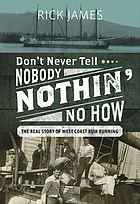
'"We operated perfectly legally. We considered ourselves philanthropists! We supplied good liquor to poor thirsty Americans ... and brought prosperity back to the Harbour of Vancouver ..." Captain Charles Hudson At the stroke of one minute past midnight, January 17, 1920, the National Prohibition Act was officially declared in effect in the United States. From 1920 to 1933 the manufacture, sale, importation and transportation of alcohol and, of course, the imbibing of such products, was illegal. Prohibition was already a bust in Canada and it wasn't long before fleets of vessels, from weather-beaten old fish boats to large ocean-going steamers, began filling their holds with liquor to deliver their much-valued cargo to their thirsty neighbours to the south. Contrary to popular perception, rum-running along the Pacific coast wasn't dominated by violent encounters like those portrayed in the movies. Instead, it was usually carried out in a relatively civilized manner, with an oh-so-Canadian politeness on the British Columbian side. Most operated within the law. But there were indeed shootouts, hijackings and even a particularly gruesome murder associated with the business. Using first-hand accounts of old-time rum-runners, extensive research using primary and secondary documentation, and the often-sensational newspaper coverage of the day, Don't Never Tell Nobody Nothin' No How sets out to explain what really went down along the West Coast during the American "Noble Experiment."'-- Provided by publisher 312 pages : illustrations, maps ; 24 cm Desiderata
|
2018 |
|
Dominion the railway and the rise of Canada by Stephen R. Bown 
"Stephen R. Bown continues to revitalize Canadian history with this thrilling account of the engineering triumph that created a nation. In The Company, his bestselling work of revisionist history, Stephen Bown told the dramatic, adventurous and bloody tale of Canada's origins in the fur trade. With Dominion he continues the nation's creation story with an equally thrilling and eye-opening account of the building of the Canadian Pacific Railway. In the late 19th century, demand for fur was in sharp decline. This could have spelled economic disaster for the venerable Hudson's Bay Company. But an idea emerged in political and business circles in Ottawa and Montreal to connect the disparate British colonies into a single entity that would stretch from the Atlantic to the Pacific. With over 3,000 kilometers of track, much of it driven through wildly inhospitable terrain, the CPR would be the longest railroad in the world and the most difficult to build. Its construction was the defining event of its era and a catalyst for powerful global forces. The times were marked by greed, hubris, blatant empire building, oppression, corruption and theft. They were good for some, hard for most, disastrous for others. The CPR enabled a new country, but it came at a terrible price. In recent years Canadian history has been given a rude awakening from the comforts of its myths. In Dominion, Stephen Bown again widens our view of the past to include the adventures and hardships of explorers and surveyors, the resistance of Indigenous peoples, and the terrific and horrific work of many thousands of labourers. His vivid portrayal of the powerful forces that were molding the world in the late 19th century provides a revelatory new picture of modern Canada's creation as an independent state."-- Provided by publisher 400 pages, 8 unnumbered pages of plates : illustrations, maps ; 25 cm Desiderata
|
2023 |
|
Distant neighbors a comparative history of Seattle & Vancouver by Norbert MacDonald 
Distant Neighbors: A Comparative History of Seattle & Vancouver by Norbert MacDonald is a 1987 urban history that explores the parallel yet distinct development of two major Pacific Northwest cities from the 1880s through the mid-20th century. The book analyzes how differing national contexts, political structures, and economic policies shaped the unique civic characters, immigration patterns, and physical landscapes of each municipality despite their close geographic proximity and shared regional environment. Ultimately, it provides a foundational comparative framework for understanding the fascinating divergence between American and Canadian urban evolution on the Pacific coast. xxii, 259 pages, 30 unnumbered pages of plates : illustrations ; 25 cm Non-circulating [ 1 ]
|
1987 |
|
Distant Dominion Britain and the Northwest Coast of North America, 1579-1809 by Barry M. Gough 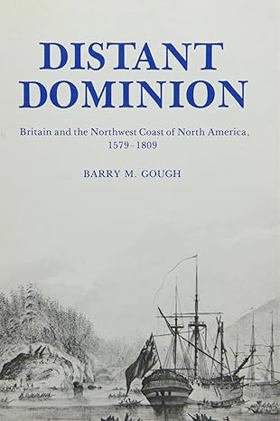
"The voyages of Cook and Vancouver heralded a vast influx of irrepressible white men.... They brought with them their morals, ideologies, knowledge, technology, plants and animals. They also brought diseases, rum and guns....powers to build and powers to destroy." Until the 1700's, the Northwest Coast of North America stood largely apart from the civilized world. Formidable mountain barriers and remoteness from Atlantic sea lanes kept the territory outside the orbit of emerging European empires. In the late 18th and early 19th centuries, however, Britain, Spain, France, Russsia, and the United States vied for control of this promising new frontier. Three of history's greatest mariners -- Sir Francis Drake, Captain James Cook, and Captain George Vancouver -- spearheaded British expeditions of discovery and trade to the Northwest coast. Despite competition from her European and American rivals, Britains ability to use and control the sea enabled her to establish by the late 1700's a "beachhead of empire" in the area now known as British Columbia.Gough shows how, by outmanoevring her Spanish rivals in a "skilful game of diplomatic chess," Britain concluded the Nootka Agreement. Thus she was able to exploit her trading partnership with the coast Indians and cement a lucrative sea-borne commerce with the Far East. The arrival overland of the Nor'westers and other fur-trading groups further strengthened Britain's financial and political interests in the area -- ending forever the isolation of Northwest America, and 'changing beyond measure the culture of its Indian peoples.' Distant Dominion is the first comprehensive survey to examine Britain's motives for expeditions to this most distant frontier of British maritime development. It is also the first to draw the history of the coast into the general realm of Pacific history, relating its development to events in Europe, the American eastern seaboard, Australia, the Falkland Islands, and China. This entertaining book offers fresh insight into an exciting chapter of North American history. 215 pages Non-circulating [ 1 ]
|
2014 |
|
Distant corner Seattle architects and the legacy of H.H. Richardson by Jeffrey Karl Ochsner, Dennis Alan Andersen 
On the afternoon of 6 June 1889, a fire in a cabinet shop in downtown Seattle spread to destroy more than thirty downtown blocks covering 116 acres. Disaster soon became opportunity as Seattle’s citizens turned their full energies to rebuilding: widening and regrading streets, laying new water pipes and sewer lines, promulgating a new building ordinance requiring construction in the commercial core, and creating a new professional fire department. A remarkable number of buildings, most located in Seattle’s present-day Pioneer Square Historic District, were permitted within a few months and constructed within a few years of the Great Seattle Fire. As a result, the post-fire rebuilding of Seattle offers an extraordinarily focused case study of late-nineteenth-century American urban architecture. Seattle’s architects, seeking design solutions that would meet the new requirements, most often found them in the Romanesque Revival mode of the country’s most famous architect, Henry Hobson Richardson. In October 1889, Elmer Fisher, Seattle's most prolific post-fire architect, specifically cited the example of H. H. Richardson in describing the city's new buildings. In contrast to Victorian Gothic, Second Empire, and other mid-nineteenth-century architectural styles, Richardson’s Romanesque Revival vocabulary of relatively unadorned stone and brick with round-arched openings conveyed strength and stability without elaborate decorative treatment. For Seattle’s fire-conscious architects it offered a clear architectural system that could be applied to a variety of building types - including office blocks, warehouses, and hotels - and ensure a safer, progressive, and more visually coherent metropolitan center. Distant Corner examines the brief but powerful influence of H. H. Richardson on the building of America’s cities, and his specific influence on the architects charged with rebuilding the post-fire city of Seattle. Chapters on the pre-fire city and its architecture, the technologies and tools available to designers and builders, and the rise of Richardson and his role in defining a new American architecture provide a context for examining the work of the city’s architects. Seattle's leading pre- and post-fire architects - William Boone, Elmer Fisher, John Parkinson, Charles Saunders and Edwin Houghton, Willis Ritchie, Emil DeNeuf, Warren Skillings, and Arthur Chamberlin - are profiled. Distant Corner describes the new post-fire commercial core and the emerging network of schools, firehouses, and other public institutions that helped define Seattle’s neighborhoods. It closes with the sudden collapse of Seattle’s economy in the Panic of 1893 and the ensuing depression that halted the city’s building boom, saw the closing of a number of architects’ offices, and forever ended the dominance of Romanesque Revival in American architecture. With more than 200 illustrations, detailed endnotes, and an appendix listing the major works of the city's leading architects, Distant Corner offers an analysis of both local and national influences that shaped the architecture of the city in the 1880s and 1890s. It has much to offer those interested in Seattle’s early history, the building of the city, and the preservation of its architecture. Because this period of American architecture has received only limited study, it is also of importance for those interested in the influence of Boston-based H. H. Richardson and his contemporaries on American architecture at the end of the nineteenth century. xii, 409 pages : illustrations ; 29 cm Desiderata
|
2003 |
|
Dispatches and dictators Ralph Barnes for the Herald Tribune by Barbara S. Mahoney 
Dispatches and Dictators uncovers the fascinating story of Oregon native Ralph Barnes, the New York Herald Tribune's European correspondent, who served in Paris, Rome, Moscow, Berlin, and London in the years between the two world wars. Barnes has been praised by colleagues and competitors alike as one of the best reporters of that pivotal era. But since his death in the 1940 crash of a British bomber in Yugoslavia, he has been largely forgotten. With persistence and unusually keen insight, Ralph Barnes reported on Fascism, Communism, Nazism, and the events leading to World War II. Stalin confined Barnes to Moscow for disclosing that millions were dying during the Soviet collectivization of agriculture, and Hitler expelled Barnes from Germany for predicting the Nazi attack on the Soviet Union. Recently, scholars have rediscovered Barnes, recognizing the perceptiveness of his observations about the nature of the Soviet regime, the centrality of anti-Semitism to the Nazis, and the descent into war. Drawing from Barnes's dispatches, his personal correspondence, and the recollections of his colleagues, Dispatches and Dictators offers a valuable perspective on the interwar period and on the challenges facing journalists covering the events of the time. Barnes's story also offers an intimate glimpse into one family's experience with the risks, hardships, and separations that belie the romantic popular image of the foreign correspondent. vi, 310 pages : illustrations ; 24 cm Desiderata
|
2002 |
|
Discovering nothing in pursuit of an elusive Northwest Passage by David L. Nicandri 
"The many attempts by navigators to find a Northwest Passage via its Pacific portal all ended in failure; however, their discoveries spurred expansionist developments that would forever alter the landscape of North America. In Discovering Nothing, David L. Nicandri maps a cast of geographic visionaries and practical explorers as they promoted or sought a workable commercial route linking the Pacific Ocean to the Atlantic. The discovery of the legendary northern passage proved elusive, but the equivalent land bridges that were built in the form of two transcontinental railroads changed the futures of Canada and the United States. Drawing from close readings of explorers’ personal journals, Nicandri provides readers a detailed, engaging, and multifaceted investigation into the many players and failed enterprises at the core of this search, beginning in the eighteenth century through to today--and to the unexpected impact of climate change on this fabled passage."-- Provided by publisher 328 pages Desiderata
|
2024 |
|
Discovering Main Street travel adventures in small towns of the Northwest by Foster Church 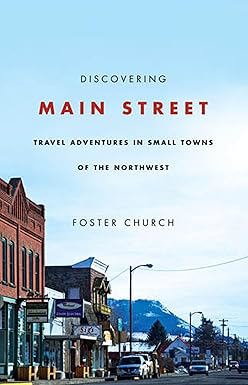
Small towns punctuate the landscape of Oregon and Washington. They burrow in crinkles of hills, sit alongside mighty rivers, survive in desert canyons and sagebrush plains, dot the fertile Willamette Valley, and perch at the edge of the Pacific Ocean. In Discovering Main Street, Foster Church reveals the unexpected and unique pleasures of exploring small towns, what he calls “the last frontier of American tourism.” Organized by region—Willamette Valley, Oregon Coast, Southern Oregon, Eastern Oregon, and Southern Washington—the profiles in Discovering Main Street begin with route tips and end with comments on where to stay and eat. Church’s engaging narratives provide history, highlights, and insights into each of the nearly fifty profiled communities. A useful introduction summarizes Church’s recommendations for a small town visit, which include hanging out at the local cafe, attending a school sports event, and hiking the surroundings—because without exception, small towns in the Northwest are set in hauntingly beautiful environments, from stark deserts to deep, mossy forests. Discovering Main Street provides an alternative to the outdoor adventure guides that dominate bookshelves in the Northwest. It will appeal to armchair travelers, to Northwest enthusiasts, and to any curious explorers seeking adventure in hidden—and unexpected—places. 192 pages : maps ; 22 cm Desiderata
|
2010 |
|
Discover Nanaimo an illustrated history by Charles Lillard, Lynn Welburn, Greater Nanaimo Chamber of Commerce 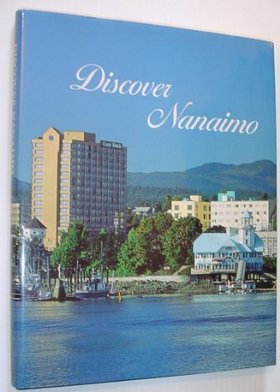
Published in 1992 by the Greater Nanaimo Chamber of Commerce, Discover Nanaimo: An Illustrated History by Charles Lillard and Lynn Welburn provides a richly documented examination of the city's past. The authors skillfully weave together archival photography and narrative text to trace Nanaimo's transformation from a resource-extraction hub into a vibrant coastal community. By balancing civic milestones with everyday social history, the volume offers scholars and regional enthusiasts an engaging window into the Pacific Northwest's economic and cultural development. 149 p. : ill. (some col.), ports. ; 29 cm. Desiderata
|
1992 |
|
Dining car to the Pacific the "famously good" food of the Northern Pacific Railway by William A. McKenzie 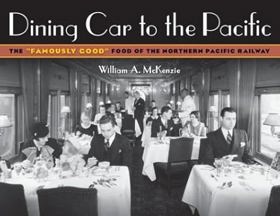
"William A. McKenzie offers an illustrated and detailed account of hospitality on the Northern Pacific - a service that many considered the best in the industry - drawing on sources ranging from railroad records of the 1860s to anecdotal accounts from the people who were there. In addition, McKenzie includes more than 150 authentic recipes used on the line, such as the Great Big Baked Potato, Washington Apple Pan Cake, and Northern Pacific Fruit Cake. Dining Car to the Pacific will be a treasured addition to the libraries of historians, cooks, and any one with nostalgia for the dinning car experience."--Jacket xi, 164 pages : illustrations ; 22 x 28 cm. Desiderata
|
2004 |
|
Digressions of a native son by Emmett Watson 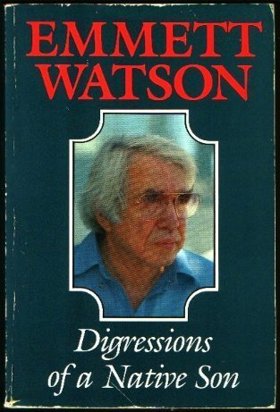
Digressions of a Native Son is a 1982 memoir by Emmett Watson (1918-2001), a Seattle journalist whose columns appeared in Seattle newspapers for more than 50 years. 251 pages ; 21 cm Desiderata
|
1982 |
|
Digging Duvall's past by Allen Miller, Duvall Historical Society (Wash) 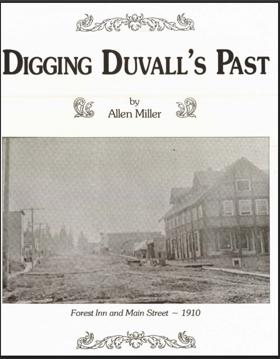
52 pages of great newspaper articles written by Allen Miller, many vintage black and white photos covering logging, new buildings in town, schools and more. iv, 52 pages : illustrations, portraits ; 28 cm Desiderata
|
1995 |
|
|
1983 |