Catalog of British Columbiana and Pacific Northwest Americana
Encyclopedia Cascadia Catalog contains book titles of mostly non-fiction Pacific Northwest Coast of North America Titles (primarially British Columbia, Idaho, Oregon and Washington State) in an easy-to-understand title catalog. If you see a link with this badge ONLINE CIRC it means that there is an online institution that provides free access to that title. In some cases there may be more than one institution hosting the title digitally.
| Catalog Title | Published |
|---|---|
|
A tidal odyssey Ed Ricketts and the making of Between Pacific tides by Richard Astro , Donald G. Kohrs 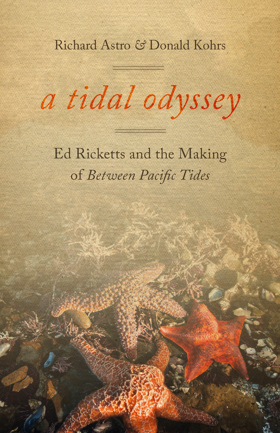
"Between Pacific Tides by Edward F. Ricketts and Jack Calvin is arguably the most important book about marine ecology on the Pacific coast of North America. At a time when almost all studies of life in the intertidal zones were taxonomic, Ricketts and Calvin revolutionized the field and helped to lay the groundwork for studies of the impact of environmental change on the natural world. Though Ricketts is perhaps best known as a quirky character in John Steinbeck's fiction, he was a serious marine biologist who conducted pioneering research. In A Tidal Odyssey, literary scholar Richard Astro and archivist Donald Kohrs explore how Between Pacific Tides came to be, covering both the writing process and the long journey to publication. They tell three interwoven stories: the development of ecology as a valuable new approach to the study of marine life in the intertidal zone; a case study of how new and dynamic science is published and reaches a larger audience; and the intellectual development of Ed Ricketts. Not only a scientist but also an expert in music, philosophy, history, and literature, Ricketts and his work impacted a broad range of writers and scholars. A number of these intellectual figures appear in A Tidal Odyssey, including Ricketts's co-author, Jack Calvin, and illustrator, Ritch Lovejoy; mythologist Joseph Campbell; novelist Henry Miller; composer John Cage; and of course John Steinbeck. The authors have drawn extensively from Ricketts's archive, including previously unpublished letters, memoranda, notebooks, and photographs. A Tidal Odyssey is for anyone interested in the world of Ed Ricketts as well as marine biology, intertidal ecology, and how ecological studies underpin our understanding of the impact of environmental change on the well-being of our planet"-- Provided by publisher xv, 232 pages : illustrations ; 23 cm CIRC [ 0 ]
|
2021 |
|
A Sto:lo Coast Salish historical atlas by Keith Carlson, Albert Jules McHalsie, Stó:lō Heritage Trust 
This volume presents an in-depth natural, cultural, and spiritual history of the Fraser River region and its aboriginal and post-contact inhabitants over 15,000 years, in graphs, charts, lexicographies, historic maps, archival photographs, and original artwork. It covers such diverse subjects as: origins of the people and landscape, relationship between the Coast Salish spiritual beliefs and contemporary land management, pre-contact fortifications and warfare, expression and history of Sto:lo and Coast Salish identity, population movement in the historic era, architectural history, Sto:lo systems of justice, spatial analysis of hop yards, salmon canneries and residential schools, reinterpretation of Sto:lo historical demographics xvi, 208 p. : ill. (some col.), maps (some col.) 38 cm. CIRC [ 1 ]
|
2001 |
|
A sound defense military sites, lighthouses, and memorials of Puget Sound by Nancy L. McDaniel 
"A Sound Defense" is a comprehensive description of military sites of Puget Sound. Military historical sites in the twelve counties (Whatcom, Skagit, Snohomish, San Juan, Island, King, Pierce, Thurston, Mason, Kitsap, Clallam and Jefferson) are described with an emphasis on the unique things which happened there. Over 150 pictures and maps are included. Nancy McDaniel, Colonel, USAF, MSC (Retired) is a Washington State native and brings a love of the area and combines that with a perspective on the contributions that the military has had on Western Washington. "A Sound Defense" describes blockhouses built during the Indian conflicts. It addresses "The Pig War" and the politics of the international relationships which helped establish the boundaries of the United States. Forts built to protect Puget Sound as a result of the decisions of the Endicott Board are described along with the personalities of the commanders and personnel who were assigned there. Long forgotten installations established to provide early warning of approaching enemy aircraft are prominent in this comprehensive book. Lighthouses throughout the area are highlighted with the inclusion of historical photos and stories of early lightkeepers. Most importantly, "A Sound Defense" recognizes the contributions of military personnel throughout the years by the inclusion of memorials and facilities dedicated to recognizing their service to the country. xvi, 365 pages : illustrations, maps ; 23 cm CIRC [ 1 ]
|
2013 |
|
A song of Yamhill and Oregon's northwestern Willamette Valley by Gordon N. Zimmerman 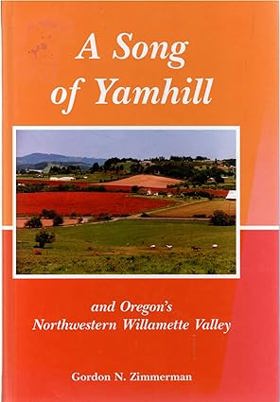
Published by Gordon N. Zimmerman, A Song of Yamhill and Oregon's Northwestern Willamette Valley weaves local history, personal reminiscences, and genealogical lore to celebrate the enduring rural heritage of the upper Willamette Valley. The book details the arrival of early Euro-American pioneers who navigated the Oregon Trail to settle the fertile, rolling hills of Yamhill County, establishing agrarian communities amidst rich timberlands and river valleys. Through vivid narrative vignettes, the text captures the seasonal rhythms of farming, local institution-building, and the close-knit social fabric of a foundational Oregon agricultural hub. A keen insight drawn from the text is how regional local histories act as counter-narratives to rapid urban sprawl; by meticulously preserving the human-scale stories of families tied to the land, the work anchors modern landscape identity in deep-rooted community stewardship rather than commercial development. xviii, 207 pages : illustrations, portraits ; 23 cm CIRC [ 1 ]
|
2005 |
|
A Small world of our own authentic pioneer stories of the Pacific Northwest from the Old Settlers contest of 1892 by Robert Allen Bennett 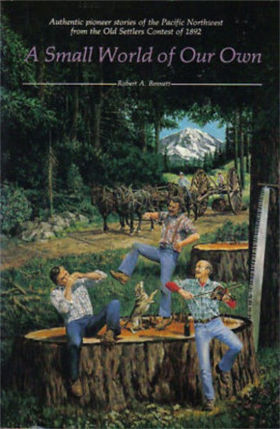
A Small World of Our Own: Authentic Pioneer Stories of the Pacific Northwest from the Old Settlers Contest of 1892 compiled by Robert Allen Bennett is a 1985 historical anthology, published by Pioneer Press Books in Walla Walla, Washington, that preserves the firsthand experiences of the region's early emigrants. The volume resurrects a unique collection of autobiographical essays originally submitted to an 1892 newspaper contest, capturing the unvarnished realities of mid-19th-century frontier life straight from the memories of the aging pioneers. Through these deeply personal and often harrowing narratives, the book details the grueling hardships of the overland wagon trails, the arduous task of carving out homesteads in the wilderness, early pioneer-Indigenous relations, and the sheer physical endurance required to settle the Washington, Oregon, and Idaho territories. Ultimately, it serves as an invaluable, primary-source-driven resource for regional historians and genealogists seeking the authentic, grassroots voices and foundational settlement lore that shaped the Pacific Northwest. xi, 373 pages ; 23 cm CIRC [ 1 ]
|
1985 |
|
A shadow in the forest Idaho's black bear by John Beecham, Jeff Rohlman, Idaho Department of Fish and Game 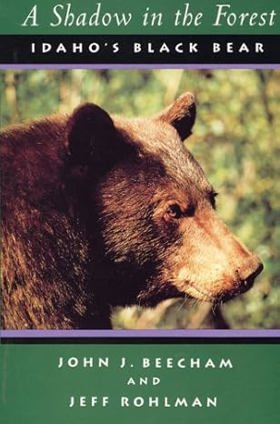
Did you know that Idaho's black bear are more active during the day than at night, that the bears diet is less than 2 percent meat and that the number of cubs born in the spring is related to the size of the fall berry crop? These are just a few of the facts the authors present about the black bear, a shy adaptable species whose secretive habits and preference for forested habitats has made it a difficult animal to observe. The authors have been collecting biological data since 1972 in order to develop a comprehensive management program for the state's black bear population, and this volume summarizes much of their research. As the black bear's range shrinks with man's encroachment into isolated areas, studies such as this one offer scientists and naturalists the necessary data to make informed decisions about successfully managing this unique and irreplaceable species of American wildlife. This volume will provide naturalists and general readers with information on and a greater understanding of the rare and elusive Idaho black bear xviii, 245 pages, [8] folded pages of plates : illustrations (some color), maps ; 13 cm. CIRC [ 0 ]
|
1994 |
|
A selection of publications on the Indians of British Columbia by Alan L. Hoover, British Columbia Provincial Museum 
Selection of monographs, films, children's books and bibliographies focusing the Indians of British Columbia. Includes abstracts 50 pages ; 28 cm CIRC [ 1 ]
|
1982 |
|
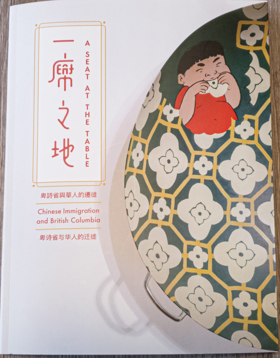
A seat at the table Chinese immigration and British Columbia by curators & editors : Denise Fong, Viviane Gosselin, Henry Yu = 一席之地 : 卑诗省与华人的迁徙 / 策展与编辑方静怡, Viviane Gosselin, 余全毅., 方静怡 , Viviane Gosselin , 余全毅 , Museum of Vancouver (Host institution, Issuing body), University of British Columbia (Issuing body) / Viviane Gosselin, Henry Yu = Yi xi zhi di : Beishi
|
2021 |
|
A season on Vancouver Island by Bill Arnott (Author, Photographer) 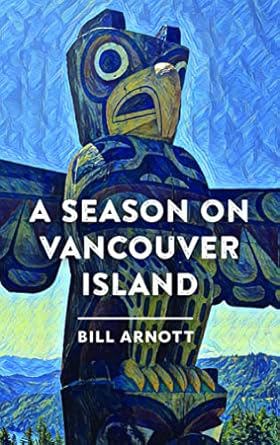
"Join intrepid travel writer Bill Arnott as he escapes the confines of life in Vancouver for an epic and quirky road trip around Vancouver Island and to some of the surrounding smaller islands. Hitting all of the high points and chatting with locals along the way, Bill discovers why Vancouver Island has become one of western North America's top tourist destinations. From great food to wonderful wine, stunning natural habitats and memorable encounters with wildlife, Bill paints a charming picture of life on Canada's West Coast."-- Front cover flap 197 pages : color illustrations, color map ; 18 cm CIRC [ 0 ]
|
2022 |
|
A school for the people a photographic history of Oregon State University by Lawrence A. Landis 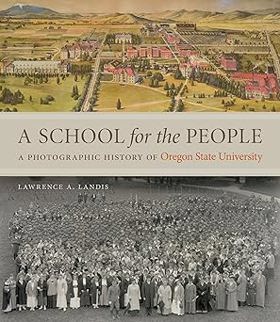
A School for the People tells the story of OSU’s nearly 150 years as a land grant institution through more than 500 photographs, maps, documents, and extensive captions. In-depth chapters focus on themes such as campus development, the growth of academics, the evolution of research as a major focus of the university, campus life and organizations, and, of course, athletics. A capsule history includes many of the iconic photographs associated with the university. As one of the first colleges and universities to offer photography as part of its curriculum in the early 1890s, OSU is well documented visually. Most of those photographic treasures have made their way into the holdings of the Special Collections & Archives Research Center at OSU’s Valley Library. Gleaned from hundreds of thousands of images at the Center, many of the photos included here have never before been seen by the general public. Written by a longtime archivist at OSU’s Special Collections & Archives Research Center, A School for the People tells the full, dynamic story of this multi-faceted and living university, documenting the inevitable ups and downs of the institution. Overflowing with visual riches, it will appeal to OSU alumni, faculty and staff, and anyone with an interest in the history of higher education in Oregon or land grant institutions generally. xi, 337 pages : illustrations (some color), portraits, facsimiles ; 30 cm CIRC [ 0 ]
|
2015 |
|
A San Juan Islands journal by Jo Ann Ridley, Mary Randlett, Jo Ann Morse 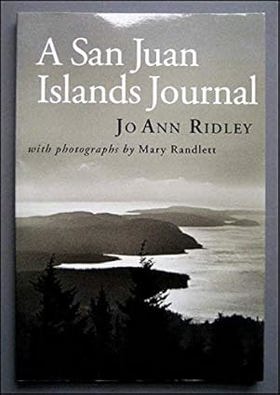
A collection of essays on the San Juan Islands by writer and former writer of San Juan Island articles for the Washington State Ferries publication Enetai. viii, 85 pages : illustrations, map ; 24 cm CIRC [ 0 ]
|
2004 |
|
A role for private citizens in historic preservation by Ann Swanson, Idaho State Historical Society
A Role for Private Citizens in Historic Preservation by Ann Swanson is a 1985 civic guide and technical publication issued by the Idaho State Historical Society that outlines the critical importance of grassroots involvement in heritage conservation. The work provides a practical framework for local individuals, community organizations, and volunteers to actively identify, protect, and advocate for historic sites and architecture within their communities. By demystifying preservation policies and emphasizing collaborative efforts between private citizens and state agencies, Swanson empowers residents to take ownership of their local history rather than relying solely on government intervention. Ultimately, it serves as an invaluable, instructional resource that highlights the indispensable role of local advocacy and community stewardship in safeguarding the unique architectural and cultural legacy of Idaho and the broader Pacific Northwest. 13 pages ; 22 cm CIRC [ 1 ]
|
1985 |
|
A river without banks place and belonging in the Inland Northwest by William C. Johnson 
A River Without Banks chronicles one family’s journey to Idaho, with all of its uncertainties, promises, and hopes. The book explores their encounters with a place still partly wild, whose communities and landscapes teach them how to respect the earth and each other. William Johnson’s essays move from a family vacation spent observing moose, to a comparison of the creation myths from Genesis and the Nez Perce, to watching a raptor seeking prey. Johnson meditates on how places, animals, and people teach us “how to see, and how we do, and don’t, belong.” In prose that reveals a poet’s eye, Johnson examines how family relationships affect how we see the natural world. He explores the power of words to divide and to heal. He illuminates the challenges of sustaining a vital relationship with a home place. A River Without Banks will appeal to readers interested in the literature of place, ecology, natural history, indigenous culture, and conservation. 160 pages ; 22 cm CIRC [ 0 ]
|
2010 |
|
A river lost the life and death of the Columbia by Blaine Harden 
This is a book about how well-intentioned Americans dammed up the Columbia, "Great River of the West," fulfilling dreams of cheap electricity and gardens flourishing in the desert. It is also a narrative of exploitation: of Native Americans, of endangered salmon, of nuclear waste, and of a river - once wild - tamed to puddled remains. Harden's story is a journey of rediscovery. His home town, Moses Lake, Washington, once bone dry, could not have existed without gargantuan irrigation schemes. His father, a Depression migrant trained as a welder, helped build dams - including Grand Coulee - and later worked at the secret Hanford plutonium plant. Now he and his neighbors, who had thought of themselves as patriots, stood accused of killing the river. As Blaine Harden traveled the thousand miles of the Columbia - by barge, by car, and sometimes on foot - his own past seemed both foreign and familiar. He met rugged individualists (albeit with government subsidies), fervent environmentalists, and Native Americans reduced to consuming canned salmon. He also encountered a newly ascendant political force whose more subtle agenda was to preserve and conserve for its own pleasure and recreation 286 pages : maps ; 21 cm CIRC [ 1 ]
|
2012 |
|
A river captured the Columbia River Treaty and catastrophic change by Eileen Delehanty Pearkes 
A River Captured explores the controversial history of the Columbia River Treaty and its impact on the ecosystems, Indigenous peoples, contemporary culture, cross-border politics and recent history of the Pacific Northwest. The Columbia River Basin is a vast region in North America, primarily located in the Pacific Northwest of the United States and parts of Canada. It covers portions of seven U.S. states: Washington, Oregon, Idaho, Montana, Wyoming, Nevada, and Utah, as well as the Canadian province of British Columbia. The basin is defined by the watershed of the Columbia River and its tributaries, making it one of the largest river basins in North America. Long lauded as a model of international co-operation, the Columbia River Treaty governs the storage and management of the waters of the upper Columbia River basin, a region rich in water resources and with a natural geography well suited to hydroelectric megaprojects. The Treaty also displaced more than 2,000 residents of over a dozen communities, flooded and destroyed archaeological sites, and upended once-healthy fisheries. Paying special attention to First Nations history, ecology, economics, politics, and Canada–US relations, this investigative work weaves from the present day to the past and back again in an engaging and unflinching examination of how and why Canada decided to sell water storage rights to American interests. With one of the Treaty’s provisions set to change in 2024 and termination of the treaty requiring a 10-year notice period, this updated edition of A River Captured looks at the destructive mistakes of our collective past in order to save us from an even more difficult future 341 pages : illustrations, maps ; 20 cm CIRC [ 0 ]
|
2024 |
|
A richer harvest an anthology of work in the Pacific Northwest by Craig Wollner, W. Tracy Dillon 
The voices of workers, from logging camps to the Microsoft campus. This fascinating collection of writings taps a rich vein of Northwest literature. From pioneer journals to union tracts and cyberpunk fiction, the selections gathered here reveal the lives of the Northwest's working people and insights into the nature of work in the region. With its strong and varied mix of fiction, poems, manifestos, songs, memoirs, and oral histories, A Richer Harvest creates a powerful, sometimes gritty portrait of work life. Selections depict the natural beauty of the land, the rough and perilous employments, the often bloody tradition of labor radicalism, and the reverence for honest, hard work. The writings detail workers' triumphs and frustrations on farms, in forests, on waterways, and in offices, stores, and factories. Many are the observations of laborers themselves; others are the product of writers who gave voice to the concerns of the working class. The selections are arranged according to three broad themes that trace the evolution of the Northwest's laboring classes. Headnotes introduce each selection, providing historical and literary context. Contributors include Sherman Alexie, Kim Barnes, Ernest Callenbach, Douglas Coupland, H. L. Davis, Tess Gallagher, Woody Guthrie, Hazel Hall, Joe Hill, Ken Kesey, Ursula K. Le Guin, Craig Lesley, Clyde Rice, and Gary Snyder. xi, 276 pages : illustrations ; 23 cm. CIRC [ 0 ]
|
1999 |
|
A ram in the thicket the story of a roaming homesteader family on the Mormon frontier by Frank C. Robertson 
Frank Robertson's hard-edged autobiography about pioneering life in northern and southern Idaho in the 1890s appears in this reprint edition with an introduction by historian Charles S. Peterson, Professor Emeritus at Utah State University and Professor of History at Southern Utah University. Enmeshed in poverty, unremitting toil, and personal conflict, the Robertson family lived first in the wilderness near Moscow, Idaho, then subsequently converted to Mormonism and moved to Chesterfield, Idaho. The family continued to face financial hardships until 1922 when Frank Robertson sold his first short story. From then until his death in 1969, this prolific and popular western writer produced countless short stories and at least 150 books. Robertson's life story is a kind of regional history in itself, and his writing is firmly rooted in those experiences. He worked diligently at his writing, found what would sell, and won great popularity with American and European audiences. With a vigorous resurgence in western regionalism underway, republication of A Ram in the Thicket makes this man's remarkable autobiography available once again to interested readers.The Story of a Roaming Homesteader Family on the Mormon Frontier 311 pages illustrations 22 cm CIRC [ 0 ]
|
1959 |
|
A point in time a history of Yarrow Point, Washington by Suzanne Knauss, Charles Pierce LeWarne, King County (Wash). Office of Cultural Resources, Yarrow Point History Project Committee (Wash), King County Landmarks and Heritage Commission (Wash) 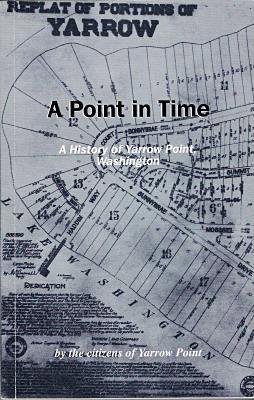
Published through collaborative efforts by the Yarrow Point History Project Committee, King County Office of Cultural Resources, and historians like Suzanne Knauss and Charles Pierce LeWarne, A Point in Time: A History of Yarrow Point, Washington chronicles the transformation of a quiet Lake Washington peninsula from a rugged wilderness into an exclusive residential enclave. The book traces the area's evolution from its early logging days and seasonal strawberry farms into a suburban sanctuary shaped by ferry access and the eventual construction of the floating bridges. Through local archives, oral histories, and photographs, the text details how residents deliberately cultivated a private, close-knit community while remaining tethered to the economic engine of nearby Seattle. A keen insight drawn from the work is how geographical isolation on a peninsula can be aggressively repurposed as a tool for modern exclusivity; by leveraging its distinct peninsular geography and limiting major thoroughfares, Yarrow Point successfully transformed a natural barrier into a socioeconomic filter that insulated its inhabitants from rapid urban sprawl. 174 pages : illustrations, maps ; 22 cm CIRC [ 1 ]
|
2002 |
|
A pocket guide to the Unheralded artists of BC series by Marsha Lederman (Writer of introduction) 
"This small attractive full-colour book, will gather thirteen forgotten and accomplished artists from the acclaimed Unheralded Artists of BC series, in one place, for the first time. There will be a short bio and a selection of art from each one. These artists were painters, sculptors, watercolourists, draftsmen, portraiture artists, abstractionists, surrealists, visionaries, art teachers, travellers, adventurists, printmakers, immigrants and most importantly passionate British Columbia artists. In British Columbia between 1900 and the 1960s over 16,000 artists worked and lived. It was the height of an immense creative surge in the province. Beyond the handful of names of successful artists there is little documented evidence of others. Art was made invisible by socioeconomic or political forces and by a lack of public/private galleries."-- Provided by publisher 187 pages : chiefly colour illustrations ; 18 cm. CIRC [ 0 ]
|
2020 |
|
A place for inquiry, a place for wonder the Andrews Forest by William G. Robbins 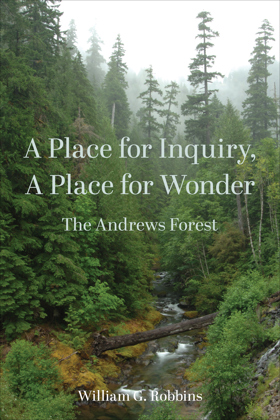
"The H.J. Andrews Experimental Forest is a slice of classic Oregon: due east of Eugene in the Cascade Mountains, the Andrews Forest comprises almost 16,000 acres of the Lookout Creek watershed. The landscape is steep, with hills and deep valleys and cold, fast-running streams. The densely forested landscape includes cedar, hemlock, and moss-draped ancient Douglas fir trees. One of eighty-one USDA experimental forests, the Andrews is administered cooperatively by the US Forest Service, Oregon State University, and the Willamette National Forest. While many Oregonians may think of the Andrews simply as a good place for a hike, research conducted there has profoundly reshaped Forest Service management policies and contributed to our understanding of healthy forests"-- Provided by publisher xi, 233 pages ; illustrations, map, portraits ; 23 cm CIRC [ 0 ]
|
2020 |
|
A pioneer scrapbook of the Columbia River North-Shore communities Wahkiakum and Pacific Counties, Washington, 1900-1985 by Carlton E. Appelo 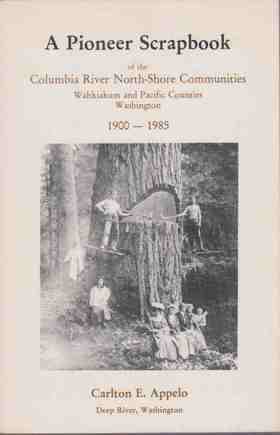
A Pioneer Scrapbook of the Columbia River North-Shore Communities: Wahkiakum and Pacific Counties, Washington, 1900-1985 by Carlton E. Appelo is a richly detailed local history compilation that captures the everyday life and grassroots heritage of the lower Columbia River basin. Structured as an expansive historical scrapbook, the volume gathers a wealth of archival photographs, family anecdotes, newspaper clippings, and regional lore to chronicle the development of the area's vital logging, fishing, and agricultural communities over an 85-year span. Ultimately, it serves as an invaluable, community-driven resource for genealogists and regional historians seeking a highly personal and visual record of the resilient pioneer families who shaped the rural coastal landscapes of southwestern Washington. 132 pages : illustrations ; 24 cm CIRC [ 1 ]
|
1986 |
|
A pioneer gentlewoman in British Columbia the recollections of Susan Allison by Susan Allison, Margaret A. Ormsby 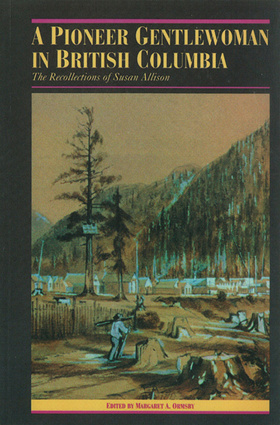
In 1860, at the age of fourteen, Susan Louisa Moir left England for British Columbia. After settling initially at Hope, she lived briefly in both Victoria and New Westminster, then B.C.’s two most important settlements. Returning to Hope, she helped her mother open the community’s first school, and in 1868 she married John Fall Allison, riding on her honeymoon over the Allison Trail into the unsettled Similkameen Valley. Her record of the voyage, of Victoria, New Westminster, and Hope as they were in the 1860s, and her memories of the isolated but fulfilling life she, her husband, and their fourteen children led in the Similkameen and Okanagan Valleys provide a unique view of the pioneer mind and spirit. There were exciting moments – a horseback journey to Hope through a forest fire that made the Skagit River boil, her husband’s boat nearly crushed by a gigantic ice floe on Lake Okanagan – but setting the tone of the whole account is an abiding natural curiosity and respect for both of her closest neighbours – the Similkameen and Okanagan Indians and the wilderness itself. It is these qualities, expressed in forceful, uncomplicated prose, that make Susan Allison’s Recollections a major addition to Canadian pioneer literature. li, 210 pages, 6 unnumbered leaves of plates : illustrations ; 24 cm CIRC [ 0 ]
|
1976 |
|
A pictorial history of the state of Washington by Ralph Ernest Downie
157, ii pages including color frontispiece, illustrations plates, portraits, folded map 26 cm CIRC [ 1 ]
|
1937 |
|
A perfect Eden encounters by early explorers of Vancouver Island by Michael Layland 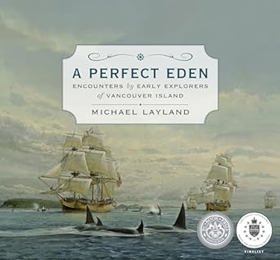
"In 1842, when explorer James Douglas encountered the rugged natural paradise that would become Vancouver Island, he described it as "a perfect Eden." This book gathers the early recorded histories and personal accounts left by Chinese seafarers, Spanish and British naval officers, traders seeking sea otter pelts, colonial surveyors, as well as soldiers, settlers, and other adventurers, starting from many centuries ago up to 1858. Collected here in detail for the first time, these accounts create a multilayered tale of discovery and exploration."-- Provided by publisher xv, 240 pages : illustrations (some colour), maps (some colour), portraits (some colour) ; 25 x 27 cm CIRC [ 1 ]
|
2016 |
|
A peculiar paradise a history of blacks in Oregon, 1788-1940 by Elizabeth McLagan , Oregon Black Pioneers (Publisher) 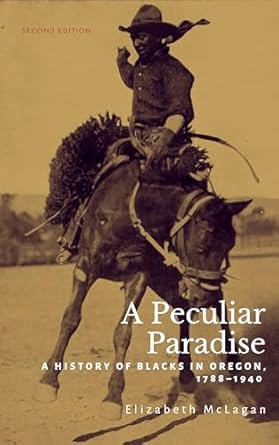
A Peculiar Paradise: A History of Blacks in Oregon, 1788–1940, remains the most comprehensive chronology of Black life in Oregon more than forty years after its original publication in 1980. Elizabeth McLagan’s work reveals how in spite of those barriers, Black individuals and families made Oregon their home and helped create the state’s modern Black communities. A longtime resource for those seeking information on the legal and social barriers faced by people of African descent in Oregon, the book is available again through this co-publication with Oregon Black Pioneers, Oregon’s statewide African American historical society. The revised second edition includes additional details for students and scholars, an expanded reading list, a new selection of historic images, and a new foreword by Gwen Carr and afterword by Elizabeth McLagan. Oregon Black Pioneers is Oregon’s only historical society dedicated to preserving and presenting the experiences of African Americans statewide. Since 1993, Oregon Black Pioneers has illuminated the seldom-told history of people of African descent in Oregon through exhibitions, public programs, publications, and historical research. Learn more at oregonblackpioneers.org. xiv, 193 pages : illustrations, portraits ; 23 cm CIRC [ 0 ]
|
2022 |