Latah County County
Established May 14, 1888 with its county seat at Moscow. This area was first formed as Lah-Toh County in 1864 with Coeur d’Alene as the county seat, in 1867 the name Lah-Toh was dropped when the area was placed in Nez Perce County. In 1888 the U.S. Congress created the county as we know it, the 16th Idaho county and the only Idaho county to be created by Congress. Named for Latah Creek, which drains the northwest corner. The name is Nez Perce and means “the place of pine trees and pestle,”because the Indians found stones here suitable for pulverizing camas roots and shade under the pine trees in which to work.
Mapped Location
Latah County: The mapped location is an approximation and should not be used for navigation or wayfinding.
Information
General information on Latah County
- Feature Type: County
- County Seat: City of Moscow
- Established: Monday, May 14, 1888
Official, historical, colloquial and alternative toponyms for Latah County
A brief list of names that this geographic feature has been named
| Name | Description |
|---|---|
| Latah County | Official |
Origin Notes and History of Latah County
References to Latah County that document the origin of its place name
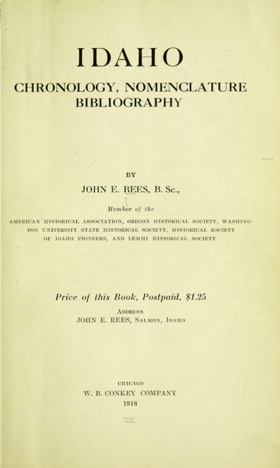
LATAH.—Named for the Nez Perce Indian word Latah (q.v.). The county seat is Moscow, so named when the postoffice was moved, during the 1870s, one mile west of the old site by a Russian by the name of Hogg.
LATAH, Benewah County.—This is a Nez Perce Indian name given to a place near Desmet (q.v.) where, in olden times, they found some kind of stone out of which they made pestles with which to pound and smash roots. These they called "Tah-ol," and at this same place were large pine trees called "La-kah." By eliminating the last syllable in each word is made "La-tah," meaning "pine and pestle place."
A Selected Bibliography of Latah County, County
A compilation of essential readings detailing the history, geography, and culture of the region.
CELEBRATING PALOUSE COUNTRY a history of the landscape in text and images by RICHARD SCHEUERMAN
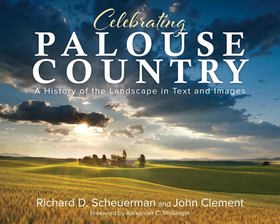
Enhanced with spectacular photographs from John Clement, travel through time among the Palouse Country’s beauty and expanse, starting with its First Peoples, then moving through distinct immigrant groups. Chapters cover events that prompted emigration, describe the settlers’ transitions and living conditions, chronicle significant people and families, discuss major influences that impacted the population, and recount how the communities grew and changed.
Desiderata
Wheat country railroad the Northern Pacific's Spokane & Palouse and competitors by Phil Beach

Phil Beach’s Wheat country railroad: the Northern Pacific's Spokane & Palouse and competitors explores the collaborative infrastructure development and profound economic integration of the uniquely fertile Palouse region in the inland Pacific Northwest. The narrative illustrates how the specific environmental realities of this expansive topography—defined by undulating, deep-loess hills, vast dry-land farming expanses, and profound geographic isolation from coastal maritime ports—required immense engineering resilience and shared daily adaptation from early agricultural communities. By detailing the gradual transition from isolated wheat farms relying on arduous overland wagon freight to the thoughtful engineering of complex, interwoven rail networks, the text highlights how the area's prosperity relied on cooperative responses to its immense natural abundance. Ultimately, the account demonstrates that patiently overcoming the logistical challenges of eastern Washington and collaboratively laying the vital steel corridors of the Spokane & Palouse were essential steps in transforming a remote frontier into a deeply rooted, highly connected agrarian heartland.
"A detailed history and reference work concerning railroads south of Spokane, Washington, and north of the Snake River."--Provided by publisher
xviii, 349 pages : illustrations, maps ; 29 cm
Desiderata
Good times in old Genesee a tale of two families by Gerald Hickman , Tea Joe Hickman
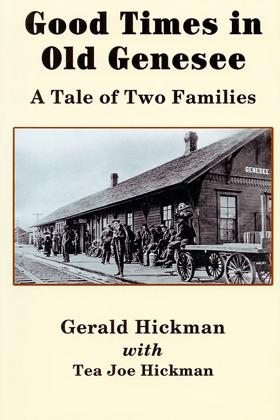
It's a personal and historical recollection of Genesee, Idaho from a former resident, a trip in time to his childhood ranch and beyond, back to the pioneers, in the Genesee valley of North-Central Idaho. It's a visit to Old Genesee, a small community deep in the winter snows and summer grains where his family found a place for themselves. The book covers the period from the first settlers of the 1870s to World War II. It describes the natural history of the area, the early town, and the farming and country life of the early pioneers and those who followed, as engines replaced horses out in the fields. With help from his granddaughter Tea Joe, Gerald Hickman shares his love of Western U.S. history in Good Times in Old Genesee. It's a trip in time to his childhood ranch and beyond, back to the pioneers, in the Genesee valley of North-Central Idaho. It's a visit to Old Genesee, a small community deep in the winter snows and summer grains where his family found a place for themselves. The book covers the period from the first settlers of the 1870s to World War II. It describes the natural history of the area, the early town, and the farming and country life of the early pioneers and those who followed, as engines replaced horses out in the fields. Gerald lives in Eastern Washington near the rolling Palouse hills that stretch out southward to Genesee, with Micky, his childhood bride of 47 years. They have three grown daughters, a dog named Spot, and a cat named Lilly. He is preparing another book on the Indian Wars 1850 through 1865.
107 pages : illustrations, map ; 20 cm
Desiderata
Moscow living and learning on the Palouse by Julie R. Monroe
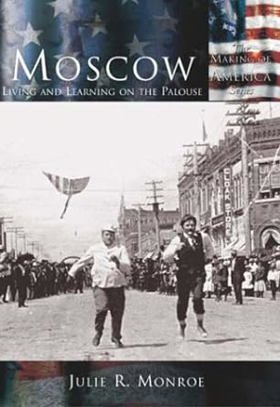
Published in local editions by Julie R. Monroe, Moscow: Living and Learning on the Palouse explores the unique cultural and historical evolution of this iconic north-central Idaho college town. The book chronicles Moscow's transition from a nascent pioneer settlement into the intellectual hub of the rolling Palouse hills, deeply shaped by the establishment of the University of Idaho in 1889. Through archival photographs and engaging community narratives, the text highlights the enduring interplay between agricultural grit and academic ambition. A keen insight drawn from the work is how isolated university towns create distinct cultural islands; by placing a major institution of higher learning in the middle of a vast, conservative farming economy, Moscow fostered a rare hybrid society where agrarian pragmatism and progressive intellectualism perpetually collide and shape each other.
160 pages : illustrations ; 25 cm.
Desiderata
Company town Potlatch, Idaho, and the Potlatch Lumber Company by Keith Petersen, Latah County Historical Society (Publisher)
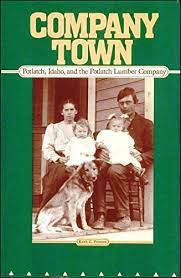
Company Town: Potlatch, Idaho, and the Potlatch Lumber Company by Keith Petersen is a 1987 historical study published in association with the Latah County Historical Society that examines one of the American West's most meticulously planned corporate communities. The book chronicles the establishment and daily life of the lumber town, detailing the Weyerhaeuser syndicate's paternalistic control over its workers' housing, commerce, and social institutions from 1905 until the town's privatization in the 1950s. Ultimately, it serves as a compelling case study of industrial capitalism, labor relations, and the unique socio-economic dynamics that defined early 20th-century timber operations in the Pacific Northwest.
xix, 284 pages, 32 unnumbered pages of plates : illustrations ; 24 cm
Non-circulating [ 1 ]
This crested hill an illustrated history of the University of Idaho by Keith Petersen

This Crested Hill: An Illustrated History of the University of Idaho by Keith Petersen is a comprehensive, visually rich chronicle published in 1987 to commemorate the upcoming centennial of the state's flagship university in Moscow, Idaho. The book traces the institution's evolution from a single, uncompleted building in 1889 into a modern, thriving research university, highlighting key academic milestones, student life, and campus architecture. Through a compelling blend of historical narrative and archival photographs, it serves as an enduring tribute to the legacy and development of higher education in the Gem State.
245 pages : illustrations ; 31 cm
Desiderata
Moscow's centennial, 1887-1987 a century smiles by Idahonian

Moscow's Centennial, 1887-1987: A Century Smiles, compiled and published in 1987 by the local newspaper, the Daily Idahonian, is a commemorative history celebrating the 100th anniversary of this prominent Idaho community's incorporation. The illustrated volume gathers archival photographs, pioneer anecdotes, and journalistic retrospectives to chronicle the town's transformation from a modest agricultural settlement in the Palouse region into a thriving civic and cultural center alongside the University of Idaho. Ultimately, it serves as a nostalgic, community-focused tribute and a valuable local reference that captures the heritage, agricultural roots, and civic milestones of Moscow's first century.
104 pages : illustrations, portraits ; 35 cm
Desiderata
A great good country a guide to historic Moscow and Latah County, Idaho by Lillian Woodworth Otness, Latah County Historical Society (Publisher)

Moscow at the turn of the century by Homer David

Moscow at the Turn of the Century offers a detailed local history of a rapidly growing pioneer community nestled within the distinctive, rolling loess hills of the Palouse region in northern Idaho. The narrative anchors the town's early civic and economic development directly to this fertile inland landscape near the Washington border, where rich soils fueled a booming dryland wheat economy. By documenting the physical expansion of the town grid, early local rail connections, and the foundational establishment of the University of Idaho, David traces the transformation of an isolated agricultural outpost into a permanent regional hub. Ultimately, the book provides a grounded geographic portrait of how early settlers adapted to and capitalized on the sweeping, wind-blown topography of this vital inland Pacific Northwest corridor.
vii, 86 pages : illustrations ; 22 cm.
Non-circulating [ 1 ]
Underneath the bough collected poems of Kenneth B. Platt by Kenneth B. Platt
A collection of poems by Moscow resident and long-time Latah County Historical Society volunteer Kenneth B. Platt. It includes a section of sheet music to accompany various poems.
92 pages, 11 unnumbered leaves of plates, [18] pages (folded) : illustrations, music ; 22 cm
Desiderata
They came to a ridge by Ann Nilsson Driscoll, Maryann McKie

This history was written with the hope that the pioneers of our area be remembered, and that the simple duties and pleasures of the pioneer people may be interesting to those who read it. The true pioneers of American and Driscoll Ridges are those who came here to establish their families and make a home in this new land. The period of the true pioneer to this area extends from when Frank May came in 1876 until about 1900. In my research I have carefully refrained from elaborating on the material so as to write it with as much authenticity as possible. -The Author
96 pages : illustrations, map, portraits ; 23 cm
Non-circulating [ 1 ]
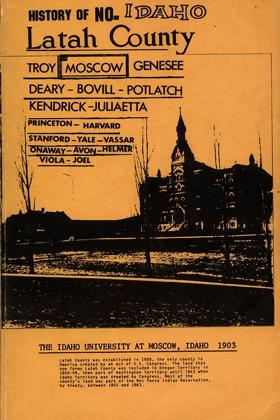
From the forward by Simon K. Benson: “This new addition of Early History of North Idaho, but more particular the history of Latah County, Moscow (Paradise City) 1871, Troy (Huff Gulch) our first home after World War II. Some of the history first came out in a limited edition in 1903. I have republished with permission and the desire of many of the families, and chiefly as a tribute to my father-in-law Guy Senter (now deceased). “The book is a valuable reference work on early Northern Idaho and Latah County history from the explorations into the old Oregon territory, of which the counties of Northern Idaho were once a part. “This book can bring knowledge, enjoyment and memories for anyone who reads it. Books can have a wide distribution and bring joy as an ideal gift. “Perhaps everyone who ever lived in Latah County or had a parent or grandparent who did, can once again relive the nostalgic, exciting pages of the past. ‘Let’s live to give, learn, love, and remember.’” (276 pages)
276 pages : illustrations, portraits ; 21 cm
Desiderata
The trees grew tall by John B. Miller
The history of Bovill, Idaho, from its early days into the 1930s, written by John B. Miller. Miller was born on a Latah County homestead near Bovill and was a University of Idaho graduate with a degree in geology.
xi, 214 pages : illustrations, maps, portraits ; 24 cm
Non-circulating [ 1 ]
Early and present history of Fix Ridge, Latah County, Idaho, 1877-1964 by Maris T. Dennler, Fix Ridge Club (Issuing body)
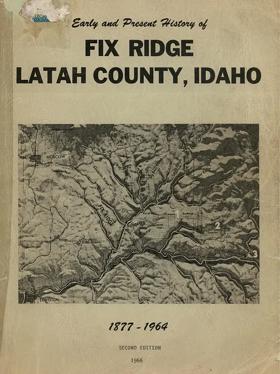
From the preface: This book "represents merely an attempt to pay a tribute to the 'old days' and the 'old Pioneers' and to record as accurately as possible the events and happenings of this area, both past and present."
xvi, 128 leaves, 39 unnumbered leaves of plates : illustrations, map (on cover) portraits ; 28 cm
Desiderata
Beacon for mountain and plain story of the University of Idaho by Rafe Gibbs
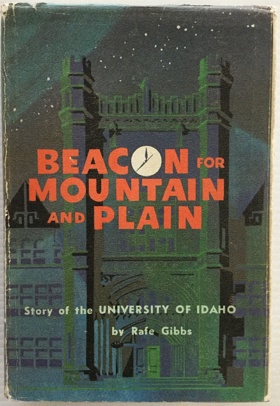
Rafe Gibbs’s Beacon for Mountain and Plain: Story of the University of Idaho chronicles the pioneer and institutional history of a land-grant university established amidst the profoundly fractured geography of the Idaho Panhandle. The narrative meticulously maps the rolling, fertile loess topography of the Palouse basin, detailing how this remote agricultural enclave was historically severed from the state's southern population centers by the massive, impassable alpine barrier of the Salmon River Mountains and the precipitous canyons of the Snake River. By detailing the immense logistical hurdles of building a centralized academic hub in such profound physical isolation, the book illustrates how the institution’s foundational mission was strictly dictated by the severe environmental realities of the inland empire. Gibbs highlights how the university was forced to prioritize vital, place-based sciences—specifically pioneering advanced dryland farming techniques to exploit the region's deep, wind-blown prairie soils, and developing rigorous forestry programs to manage the sprawling, heavily timbered slopes of the northern Rockies. Ultimately, the account captures the defining topographical divide of the state, demonstrating how establishing this isolated educational outpost was the absolute prerequisite for both culturally unifying a pioneer populace partitioned by extreme mountain geography and driving the modern, scientific management of its immense natural resources.
x, 420 pages illustrations, portraits, facsimiles 24 cm
Desiderata
Whispers from "Old Genesee," and echoes of the Salmon River by John A. Platt
Early day history and folklore of the Idaho Panhandle, including Latah, Nez Perce, Idaho and Lewis counties. Preface by the author: "In writing the following pages I have been influenced by a desire to record for our sons and daughters, and their descendants, a written chronicle of the happenings of our lives, together with a mention of certain interesting events which occurred in the vicinity of Genesee during the pioneer days. As these events happened from sixty to seventy-five years ago, there may be some lapse of memory or wrong interpretations. I was only a small boy at the time the earlier events transpired, but they made such a deep impression on my mind that I have never forgotten them. This will not be a complete history – nor a literary masterpiece. It will contain some history, some biography, and perhaps a sprinkling of “blarney.” If the reader, as he peruses these pages, finds amusement, information or entertainment from my efforts, I will feel amply rewarded.”
[7], 75, [6],46, [1] pages : illustrations, map, portraits ; 23 cm
Non-circulating [ 1 ]
A history of Latah County to 1900 by Lawrence Ray Harker
Lawrence Ray Harker’s A history of Latah County to 1900 explores the gradual pioneer settlement and enduring agricultural development of the uniquely fertile, rolling topography of the Palouse region in northern Idaho. The narrative illustrates how the specific environmental realities of this landscape—defined by vast expanses of deep, wind-blown loess soils, the dense white pine timberlands of the eastern foothills, and the seasonal rhythms of the inland climate—required immense resilience and thoughtful cultivation from early homesteaders. By detailing the steady transition from isolated mining camps and early subsistence claims to the collaborative establishment of robust dry-land farming networks and the eventual integration of vital rail corridors, the text highlights how the county's prosperity relied on community-driven adaptation to its rich natural resources. Ultimately, the account demonstrates that cooperatively harnessing the immense agricultural potential of the Palouse hills and patiently building cohesive civic and educational institutions, such as those in early Moscow, were essential steps in transforming a remote frontier into a thriving, deeply rooted agrarian and cultural heartland of the inland Pacific Northwest.
83 leaves ; 28 cm
Desiderata
An illustrated history of north Idaho : embracing Nez Perces, Idaho, Latah, Kootenai and Shoshone counties, state of Idaho by Western Historical Publishing Company
Published in 1903, this extensive volume chronicles the pioneer settlement, Native American history, and rapid industrial development across the rugged panhandle region of northern Idaho. A keen insight drawn from the text is how the area's extreme geographic isolation from southern Idaho forced these northern counties to develop a distinct, fiercely independent culture driven by the volatile boom-and-bust cycles of the Coeur d'Alene mining districts and vast timber operations. The book details the civic and economic growth within Nez Perces, Idaho, Latah, Kootenai, and Shoshone counties, documenting their transition from frontier wilderness to established industrial hubs. Like similar regional histories of its era, the narrative ultimately serves as a vital genealogical resource by preserving hundreds of biographical sketches of the prospectors, farmers, and civic leaders who built the region.
xxviii, 1238 pages, [113] leaves of plates : illustrations, portraits ; 31 cm
ONLINE Circulation [ 1 ]
Related Online Resources
Washington, Idaho & Montana Railway Records Collection
Maps and blueprints from the Washington, Idaho & Montana Railway Records.This digital collection consists of 11 smaller blueprints and maps, the Washington, Idaho & Montana (WI&M) Railway Records collection. The items include the WI&M proposed railway tracks, standard plans for the WI&M section houses, and maps of the WI&M Railway line. Palouse, Potlatch, Freeze, Onaway, Woodfell, Princeton, Harvard, Stanford, Vassar, Avon, Deary, Jansville, Helmer, Cornell, Bovill
WEB LINK
Latah County
- Advent Hollow (historical)
- Aspendale
- Avon
- Blaine
- Bovard (historical)
- City of Bovill
- Buswell (historical)
- Chambers (historical)
- Cora
- Cornwall
- Crescent
- City of Deary
- Estes
- Freeze
- City of Genesee
- Hampton
- Harvard
- Helmer
- Howell
- Jamestown (historical)
- Joel
- City of Juliaetta
- City of Kendrick
- Lenville
- Lidyville (historical)
- Linden
- City of Moscow
- Mountain Home (historical)
- Nora
- City of Onaway
- Orchard Homes (historical)
- City of Potlatch
- Potlatch Junction
- Princeton
- Sherwin
- Slabtown
- Stanford
- City of Troy
- Vassar
- Viola
- Yale (historical)
- Yellow Dog (historical)
Political Boundaries
Last updated: 2025-09-23