Curry County County
Named after Territorial Governor George L. Curry, the county was a part of “Coose” [sic] County until it was created in 1855. Port Orford was the county seat until 1859 when it was replaced by Ellensburg (later renamed Gold Beach).
Mapped Location
Curry County: The mapped location is an approximation and should not be used for navigation or wayfinding.
Information
General information on Curry County
- Feature Type: County
- County Seat: City of Gold Beach
- Established: Tuesday, December 18, 1855
Official, historical, colloquial and alternative toponyms for Curry County
A brief list of names that this geographic feature has been named
| Name | Description |
|---|---|
| Curry County | Official |
Related Catalog Titles
A Bibliography for Curry County, County
What happened here? stories and legends based on the history of Coos and Curry counties, Oregon by Shirley Nelson
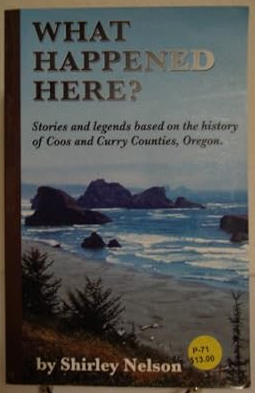
Published in local editions by Shirley Nelson, What Happened Here? Stories and Legends Based on the History of Coos and Curry Counties, Oregon weaves together local folklore, pioneer accounts, and historical research to chronicle the dramatic frontier past of Oregon's rugged southwestern coast. The book captures the dangerous realities of early coastal settlement, detailing shipwrecks along treacherous bars, gold-mining rushes in river canyons, and the often-tense interactions between Euro-American homesteaders and indigenous populations. Drawing on regional oral histories, Nelson preserves the vibrant, hard-scrabble legends that defined the daily existence of isolated coastal communities. A keen insight drawn from the text is how regional folklore functions as a vital psychological coping mechanism; by transforming the brutal isolation and constant tragedies of a perilous maritime frontier into enduring campfire legends, early settlers forged a resilient collective identity that helped them tame a deeply unforgiving landscape.
111 pages : illustrations, maps ; 22 cm
CIRC [ 1 ]
The state of Jefferson by Bernita Tickner, Gail L. Fiorini-Jenner
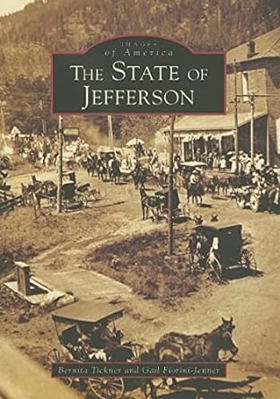
Published in 2017 by Bernita Tickner and Gail L. Fiorini-Jenner, The State of Jefferson explores the colorful, enduring political secession movement aimed at carving a new U.S. state out of the rugged rural counties of Northern California and Southern Oregon. Through a rich collection of vintage photographs and historical anecdotes, the book traces the movement from its 1941 theatrical launch—complete with gold-panning miners brandishing rifles—to its modern manifestations rooted in geographic isolation and anti-establishment sentiment. The text details how residents of this timber-and-mining corridor have long felt economically and politically abandoned by distant state capitals in Sacramento and Salem. A keen insight drawn from the work is how the persistent mythos of the "State of Jefferson" functions less as a viable legislative blueprint and more as a profound psychological safety valve; it provides rural populations with a shared, defiant regional identity that channels deep-seated economic grievances against metropolitan dominance into theatrical civic rebellion.
128 pages : chiefly illustrations, map ; 24 cm.
CIRC [ 1 ]
Port Orford, a history by Patrick Masterson
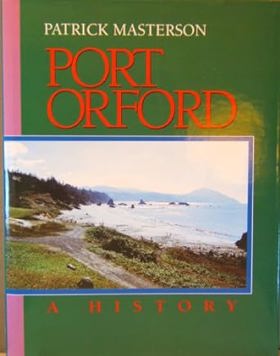
Published by local historian Patrick Masterson, Port Orford, A History chronicles the dramatic evolution of Oregon's oldest continuously settled town, perched precariously on a storm-lashed headland above the Pacific. The book traces the area's rich timeline from its 1851 founding amidst a brief gold rush and subsequent conflicts with local Native tribes, through its decades as a rugged timber and commercial fishing hub. Drawing on historical documents and archival photographs, the text captures the fierce independence required to inhabit a remote coastal enclave characterized by treacherous waters and geographic isolation. A keen insight drawn from the work is how Port Orford's unusual open-water port—where boats must be hoisted in and out of the sea by giant land-based cranes—serves as a physical metaphor for the town's entire existence; it illustrates that surviving on the edge of the wilderness demands a permanent, ingenious defiance against standard modern infrastructure.
ii, 203 pages : illustrations ; 29 cm
CIRC [ 1 ]
Battle Rock the hero's story : a true account, Oregon coast Indian attack : an Oregon documentary by Bert Webber, Margie Webber, J. M. Kirkpatrick
Published by maritime historians Bert Webber, Margie Webber, and J.M. Kirkpatrick, Battle Rock: The Hero's Story chronicles the harrowing 1851 clash between a small party of American gold-seekers led by Captain William Tichenor and the local Quat-a-qtie (Tututni) people on the southern Oregon coast. The book details the group's desperate defense atop a rocky sea stack in present-day Port Orford after an initial exploratory landing provoked fierce Indigenous resistance to protect their ancestral territory. Drawing on historical documents, pioneer journals, and local accounts, the text preserves a violent and foundational episode of frontier expansion. A keen insight drawn from the work is how regional historical documentation often elevates colonial survival narratives while obscuring the broader geopolitical trauma; by framing the skirmish through the heroic lens of isolated pioneers under siege, the account masks the reality that the true assault was an unprovoked imperial intrusion onto sovereign Indigenous land.
75 pages : illustrations, maps, portraits ; 22 cm
CIRC [ 1 ]
Whitewater mailmen the story of the Rogue River mail boats by Gary Meier, Gloria Meier
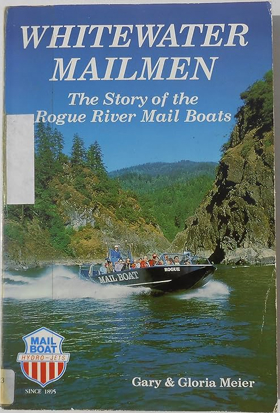
Authored by regional historians Gary Meier and Gloria Meier, Whitewater Mailmen: The Story of the Rogue River Mail Boats chronicles the perilous and essential maritime service that kept Oregon's remote canyon settlements connected to the outside world. The book details the history of the daring pilots who navigated the treacherous rapids, submerged boulders, and churning white water of the lower Rogue River to deliver mail, supplies, and passengers to isolated homesteaders. Drawing on archival photographs and firsthand interviews, the text captures the mechanical evolution from wooden skiffs to specialized jet boats that conquered an unforgiving aquatic highway. A keen insight drawn from the work is how postal delivery infrastructure served as the true lifeblood of geographic integration in the American West; by transforming a dangerous wilderness river into a dependable federal mail route, these boatmen proved that modern state control and community survival in the rugged backcountry depended entirely on mastering wild, untamed waters.
xii, [187] pages : illustrations ; 23 cm
CIRC [ 1 ]
A century of Coos and Curry history of southwest Oregon by Emil R. Peterson, Alfred Powers, Coos Curry Pioneer & Historical Association
The nearly 600 pages of the pioneer history includes a 100+ page alphabetical Biographical Appendix with short entries for several hundred people. The history section begins with descriptions of Coos and Curry counties. This history proper starts in 1795 and includes a number of anecdotes, reminiscences, biographical portraits, and city histories, as well as historical narratives. Topics include Battle Rock, Rogue River, southern Curry County, report of an Indian agent, Coos Bay Colony, Bandon Beach, Coos Bay, Coquille Valley, Coos economic activity for 1897, Curry County, Nosler emigration, mineral belt, and crimes, casualties and miscellaneous happenings. Includes photographs of significant buildings and local residents.
599 pages : illustrations, portraits, maps ; 23 cm
CIRC [ 1 ]
Pioneer history of Coos and Curry Counties, Or. heroic deeds and thrilling adventures of the early settlers by Orvil Ovando Dodge, Pioneer and Historical Association of Coos County, Or (Issuing body)
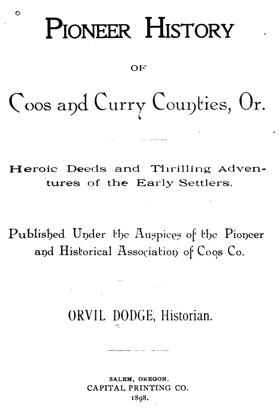
Published in 1898 by Orvil Ovando Dodge, this historical volume chronicles the early white settlement, resource extraction, and violent conflicts that defined the foundational pioneer era of Oregon's rugged southern coast. A keen insight drawn from the text is how its highly romanticized framing of the brutal Rogue River Wars as "heroic deeds" demonstrates the active mythmaking required by early settlers to morally justify the violent displacement of indigenous populations in pursuit of timber and coastal gold. The narrative details the region's extreme geographic isolation, explaining how the impenetrable Coast Range forced these early communities to develop fiercely independent maritime and logging economies rather than relying on overland trails. Furthermore, the book serves as a vital genealogical archive by preserving extensive biographical sketches and firsthand accounts of the resilient prospectors, sailors, and civic leaders who built Coos and Curry counties.
4 preliminary leaves, 5-468, 103 pages, 27 unnumbered leaves of plates : frontispiece, illustrations, portraits ; 22 cm
CIRC [ 0 ]
Curry County
- Agness
- Bagnell Ferry
- City of Brookings
- Carpenterville
- Denmark
- Eckley (historical)
- City of Gold Beach
- Harbor
- Hunter Creek
- Illahe
- Jerrys Flat (historical)
- Knoxville (historical)
- Lakeport (historical)
- Langlois
- Marial
- Nesika Beach
- Ophir
- Pistol River
- Plum Trees
- City of Port Orford
- Sixes
- Wedderburn
Political Boundaries
Last updated: 2025-09-23