Josephine County County
Josephine County, named for Virginia “Josephine” Rollins, the first white woman to make this county her home, was established in 1856 out of the western portion of Jackson County. The county seat was originally located in Sailor Diggings (later, Waldo), but in July of 1857 was relocated to Kerbyville, situated on the main route between the port of Crescent City, California and the gold fields.
The discovery of rich placers at Sailor Diggings in 1852 and the resulting gold rush brought the first settlers to this region. Several U.S. Army forts were maintained in the county and many engagements during the Rogue River Indian War (1855–1858) took place within its boundaries. In 1886, the county seat was finally relocated to Grants Pass, a new town on the railroad that was completed through Oregon that same year. Grants Pass is now the departure point for most Rogue River scenic waterway guided fishing and boat trips. The Illinois River, one of the Rogue’s tributaries, has also been designated a scenic waterway.
Mapped Location
Josephine County: The mapped location is an approximation and should not be used for navigation or wayfinding.
Information
General information on Josephine County
- Feature Type: County
- County Seat: City of Grants Pass
- Established: Tuesday, January 22, 1856
Official, historical, colloquial and alternative toponyms for Josephine County
A brief list of names that this geographic feature has been named
| Name | Description |
|---|---|
| Josephine County | Official |
Related Catalog Titles
A Bibliography for Josephine County, County
The state of Jefferson by Bernita Tickner, Gail L. Fiorini-Jenner
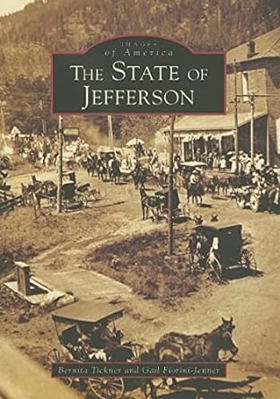
Published in 2017 by Bernita Tickner and Gail L. Fiorini-Jenner, The State of Jefferson explores the colorful, enduring political secession movement aimed at carving a new U.S. state out of the rugged rural counties of Northern California and Southern Oregon. Through a rich collection of vintage photographs and historical anecdotes, the book traces the movement from its 1941 theatrical launch—complete with gold-panning miners brandishing rifles—to its modern manifestations rooted in geographic isolation and anti-establishment sentiment. The text details how residents of this timber-and-mining corridor have long felt economically and politically abandoned by distant state capitals in Sacramento and Salem. A keen insight drawn from the work is how the persistent mythos of the "State of Jefferson" functions less as a viable legislative blueprint and more as a profound psychological safety valve; it provides rural populations with a shared, defiant regional identity that channels deep-seated economic grievances against metropolitan dominance into theatrical civic rebellion.
128 pages : chiefly illustrations, map ; 24 cm.
CIRC [ 1 ]
Golden days and pioneer ways by Ruth Pfefferle
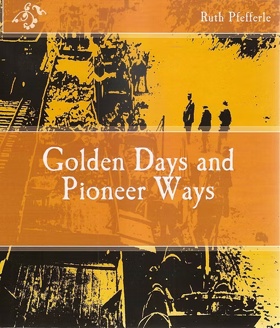
Published in 1934 by Ruth Pfefferle, Golden Days and Pioneer Ways is a localized chronicle of early settlement and domestic life in the Pacific Northwest, heavily focused on the intimate, day-to-day realities of homesteading. Drawing from family lore, pioneer letters, and community reminiscences, the text shifts away from grand geopolitical maneuvering to spotlight the domestic labor, social bonds, and domestic resilience of early families. Through a collection of homespun anecdotes and localized histories, the book paints an idyllic portrait of frontier community-building, celebrating the endurance and adaptability required to establish permanent roots in an isolated and demanding environment.
vi, 128 pages : illustrations, portraits ; 28 cm
CIRC [ 1 ]
110 years with Josephine the history of Josephine County, Oregon, 1856-1966 by Jack Sutton, Josephine County Historical Society

Josephine County
- Allentown (historical)
- Althouse (historical)
- Bridgeview
- Brown City (historical)
- Browntown
- Browntown (historical)
- California Bar
- City of Cave Junction
- Dryden
- Fruitdale
- Galice
- Golden
- City of Grants Pass
- Greenback (historical)
- Holland
- Hugo
- Kerby
- Leland
- Merlin
- Murphy
- New Hope
- O'Brien
- Placer
- Pleasant Valley
- Rand
- Redwood
- Selma
- Speaker
- Sunny Valley
- Takilma
- Three Pines
- Wilderville
- Williams
- Williamsburg (historical)
- Wolf Creek
- Wonder
Political Boundaries
Last updated: 2013-01-08