Coos County County
Coos County was created by the Territorial Legislature from parts of Umpqua and Jackson Counties in 1853 and included Curry County until 1855. The county seat was Empire City until 1896 when it was moved to Coquille. Although trappers had been in the area a quarter-century earlier, the first permanent settlement in present Coos County was at Empire City, now part of Coos Bay, by members of the Coos Bay Company in 1853. The name “Coos” derives from the Coos Tribe and translates to “lake” or “place of pines.”
Mapped Location
Coos County: The mapped location is an approximation and should not be used for navigation or wayfinding.
Information
General information on Coos County
- Feature Type: County
- County Seat: City of Coquille
- Established: Thursday, December 22, 1853
Official, historical, colloquial and alternative toponyms for Coos County
A brief list of names that this geographic feature has been named
| Name | Description |
|---|---|
| Coos County | Official |
Related Catalog Titles
A Bibliography for Coos County, County
What happened here? stories and legends based on the history of Coos and Curry counties, Oregon by Shirley Nelson
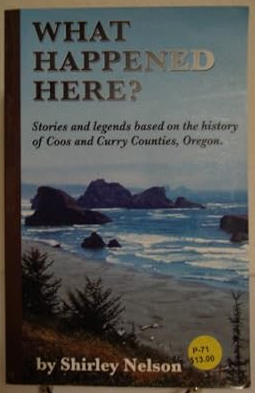
Published in local editions by Shirley Nelson, What Happened Here? Stories and Legends Based on the History of Coos and Curry Counties, Oregon weaves together local folklore, pioneer accounts, and historical research to chronicle the dramatic frontier past of Oregon's rugged southwestern coast. The book captures the dangerous realities of early coastal settlement, detailing shipwrecks along treacherous bars, gold-mining rushes in river canyons, and the often-tense interactions between Euro-American homesteaders and indigenous populations. Drawing on regional oral histories, Nelson preserves the vibrant, hard-scrabble legends that defined the daily existence of isolated coastal communities. A keen insight drawn from the text is how regional folklore functions as a vital psychological coping mechanism; by transforming the brutal isolation and constant tragedies of a perilous maritime frontier into enduring campfire legends, early settlers forged a resilient collective identity that helped them tame a deeply unforgiving landscape.
111 pages : illustrations, maps ; 22 cm
CIRC [ 1 ]
Coos Bay Plundertown, USA by Al Sandine
Published in local editions by Al Sandine, Coos Bay Plundertown, USA is a blistering polemical history examining the corporate exploitation and environmental degradation of Oregon’s largest coastal port. The book chronicles how powerful timber and industrial interests, in collusion with local political figures, systematically gutted the region's natural resources and bypassed community oversight to maximize short-term profits. Through sharp critique and detailed local documentation, the text exposes the severe economic and ecological fallout left in the wake of unchecked industrial ambition. A keen insight drawn from the work is how resource-dependent towns are frequently treated by outside corporate forces as disposable sacrifice zones; the narrative reveals that "plundertown" status is not an accidental policy failure, but the predictable end-result of an extractive economic model that privatizes public wealth while socializing long-term environmental ruin.
175 pages : illustrations, maps, portraits ; 22 cm
CIRC [ 1 ]
A century of Coos County railroads by Steven Greif

Published by local historian Steven Greif, A Century of Coos County Railroads chronicles the ambitious, logistically treacherous, and economically volatile history of rail development along southwest Oregon’s rugged coast. The book details the immense engineering feats required to carve rail lines through dense timber, cross treacherous waterways, and connect isolated coastal timber and shipping towns to the national grid. Through detailed archival photographs, corporate records, and local lore, the text charts how steel tracks served as the primary economic lifeline that transitioned the region from maritime isolation into a heavy industrial timber economy. A keen insight drawn from the work is how railroads on the Pacific Northwest frontier acted as both liberators and tyrants; while steel lines successfully shattered geographic isolation, they simultaneously bound local communities to boom-and-bust corporate monopolies, making the region's economic survival entirely dependent on external market demands.
57 pages : illustrations, facsimiles, map ; 28 cm
CIRC [ 1 ]
Yester years by Gordon Ross
Published locally by longtime Coos County dairy farmer, historian, and former commissioner Gordon Ross, Yester Years is a collection of humorous and homespun stories documenting the trials, eccentricities, and daily realities of early rural life in southwest Oregon. Drawing heavily on family lore, handed-down anecdotes, and personal recollections of the Ross Slough and Coos Bay regions, the book captures a vanishing landscape where neighbors survived through grit, improvisation, and close-knit community cooperation. Through lighthearted and unpretentious prose, the text preserves the rich oral history of pioneers, farmers, and loggers who shaped the rugged frontier. A keen insight drawn from the work is how regional humor functions as an essential survival mechanism; by chronicling the absurdities and hardships of frontier isolation with witty storytelling, the narrative reveals that laughter was just as vital as physical labor in subduing an unforgiving wilderness.
93 pages : illustrations ; 22 cm
CIRC [ 1 ]
Bandon tales stories of country life by Granny Abbott
Authored by longtime southern Oregon resident Granny Abbott, Bandon Tales: Stories of Country Life offers a charming, homespun collection of reminiscences documenting early homesteading, farming, and coastal community life near Bandon during the late 19th and early 20th centuries. The book captures the unvarnished realities of rural survival, neighborly mutual aid, and domestic routines against the backdrop of raw wilderness and sweeping Pacific shores. Through affectionate and straightforward prose, the text preserves the colloquial voice and everyday folklore of pioneers who carved out an existence on a windswept frontier. A keen insight drawn from the work is how domestic humor and storytelling served as vital psychological currency for frontier women; by framing crushing physical hardships through the lens of wry local comedy, homesteaders built emotional resilience and forged unbreakable social ties that kept isolation at bay.
111 pages : illustrations ; 21 cm
CIRC [ 1 ]
The night Bandon burned by Curt Beckham
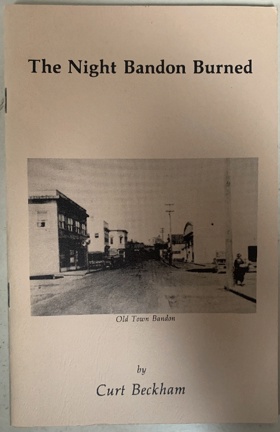
This small booklet details the disastrous fire that destroyed Bandon, Oregon on September 26, 1936. Includes several black and white photographs of the town before and after the fire.
45 pages : photographs ; 22 cm
CIRC [ 1 ]
The Coos Bay region, 1890-1944 life on a coastal frontier by Nathan Douthit
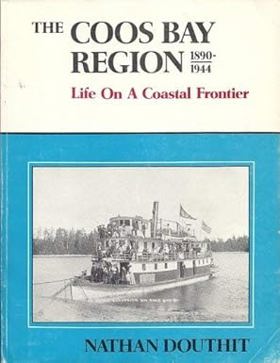
About two-thirds of the way from San Francisco Bay to the Columbia River lies Coos Bay, the larges natural harbor on the Oregon coast.... the subject of this book. It is a book about the social and economic development of a small corner of the Pacific Northwest from a coastal frontier into a major population and forest industrial center of Oregon.
163 pages : illustrations ; 28 cm
CIRC [ 0 ]
Coos Bay the pioneer period, 1851-1890 by Stephen Dow Beckham
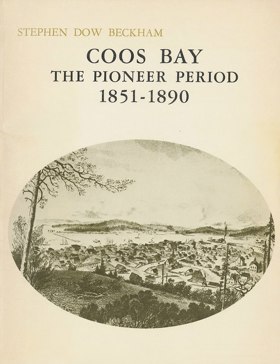
Study of the Coos Bay region focusing on the years 1851-1890. During this period a little known estuary on the southwest coast of Oregon became a thriving center for lumbering, shipbuilding, coal mining, and agriculture. This work is not intended to be a complete local history of Coos Bay, however the author examines those events and undertakings that have had special significance in the development of the area.
v, 70 pages illustrations 28 cm
CIRC [ 1 ]
Pioneers and incidents of the Upper Coquille Valley, 1890-1940 by Alice H. Wooldridge (Compiler)
Coos River echoes a story of the Coos River Valley by Charlotte L. Mahaffy
A century of Coos and Curry history of southwest Oregon by Emil R. Peterson, Alfred Powers, Coos Curry Pioneer & Historical Association
The nearly 600 pages of the pioneer history includes a 100+ page alphabetical Biographical Appendix with short entries for several hundred people. The history section begins with descriptions of Coos and Curry counties. This history proper starts in 1795 and includes a number of anecdotes, reminiscences, biographical portraits, and city histories, as well as historical narratives. Topics include Battle Rock, Rogue River, southern Curry County, report of an Indian agent, Coos Bay Colony, Bandon Beach, Coos Bay, Coquille Valley, Coos economic activity for 1897, Curry County, Nosler emigration, mineral belt, and crimes, casualties and miscellaneous happenings. Includes photographs of significant buildings and local residents.
599 pages : illustrations, portraits, maps ; 23 cm
CIRC [ 1 ]
Pioneer history of Coos and Curry Counties, Or. heroic deeds and thrilling adventures of the early settlers by Orvil Ovando Dodge, Pioneer and Historical Association of Coos County, Or (Issuing body)
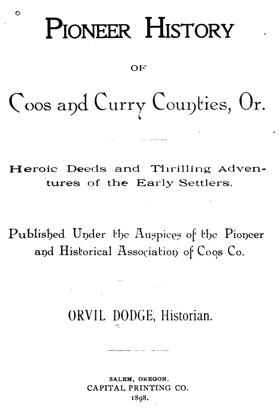
Published in 1898 by Orvil Ovando Dodge, this historical volume chronicles the early white settlement, resource extraction, and violent conflicts that defined the foundational pioneer era of Oregon's rugged southern coast. A keen insight drawn from the text is how its highly romanticized framing of the brutal Rogue River Wars as "heroic deeds" demonstrates the active mythmaking required by early settlers to morally justify the violent displacement of indigenous populations in pursuit of timber and coastal gold. The narrative details the region's extreme geographic isolation, explaining how the impenetrable Coast Range forced these early communities to develop fiercely independent maritime and logging economies rather than relying on overland trails. Furthermore, the book serves as a vital genealogical archive by preserving extensive biographical sketches and firsthand accounts of the resilient prospectors, sailors, and civic leaders who built Coos and Curry counties.
4 preliminary leaves, 5-468, 103 pages, 27 unnumbered leaves of plates : frontispiece, illustrations, portraits ; 22 cm
CIRC [ 0 ]
Coos County
- Allegany
- Arago
- Bancroft
- City of Bandon
- Barview
- Bay Park
- Bridge
- Broadbent
- Bullards
- Bunker Hill
- Cedar Point
- Charleston
- Coaledo
- City of Coos Bay
- Coos City (historical)
- Coos River
- Cooston
- City of Coquille
- Cranberry Corners
- Crown Point
- Dellwood
- Delmar
- Dew Valley
- Dora
- Englewood
- Estabrook
- Etelka (historical)
- Fairview
- Fourmile
- Gaylord
- Glasgow
- Gravelford
- Green Acres
- Hauser
- Kings Landing (historical)
- City of Lakeside
- Lampa (historical)
- Laurel Grove
- Lee (historical)
- Leneve
- Libby
- McKinley
- Millington
- City of Myrtle Point
- City of North Bend
- Norway
- Parkersburg
- City of Powers
- Prosper
- Randolph
- Remote
- Riverton
- Saunders Lake
- Shorewood
- Sitkum
- Sumner
- Templeton
- Tenmile
- Winterville
Political Boundaries
Last updated: 2013-01-08