Chelan County County
The county was created out of Okanogan and Kittitas Counties on March 13, 1899. It derives its name from a Chelan Indian word meaning "deep water," likely a reference to 55-mile (89 km)-long Lake Chelan, which reaches a maximum depth of 1,486 feet (453 m).
Mapped Location
Chelan County: The mapped location is an approximation and should not be used for navigation or wayfinding.
Information
General information on Chelan County
- Feature Type: County
- County Seat: City of Wenatchee
- Established: Monday, March 13, 1899
Official, historical, colloquial and alternative toponyms for Chelan County
A brief list of names that this geographic feature has been named
| Name | Description |
|---|---|
| Chelan County | Official |
Origin Notes and History of Chelan County
References to Chelan County that document the origin of its place name
CHELAN. This is an Indian word to which two meanings have been given. Henry Gannett, of the United States Geological Survey, says it means "deep water." (Place Names in the United States.) John B. Wapato, grandson of Chief John Wapato, says he learned from his grandfather that the word means "land of bubbling water." (L. B. Sines, in Names MSS., Letter 860.) Probably the first time it was reduced to writing was by Alexander Ross, 1810-1813, and he showed its true Indian character by the spelling as follows: "passed a small but rapid stream, called by the native Tsill-ane, which descended over the rocks in white broken sheets." (Oregon Settlers, page 149.) The name has been given a wide geographic use. A long narrow lake extends from near the Columbia River for sixty miles pack into the Cascade Mountains. For a long time it was said to be "bottomless" in depth. Its depth is now known to extend below sea level. As applied to this lake the name might well mean "deep water." The lake drains into the Columbia River through the swift Chelan River in which are the Chelan Falls, and at the southern end of the lake is the town of Chelan. Chelan Butte has a height of 8892 feet, and overlooking the deep waters is a rugged ridge known as Chelan Mountains. In 1899 a new county was planned to be known as Wenatchee. The law was approved on March 18 of that year, but the name of the new county had been changed to Chelan.
Related Catalog Titles
A Bibliography for Chelan County, County
The Stehekin we remember by Buckner Sisters, Irene Sargo, Harriet Morehead, Elizabeth Gans
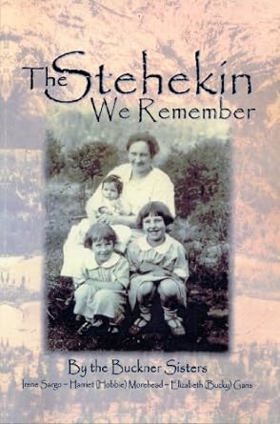
Published in 2007 by Irene Sargo, Harriet Morehead, and Elizabeth Gans—known as the Buckner sisters—The Stehekin We Remember offers an intimate, firsthand chronicle of pioneer life in the isolated Stehekin Valley at the head of Lake Chelan during the 1920s through the 1940s. The book blends family memoirs, historic photographs, and detailed genealogical maps to document the daily routines of self-sufficient homesteading, one-room schoolhouses, and orchard management without modern amenities. Alongside their own family history, the authors meticulously record the profiles of neighboring pioneer households, preserving a comprehensive social fabric of the valley. A keen insight drawn from the text is how it highlights the duality of isolation; while geographic remoteness imposed severe physical hardships and labor-intensive survival strategies on children growing up in the North Cascades, it simultaneously fostered a remarkably resilient, hyper-collaborative community network that deeply anchored their collective identity.
203 pages : illustrations ; 23 cm
CIRC [ 1 ]
The Wenatchee Valley and its first peoples thrilling grandeur, unfulfilled promise by Richard D. Scheuerman, John Clement, Clifford E. Trafzer, Wenatchee Valley Museum and Cultural Center
Published by the Wenatchee Valley Museum and Cultural Center, The Wenatchee Valley and its First Peoples: Thrilling Grandeur, Unfulfilled Promise by Richard D. Scheuerman, John Clement, and Clifford E. Trafzer examines the complex cultural history of Washington's mid-Columbia region. The book juxtaposes the awe-inspiring geography of the high-desert river valley with the tragic history of displacement experienced by its original indigenous inhabitants, particularly the Wenatchi people. Through historical accounts, archival photographs, and cultural analysis, the authors trace how rapid Euro-American settlement and irrigation projects transformed the landscape while frequently breaking solemn treaties. A keen insight drawn from the text is how the subtitle's reference to "unfulfilled promise" operates as a poignant critique of manifest destiny; it highlights how the modern agricultural bounty of the Wenatchee apple capital was built directly upon the unfulfilled legal and moral guarantees made to the valley's original stewards.
xxii, 145 pages : color illustrations, map, portraits ; 23 x 29 cm
CIRC [ 1 ]
Mapping women's sense of place in Stehekin, WA an oral history-based study of place by Christina Copeland

Authored as an oral history-based study by Christina Copeland, Mapping Women's Sense of Place in Stehekin, WA investigates how women have historically experienced, shaped, and emotionally mapped the deeply isolated community nestled at the head of Lake Chelan. The dissertation draws on extensive interviews to examine the gendered dimensions of living in a remote, rugged mountain enclave accessible primarily by boat, floatplane, or trail. By centering women's narratives, the text illuminates the invisible labor, social bonds, and unique environmental attachments required to sustain family and community life in an extreme wilderness setting. A keen insight drawn from the work is how geographical isolation redefines gender roles on the frontier; rather than being sidelined by rugged topography, women in Stehekin often became the primary architects of community stability, forging a profound, place-based identity that transformed an intimidating wilderness into an enduring home.
vii, 153 leaves : illustrations, maps ; 29 cm
CIRC [ 1 ]
Pioneers of Peshastin the son : growing up in the Wenatchee Valley by Carl J. Bergren
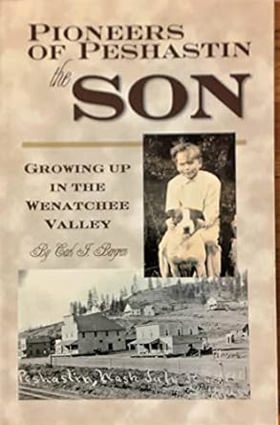
Authored by Carl J. Bergren, Pioneers of Peshastin the Son: Growing Up in the Wenatchee Valley provides a deeply personal memoir of growing up amidst the apple orchards and rugged hills of north-central Washington during the mid-20th century. The book captures the rhythm of rural agricultural life in the Peshastin and Leavenworth areas, detailing the grueling seasonal labor of fruit farming, local school days, and the tight-knit bonds of a valley community dependent on the land. Through nostalgic recollections and family history, the text contrasts the idyllic pastoral imagery of orchard country with the demanding economic realities faced by generational farming families. A keen insight drawn from the work is how second-generation pioneers experienced a complex burden of inheritance; rather than discovering an untamed wilderness, children of the original homesteaders were tasked with maintaining and monetizing an already-carved-out agricultural landscape, transforming the raw grit of frontier survival into a rigid, generational corporate farming routine.
152 pages : illustrations ; 22 cm
CIRC [ 1 ]
"We left because the creek went dry" the people of the First Creek District, Lake Chelan, Washington, 1888-1932 by Elizabeth Watson Perry
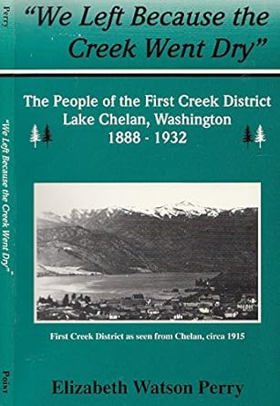
Authored by Elizabeth Watson Perry, "We Left Because the Creek Went Dry": The People of the First Creek District, Lake Chelan, Washington, 1888-1932 chronicles the rise and abandonment of an isolated homesteading community on the arid shores of north-central Washington. The book draws on diaries, family photographs, and oral histories to detail the immense physical and economic toll placed on pioneers attempting to farm steep, water-scarce canyon benches. Through intimate accounts of daily struggle, the text exposes the severe environmental limits that ultimately forced settlers to abandon their hard-won acreage. A keen insight drawn from the work is how agricultural boosterism recklessly ignored ecological realities; by romanticizing the arid Pacific Northwest as an endless land of agrarian promise, promotional literature lured families into fragile microclimates where a single vanishing water source could entirely erase a generation of backbreaking labor.
143 pages : illustrations, map ; 23 cm
CIRC [ 1 ]
Stehekin, a valley in time by Grant McConnell
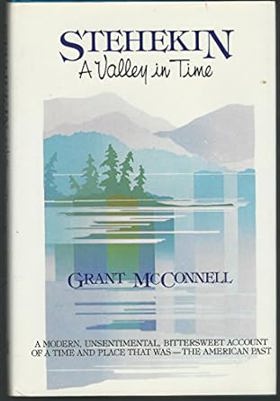
Looks at the remote community of Stehekin in Washington's Cascade mountains and describes how a pioneering style of life has become more like that of the outside world
206 pages : map ; 24 cm
CIRC [ 1 ]
Stehekin glimpses of the past : a collection of early writings by Carol M. Stone (Compiler)
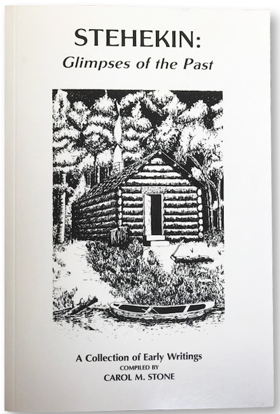
A rare collection of the early history of the Stehekin valley, head of Lake Chelan, in Washington’s North Cascades. Lively narratives describe adventures of early explorers with pack trains, and accounts of riding the first steam boats on Lake Chelan. Writing styles of the 1900’s paint vivid and enticing pictures of exciting journeys to the upper mining holds in Horseshoe Basin, the presence of Native Americans, and the influence of the railroad bringing visitors clear across the country to relax and recreate in glorious mountain surroundings. Republished by Stehekin Heritage, Carol Stone’s collection of stories are gathered from early local newspaper articles and explorer’s journals. For those that know and love Stehekin, or wish to know how settlement began in this remote community, Glimpses of the Past is a worthy compilation and reference of accurate history of the Chelan area.
xi, 248 pages : illustrations, map, portrait ; 22 cm
CIRC [ 1 ]
Stehekin a wilderness journey into the Northern Cascades by William A. Bake, United States National Park Service
Lake Chelan in the 1890's 1891 steamboat trip to Stehekin on Lake Chelan's first steamer by Nelson Wayne Durham
A history of Wenatchee the apple capital of the world by John Arthur Gellatly
Passes to the North history of Wenatchee Mountains by Edson Dow
A history of central Washington including the famous Wenatchee, Entiat, Chelan and the Columbia Valleys with an index and eighty scenic-historical illustrations by Lindley M. Hull
Published in 1929 and compiled by Lindley M. Hull for the Pioneer Association of Central Washington, A History of Central Washington is a massive, 624-page regional chronicle detailing the settlement of the Wenatchee, Entiat, Chelan, and Columbia valleys. Divided into two primary sections—"The Story of Pioneer Settlements" and "The Development Period"—the volume combines eighty scenic-historical illustrations with exhaustive biographical sketches of early white homesteaders. The text meticulously documents the physical transformation of the region, emphasizing the construction of irrigation ditches, the establishment of commercial orchards, and the founding of local civic institutions. Like many pioneer-driven histories of the era, the book operates as a triumphalist civic monument celebrating the rugged endurance and capitalist successes of the region's Anglo-American founders.
A keen insight drawn from the work is how the narrative conceptually weaponizes agricultural "development" to morally legitimize colonial displacement. By framing the region's history fundamentally around the engineering of irrigation canals and the cultivation of profitable cash crops, Hull’s compilation equates valid land ownership exclusively with industrial-scale agrarian capitalism. This historiographical maneuver effectively reduces the original Indigenous inhabitants and their complex, pre-existing territorial claims to mere background frontier trivia, occasionally noting them only as transient obstacles or linguistic curiosities. Consequently, the aggressive ecological enclosure and demographic replacement of the region is structurally sanitized, demanding that readers view the settlement of central Washington not as an act of territorial conquest, but as the righteous, inevitable unlocking of a previously "wasted" landscape's true economic destiny.
624 pages : illustrations ; 23 cm
CIRC [ 1 ]
An illustrated history of Stevens, Ferry, Okanogan and Chelan counties, state of Washington by Western Historical Publishing Company
Published in 1904 by the Western Historical Publishing Company, this comprehensive volume chronicles the pioneer settlement, civic foundation, and industrial emergence of four rugged counties in northern Washington state. A keen insight drawn from the text is how the sudden, controversial opening of former Native American reservation lands (such as the Colville Reservation) to white prospectors triggered explosive mining booms, acting as the primary catalyst that rapidly transformed this isolated northern frontier into permanent communities. The narrative details the distinct economic drivers across the region, from the rich mineral districts of Ferry and Stevens to the vast cattle ranges and early orchard irrigation projects of Okanogan and Chelan counties. Furthermore, the book preserves the area's pioneer legacy by featuring hundreds of detailed biographical sketches of the resilient prospectors, ranchers, and civic leaders who built these foundational settlements.
xxii, 867 pages, 43 unnumbered leaves of plates : illustrations, portraits ; 31 cm
ONLINE CIRC [ 1 ]
Chelan County
- Appleyard
- Ardenvoir
- Azwell
- Berne
- Blewett (historical)
- City of Cashmere
- City of Chelan
- Chelan Falls
- Chiwaukum
- Chumstick
- Coles Corner
- Domke Lake Resort
- Dryden
- City of Entiat
- Entiat (historical)
- Farris
- Granite Falls
- Greens Landing
- Holden (historical)
- Hollywood Beach
- Lake Chelan Hills
- City of Leavenworth
- Lucerne
- Malaga
- Manson
- Maplecreek
- Merritt
- Monitor
- Moore
- Nason Creek
- Olds
- Peshastin
- Plain
- Shrine Beach
- Stayman
- Stehekin
- Sunnybank
- Sunnyslope
- Telma
- Trinity
- Wagnersburg
- City of Wenatchee
- Wenatchee Heights
- West Wenatchee
- Winesap
- Winton
Political Boundaries
Last updated: 2017-06-28