City of Tacoma Pierce County, Washington
Mapped Location
City of Tacoma: The mapped location is an approximation and should not be used for navigation or wayfinding.
Information
General information on City of Tacoma
- Feature Type: Incorporated
Official, historical, colloquial and alternative toponyms for City of Tacoma
A brief list of names that this geographic feature has been named
| Name | Description |
|---|---|
| City of Tacoma | Official |
| Tacoma | Official |
Origin Notes and History of City of Tacoma
References to City of Tacoma that document the origin of its place name
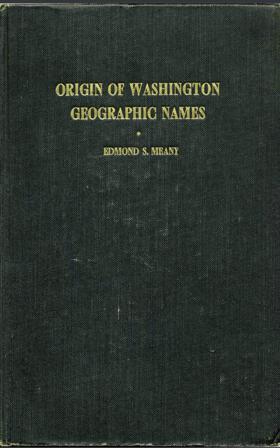
TACOMA, principal city of Pierce County, on Commencement Bay, now known as Tacoma Harbor. The name is said to be of Indian origin, but its source and meaning have been the subjects of much debate and disputation. Of all those who have written on the subject, the best authority is undoubtedly Thomas W. Prosch. A pioneer newspaper man with a bent toward history, he had the advantage accompanying such training. Furthermore, on September 12, 1877, he was married to Miss Virginia McCarver, whose father, General Morton Matthew McCarver, reputed founder of the City of Tacoma, had been dead only two years at the time of his daughter's wedding. Mr. Prosch had thus entered upon access to family traditions and records. In 1906 and 1909, Mr. Prosch wrote and published two books -- McCarver and Tacoma, and The Conkling-Prosch Family -- which he tells with clearness and frankness how General McCarver founded and named Tacoma and how a contention over the naming arose at the very beginning. He shows the first settler of Tacoma to have been Nicholas Delin, who arrived in 1852 and began a small water-power sawmill. Peter Judson and family, members of the famous party of immigrants who crossed the Naches Pass in 1853, were the next to settle on the bay. There were others who found employment in and around the mill. When the Indian war broke out in 1855, the white people left the bay and Mr. Delin sold his mill to J. L. Perkins, he to Milas Galliher, the last owner being Frank Spinning. For several years prior to 1864, the south side of the bay was deserted. On Christmas day of 1864, Job Carr settled there. His family are often counted the first settlers of Tacoma. In 1868, General McCarver arrived looking for a townsite that would serve as the terminus of the proposed Northern Pacific Railroad. He bought most of Job Carr's claim and acquired other lands. He had financial associates in Portland. The first plat of the proposed town bore the name "Commencement City," a name derived from that of the bay. This plat was not filed of record. On Friday, September 11, 1868, Philip Ritz arrived at the MçCarver home. He was gathering information for the Northern Pacific Railroad Company and had heard of General McCarver's proposal to build a town. He wanted to suggest a name He was enthusiastic about the book The Canoe and the Saddle, by Theodore Winthrop, in which it was said the Indians knew Mount Rainier by the name of Tacoma. He was eloquent in advocating that name for the town. Mr. Prosch says sleep was banished from the McCarver home that night and Saturday morning found the family still talking over the new name. (McCarver and Tacoma, page 164.) The associates in Portland accepted General McCarver's suggestion that the new name be put upon the plat instead of "Commencement City" and the naming was accomplished. Mr. Prosch says: "The Indian name for the land taken by the Carrs was Chebaulip. None of the citizens heeded that, and as the Indians themselves had little regard for their own names, and were always willing to adopt those of the whites instead, Chebaulip was passed and forgotten" (McCarver and Tacoma, pages 162-163.) A later and more extended publication is Tacoma, Its History and Its Builders, A Half Century of Activity, by Herbert Hunt, published in Chicago in 1916. Mr. Hunt devotes pages 134 to 141 to a discussion of the name. It does not differ materially in results from the record of Thomas W. Prosch. However, he says (page 135): "That it was favorably received may be assumed from the fact that Anthony Carr, M. M. McCarver, John W. Ackerson and C. P. Ferry each has claimed the honor of applying it to 'Chebaulip'." The author examines each of the claims carefully and also calls attention to the facts that a hotel in Olympia and a lodge of Good Templars had each been known by the name Tacoma some months before it was applied to the new town. These two names probably emanated from the same book by Theodore Winthrop. In 1908, Benjamin C. Harvey, of Tacoma, collected much material on the name which was published in Tacoma in 1914. (Washington State Historical Society Publications, 1907-1914, Volume II., pages 440-464.) His work was in the interest of changing the name of Mount Rainier to "Mount Tacoma." Of course many references are there made to the origin and meaning of the word. One of the published letters is from Dr. Charles M. Buchanan, for many years in charge of the Tulalip Indian Reservation. He was the greatest authority yet developed on the Indian languages and dialects of Puget Sound. In one of his letters to Mr. Harvey, he says Tacoma is not at all a local word but an Algonkin word meaning "near to heaven," and he calls attention to many uses of the word in various forms east of the Rocky Mountains. There are many meanings given for the word, such as "nourishing breast," "mother of waters," "frozen waters." Several writers, in the correspondence referred to, suggest that Mr. Winthrop probably heard the Indians use the Chinook Jargon word T'kope meaning "white." (Shaw's The Chinook Jargon, page 27.) Mr. Buchanan thinks it quite likely as the explosive pronunciation of T'kopt by the Indian would somewhat resemble the white man's pronunciation of Tacoma.
Related Catalog Titles
A Bibliography for City of Tacoma, Pierce County, Washington
Murderland crime and bloodlust in the time of serial killers by Caroline Fraser
"From the Pulitzer Prize-winning author of Prairie Fires comes a terrifying true-crime history of serial killers in the Pacific Northwest and beyond-a gripping investigation of how a new strain of psychopath emerged out of a toxic landscape of deadly industrial violence Caroline Fraser grew up in the shadow of Ted Bundy, the most notorious serial murderer of women in American history, surrounded by his hunting grounds and mountain body dumps, in the brooding landscape of the Pacific Northwest. But in the 1970s and '80s, Bundy was just one perpetrator amid an uncanny explosion of serial rape and murder across the region. Why so many? Why so weirdly and nightmarishly gruesome? Why the senseless rise and then sudden fall of an epidemic of serial killing? As Murderland indelibly maps the lives and careers of Bundy and his infamous peers in mayhem-the Green River Killer, the I-5 Killer, the Night Stalker, the Hillside Strangler, even Charles Manson-Fraser's Northwestern death trip begins to uncover a deeper mystery and an overlapping pattern of environmental destruction. At ground zero in Ted Bundy's Tacoma stood one of the most poisonous lead, copper, and arsenic smelters in the world, but it was hardly unique in the West. As Fraser's investigation inexorably proceeds, evidence mounts that the plumes of these smelters not only sickened and blighted millions of lives but also warped young minds, including some who grew up to become serial killers. A propulsive nonfiction thriller, Murderland transcends true-crime voyeurism and noir mythology, taking readers on a profound quest into the dark heart of the real American berserk"-- Provided by publisher
466 pages, 16 unnumbered pages of plates : illustrations (some color), maps (some color) ; 25 cm
CIRC [ 0 ]
Becoming Nisei Japanese American urban lives in prewar Tacoma by Lisa M. Hoffman , Mary L. Hanneman
Tacoma’s vibrant Nihonmachi of the 1920s and '30s was home to a significant number of first generation Japanese immigrants and their second generation American children, and these families formed tight-knit bonds despite their diverse religious, prefectural, and economic backgrounds. As the city’s Nisei grew up attending the secular Japanese Language School, they absorbed the Meiji-era cultural practices and ethics of the previous generation. At the same time, they positioned themselves in new and dynamic ways, including resisting their parents and pursuing lives that diverged from traditional expectations. Becoming Nisei, based on more than forty interviews, shares stories of growing up in Japanese American Tacoma before the incarceration. Recording these early twentieth-century lives counteracts the structural forgetting and erasure of prewar histories in both Tacoma and many other urban settings after World War II. Lisa Hoffman and Mary Hanneman underscore both the agency of Nisei in these processes as well as their negotiations of prevailing social and power relations.
xv, 289 pages : illustrations, maps ; 23 cm.
CIRC [ 0 ]
To Tacoma by trolley the Puget Sound Electric Railway by Warren W. Wing
Wonderful history of the Puget Sound Electric Railway, part of Stone & Webster's empire of west coast interurbans. With beautiful black and white photos on almost every page plus 8 pages in color. Includes 200 photos, maps and complete equipment roster. 144 pages.
144 pages : illustrations (some color), maps ; 29 cm
CIRC [ 1 ]
South on the Sound an illustrated history of Tacoma and Pierce County by Murray Morgan, Rosa Morgan , Rita Happy
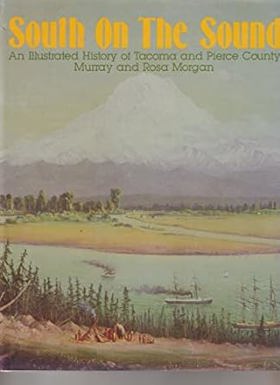
South on the Sound: An Illustrated History of Tacoma and Pierce County chronicles the evolution of Washington’s "City of Destiny" and its surrounding region from Indigenous roots and early European settlement through its late-twentieth-century industrial growth. Written by celebrated Pacific Northwest historian Murray Morgan alongside Rosa Morgan and Rita Happy, the book combines engaging narrative with a rich archive of historical photographs, maps, and archival imagery. It highlights major regional milestones, including Tacoma's pivotal selection as the Northern Pacific Railroad’s western terminus, the rise of timber and maritime shipping, and local community life. The volume stands as an accessible, visually driven portrait of the South Sound's cultural and economic heritage.
199 pages : illustrations (some color) ; 29 cm
CIRC [ 1 ]
The working waterfront the story of Tacoma's ships and men by Ronald Magden, A. D. Martinson
Puget's sound a narrative of early Tacoma and the southern Sound by Murray Morgan
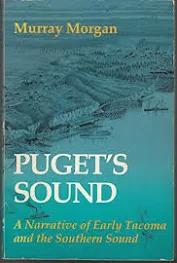
With the same ability to make personalities and events come alive that characterizes his classic "Skid Road", Murray Morgan here tells the colorful story of southern Puget Sound, where major events of Washington's history took place, and of Tacoma, the area's principal city. Drawing upon the original journals and reports, Morgan tells his story largely in terms of individuals, interweaving portraits of well-known historical figures with those who are more obscure but who have a special significance. Journalist and historian Murray Morgan (1916-2000) was the author of more than twenty books, including "Skid Road: An Informal Portrait of Seattle" and "The Last Wilderness". He worked for "Time" magazine, the "New York Herald Tribune", and CBS News before returning to Washington where he taught at Tacoma Community College and for fifteen years hosted the early morning radio show 'Our Town, Our World.'
360 s. : illustrations
CIRC [ 1 ]
Origin of geographic names of Tacoma/Pierce County, Washington by Gary Fuller Reese
Steamer to Tacoma by Wilbur Thompson, Allen Beach
Tacoma, its history and its builders a half century of activity by Herbert Hunt

Published in 1916 by journalist Herbert Hunt, Tacoma, Its History and Its Builders: A Half Century of Activity offers an exhaustive chronicle of the city’s aggressive rise from a rugged Puget Sound mill town to a major industrial railroad terminus. The multi-volume text details the ruthless corporate maneuvering of the Northern Pacific Railway, the fierce regional rivalry with Seattle, and the foundational lumber and maritime industries that fueled Tacoma's ambitions as the self-proclaimed "City of Destiny." A keen insight drawn from the work is how early civic boosterism actively sanitized the city's history of racial violence to protect its commercial reputation; by framing the brutal 1885 expulsion of Tacoma's entire Chinese community as a tragic but necessary measure for labor stability, Hunt's narrative demonstrates how pioneer-era historians deliberately rewrote organized xenophobia as an acceptable cost of maintaining civic order and industrial progress.
3 volumes frontispieces, plates, portraits, maps 27 cm
ONLINE CIRC [ 3 ]
Pierce County
- Alder
- Alderton
- Allison
- American Lake Garden Tract
- Arletta
- Artondale
- Ashford
- Bayview
- Bee
- Benroy
- Berkeley
- City of Bonney Lake
- Brookdale
- Browns Point
- City of Buckley
- Burnett
- Caledonia
- Canterwood
- Town of Carbonado
- Cascade Junction
- Castlenook (historical)
- Cebalop (historical)
- Cedar View
- Clay City
- Clinton Park
- Clover Park
- Croker
- Cromwell
- Custer
- Dash Point
- Dieringer
- City of DuPont
- East Cromwell
- Eastward
- Town of Eatonville
- Eatonville Junction
- City of Edgewood
- Elbe
- Electron
- Elk Plain
- Excelsior
- Fairfax
- City of Fife
- Fife Heights
- City of Fircrest
- Forest Beach
- Fort Nisqually
- Fox Island
- Fox Island
- Frederickson
- Gertrude
- City of Gig Harbor
- Glencove
- Graham
- Greenwater
- Herron
- Hillhurst
- Hillside
- Home
- Hope
- Interlaken
- Jims Corner
- Johnson Landing
- Johnsons Corner
- Kapowsin
- Ketron
- Key Center
- La Grande
- Lake Bay
- Lake City
- Lakebay
- Lakeview
- City of Lakewood
- Larchmont
- Leber
- Longbranch
- Longmire
- Loveland
- Magnolia Heights
- Maplewood
- McKenna
- McMillin
- Meridian
- Midland
- Midway
- City of Milton
- Minter
- Mock City
- Monta Vista
- National
- New Reliance
- Nisqually Vista
- North Puyallup
- Oakland
- Ohop
- Ohop Bob
- Old Tacoma
- City of Orting
- Paradise
- Park Junction
- Parkland
- Peach Acres
- Pioneer
- Ponderosa Estates
- Ponders Corner
- Prairie Ridge
- Purdy
- City of Puyallup
- Puyallup River Junction
- Reliance
- Rhododendron Park
- Rocky Ridge
- Rosedale
- City of Roy
- Town of Ruston
- Shore Acres
- Snoquera
- South Hill
- Town of South Prairie
- Spanaway
- Town of Steilacoom
- Summit
- City of Sumner
- Sunrise
- Sunrise Beach
- Sunset Beach
- Sunshine Beach
- Surprise Valley
- Swede Hill
- City of Tacoma
- Tanwax
- Thrift
- Tillicum
- City of University Place
- Upper Fairfax
- Vaughn
- Voss Resort
- Waller
- Warren
- Wauna
- Town of Wilkeson
- Wollochet
- Yoman
Political Boundaries
Last updated: 2025-09-23