Ocean Falls Central Coast Regional District, British Columbia
Community - An unincorporated populated place, generally with a population of 50 or more, and having a recognized central area that might contain a post office, store and/or community hall, etc, intended for the use of the general public in the region. Head of Cousins Inlet, W end of Dean Channel, W of Bella Coola, Range 3 Coast Land District
Mapped Location
Ocean Falls: The mapped location is an approximation and should not be used for navigation or wayfinding.
Information
General information on Ocean Falls
- Feature Type: Place
Official, historical, colloquial and alternative toponyms for Ocean Falls
A brief list of names that this geographic feature has been named
| Name | Description |
|---|---|
| Ocean Falls | Official |
Origin Notes and History of Ocean Falls
References to Ocean Falls that document the origin of its place name
Ocean Falls (Post Office, mill town) was adopted in the 1930 BC Gazetteer. Form of name changed to Ocean Falls (settlement) 13 March 1947 on 93 SW. Form of name changed to Ocean Falls (Post Office and Steamer Landing) in the 1953 BC Gazetteer. Form of name changed to Ocean Falls (community) 28 February 1983 on 93 D/5.
Ocean Falls Post Office opened 1 August 1912; closed 23 August 1913. Re-opened 15 May 1916.
Until Link Lake was dammed an impressive waterfall fell into the ocean here.
Related Catalog Titles
A Bibliography for Ocean Falls, Central Coast Regional District, British Columbia
Rain people the story of Ocean Falls by Bruce Ramsey, Roland Neave
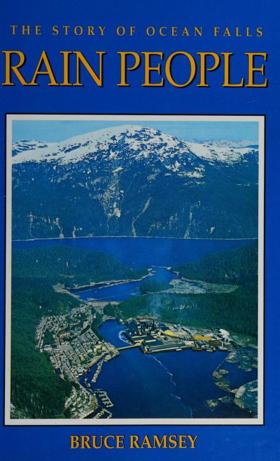
Authored by Bruce Ramsey and edited by Roland Neave, Rain People: The Story of Ocean Falls chronicles the rise and fall of the isolated, company-owned pulp and paper mill town nestled in the rugged coastal fjords of British Columbia. The book traces the community's mid-century heyday as a thriving industrial enclave accessible only by boat or plane, powered by torrential local rainfall and sustained by a tight-knit working-class population. Through archival photographs and personal accounts, the text details the sudden, devastating corporate closure that transformed a bustling boomtown into a damp ghost town. A keen insight drawn from the work is how corporate paternalism created a profound psychological vulnerability in remote industrial outposts; when distant executives pulled the plug on the mill, residents discovered that their entire social fabric, municipal infrastructure, and sense of identity had been built on foundation stones owned entirely by a corporation.
xi, 240 p. : ill., maps (1 folded), ports. ; 22 cm.
CIRC [ 1 ]
Central Coast Regional District
- Atnarko
- Bella Bella
- Bella Coola
- Boswell
- Brunswick
- Campbell Island
- Dawsons Landing
- Duncanby Landing
- Firvale
- Good Hope
- Goose Bay
- Hagensborg
- Kilbella Bay
- Kimsquit
- Margaret Bay
- Nalos Landing
- Namu
- Ocean Falls
- Old Bella Bella
- Oweekeno
- Rivers Inlet
- Shearwater
- South Bentinck
- Stuie
- Tallheo
- Wadhams
- Waglisla
Political Boundaries
Last updated: 2023-09-26