Skagit County County
The county was formed in 1883 from Whatcom County and is named for the Skagit Indian tribe, which has been indigenous to the area prior to European-American settlement.
Mapped Location
Skagit County: The mapped location is an approximation and should not be used for navigation or wayfinding.
Information
General information on Skagit County
- Feature Type: County
- County Seat: City of Mount Vernon
- Established: Wednesday, November 28, 1883
Official, historical, colloquial and alternative toponyms for Skagit County
A brief list of names that this geographic feature has been named
| Name | Description |
|---|---|
| Skagit County | Official |
Origin Notes and History of Skagit County
References to Skagit County that document the origin of its place name

SKAGIT, the name of an indian tribe which lived on the river now known by the same name, The tribe also occupied part of Whidbey Island. As in the case of other Indian names there have been many forms of the word used. (Handbook of American Indians, Volume II., page 585.) John Work, of the Hudson's Bay Company, in 1824, referred to Scaadchet Bay. (Washington Historical Quarterly, July, 1912, page 225.) George Gibbs used the present form of the word on March 1, 1854. (Pacific Railroad Reports, Volume I., page 471.) The same form is used in the treaty by which the Skagits ceded their lands, January 22, 1855. The County bearing this name was created by the Legislature of the Territory of Washington on November 28, 1883. At the southern extremity of Whidbey Island is a bluff called Scatchet Head, another spelling of the same word. Near the northern extremity of the same island are Skagit Bay and Skagit Island. Skagit City began with Barker's trading post in 1869. The townsite was platted on the homestead of W. H. McAlpine. "It is no longer much of a place." (History of Skagit and Snohomish Counties, page 246.) The Wilkes Expedition, 1841, charted the island as "Skait Island" (Hydrography, Volume XXIII., Atlas, chart 90.)
Related Catalog Titles
A Bibliography for Skagit County, County
Maritime names of Washington by Richard W. Blumenthal
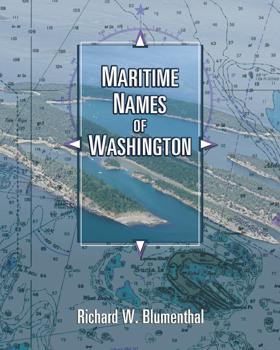
Maritime Names of Washington is a wonderful companion if you are a boating enthusiast or simply curious about Washington’s maritime history. This book is a scholarly study on the origins of place names for our coastal and inland waters. It covers every name that appears on current nautical charts, from the Pacific Coast to the Strait of Juan de Fuca, the San Juans, and Puget Sound from Port Townsend to Olympia. It includes every named island, bay, point, inlet, pass, harbor, rock, channel, strait, canal, peninsula, sound, and shoal. The book also features many local and historical names that are not shown on the charts. The manuscript generally identifies the individual who named the place, when, why, and for whom. It also identifies the chart where the name first appeared and the early settlement history of many places. The manuscript is richly annotated and uses many quotes from the observations of our earliest explorers to give readers a glimpse of what Puget Sound country looked like 200+ years ago. Each of our early explorations is discussed in detail as they relate to individual place names. The book contains 170 pictures and 44 historical nautical charts from 1790 to 1900 that show many of the names
ix, 501 pages : illustrations, maps, charts ; 26 cm
CIRC [ 1 ]
Hiking close to home Whidbey, Fidalgo, and Guemes Islands : 2023 edition by Maribeth Crandell
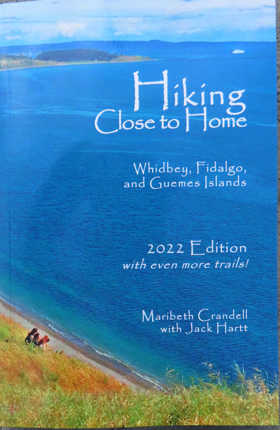
Forests, fields, beaches and bluffs -- our islands provide plenty of options for just about any hiking ability. You don't have to go very far. Explore your own backyard with this handy guide to more than seventy hikes that are Close to Home. Maribeth Crandell has over twenty years of experience as a hiking guide in the Pacific Northwest. For decades she's made Whidbey and Fidalgo Islands her home. Jack Harrt managed Deception Pass State Park for 14 years and now works with trail organizations in Skagit County. Here they share some of their favorite local trails with you."--Page 4 of cover
xii, 160 pages : color illustrations, color maps ; 22 cm
CIRC [ 1 ]
In the valley of mystic light an oral history of the Skagit Valley arts scene by Claire E. Swedberg , Rita Hupy
Claire Swedberg and Rita Hupy conducted hundreds of interviews to investigate what role a community plays in the arts, and what the arts can bring to a community. The result is In the Valley of Mystic Light, the first book to chronicle the unique story of the La Conner art scene, while exploring, on a personal level, what it means to be a Northwest artist. This remarkable story provides an illustration of the universal creative process as told by the mystic artists of the Northwest and the townspeople who provided them with support and inspiration.
ix, 298 pages : illustrations (some color) ; 26 cm
CIRC [ 0 ]
A sound defense military sites, lighthouses, and memorials of Puget Sound by Nancy L. McDaniel

"A Sound Defense" is a comprehensive description of military sites of Puget Sound. Military historical sites in the twelve counties (Whatcom, Skagit, Snohomish, San Juan, Island, King, Pierce, Thurston, Mason, Kitsap, Clallam and Jefferson) are described with an emphasis on the unique things which happened there. Over 150 pictures and maps are included. Nancy McDaniel, Colonel, USAF, MSC (Retired) is a Washington State native and brings a love of the area and combines that with a perspective on the contributions that the military has had on Western Washington. "A Sound Defense" describes blockhouses built during the Indian conflicts. It addresses "The Pig War" and the politics of the international relationships which helped establish the boundaries of the United States. Forts built to protect Puget Sound as a result of the decisions of the Endicott Board are described along with the personalities of the commanders and personnel who were assigned there. Long forgotten installations established to provide early warning of approaching enemy aircraft are prominent in this comprehensive book. Lighthouses throughout the area are highlighted with the inclusion of historical photos and stories of early lightkeepers. Most importantly, "A Sound Defense" recognizes the contributions of military personnel throughout the years by the inclusion of memorials and facilities dedicated to recognizing their service to the country.
xvi, 365 pages : illustrations, maps ; 23 cm
CIRC [ 1 ]
Letters from Kik-I-allus a farmer's perspective by Glen Johnson
Published in local editions by Glen Johnson, Letters from Kik-I-allus: A Farmer's Perspective collects insightful essays and correspondence reflecting on rural life, environmental stewardship, and local history near the Skagit River delta. Written from the perspective of a working farmer tied to the ancestral homeland known as Kik-I-allus, the book chronicles the daily rhythms of agriculture, the seasonal cycles of the Pacific Northwest, and the mounting pressures of modern development on traditional farmlands. Through evocative prose, Johnson bridges personal agronomic experience with a deep-seated reverence for the surrounding watershed and its indigenous legacy. A keen insight drawn from the text is how the traditional agrarian viewpoint acts as an acute ecological barometer; by documenting the subtle, creeping degradation of local soils and water tables firsthand, the author reveals that the survival of family farming is inextricably bound to the broader health of the regional ecosystem.
246 pages : illustrations, map ; 18 cm
CIRC [ 1 ]
The Skagit collection first views : an early history of Skagit County, 1850-1899, vol. 2 by Theresa Trebon , Skagit Valley Herald

Published in local editions by archivist Theresa Trebon in cooperation with the Skagit Valley Herald, The Skagit Collection: First Views: An Early History of Skagit County, 1850-1899, Vol. 2 compiles rare historical photographs and local narratives documenting the formative decades of Washington's Skagit Valley. The volume captures the arduous daily lives of early homesteaders, loggers, and commercial fishermen who wrestled a tamed agricultural and industrial landscape out of dense river deltas and dense timberlands. Drawing heavily from archival images and early newspaper columns, the text preserves the visual and social fabric of communities navigating rapid frontier expansion. A keen insight drawn from the work is how late 19th-century local journalism and photography served as deliberate acts of community-building; by visually documenting fledgling settlements before they were fully established, pioneers used the camera to legitimize their presence and carve a permanent sense of permanence out of a fluid, flood-prone wilderness.
xxiv, 143 pages : illustrations, portraits ; 20 cm
CIRC [ 1 ]
Memories of Clear Lake by Charles R. Hyatt, Clear Lake Historical Association
Published by the Clear Lake Historical Association and compiled by Charles R. Hyatt, Memories of Clear Lake presents a nostalgic and detailed chronicle of the historic logging, rail, and community developments around the Skagit County settlement in northwest Washington. The book compiles vintage photographs, local newspaper excerpts, and personal reminiscences to trace how a bustling timber outpost grew and shifted alongside the changing regional economy. Through these collected records, the text preserves the domestic and industrial rhythms of families who built their lives amidst towering old-growth forests and local waters. A keen insight drawn from the work is how single-industry towns experienced a unique form of community permanence even after their primary resource vanished; by documenting how residents repurposed old logging infrastructure and community spaces for long-term rural living, the narrative reveals that the true legacy of these settlements was not the timber they exported, but the stubborn social bonds forged in the shadow of the mill.
vi, 105 pages : illustrations ; 22 cm
CIRC [ 1 ]
So they called the town "Concrete" a story of life and times in unique Concrete, Washington by Charles M. Dwelley
Concrete, as a town, had a colorful and interesting history and those who took part even briefly never forgot "those old days in Concrete." Some of the itinerant workers who arrived with the building of the railroad in 1900 - Italians, Swedes, Norwegians, Greeks from the old country; plus Northerners, Southerners, Easterners of all nationalities remained to become accorded an unusual acceptance and welcome that made them feel at home. Many who came for a short employment stayed on to marry and settle in, and lived to be buried here as old-timers. It was that kind of town. If you want to know the rest of the story, read on.
134 pages : illustrations ; 21 cm
CIRC [ 1 ]
Skagit memories stories of the settlement years as written by the pioneers themselves by Charles M. Dwelley, Helen May Dwelley

Building the Skagit a century of Upper Skagit Valley history, 1870-1970 by Paul C. Pitzer
This brief history tells the story of a small valley in Washington State's North Cascades. Over the century since its discovery, it has been developed into a National Parks and Recreation Area, and a large hydroelectric resource that supplies much of Seattle's power. First there were the gold miners who came in 1880 and returned in 1908. Next came the homesteaders who fought the weather and the government for their land. After World War I, Seattle City Light gained control of the Skagit. Would they ever finish building the first dam at Gorge Creek? Why did the Mayor fire J.D. Ross, Seattle City Light's superintendent? What was the Old Skagit Tour like? Construction o all Skagit dams was difficult. The weather and the geology made completion of the project a notable achievement. Building the Skagit is one example of the struggles that have led to the development of our nation's natural resources
105 pages : illustrations, maps, portrait ; 21 cm
CIRC [ 1 ]
McMurray-- gone with the trees by Varee A. Bandazy
McMurray and Medina are former logging towns in Skagit County, Washington
ix, 181 pages : illustrations, maps, portraits ; 21 cm
CIRC [ 1 ]
Skagit settlers trials and triumphs, 1890-1920 by Skagit County Historical Society, Margaret Willis
Valley of the spirits the Upper Skagit Indians of western Washington by June M. Collins
"Although the Upper Skagit Indians at one time controlled the great Skagit River drainage system in northwestern Washington, relatively little has been known about them, owing to the isolation in which many of them lived. When June Collins began her field work among the Upper Skagit in 1942, many precontact religious traditions and family and kinship practices had survived. Continuing her field work at intervals over a period of twenty years, she formed strong friendships with her informants. She is therefore able to present one of the most detailed and thorough ethnographic studies ever undertaken of a Northwest Coast people. Of particular interest is the exceptionally detailed description of Upper Skagit religious life, which was characterized by a belief in guardian spirits. Basing her analysis on dozens of case studies and descriptions by informants, Collins discusses the nature of the spirits, how they were acquired by the individual, the powers they conferred, and the dances held in their honor"--Book jacket
xiii, 267 pages : illustrations ; 22 cm.
CIRC [ 1 ]
Chechacos all the pioneering of Skagit by Skagit County Historical Society, Margaret Willis
This isle of Guemes by Helen Troy Elmore, Community Club of Guemes Island
Blanket Bill Jarman northwest Washington mystery man : first pioneer settler in Whatcom and Skagit counties by Percival Robert Jeffcott
Published in 1958, Percival Robert Jeffcott's book is a biographical account of William Robert "Blanket Bill" Jarman, recognized as the first white pioneer to settle in Washington's Whatcom and Skagit counties. The work seeks to untangle the factual history of Jarman's frontier life from the dense web of myths, legends, and tall tales that had grown around him over the decades. By meticulously cross-referencing interviews and local lore with documentary evidence—such as Hudson's Bay Company records—Jeffcott systematically investigates and debunks several exaggerated stories, including a famous tale about Jarman being ransomed. Ultimately, the text serves as both a detailed character study of an elusive regional figure and a rigorous examination of early Pacific Northwest pioneer folklore.
xii, 202 p. : ill. ; 24 cm.
CIRC [ 1 ]
An Illustrated history of Skagit and Snohomish Counties, their people, their commerce and their resources with an outline of the early history of the State of Washington, endorsed as authentic by local committees of pioneers by The Interstate Publishing Company
Published by the Interstate Publishing Company, An Illustrated History of Skagit and Snohomish Counties offers a sweeping, encyclopedia-style chronicle of early pioneer settlement and economic development in northwestern Washington. The extensive volume traces the rapid transformation of the region's dense primeval forests and fertile river valleys into thriving hubs of the timber, agricultural, and maritime industries. Through exhaustive biographical sketches of prominent families—explicitly endorsed as "authentic" by local pioneer committees—the text serves as a monumental archive documenting the civic ambition and commercial resource extraction that defined the Puget Sound hinterlands. A keen insight drawn from the work is how the overt endorsement by pioneer committees reveals the manufactured nature of early frontier historiography; by tightly controlling the published narrative to validate their own commercial successes, the region's founding elite actively engineered a sanitized, triumphant origin story designed to cement their social authority and attract future investment.
1117 pages : portraits ; 29 cm
ONLINE CIRC [ 1 ]
Related Online Resources
Coast Salish Place Names of the San Juan Islands
An ongoing project of a present day look at historic Coast Salish locations throughout the San Juan Islands and Strait of Georgia compiled by the Samish Indian Nation
WEB LINK
Skagit County
- Alexander Beach
- Alger
- Allen
- City of Anacortes
- Atlanta (historical)
- Avon
- Baker Heights
- Bay View
- Belfast
- Big Lake
- Birdsview
- Blanchard
- Bow
- City of Burlington
- Cedardale
- Chuckanut Junction
- Clear Lake
- Cokedale
- Town of Concrete
- Conway
- Corkindale
- Day Creek
- Dewey
- Edison
- Edison Station
- Equality
- Fidalgo
- Fish Town
- Fredonia
- Gibraltar
- Grassmere
- Guemes
- Town of Hamilton
- Hamilton Junction
- Hoogdal
- Howards Corner
- Indian Village
- Town of La Conner
- Lake Cavanaugh
- Lake McMurray
- Leary
- Town of Lyman
- Mansford
- Marblemount
- McMurray
- Milltown
- Minkler
- Montborne
- City of Mount Vernon
- Nestos (historical)
- North Beach
- Portage
- Prairie
- Rexville
- Rockport
- Rosario Beach
- Samish
- Samish Island
- Sauk
- City of Sedro-Woolley
- Sharpes Corner
- Shelter Bay
- Similk Beach
- Skagit City
- Snee Oosh
- Sterling
- Sunset
- Swinomish Village
- Thornwood
- Urban
- Van Horn
- West Shore
- Whitmarsh Junction
- Whitney
- Yokeko Point
Political Boundaries
Last updated: 2025-09-23