Catalog of British Columbiana and Pacific Northwest Americana
The Encyclopedia Cascadia Catalog indexes mostly non-fiction literature covering the Pacific Northwest coast of North America, with an emphasis on British Columbia, Idaho, Oregon, and Washington State.
| Catalog Title | Published |
|---|---|
|
The Indian history of British Columbia the impact of the white man by Wilson Duff, Royal British Columbia Museum 
In The Impact of the White Man, Wilson Duff presents a clear and comprehensive summary of the effects of immigrant settlement on the population, culture, economy and religion of British Columbia's First Peoples. First published in 1964, this book has stood the test of time. With more than 15,000 copies in print, it remains an important anthropological and historical record up to the 1960s. Duff wrote The Impact of the White Man as the first of three volumes on the history of the First Peoples in B.C. He never completed the other two volumes, but this book, on its own, has become a classic of anthropology. The new edition retains the author's original text and features more photographs, an appendix updating the names and territories of First Nations in B.C., a new list of recommended reading, and an index 184 pages : illustrations, maps ; 23 cm Non-circulating [ 1 ]
|
1997 |
|
The Nez Perce Indians and the opening of the Northwest by Alvin M. Josephy 
This is the story of the so-called Inland Empire of teh Northwest, that rugged and majestic region bounded east and west by the Cascades and the Rockies, from the time of the great exploration of Lewis and Clark to the tragic defeat of Chief Joseph in 1877. Explorers, fur traders, miner, settlers, missionaries, ranchers and above all a unique succession of Indian chiefs and their tribespeople bring into focus one of the permanently instructive chapters in the history of the American West xx, 705 pages : illustrations, maps ; 23 cm Non-circulating [ 1 ]
|
1997 |
|
Fire, faults & floods a road & trail guide exploring the origins of the Columbia River basin by Marge Mueller, Ted Mueller 
Fifty-three trips are targeted to assist readers in finding and understanding the area's major geologic features. Among the regions covered are: Missoula, Montana and the lower Clark Fork drainage; Grande Ronde and Joseph Creek Canyons on the borders of Washington, Oregon, and Idaho; the Columbia River Gorge; and the northern Oregon Coast. Includes b&w photos and maps. c. Book News Inc 288 pages : illustrations, maps ; 22 cm Non-circulating [ 1 ]
|
1997 |
|
The price of taming a river the decline of Puget Sound's Duwamish/Green waterway by Mike Sato 
The historical puzzle that is the Green River and its drainage basin, from Mount Rainier to Puget Sound, is carefully pieced together in this portrait of the people, events, and dramatic forces that have determined the fate of this once-powerful river. Beginning in the early years of this century, the Duwamish/Green waterway was rechanneled, dredged, dammed, and diked in an attempt to prevent flooding and salvage land for agriculture and industry. The "taming" of the river made a valuable stretch of land usable year-round but the consequences have been pollution and the destruction of the habitat it once provided for fish, shellfish, and wildlife. Ranging from prehistoric times to the present, from geologic forces to political and economic battles, The Price of Taming a River shows clearly what has been lost but also tells the compelling story of the individuals and communities who are working to restore and preserve the watershed. It is a story of small places and large issues, of bitter controversy and quiet victories, which presents a vision of what can be accomplished by those who choose to embrace their role as stewards of the river 107 pages : illustrations ; 21 cm Non-circulating [ 1 ]
|
1997 |
|
The Whitman Massacre by E. M. Saunders 
Authored by E. M. Saunders, The Whitman Massacre provides a dramatic narrative account of the tragic 1847 attack on the Cayuse Indian mission at Waiilatpu by members of the Cayuse tribe, resulting in the deaths of Marcus and Narcissa Whitman and twelve others. The book explores the mounting racial tensions, cultural misunderstandings, and devastating epidemics—particularly measles—that fueled Indigenous resentment against encroaching American settlers. Drawing on historical documents and period accounts, the text examines how the missionary enterprise inadvertently triggered a catastrophic clash of worlds in southeastern Washington. A keen insight drawn from the work is how medical disparities served as the ultimate catalyst for frontier violence; because traditional Cayuse healing practices failed against introduced European diseases while white missionaries survived, the tribe perceived the plague as targeted biological warfare, turning a public health disaster into a fatal geopolitical flashpoint. 56 pages Non-circulating [ 1 ]
|
1997 |
|
British Columbia place names by G. P. V. Akrigg, Helen B. Akrigg 
Elephant Crossing. Houdini Needles. Miniskirt, Tickletoeteaser Tower, and Why Not Mountain. These are just some of the many names of places, rivers, mountains, and lakes that you will come across in the newest edition of British Columbia Place Names. This classic which, in its various editions, has sold over 29,000 copies, covers about 2,500 geographical features, cities, towns, and smaller communities in the province. The book abounds with fascinating historical facts, stories, and remarkable characters involved with the names of towns, cities, rivers, lakes, mountains, and islands. The selection was determined by the geographical importance of the feature as well as story of the naming. In the introduction the authors deal with the stages by which B.C. acquired its place names, the history of research into those names, and the categories into which they fall. The latter range from the honorific and commemorative to the comic and disrespectful. Aboriginal names receive particular attention. The location of each place is clearly indicated and the text is accompanied by detailed maps. Brief biographical accounts of persons with places named after them as well as an abundance of anecdotes make this a fascinating book for browsers and an invaluable resource for historians. xxv, 304 pages : maps ; 24 cm Non-circulating [ 1 ]
|
1997 |
|
Snowbound by Ladd Hamilton 
Into the untamed vastness of the Bitterroot mountains go three young New York men, their guide, and a camp cook. This is to be the adventure of a lifetime, but it is already September. Ahead of the hunters, as they make their way up the Lolo Trail, are the record snows of 1893 and a cruel, controversial decision. Snowbound is the true story of the Carlin party, whose ill luck and bad judgement drove decent men to an ethical dilemma that intrigued the nation and still can raise an argument wherever people rub shoulders with wilderness. Ladd Hamilton’s previous book for WSU Press, This Bloody Deed, detailed the story of the Magruder massacre of the 1860s in that same Idaho wilderness. The New York Times Book Review noted that “This Bloody Deed is marked by the author’s…familiarity with that rough Western terrain and his clear affection for the complex people who…roamed and tamed it.” Once again, Hamilton has brought rich narrative detail and crackling tension to an intriguing episode of Northwest history. Ladd Hamilton retired in 1987 as senior editor and columnist of the Lewiston Morning Tribune, and since then has been writing and teaching journalism at Lewis-Clark State College in Lewiston, Idaho. He and his wife Pauletta live in the Lewiston Orchards. xii, 228 pages, 8 unnumbered pages of plates : illustrations, map, portraits ; 24 cm Desiderata
|
1997 |
|
The Rogue River Indian War and its aftermath, 1850-1980 by E. A. Schwartz 
This history of the native peoples of western Oregon is a systematic study of the formation, application and effects of United States Indian policy. Historian E.A. Schwartz tells how contacts with whites early in the nineteenth century culminated in the pork-barrel Rogue River War of 1855-56, in which the Rogue River peoples demonstrated superior tactics and repeatedly drove off more-numerous opponents. Schwartz narrates how the Indian peoples known today as the Confederated Tribes of the Siletz Reservation survived American expansion and coped with each federal Indian-policy initiative, from the new western reservation policy of the 1850s through termination and restoration in the 1970s xiv, 354 pages : illustrations, maps ; 24 cm Desiderata
|
1997 |
|
Northwest birds in winter by Alan Contreras 
Observing birds in the Pacific Northwest in winter is both challenging and rewarding. Despite the weather and the fact that many birds are not in their brightest plumage, winter birding is growing increasingly popular. Unlike the breeding season, when many birds are territorial and observers must travel widely to see them, in winter many birds concentrate and a field trip can find amazing densities and species variety in a small area. Northwest Birds in Winter is the first guide to the distribution and abundance of birds that winter in Oregon, Washington, Idaho, and southern British Columbia. It offers a summary of winter status and distribution information for the nearly 380 regularly occurring species in the region. Detailed winter range maps and 30-year population trend data are provided for many of the species. In addition, the book includes suggestions as to the best winter birding sites in the Pacific Northwest and photographs of the region's most unusual winter birds. This seasonal guide is an essential addition to the literature on Northwest birds and a valuable new resource for birders in the Pacific Northwest. xxiv, 264 pages : illustrations, maps ; 22 cm Desiderata
|
1997 |
|
An annotated bibliography of Oregon bird literature published before 1935 by George A. Jobanek 
George Jobanek's exhaustive, richly annotated bibliography fills an important gap in Oregon bird literature and offers a valuable new resource for professional and informed amateur ornithologists, wildlife managers, biologists, ecologists, and anyone with a serious interest in the natural history of the Pacific Northwest. In compiling this unique book, George Jobanek carefully researched early ornithological, scientific, and natural history publications, from American Field to Zoe, for records of Oregon birds. Most of these early articles are today relatively rare; many were overlooked or ignored by previous bibliographers. In his annotations for each of the nearly two thousand entries, Jobanek conveys the salient points of each article and reveals its usefulness for contemporary readers. Direct quotations from the references allow for a glimpse of an earlier, golden age in ornithology. References are organized by author and cross-indexed by species (e.g., 86 entries for Sage Grouse), county (e.g., 220 entries for Klamath County), and key word (e.g., "behavior," "conservation," "distribution," "introduction," "migration," "nesting," "taxonomy"). A gazetteer identifies localities mentioned in the annotations. xii, 481 pages : illustrations ; 24 cm Desiderata
|
1997 |
|
Silent shores & sunken ships by Milton Parent 
Milton Parent’s Silent Shores & Sunken Ships documents the spatial, maritime, and industrial history of Upper Arrow Lake and the Columbia River reaches stretching south from Revelstoke to Galena Bay and Shelter Bay. The chronicle focuses on the strategic role of Arrowhead as the CPR railhead where transcontinental rail traffic transferred directly onto sternwheelers servicing the mining towns and lumber camps of the Kootenay and Lardeau districts. Parent details the establishment of massive shoreline lumber operations, including the giant mills at Comaplix and Beaton, while recording the perilous navigation of steamships like the S.S. Revelstoke and S.S. Columbia. The volume concludes by documenting the civic and geographical dislocation triggered by the construction of the Hugh Keenleyside Dam, which permanently flooded historical townsites, farms, and ferry landings beneath the expanded lake reservoir. 368 pages : illustrations, maps, portraits ; 29 cm Desiderata
|
1997 |
|
Looking back at the Cariboo-Chilcotin by Irene Stangoe
Irene Stangoe’s Looking Back at the Cariboo-Chilcotin chronicles the settlement, ranching enterprises, and frontier communities scattered across the vast plateau country west of the Fraser River. Stangoe traces how pioneer cattlemen established expansive grazing spreads across rangelands traditionally stewarded by the Tsilhqot'in and Southern Carrier peoples. The volume details the daily operations of remote roadhouses, general stores, and family ranches situated along the Chilcotin Highway, featuring focused historical portraits of Riske Creek, Alexis Creek, Hanceville, Big Creek, Meldrum Creek, Redstone, Lees Corner, and Chilanko Forks. Through local oral histories, historic photographs, and personal interviews, the work captures the resilient community networks and agrarian adaptations required to sustain isolated settlements across this expansive interior terrain. 160 pages : illustrations, maps, portraits ; 22 cm Desiderata
|
1997 |
|
British Columbia a natural history by Richard J. Cannings, Sydney G. Cannings 
A comprehensive review of the physical and natural environments of the Province, written for interested laypersons, describing the natural history of BC by ecological region. Also discusses threatened ecosystems, climate change and introduced species 310 pages : illustrations (some color) ; 27 cm Non-circulating [ 1 ]
|
1996 |
|
Handbook of North American Indians Volume 17, Languages by Ives Goddard, William C. Sturtevant, Smithsonian Institution 
This volume is part of the Smithsonian Institution’s Handbook of North American Indians series, the ultimate resource for Native American history across various regions of North America. The set is intended to give an encyclopedic summary of what is know about the prehistory, history, and cultures of the aboriginal peoples of North America north of the urban civilizations of central Mexico. Volume 17 provides a basic reference work on the Native languages of North America, their characteristics and uses, their historical relationships, and the history of research on these languages. Contains copyrighted material. 10th volume to be published in a 20 volume set. xiii, 957 pages : illustrations, maps ; 29 cm Non-circulating [ 1 ]
|
1996 |
|
The Sunshine Coast from Gibsons to Powell River by Howard White 
British Columbia's Sunshine Coast is a sublimely scenic 160-kilometre stretch of waterfront between Howe Sound and Desolation Sound, reached by a 40-minute ferry ride from West Vancouver. Join Howard White, award-winning humorist and lifelong coast denizen, on a guided tour from Gibsons, where the long-running TV series The Beachcombers was filmed, to Powell River, the largest community in the region. Along the way, sojourn in Roberts Creek, whose patron saint, the irrepressible Harry Roberts, invented the name "Sunshine Coast." Stop over in Sechelt, named for the Shi'sha'lh or Sechelt Nation who once occupied the bulk of the Sunshine Coast territory. Follow the seriously twisty highway to visit Pender Harbour, where some local fishing folk still do their Saturday shopping in kicker boats. Drop anchor in Princess Louisa Inlet, and discover why the likes of John Barrymore and Andrew Carnegie once came to marvel at its canyon-like splendour. With paintings by local artists, poems by local poets, tall tales by local characters, miracles by Sechelt medicine men, tips on predicting the weather, a fair share of risqué gossip about historical figures, a good mix of bold opinions and hard facts and over 150 beautiful colour photographs, The Sunshine Coast is a book to be treasured, not just by residents and visitors, but by anyone with an eye for fascinating places. First published in 1996, this fully revised edition contains updated text and all new photographs of coast life from the area's most talented photographers including Dean van't Schip and Keith Thirkell. 127 pages : illustrations (some color), color maps ; 29 cm Non-circulating [ 1 ]
|
1996 |
|
Roadside history of Idaho by Betty B. Derig 
The best way to enjoy Idaho's rich heritage is to visit the sites where history happened. Roadside History of Idaho makes you feel like you've got a native guide at hand as it transports you to those places through well-researched, well-told stories and vivid historical photographs xx, 362 pages : illustrations, maps ; 24 cm. Non-circulating [ 1 ]
|
1996 |
|
The interwoven lives of George Vancouver, Archibald Menzies, Joseph Whidbey, and Peter Puget exploring the Pacific Northwest Coast by John Michael Naish 
The Vancouver Voyage exemplifies the extraordinary upsurge in optimism and adventure in the last two decades of the 18th century. Four men were the lynch-pins of that enterprise and this volume examines their achievements and sufferings. It particularly examines the interplay and stress between the men, both physical and psychological, during the voyage. Evidence as to the nature of Vancouver's own chronic disease (which killed him in his 41st year) is presented, and his psychological state is analysed. The achievement of both Vancouver and Menzies in defeating scurvy during the voyage is described. Menzies' largely unpublished and voluminous journal provides the major source of information on the lands explored and the peoples encountered, and the work also contains original material about Whidbey's later life and relationships. Although unusual in format, this work seeks to illuminate the history of those times by applying a physician's eye to four outstanding representatives of an age of optimism. With nineteen photos and eight maps. 537 pages ; 24 cm. Non-circulating [ 1 ]
|
1996 |
|
A Traveler's History of Washington A Roadside Historical Guide by Bill Gulick 
What happened here? Travelers interested in history want to know about the history of the sites that they pass in the Evergreen State. Who but veteran author Bill Gulick could write the premier historical travel book on Washington? xxviii, 559 pages : illustrations, maps ; 23 cm Non-circulating [ 1 ]
|
1996 |
|
Northwest history articles from the Pacific Northwesterner Quarterly by Jerome Peltier 
Authored by regional historian Jerome Peltier, Northwest History Articles from the Pacific Northwesterner Quarterly compiles a diverse collection of scholarly essays exploring the colorful characters, military engagements, and economic milestones of the inland Pacific Northwest. The volume draws upon meticulous archival research to examine forgotten pioneer trails, early territorial politics, and the complex interactions between native populations and American settlers across Washington, Idaho, and Montana. Through these rigorously detailed historical vignettes, the text preserves the intricate texture of frontier life beyond the Cascade Mountains. A keen insight drawn from the work is how regional historical journals serve as vital repositories for the micro-histories that grand national narratives routinely overlook; by rescuing obscure local disputes and personal journals from archival obscurity, the collection demonstrates that the true fabric of westward expansion was woven from countless localized conflicts and compromises rather than sweeping political decrees. vxiii, 164 pages : illustrations ; 26 cm Non-circulating [ 1 ]
|
1996 |
|
Indian battles along the Rogue River, 1855-56 one of America's wild and scenic rivers by Frank K. Walsh 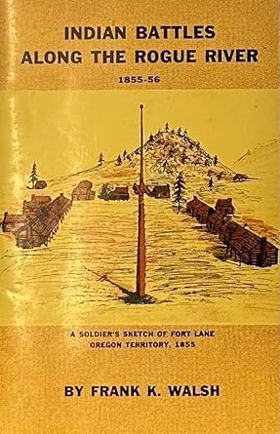
Authored by local historian Frank K. Walsh, Indian battles along the Rogue River, 1855-56: One of America's wild and scenic rivers details the violent armed conflict between regional indigenous bands and white miners and settlers during the height of the Oregon gold rush. The book combines historical accounts, maps, and archival photographs to chronicle the brutal military campaigns, displacement tactics, and fortified engagements that defined the Rogue River Indian War. Through a detailed chronology of the hostilities, the text illustrates the catastrophic human cost of rapid mineral exploitation and land seizure in southwest Oregon. A keen insight drawn from the work is how the romanticized iconography of wild western rivers deliberately obscures the bloody ethnic cleansing required to secure them; by contrasting the pristine, scenic beauty of the modern Rogue River with the suppressed history of the forced removal camps along its banks, the narrative exposes how modern recreational landscapes are frequently built directly over the hidden graves of frontier warfare. iv, 28 pages : illustrations, maps, portraits ; 22 cm Non-circulating [ 1 ]
|
1996 |
|
The faces of history Portraits of the men and women who shaped life in Boundary County, Idaho by Stan DeHart
Authored by local historian Stan DeHart, The Faces of History: Portraits of the Men and Women Who Shaped Life in Boundary County, Idaho compiles a rich photographic and biographical archive of the pioneers, homesteaders, and laborers who carved a community out of the remote panhandle of northern Idaho. The book uses vintage portrait photography and detailed oral histories to resurrect the individual stories of those who braved isolation, harsh winters, and demanding resource industries near the Canadian border. Through these personal profiles, the text honors the human grit that transformed an untamed river valley into a permanent, functioning society. A keen insight drawn from the work is how frontier portraiture functioned as a deliberate act of civilizing permanence; by meticulously dressing up and sitting for traveling photographers, isolated homesteaders used visual self-representation to project dignity and social order onto an unforgiving wilderness that constantly threatened to swallow their hard-won achievements. Oversized paperback Desiderata
|
1996 |
|
Barns of the West a vanishing legacy by Arthur A. Hart 
Text and photos illustrate a variety of barn structures and styles, including hops drying barns. Barns photographed are in Montana, Idaho, Oregon, Washington, and Alaska 112 pages : chiefly illustrations (some color) ; 29 cm Desiderata
|
1996 |
|
So Incredibly Idaho! seven landscapes that define the gem state by Carlos A. Schwantes 
Using colorful images from his photographic collection, Carlos Schwantes describes the hidden forces and historical events that have impacted the landscape of Idaho. xxi, 146 pages : color illustrations, color maps ; 24 cm Desiderata
|
1996 |
|
Nez Perce women in transition, 1877-1990 by Caroline James 
Traditionally Nez Perce Indian women have held important roles within the tribe. The women conducted vital, routine, day-in and day-out domestic chores as well as maintaining a strong influence in tribal community, culture, and tradition. As white encroachment on Nez Perce lands increased and the missionaries increased their influence, the lives of the Nez Perce changed dramatically. This volume is the first look into the lives and contributions of Nez Perce women as they struggled to maintain their families and communities in times of great change. Nez Perce Women in Transition includes unique individual accounts recorded directly from personal interviews with Nez Perce women ranging in age from twenty to ninety. The narratives, in combination with a broad selection of photographs, present some of the major historical, political, and cultural changes that have occurred and provide an opportunity to view Nez Perce women as they made and continue to make dramatic transitions xxix, 245 pages : illustrations, maps ; 27 cm Desiderata
|
1996 |
|
Sketching in the San Juans--and a bit beyond sketches, paintings, comments by Barbara M. Meyer 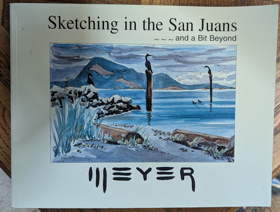
Hold on to your heart as you step into the world of Barbara Meyer's watercolor sketches. Immerse yourself in the tranquility and serenity of every brush stroke as she shares her keenness for empty, wind-swept beaches, new-mown hay and rough -wooded barns. Smile out loud at her humorous and ironic observations of those pesky island birds who insist on occupying every post and piling, especially if it says "No Trespassing". This collection, gently lifted from her sketchbooks, represents the unique observations of one woman's 25-year journey through the timeless space that is the San Juan Islands. Pick up this book as often as you wish, to find a new corner in which to visit and escape. Take a deep breath and inhale the atmosphere. By Barbara Meyer. 1996. Paper Jam Publishing 94 pages : illustrations (some color) ; 22 cm Desiderata
|
1996 |