Catalog of British Columbiana and Pacific Northwest Americana
Encyclopedia Cascadia Catalog contains book titles of mostly non-fiction Pacific Northwest Coast of North America Titles (primarially British Columbia, Idaho, Oregon and Washington State) in an easy-to-understand title catalog. If you see a link with this badge ONLINE CIRC it means that there is an online institution that provides free access to that title. In some cases there may be more than one institution hosting the title digitally.
| Catalog Title | Published |
|---|---|
|
Since the time of the transformers the ancient heritage of the Nuu-chah-nulth, Ditidaht and Makah by Alan D. McMillan 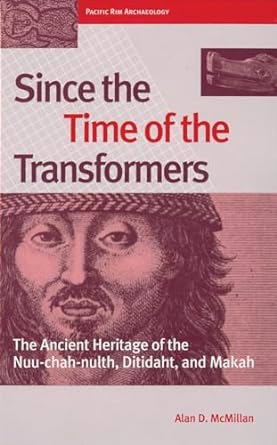
"The Nuu-chah-nulth, Ditidaht, and Makah occupy western Vancouver Island and the northern tip of the Olympic Peninsula in Washington. This book examines the long culture history of these closely related peoples, a history that extends back to mythic times, when the powerful transformers put the landscape and the animals in their present forms." "Alan McMillan brings together an impressive array of sources and integrates them into a single account. Archaeological evidence dating back more than 4,000 years is discussed in detail. Native oral traditions, linguistic studies, and historic evidence also contribute to a rounded picture of these societies and to an understanding of the changes that have occurred over time."--Jacket xii, 252 pages : illustrations, maps ; 24 cm CIRC [ 1 ]
|
1999 |
|
The Sooke story the history and the heartbeat by Elida Peers , Sooke Region Museum 
This history tells of the native people and of the first settlers - and with some anecdotal quotes, condenses the years of development of community, industry and culture into these pages. Anyone who has lived for any length of time in the Sooke area or whose family were participants in the early years of its growth will find this book of great interest." - Introduction 433 pages : illustrations ; 23 cm CIRC [ 1 ]
|
1999 |
|
River city a history of Campbell River and the Discovery Islands by Jeanette Taylor 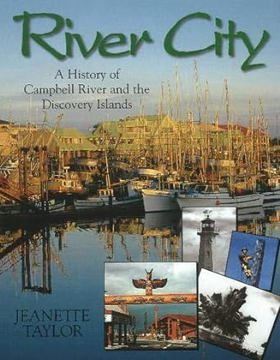
Campbell River, stretching along the benchland of Discovery Passage on the east Coast of Vancouver Island, is the hub of the island's north and the surrounding islands and inlets. Internationally renown as a sports fishing destination acclaimed for the size and quality of its salmon and for the wild beauty of its surroundings, the area draws tens of thousands of tourists each year. The modern Campbell River, with a population of 30,000, carries only faint hints of its rustic beginnings as logging and fishing village, and even fewer traces of its ancient roots as a First Nations fishing community. Jeanette Taylor, a longtime resident and local historian, delves deeply into the area's history to deliver a fascinating insider's account of the people who have melded their skills and souls with the bold, brash, richly endowed landscape of Campbell River and the Discovery Islands. Taylor follows the Lekwiltok peoples from their migration south to Campbell River's fishing grounds, through to "first contact" and the ensuing struggle for cultural and economic survival. She documents the indomitable first settlers of the area, whose vision and determination set the tone for the area's future growth, including Fred Nunns, who paddled up the coast from Comox with a piano straddling two canoes; businessman W.E. Anderson who made his fortune in the Yukon Gold Rush and expanded it by investing in the Quathiaski Canning Company; and a host of other Native people, loggers, fishermen, daredevils and pioneering men, women and children. They left their indelible stamp on Campbell River through the Great Depression, two World Wars and the astounding postwar boom in traditional industries, sport fishing and tourism. The vision and vigour of the area's first settlers can be seen in Campbell River citizens of the nineties. The resource industries that generated its first wave of expansion have declined, but Campbell River is standing firm, looking to the new millennium with optimism as the ecotourism trade develops and restoration and revitalization breathe new life into the community. A riveting saga as well as an important historical record, River City comes from a writer who knows and loves the area's history, and who brings fresh insights into life and work along the Discovery Coast. 239 pages : illustrations, map ; 29 cm CIRC [ 1 ]
|
1999 |
|
Beyond the city limits rural history in British Columbia by R. W. Sandwell 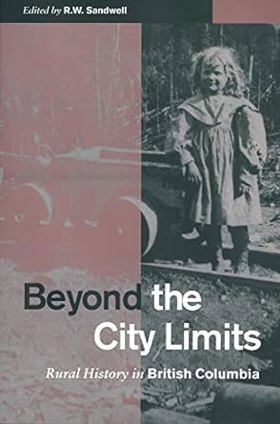
"The essays in Beyond the City Limits, all published here for the first time, challenge traditional readings of BC history. In this wide-ranging collection, R. W. Sandwell draws together a distinguished group of contributors who bring expertise, methodologies, and theoretical perspectives taken from social and political history, environmental studies, cultural geography, and anthropology. They discuss such diverse topics as Aboriginal-White settler relations on Vancouver Island, pimping and violence in northern BC, and the triumph of the codling moth over Okanagan orchardists, to show that a narrow emphasis on resource extraction, capitalist labour relations, and urban society is simply not broad enough to adequately describe those who populated the province's history." --Book Jacket viii, 293 pages : illustrations, maps ; 24 cm CIRC [ 1 ]
|
1999 |
|
Destination Cortez Island a sailor's life along the BC coast by June Cameron 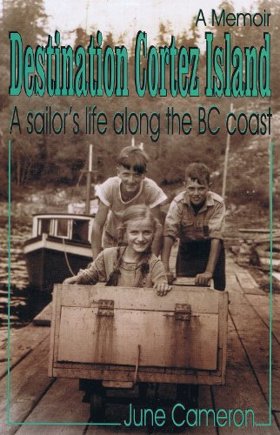
"My grandfather brought his wife and nine children to Cortez Island in 1917 with the dream of founding his own orchard, flower garden, and nursery." And so started a family legacy that would draw the author back to BC's coastal islands for the rest of her life. In 1930, June's parents bought the Loumar, a 36-foot wooden boat destined to become the family summer home for two decades. Now in her memoir of photographs, June relives the magic of those summer days on the Loumar. She provides historical background and highlights points of interest for travellers visiting the island today. 224 pages : illustrations, maps ; 22 cm CIRC [ 1 ]
|
1999 |
|
Peaceful valley the story of Kamiah's early years by Virginia Woods Meyer 
Although this book tells the story of one little Idaho town, Kamiah, located on the Nez Perce Indian reservation and visited by the Lewis and Clark expedition, in many ways it is the story of a multitude of small Pacific Northwestern towns whose origins date back to the turn of the last century--a time when individualism, initiative, and enterprise abounded. Accounts of events as they appeared in the small, weekly newspaper of that day, along with family anecdotes bring Kamiah's history to life. This is a well-researched and entertaining account by a founding father's granddaughter who collected archival pictures from state and private historical societies and museums, and who shared personal family photos never seen before. Over 75 photos and maps. v, 294 pages : illustrations, maps ; 23 cm CIRC [ 1 ]
|
1999 |
|
Annals of Astoria the headquarters log of the Pacific Fur Company on the Columbia River, 1811-1813 by Robert F. Jones 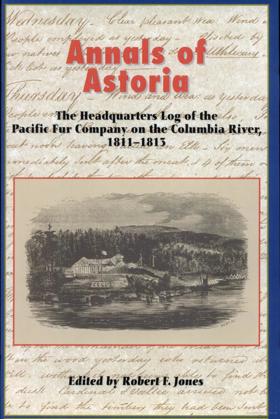
"This is the journal of Duncan McDougall, supervising partner of the Pacific Fur Company at Astoria. It records the daily operations at the post and in the Oregon country from the ship Tonquin's arrival on the Columbia until the sale of the post and the company assets to the North West Fur Company in November 1813"--Jacket xxx, 256 pages ; 24 cm CIRC [ 1 ]
|
1999 |
|
A guide to Oregon south coast history traveling the Jedediah Smith Trail by Nathan Douthit 
One of the state's most spectacular scenic regions, Oregon's southern coast is also rich in history. Fur trade explorer Jedediah Smith, Coos Indian Annie Miner Peterson, lumber baron Louis Simpson, and writer Zane Grey are just a few of the fascinating individuals who helped shape South Coast history. This indispensable guide and reference work opens with an overview of South Coast history, from prehistory to the present. This first section features in-depth looks at the region's native peoples, early exploration, white settlement, Indian-white warfare, the forest industry, transportation, and town development. The second section follows the route taken along the South Coast in 1828 by Jedediah Smith, one of the foremost explorers of the American West. It describes key historic sites from the California/Oregon border to Heceta Head. Drawing on journal entries, the author traces the Jedediah Smith Expedition's advance, and recounts its troubled relations with coastal Indians and its tragic ending. Along the expedition's route, the book profiles the region's many historic places: its archaeological sites, historic buildings, towns, museums, state parks, historic roads, natural areas, shipwrecks, and lighthouses. Nathan Douthit is professor emeritus of history and political science at Southwestern Oregon Community College in Coos Bay, where he taught from 1969 to 1997. He is author of The Coos Bay Region, 1890-1944: Life on a Coastal Frontier and articles on Indian-White relations in southern Oregon. For recreation on the South Coast, he likes to bike from Coquille to Arago, hike the coast trail from Sunset Bay to Shore Acres, and drive historic back roads. xii, 208 pages : illustrations, maps ; 26 cm CIRC [ 1 ]
|
1999 |
|
This far-off sunset land a pictorial history of Washington County, Oregon by Carolyn M. Buan 
Authored by regional historian Carolyn M. Buan, This Far-Off Sunset Land: A Pictorial History of Washington County, Oregon offers a richly illustrated chronicle of one of the Pacific Northwest’s oldest agricultural and settlement regions west of Portland. The book compiles rare historic photographs, maps, and archival documents to trace the area's evolution from Donation Land Claim homesteads and early pioneer trails into a bustling network of farming communities and suburban outposts. Through its curated visual narrative, the text highlights the enduring legacy of the Tualatin Valley’s farming families, immigrant laborers, and small-town merchants. A keen insight drawn from the work is how pictorial histories of the Willamette Valley reveal the rapid spatial erasure of agrarian landscapes; the stark transition captured across the photo spreads from open orchards and wooden barns to sprawling paved infrastructure underscores how swiftly post-war modernization consumed the physical markers of pioneer settlement. 192 pages : illustrations ; 29 cm CIRC [ 1 ]
|
1999 |
|
"We left because the creek went dry" the people of the First Creek District, Lake Chelan, Washington, 1888-1932 by Elizabeth Watson Perry 
Authored by Elizabeth Watson Perry, "We Left Because the Creek Went Dry": The People of the First Creek District, Lake Chelan, Washington, 1888-1932 chronicles the rise and abandonment of an isolated homesteading community on the arid shores of north-central Washington. The book draws on diaries, family photographs, and oral histories to detail the immense physical and economic toll placed on pioneers attempting to farm steep, water-scarce canyon benches. Through intimate accounts of daily struggle, the text exposes the severe environmental limits that ultimately forced settlers to abandon their hard-won acreage. A keen insight drawn from the work is how agricultural boosterism recklessly ignored ecological realities; by romanticizing the arid Pacific Northwest as an endless land of agrarian promise, promotional literature lured families into fragile microclimates where a single vanishing water source could entirely erase a generation of backbreaking labor. 143 pages : illustrations, map ; 23 cm CIRC [ 1 ]
|
1999 |
|
Ghost towns of the Northwest by Norm Weis 
Sixty-two ghost towns from Oregon, Washington, Idaho, Wyoming, and Montana are individually described with the history of each town and specific directions on how to find them. Nearly twenty are unknown to the general public. The author has given you a head start in your quest, having explored new angles for information on some of the more familiar ghost towns, or visiting with old timers for an offbeat story or two. xviii, 319 p. : ill., maps ; 23 cm. CIRC [ 1 ]
|
1999 |
|
The left hand of Eden meditations on nature and human nature by William Ashworth 
The Left Hand of Eden contributes to the growing, often contentious debate on wilderness and forest practices, but does so from an unusual perspective - that of an environmentalist advocating abandonment of wilderness preservation. Ashworth argues that wilderness preservation is a form of separation from the land and, as such, is as harmful to nature as logging or mining. Treating nature as something "other"--Whether to preserve it or destroy it - creates a false dichotomy, from which all modern environmental battles arise: use versus preservation, civilization versus wilderness. Ashworth presents his ideas in a series of linked nature essays. In these writings he shows that proper care for the land requires not just use or reverence, but use with reverence xiv, 194 pages ; 22 cm CIRC [ 0 ]
|
1999 |
|
Plants of the Oregon coastal dunes by Alfred M. Wiedemann, L. D. Johnston, Frank H. Smith 
Plants of the Oregon Coastal Dunes offers a useful, informative guide for visitors to the Oregon Dunes National Recreation Area or anyone spending time on the state's remarkable beaches. The standard reference on the Oregon dunes for thirty years, this handy guide identifies those plants most likely encountered and serves as a general introduction to the ecology of dune areas. The first two sections explain the natural history of dunes and describe plant communities associated with dunes and how they change over time. The final section provides an easy-to-use key to 90 common dune plants. Each species profile includes a photograph, a detailed description, and information on habitat and range. This new edition considers changes in dune areas in recent decades, notes conservation efforts, and updates scientific names. 120 pages : illustrations ; 23 cm CIRC [ 0 ]
|
1999 |
|
Narrative of a journey across the Rocky Mountains to the Columbia River by John Kirk Townsend 
"The Narrative chronicles a journey of discovery by the first trained naturalist to cross the American continent. As a member of Nathaniel Wyeth's 1834 expedition to the Oregon country, John Kirk Townsend journeyed west through a "rich and unexplored region" that offered scientists an "almost inexhaustible field of study". Townsend's account of his travels is an engaging, personal record of the first transcontinental trek along the route that would soon become the Oregon Trail." "The Wyeth expedition was a venture that united commerce, religion, and science. Among the company's seventy men was Jason Lee, the first American missionary to the Oregon Country, and Thomas Nuttall, the renowned English botanist. It was Nuttall who invited Townsend, a young ornithologist, to join the expedition. The Narrative documents the expedition's role in the opening of the West and records the author's scientific contributions." "This Northwest Reprints edition of the Narrative restores the original full text, including Townsend's account of his two years at Fort Vancouver on the Columbia River and of his return home by way of the Hawaiian Islands and Chile. Also included is the original scientific appendix of bird and mammal life. George Jobanek's introduction provides a new appreciation of Townsend's accomplishments, and of his role as a scientific explorer in a new land."--Jacket xxix, 290 pages ; 23 cm. CIRC [ 0 ]
|
1999 |
|
A richer harvest an anthology of work in the Pacific Northwest by Craig Wollner, W. Tracy Dillon 
The voices of workers, from logging camps to the Microsoft campus. This fascinating collection of writings taps a rich vein of Northwest literature. From pioneer journals to union tracts and cyberpunk fiction, the selections gathered here reveal the lives of the Northwest's working people and insights into the nature of work in the region. With its strong and varied mix of fiction, poems, manifestos, songs, memoirs, and oral histories, A Richer Harvest creates a powerful, sometimes gritty portrait of work life. Selections depict the natural beauty of the land, the rough and perilous employments, the often bloody tradition of labor radicalism, and the reverence for honest, hard work. The writings detail workers' triumphs and frustrations on farms, in forests, on waterways, and in offices, stores, and factories. Many are the observations of laborers themselves; others are the product of writers who gave voice to the concerns of the working class. The selections are arranged according to three broad themes that trace the evolution of the Northwest's laboring classes. Headnotes introduce each selection, providing historical and literary context. Contributors include Sherman Alexie, Kim Barnes, Ernest Callenbach, Douglas Coupland, H. L. Davis, Tess Gallagher, Woody Guthrie, Hazel Hall, Joe Hill, Ken Kesey, Ursula K. Le Guin, Craig Lesley, Clyde Rice, and Gary Snyder. xi, 276 pages : illustrations ; 23 cm. CIRC [ 0 ]
|
1999 |
|
The Oregon weather book a state of extremes by George H. Taylor, Raymond R. Hatton 
Oregonians are nuts for weather. They're hungry for weather news, anecdotes, statistics, trivia, and, of course, forecasts. The Oregon Weather Book will whet Oregonians' insatiable appetite. A comprehensive and fact-filled resource for anyone who watches, studies, enjoys, or simply endures Oregon weather, this book offers a history of significant weather events and a guide to the forces that create and govern our weather. The authors consider perceptions (and misperceptions) about Oregon weather by residents and outsiders, including the origins of the term, "webfoot." An invaluable reference, The Oregon Weather Book is intended for all Oregonians, from die-hard weather watchers and professionals to those who look to the skies to make recreation, travel or business plans. Tips on interpreting atmospheric conditions will allow amateur forecasters to analyze and predict weather with greater accuracy. xiv, 242 pages : illustrations ; 26 cm CIRC [ 0 ]
|
1999 |
|
The climate of Oregon from rain forest to desert by George H. Taylor, Chris Hannan 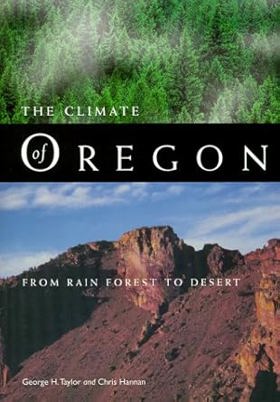
Weather is best understood as the state of the atmosphere on a given day or at a given time. Climate, on the other hand, looks at long-term averages of weather conditions. Or, as one 7-year-old explained to State Climatologist George Taylor, "weather is what you get and climate is what you're supposed to get." The Climate of Oregon gathers into a single volume a range of fascinating and useful climate information. Using state-of-the-art two-color maps and detailed tables, the authors describe various climate elements, including precipitation, temperature, winds, humidity, snow, clouds, and the growing season. Monthly maps for precipitation, snow, and temperature reveal how Oregon's climate changes throughout the year. The book defines the 9 distinct Oregon Climate Zones, examines the role of climate stations in reporting weather, and provides rich data from the state's most representative stations. Several years of unusual weather in the Pacific Northwest have generated great interest in large-scale climate change. Chapters on global warming and its impact on Oregon, El Niño and La Niña, climate changes and salmon populations, and long-term wet and dry cycles offer the latest findings on these topics. xi, 211 pages : illustrations, maps (some color) ; 26 cm CIRC [ 0 ]
|
1999 |
|
The Tillamook a created forest comes of age by Gail Wells 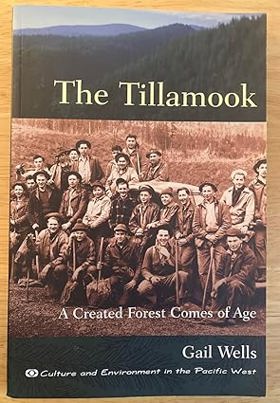
Debates over the fate of ancient forests have been commonplace in the Pacific West for decades. The Tillamook takes up the question of younger forests, exploring the creation of a managed forest and what its story reveals about the historic and future role of second-growth forests. It was Oregon's most notorious conflagration-a series of four major fires that struck the Tillamook forest beginning in 1933 and recurred with bizarre regularity through 1951. The fires burned 355,000 acres of virgin forest and became collectively known as the Tillamook Burn. In this engaging history, Gail Wells recounts the story of these famous fires and the cooperative efforts of foresters and ordinary citizens-including thousands of schoolchildren-to get young trees growing again on the burned landscape. It became one of the largest forest rehabilitation efforts ever, resulting in a created forest that promised "timber forever." Now a state forest, the Tillamook is coming of age at a time when attitudes toward forests have changed and "timber forever" is no longer the guiding principle. In contemplating the Tillamook's fate, Wells traces the historic roots of competing perspectives on forest use and examines the contemporary debate over forest issues. She sees the future of second-growth forests as holding the possibility of a workable synthesis, "a truly stable, sustainable, and humane relationship with our forests." In a new epilogue, Wells updates the story of the Tillamook five years after her book was first published, and explains why the fate of the forest remains uncertain. viii, 184 pages : illustrations, maps ; 23 cm. CIRC [ 0 ]
|
1999 |
|
The hidden forest the biography of an ecosystem by Jon R. Luoma 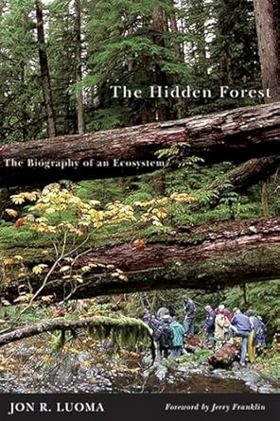
The tallest species of spruce, hemlock, fir, cedar, and pine trees on earth coexist in the old growth of the H. J. Andrews Experimental Forest in Oregon’s Cascade Range. Set aside as a living laboratory by the U.S. Forest Service in 1948, the 16,000 acres represent a vital scientific endeavor: the long-term study of a single contained ecosystem. Here, for the first time, researchers from an enormous range of disciplines—forest scientists, botanists, entomologists, wildlife ecologists, soil biologists, and others—have assembled to examine the role of every working element in the life of a forest. In The Hidden Forest, veteran science writer Jon Luoma offers an absorbing account of how these scientists came to recognize the importance of natural forest ecosystems and how their research is revolutionizing forest management. Luoma takes readers into the hidden forest where researchers have discovered a host of species previously unknown to science, and interactions in the forest ecosystem that no one previously imagined. He describes projects dealing with the forest canopy, rotting logs, insects, fungi, wildlife, streams, and the effects of flood, fire, clear cutting, and volcanic eruption. And he tells the human story behind the research, capturing the shared excitement and wonder of scientific discovery. Along the way, Luoma provides a short course in such complex issues as forest succession, biodiversity, and the politics of forestry. In a new foreword, Jerry Franklin discusses the importance of dedicated, long-term research sites and comments on new discoveries that have emerged from forest ecosystem research since The Hidden Forest was first published. x, 228 pages : illustrations ; 25 cm CIRC [ 0 ]
|
1999 |
|
Made to last historic preservation in Seattle and King County by Lawrence Kreisman, Historic Seattle Preservation Foundation 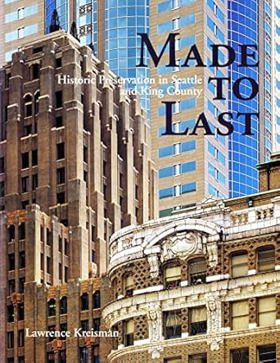
Despite the relative youth of the Pacific Northwest, its buildings and historic sites are reminders of a rich and colorful heritage. Made to Last describes exemplary preservation programs in Seattle and King County, how they developed, and the process and the extent of protection offered landmark properties. Descriptions and photographs provide a guide to individual buildings and landmark districts, demonstrating how each played a part in the remarkably swift development of county and city. Examples of rehabilitation and adaptive reuse projects accomplished through creative public and private financing are described and illustrated, as are the personal stories of commitment, perseverance, and labor that have spurred the renewal of properties—designated or not—and made them useful again. Made to Last celebrates buildings whose age is not a detriment, but rather a valuable and contributing force in the community. xiii, 225 pages : illustrations, maps ; 28 cm CIRC [ 0 ]
|
1999 |
|
Long day's journey the steamboat & stagecoach era in the northern West by Carlos A. Schwantes 
In Long Day’s Journey Carlos Schwantes gathers historical photographs, advertisements, posters, and contemporary accounts to recreate one of the most colorful periods in the American West. He traces the rapidly evolving saga of miners and settlers struggling to get from here to there in the days before railroads reached the West, trying to establish methods of transportation and communication between the eastern United States and the new territories that became Oregon, Washington, Idaho, Montana, and Wyoming—first by sea, around continents, then by land and water routes across America. Many of the enduring images and myths of the West derive from this era: the Pony Express, mule trains and plodding ox-team freighters, the picturesque side-wheelers and stern-wheelers that churned along the rivers, the colorful Concord stagecoaches drawn by four or six jingling, fleet horses. Schwantes describes in detail the technology of preindustrial modes of transportation. He explains the economics that linked the birth and death of western towns and cities, the business history of entrepreneurs and stagecoach and steamboat companies, and the challenges facing passengers and employees on the stages and steamers of the northern West. Integrating more than 200 historical photographs and other illustrations with vivid contemporary accounts, Schwantes presents a fascinating history of Americans forging the first working connections between the West and the rest of America—connections that the railroads would soon smooth and strengthen. His book Railroad Signatures across the Pacific Northwest detailed that story; here he tells of the people and animals and equipment supplanted by the twin ribbons of steel. 408 pages : illustrations (some color), maps ; 26 x 27 cm CIRC [ 0 ]
|
1999 |
|
Irrigated Eden the making of an agricultural landscape in the American West by Mark Fiege 
Irrigation came to the arid West in a wave of optimism about the power of water to make the desert bloom. Mark Fiege’s fascinating and innovative study of irrigation in southern Idaho’s Snake River valley describes a complex interplay of human and natural systems. Using vast quantities of labor, irrigators built dams, excavated canals, laid out farms, and brought millions of acres into cultivation. But at each step, nature rebounded and compromised the intended agricultural order. The result was a new and richly textured landscape made of layer upon layer of technology and intractable natural forces—one that engineers and farmers did not control with the precision they had anticipated. Irrigated Eden vividly portrays how human actions inadvertently helped to create a strange and sometimes baffling ecology. xv, 323 pages : illustrations, maps ; 25 cm. CIRC [ 0 ]
|
1999 |
|
History of Idaho's Silver Valley 1878-2000 by Ray Chapman 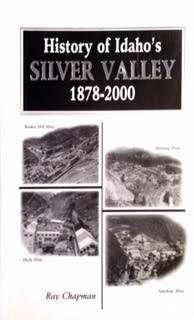
Authored by Ray Chapman, History of Idaho's Silver Valley 1878-2000 chronicles the dramatic economic boom, labor struggles, and environmental transformations of northern Idaho's mineral-rich Coeur d'Alene mining district. The book traces the region's trajectory from the late 19th-century gold and silver rushes through the explosive rise of hard-rock industrial mining, bitter union-management conflicts, and the eventual twentieth-century transition toward environmental cleanup and post-industrial reinvention. Drawing on local archives, mining records, and community lore, the text captures how rugged mountain canyons shaped a fierce, insular culture forged by subterranean labor. A keen insight drawn from the work is how the boom-and-bust cycle of extraction creates a profound psychological duality in mining towns; while the constant threat of economic collapse fosters intense, radical solidarity among workers, it simultaneously leaves the community perpetually tethered to the physical and financial scars of an exhausted landscape. 116 pages : illustrations, map ; 22 cm CIRC [ 1 ]
|
2000 |
|
The Lemhi Sacajawea's people by Brigham D. Madsen 
Native American historian Brigham D. Madsen tells the story of the Mountain Shoshoni culture from the fateful day in 1805 when Chief Ca-me-ah-wait met Lewis and Clark to 1907 when the Lemhi moved to the Fort Hall Reservation. 214 pages : illustrations, maps ; 23 cm CIRC [ 1 ]
|
2000 |
|
Outlaws of the Pacific Northwest by Bill Gulick 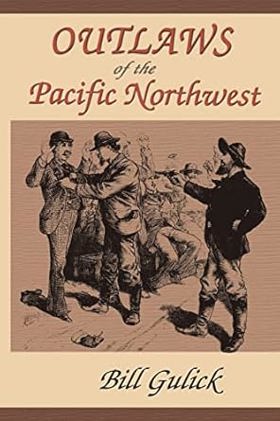
The lawlessness of the frontier towns of the plains states is well documented. However, as silver and gold deposits were found in the Pacific Northwest, the rush of miners and speculators that brought to the region brought with it its own share of crime and criminals. Author Bill Gulick sticks to the facts in telling the stories of this region but does so in swift conversational prose that entertains and educates. xiv, 199 pages : illustrations, map ; 23 cm CIRC [ 0 ]
|
2000 |