Catalog of British Columbiana and Pacific Northwest Americana
Encyclopedia Cascadia Catalog contains book titles of mostly non-fiction Pacific Northwest Coast of North America Titles (primarially British Columbia, Idaho, Oregon and Washington State) in an easy-to-understand title catalog. If you see a link with this badge ONLINE CIRC it means that there is an online institution that provides free access to that title. In some cases there may be more than one institution hosting the title digitally.
| Catalog Title | Published |
|---|---|
|
Making history the people who shaped the San Juan Islands by Lucile Saunders McDonald 
Harbor Press [Published date: 1990]. Soft cover, 214 pp. [Excerpt from rear cover] More than 1.5 million people ride the ferry each year to the San Juan Islands. Thousands more visit the archipelago by private boat or plane. All agree the San Juans are a national treasure. Stunningly beautiful, the islands have become a special place to live and visit. How did they become what they are? Who were the first settlers whose decisions shape today? What about the soldiers, the Indians, the smugglers, the pioneer families? Lucile S. McDonaId, one of Washington's most-honored historians, explores the earliest days in the islands and captures the essence of the island spirit that lives today. For those who love the islands, Making History: The People Who Shaped the San Juan Islands is a delightful, fast-paced and fascinating adventure. 214 pages : illustrations, maps ; 23 cm CIRC [ 1 ]
|
1990 |
|
Making a modern U.S. West the contested terrain of a region and its borders, 1898-1940 by Sarah Deutsch 
""Making a Modern U.S. West" provides an overview of the history of the U.S. West from 1898 to 1942 centering on what is often put at the margins in histories of the region-the flows of people, capital, and ideas across borders"-- Provided by publisher x, 640 pages ; 24 cm. CIRC [ 0 ]
|
2022 |
|
Making a Living on Saturna: Jon and Priscilla an oral history by William Gerald Schermbrucker 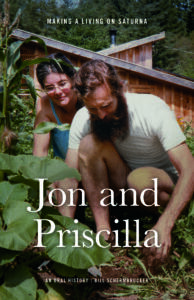
"Interviews with Jon Guy and Priscilla Ewbank who came separately to Saturna Island in the 1970's and made a rich life and living together, raising three children and making several successful businesses as part of a vibrant community. The interviews and postscript bring us to the present. The text is enriched with 10 colour and 30 BW photographs from the family collections, as well as an original colour map of the island showing places mentioned. Jon and Priscilla were and are key island figures who were involved deeply in every key aspect of the community over these decades."-- Provided by publisher pages cm CIRC [ 0 ]
|
2021 |
|
Making a chaputs the teachings and responsibilities of a canoe maker by Joe Martin , Alan L. Hoover , Royal British Columbia Museum (Issuing body) 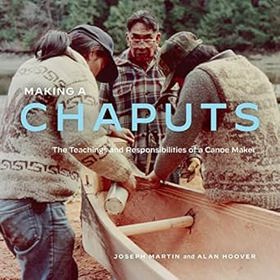
"Tla-o-qui-aht master canoe maker Joe Martin, in collaboration with former museum curator Alan Hoover, describes the meaning and method behind one of the most vivid and memorable symbols of the Northwest Coast: the dugout canoe. Both artform and technological marvel, the chaputs carries Indigenous cultural knowledge passed down through generations, not only of the practical forestry and woodworking that shape every canoe, but also of the role and responsibilities of the canoe maker. The text includes both a step-by-step explanation of the canoe-making process from tree selection onward (carefully described and dynamically illustrated) and the personal histories of a number of Joe's canoes, encompassing their planning, creation, cultural significance and role in the process of reconciliation. The teachings Joe received from his father and the expertise he has gained in a lifetime of canoe-making are recorded here in his own words for generations to come."-- Provided by publisher 86 pages : illustrations (chiefly color), map ; 23 cm CIRC [ 0 ]
|
2022 |
|
Major Granville Haller dismissed with malice by Guy Breshears 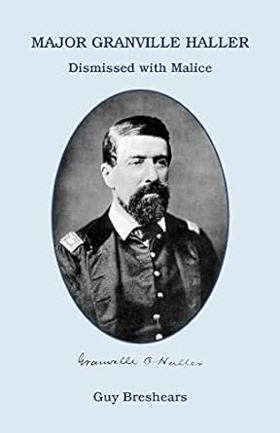
Here is the story of Major Granville Haller, a successful military officer before his sudden and unjust dismissal from the service, and his efforts to restore his name and rank. A native of York, Pennsylvania, Haller fought in the Second Seminole War, the war against Mexico (where he was twice brevetted for bravery), the Indian Wars of the Pacific Northwest, the San Juan Islands boundary dispute and the Civil War. He served on General McClellan's staff and later commanded the volunteers in the defense of York County during the Gettysburg Campaign. On July 29, 1863, Major Haller's twenty-three-year military career came to a halt when he learned that he had been dismissed for disloyal conduct and sentiments. His accuser, Lieutenant Clark Wells, was a naval officer who had spent several months in an insane asylum and had only met Haller during the Fredericksburg campaign. Inquiries to the War Department requesting a copy of his dismissal proceedings were returned unanswered. Unable to obtain a Court of Inquiry, Haller moved to Washington Territory where he spent the next sixteen years trying to restore his name. Haller's struggle is told here through his writings, official reports and court depositions so that all will recognize his contributions to the nation that dismissed him with malice. xi, 159 pages ; 22 cm CIRC [ 1 ]
|
2006 |
|
Mainstays women who shaped BC by Cathy Converse 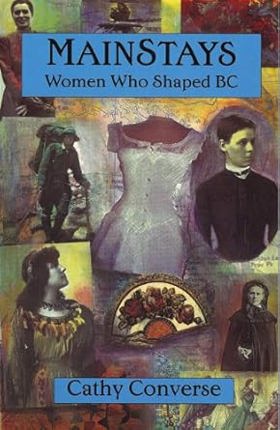
We all know that there have been women in British Columbia since the early days, and they were not just ironing shirts and baking bread. They organized unions, won elections, started schools and hospitals and became judges, scientists, artists and doctors. BC has benefited from a long tradition of energetic women who have had an impact on the province as we know it. The twenty women profiled in this book didn't all succeed in everything they attempted, but they were flexible, saw what needed to be done and just did it. xi, 212 pages : illustrations, portraits ; 22 cm CIRC [ 0 ]
|
1998 |
|
Main Street, northeastern Oregon the founding and development of small towns by Barbara Ruth Bailey 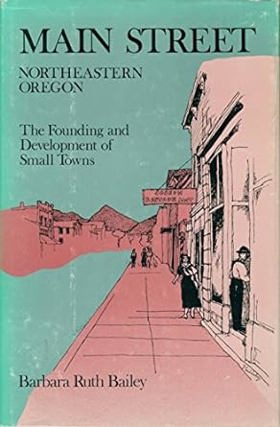
Main Street, Northeastern Oregon details the early development of a fascinating variety of communities in one of this country's most remote and spectacular regions. Collectively and through case studies, the author follows their growth, adaptation to changing economies and social patterns, and frequently their failure - out of 52 towns founded between 1862 and 1915, only 23 have survived to the 1980s. Northeastern Oregon's earliest towns grew up along the Oregon Trail and stage routes, others soon appearing along newly built railroads and adjacent to rivers, in mining districts, agricultural valleys and timbered areas. Founded for a variety of reasons - to make their founders money, to serve passing traffic, or to supple surrounding districts - they developed at different rates, and each took on a unique character. As the economic and social hub of these towns, and their architectural showpiece, northeastern Oregon's main streets exhibit a wide, though not unpredictable, range of personalities. --- excerpt from book's back cover xviii, 219 pages : illustrations ; 24 cm CIRC [ 1 ]
|
1982 |
|
Maimed by the sea erosion along the coasts of Oregon and Washington : a documentary by Bert Webber, Margie Webber
|
1983 |
|
Magnificent voyagers the U.S. exploring expedition, 1838-1842 by Herman J. Viola , Carolyn Margolis 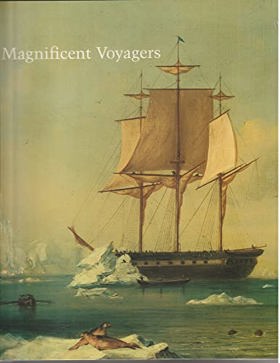
Account of the activities, chronology, mapping and botanical and zoological collections of the United States Exploring Expedition of 1838-1842, which mapped 1500 miles of the Antarctic coast and proved that the continent exists. Published in connection with the exhibition 'Magnificent Voyagers' organized by the National Museum of Natural History and circulated by the Smithsonian Institution, Washington, D.C 303, [1] pages : illustrations (some color), maps, portraits ; 28 cm CIRC [ 1 ]
|
1985 |
|
Magic Valley the story of St. Joseph Academy and the blossoming of Yakima by Ellis Lucia, Sisters of Charity of Providence 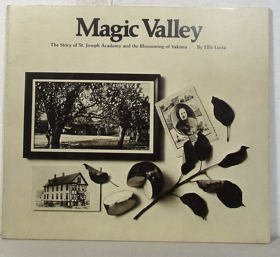
Published in 1976, Ellis Lucia’s Magic Valley chronicles the founding of St. Joseph Academy by the Sisters of Providence and its profound influence on the early development of Yakima, Washington. The narrative intertwines the institutional history of this pioneer Catholic school with the broader agricultural and civic expansion of the region. The book offers the keen insight that these frontier nuns functioned as critical civic architects, establishing the essential educational and social infrastructure that allowed a rugged agrarian settlement to successfully "blossom" into a cohesive, enduring community. 48 pages : illustrations, facsimiles ; 21 x 23 cm CIRC [ 0 ]
|
1976 |
|
Magic islands a treasure-trove of San Juan Islands lore by David Richardson 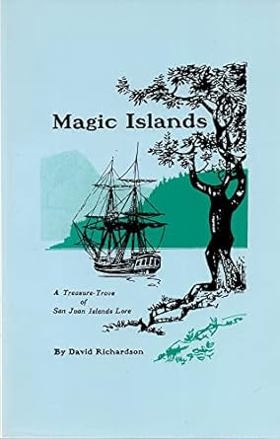
Since its first appearance in 1964 this delightful little book on the magic San Juan Islands has gone through several editions and numerous reprintings to become a real classic. Newly revised and up-to-date for today's generation of readers, this affectionate survey of the San Juans - replete with the legends and romance that make the Islands such a special place - is still the very best book of its kind. Magic Islands will add to the fun of every visitor and island-dweller. It contains descriptions of the San Juan as they are today, adds a bit of the Islands' history for flavor and hazards a peek at what the future may hold for this special place many call "paradise." 95 pages : illustrations, map ; 22 cm CIRC [ 1 ]
|
1995 |
|
Madison Park remembered by Jane Powell Thomas 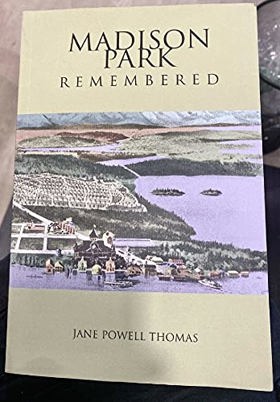
Published in local editions by Jane Powell Thomas, Madison Park Remembered captures the intimate neighborhood history and evolution of one of Seattle’s most historic lakeside communities. The book traces the area's transformation from a native transit route and late 19th-century recreational resort accessible by cable car into a vibrant residential enclave nestled along the shores of Lake Washington. Through a rich collection of archival photographs and personal reminiscences, the text preserves the vanishing daily rhythms of neighborhood cottages, local parks, and lakeside streetcar culture. A keen insight drawn from the work is how urban lakeside neighborhoods function as historical micro-ecosystems; by tracking how a recreational getaway morphed into an affluent urban suburb, the narrative reveals how Seattle's rapid geographic expansion was fundamentally propelled by the public desire to escape industrial city life while still retaining metropolitan proximity. 170 pages : illustrations, maps ; 23 cm CIRC [ 1 ]
|
2004 |
|
Made to last historic preservation in Seattle and King County by Lawrence Kreisman, Historic Seattle Preservation Foundation 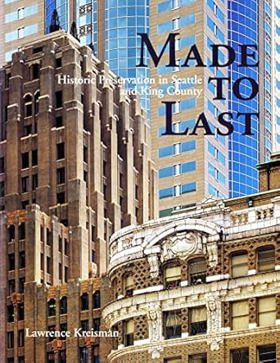
Despite the relative youth of the Pacific Northwest, its buildings and historic sites are reminders of a rich and colorful heritage. Made to Last describes exemplary preservation programs in Seattle and King County, how they developed, and the process and the extent of protection offered landmark properties. Descriptions and photographs provide a guide to individual buildings and landmark districts, demonstrating how each played a part in the remarkably swift development of county and city. Examples of rehabilitation and adaptive reuse projects accomplished through creative public and private financing are described and illustrated, as are the personal stories of commitment, perseverance, and labor that have spurred the renewal of properties—designated or not—and made them useful again. Made to Last celebrates buildings whose age is not a detriment, but rather a valuable and contributing force in the community. xiii, 225 pages : illustrations, maps ; 28 cm CIRC [ 0 ]
|
1999 |
|
Macrolichens of the Pacific Northwest by Bruce McCune (Author, Photographer), Linda Geiser , Sylvia Duran Sharnoff (Photographer), Stephen Sharnoff (Photographer), Martin Hutten (Photographer), Joseph Di Meglio (Photographer), Richard Droker (Photographer), Peter R. Nelson (Photographer), Jim Riley (Photographer), Jason Hollinger (Illustra 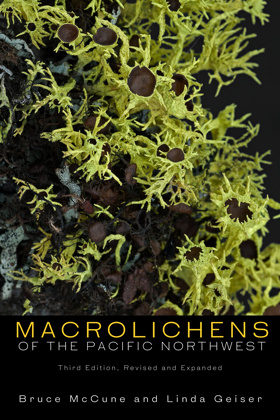
"A key component in healthy ecosystems, lichens can be found in almost any natural habitat in the Pacific Northwest. This comprehensive guide to the region's macrolichens is intended for use by beginners as well as specialists: weekend naturalists will be able to identify specimens and recognize the great diversity of lichens, while lichenologists and mycologists will gain greater knowledge of the distribution and abundance of various species. This updated third edition of Macrolichens of the Pacific Northwest includes 20 new species and an expanded introduction. It features keys to 109 genera and 681 species of Oregon and Washington macrolichens-all the macrolichens known or expected to occur in the two states. The keys also provide excellent coverage for lichens of Idaho and Montana, inland to the Continental Divide. Color photographs and detailed descriptions emphasize lichens prevalent in forested ecosystems. The illustrated glossary and introductory material cover the terminology needed to identify macrolichens and provide information on collection and handling. The biology, ecology, and air-quality sensitivity of lichens are discussed; regional air-quality sensitivities are provided for nearly 200 species. Macrolichens of the Pacific Northwest will prove invaluable to anyone seeking to identify lichens or to better understand these organisms and their vital role in the natural world."-- Provided by publisher 549 pages : illustrations (some color), color maps ; 23 cm CIRC [ 0 ]
|
2023 |
|
|
1976 |
|
Lyman's history of old Walla Walla County, embracing Walla Walla, Columbia, Garfield and Asotin counties by W. D. Lyman 
Authored in 1918 by Whitman College professor William Denison Lyman, Lyman's History of Old Walla Walla County is an expansive, subscription-based chronicle of the agricultural and civic development of southeastern Washington. The multi-volume work traces the region's transformation from the fiercely contested era of early fur traders to its establishment as the prosperous, wheat-producing epicenter of the Inland Empire. Intertwining the history of early Protestant missionaries with hundreds of flattering biographical sketches of local pioneer patriarchs, the text actively mythologizes the Anglo-American conquest of the Columbia Basin. Typical of early twentieth-century regional literature, the book functions simultaneously as a sweeping civic monument and a commercial vanity project for the area's ruling merchant and agricultural elites. A keen insight drawn from the work is how early historians weaponized the trauma of pioneer martyrdom to morally anchor the colonization process; by framing the 1847 Whitman Massacre as a holy sacrifice that explicitly consecrated the land for white civilization, Lyman's narrative effectively rebranded the subsequent violent dispossession of the Cayuse and Walla Walla peoples as a righteous, divinely ordained destiny rather than an act of aggressive territorial conquest. 2 volumes : frontispiece, plates (illustrations, portraits) ; 28 cm ONLINE CIRC [ 2 ]
|
1918 |
|
Lushootseed dictionary by Dawn E. Bates, Thom Hess, Vi Hilbert 
A celebration of western Washington Native language and culture, this book is a completely reformatted and greatly revised and expanded update of Thom Hess’s Dictionary of Puget Salish (1976). Editor Dawn Bates integrates the field notes of Vi Hilbert, UpperSkagit elder and native speaker of Lushootseed, with Hess’s analyses, mining information gathered by Hilbert and Hess from Skagit, Tulalip, Muckleshoot, Swinomish, Puyallup, and other Native consultants over a period of thirty years. The dictionary includes numerous example sentences taken from Lushootseed’s rich tradition of storytelling. The introduction to the Lushootseed-English section catalogs Lushootseed word-building structures, and entries exemplify each prefix, suffix, and root. The English-Lushootseed section features encyclopedic entries on many culturally significant topics, such as Native canoe classifications and animal names. Scientific classifications are included for botanical terms, and cultural information makes the volume interesting for the nonlinguist. An extensive introduction explains the structure of entries and provides clear definitions of grammatical terms. A detailed description of the sounds of Lushootseed will be invaluable for learners of the language. The traditional dictionary format is readable and economical, resulting in a volume of manageable size. This book is intended for use by a divers readership which includes Lushootseed speakers and their families, people of Lushootseed heritage unfamiliar with the languages, linguists, folklorists, and those interested in oral literature and the native culture of Washington state. xxi, 381 pages : map ; 26 cm CIRC [ 1 ]
|
1994 |
|
Luschiim's plants traditional Indigenous foods, materials and medicines by Luschiim Arvid Charlie , Nancy J. Turner , Harbour Publishing (Publisher) 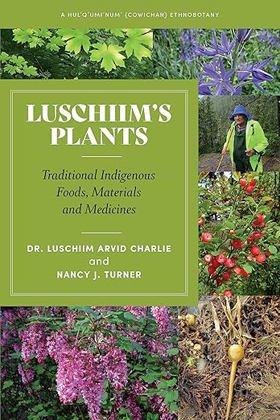
"Respected Cowichan Tribe Elder and botanical expert Luschiim, Arvid Charlie, began his education in early childhood, learning from his great grandparents and others of their generation. Luschiim's Plants represents his dedication to the survival of the Hul′q′umi′num′ language and traditional knowledge of plants for future generations. From the healing properties of qaanlhp (arbutus) to the many practical applications of q'am (bull kelp), the information presented in this remarkable guide shares knowledge of plants that Luschiim is familiar with through his own Elders' teachings and by way of direct experience over the course of his lifetime, and compiled from field outings and interviews with notable ethnobiologist and botanist Nancy Turner. In this unprecedented collection of botanical information, over 140 plants are categorized within their broad botanical groupings: algae and seaweeds, lichens, fungi and mushrooms, mosses and liverworts, ferns and fern-allies, coniferous trees, deciduous trees, shrubs and vines, and herbaceous flowering plants. Each entry is illustrated with a colour photo and includes the plant's common, scientific and Hul′q′umi′num′ names; a short description; where to find it; and cultural knowledge related to the plant. Additional notes encompass plant use, safety and conservation; the linguistic writing system used for Hul′q′umi′num′ plant names; as well as miscellaneous notes from interviews with Luschiim. This volume is an important addition to the bookshelves of botanists, and will fascinate anyone with an interest in plants of the West Coast and their traditional uses by Coast Salish peoples."-- Provided by publisher xiii, 274 pages : color illustrations, color portrait ; 23 cm CIRC [ 0 ]
|
2021 |
|
Lucky the wit and wisdom of Governor Phil Batt by Rod Gramer (Interviewer, Editor), Butch Otter, Dirk Kempthorne, Lindy High, Marc C. Johnson, Randy Stapilus, James B. Weatherby 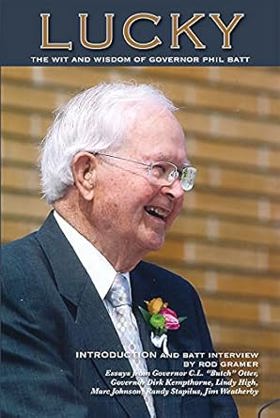
"In Lucky, Former Idaho Governor Phil Batt tells us that he has lived a “lucky” life. It is true that Batt has lived a charmed life, but it took more than luck for his half-century long and\ndistinguished political career. Wisdom and wit and more than a heavy dose of common sense and decency contributed to his success as a legislator, party chair, lieutenant governor and governor. Batt brought a practical, business-like discipline to the Statehouse, but one tempered with a soft heart for Idahoans who needed support: the young, vulnerable, and marginalized. A champion of conservative fiscal values, he was also a champion of human values like equality and fairness. Batt reflects back on his remarkable career and takes a stand on some of the pressing issues of our time- human rights,immigration, deficits, and the lack of political civility. He remembers many of the political luminaries he worked with,notably the late Democratic Governor Cecil Andrus and late Republican Senator Jim McClure. Lucky also includes insightful essays by those who know Batt well, including two former governors who credit Batt for advancing their political careers. Lucky shows us that there was more than luck to the man some call the “little giant,” it also reminds us of how lucky Idaho was to have him as its 29th governor." -- from publisher 137 pages : illustrations (some color) ; 23 cm CIRC [ 0 ]
|
2021 |
|
Lower Umpqua texts and notes on the Kusan dialects by Leo Joachim Frachtenberg
Authored by early 20th-century anthropologist Leo Joachim Frachtenberg, Lower Umpqua Texts and Notes on the Kusan Dialects serves as a vital linguistic archive of the highly endangered Indigenous languages of the southern Oregon coast. Operating within the frantic era of "salvage anthropology," Frachtenberg meticulously transcribed the complex grammatical structures, mythologies, and oral histories of the Lower Umpqua and Coos peoples directly from some of their very last fluent speakers. The resulting volume operates as both a dense academic lexicon and a poignant cultural artifact of coastal tribal communities whose societal structures were systematically dismantled by pioneer encroachment. A keen insight drawn from the work is how the foundational premise of salvage anthropology reveals a devastating colonial paradox; by urgently cataloging these complex Indigenous dialects as dying academic curiosities, researchers like Frachtenberg unwittingly produced an empirical ledger detailing the lethal efficiency of America's own aggressive policies of forced displacement and cultural erasure. vi, 156 pages ; 25 cm. ONLINE CIRC [ 1 ]
|
1914 |
|
Low on gas, high on sky Nick Mamer's 1929 venture by J. B. Rivard 
"Long before the days of jet planes, Nick Mamer and co-pilot Art Walker set an awe-inspiring record. They flew from Spokane, Washington to San Francisco, to New York, and from New York back to Spokane- without landing. This is the true story of the 1929 flight- during which their airplane was again and again refueled in the air with ropes and hose- by other daring airmen flying wood-and-fabric airplanes. For five long days, these two aviators in their single-engine biplane battled nearly-empty gas tanks, hazardous mountain ranges, electrical storms, thirst, hunger, and fatigue to set the nonstop, transcontinental round trip record."--Back cover vi, 279 pages : black and white illustrations ; 23 cm CIRC [ 0 ]
|
2019 |
|
Lost Kootenays a history in pictures by Greg Nesteroff , Eric Brighton 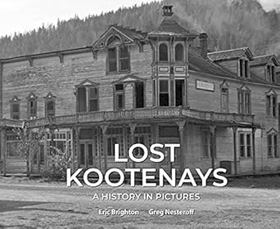
"Greg Nesteroff and Eric Brighton started the Lost Kootenays Facebook Group with the intent of preserving, promoting and sharing the history of the Kootenays and the people who lived here. Today the Lost Kootenays community is 48,000 strong and one of the most dynamic sites in British Columbia. Together Greg Nesteroff and Eric Brighton have put together the definitive photographic account of the Kootenays. From its First Peoples, to mining, forestry, fruit farming, railroading and steamboating, it is all here. With more than 130 photographs--many of them seen here for the first time--Lost Kootenays offers us a window into the past, showing life as it was then, and stirring in us the emotions of wonder and curiosity about those who have gone before us and the lives they lived."-- Provided by publisher 128 pages : illustrations ; 21 x 26 cm CIRC [ 0 ]
|
2021 |
|
Lopez Island by Susan Lehne Ferguson, Lopez Island Historical Society and Museum (Lopez Island, Wash) 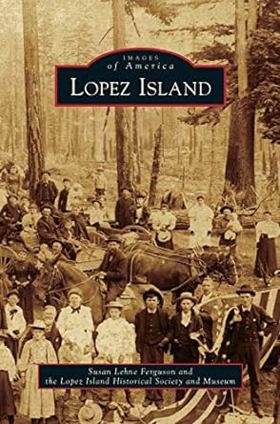
The story of Lopez Island is a story of community. Skilled, brave, generous people like Sampson Chadwick, Mother Brown, Captain Barlow, and Amelia Davis carved a spirited, nurturing community out of seaside wilderness. Homesteaders cleared forests, built farms, grew food, and raised large families, surviving then thriving together. The hamlets of Port Stanley, Richardson, and Lopez emerged, creating hubs with stores, post offices, and schools as well as thriving fishing, canning, and shipping industries. The community fostered education, music, writing, dances, chivarees, baseball, quilting, a birthday club, and grand Fourth of July celebrations. Living self-reliant lives while helping friends, neighbors, and newcomers, Lopezians created a unique community character that abides today 127 pages : chiefly illustrations, map ; 24 cm. CIRC [ 1 ]
|
2010 |
|
Looking at Indian art of the Northwest Coast by Hilary Stewart 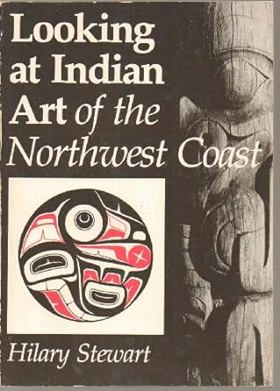
Bold, inventive and highly graphic, the indigenous art of the Northwest Coast is distinguished by its sophistication and complexity. It is also composed of basically simple elements, which, guided by a rich mythology, create images of striking power. This indispensable and beautifully illustrated book is the first to introduce everyone, from the casual observer to the serious collector of Northwest Coast prints, to the forms, cultural background and structures of this highly imaginative art. The elements of style are introduced; the myths and legends which shape the motifs are interpreted; the stylistic differences between the major cultural groupings are defined and illustrated. Raven, Thunderbird, Killer Whale, Bear: all the traditional forms are here, deftly analyzed by a professional writer and artist who has a deep understanding of this powerful culture. 111 pages : illustrations ; 23 cm CIRC [ 1 ]
|
1979 |
|
Longview, the remarkable beginnings of modern western city by John M. McClelland
|
1949 |