Grays Harbor County County
Greys Harbor County, originally named Chehalis County, was formed out of Thurston County on April 14, 1854. Its name was subsequently changed to Grays Harbor County by the Washington legislature, effective June 9, 1915. The name change helped eliminate confusion resulting from the fact that the city named Chehalis was in Lewis County.
Mapped Location
Grays Harbor County: The mapped location is an approximation and should not be used for navigation or wayfinding.
Information
General information on Grays Harbor County
- Feature Type: County
- County Seat: City of Montesano
- Established: Friday, April 14, 1854
Official, historical, colloquial and alternative toponyms for Grays Harbor County
A brief list of names that this geographic feature has been named
| Name | Description |
|---|---|
| Grays Harbor County | Official |
Origin Notes and History of Grays Harbor County
References to Grays Harbor County that document the origin of its place name
GRAYS HARBOR COUNTY, created as Chehalis County by an act of the Territorial Legislature approved on April 14, 1854. See Chehalis City and River for discussion of that name. In February, 1907, an act of the State Legislature was approved dividing Chehalis County and creating Grays Harbor County. The State Supreme Court later declared the act "entirely indefinite and uncertain." On March 15, 1915, there was approved a very brief act of the Legislature which simply changed the county's name from Chehalis to Grays Harbor.
Related Catalog Titles
A Bibliography for Grays Harbor County, County
Red Harbor Radical Workers and Community Struggle in the PacificNorthwest : Radical Workers and Community Struggle in the Pacific Northwest by Aaron Goings
In the early decades of the twentieth century, Grays Harbor was the Lumber Capital of the World. While thousands of lumber and maritime workers fought for higher wages and decent conditions, employers unified to protect their interests, often through violent and corrupt means. They spied on unionists, expelled them from their own towns, vilified them in the press, and physically assaulted labor activists. But with deep roots in their communities, radical workers continued to meet in their halls and immigrant neighborhoods—and to influence the wider labor movement well into the 1930s. In Red Harbor, Aaron Goings resurrects the forgotten history of lumber workers in a bastion of labor radicalism, examining the conflict as workers faced down an alliance of employers, police, and violent anti-radicals, including the Ku Klux Klan. But he goes beyond these clashes to illuminate the vital roles of families, immigrants, and working-class women in the labor movement, revealing how people fought not only for labor rights but also for the good of their communities. The Industrial Workers of the World (or Wobblies) in particular adopted views and tactics from socialist Finnish immigrants while authoring programs responsive to local needs and supported by the people—radical and otherwise. Vivid and revealing, Red Harbor shines a light on lumber workers and the pursuit of justice in the Pacific Northwest.
360 Pages, 6 x 9 in, 19 b&w illus
CIRC [ 0 ]
Maritime names of Washington by Richard W. Blumenthal
Maritime Names of Washington is a wonderful companion if you are a boating enthusiast or simply curious about Washington’s maritime history. This book is a scholarly study on the origins of place names for our coastal and inland waters. It covers every name that appears on current nautical charts, from the Pacific Coast to the Strait of Juan de Fuca, the San Juans, and Puget Sound from Port Townsend to Olympia. It includes every named island, bay, point, inlet, pass, harbor, rock, channel, strait, canal, peninsula, sound, and shoal. The book also features many local and historical names that are not shown on the charts. The manuscript generally identifies the individual who named the place, when, why, and for whom. It also identifies the chart where the name first appeared and the early settlement history of many places. The manuscript is richly annotated and uses many quotes from the observations of our earliest explorers to give readers a glimpse of what Puget Sound country looked like 200+ years ago. Each of our early explorations is discussed in detail as they relate to individual place names. The book contains 170 pictures and 44 historical nautical charts from 1790 to 1900 that show many of the names
ix, 501 pages : illustrations, maps, charts ; 26 cm
CIRC [ 1 ]
Trails & trials of the pioneers of the Olympic Peninsula, State of Washington by Jann Castleberry (Compiler)
“In Grays Harbor's historical record Trails & Trials of the Pioneers stands alone as an enduring trove of firsthand settler stories. ... the book came to fruition after years of conducting interviews, collecting written recollections, and compiling them into scrapbooks. ... Jann Castleberry’s revised fourth edition … is a fresh and expanded version of Cleland’s original. Historic photographs sourced from individuals, museums, and archives provide a valuable visual supplement to the original text. Castleberry also solicited new submissions from Quinault area residents whose stories compliment those captured so many years ago.”--Introduction
247 pages : illustrations, maps, portraits ; 22 cm
CIRC [ 0 ]
The port of missing men Billy Gohl, labor, and brutal times in the Pacific Northwest by Aaron Goings
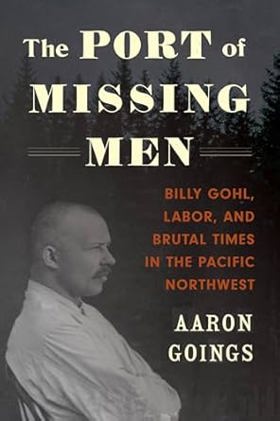
"The true story behind a labor leader reputed to be a serial killer. Aaron Goings offers a vivid biography of Billy Gohl (1873-1927), a prominent union official in Grays Harbor, Washington who came to be known for killing dozens of people, maybe even more than one hundred. In a cruel twist, many victims were his union members. "These anonymous dead men, culled from the hordes of migrant laborers who had flocked to Grays Harbor to cut trees, came to be known as the floater fleet. Billy Gohl was credited with launching most of them," Murray Morgan wrote in The Last Wilderness: A History of the Olympic Peninsula. "If he was responsible for even half of the floaters found in the harbor during his day, Gohl was America's most prolific murderer. Over a ten-year period the fleet numbered 124." A union leader turned serial killer? As a labor historian, author Aaron Goings felt compelled to get to the bottom of the story. So he dug into the archives. In this popular biography, Goings uses Gohl's life to illuminate the brutal nature of everyday life in that era: the Yukon gold rush, the brutally dehumanizing lives of sailors and loggers, and the heated clashes between pro- and anti-union forces in Grays Harbor, the world's busiest lumber shipyard, where millions of dollars were at stake. Goings carefully examines court records and other archival sources to sort through the lore and legends surrounding Gohl, painting the story of a violent man in a violent time who did kill someone-maybe even more than one-but comes almost comically short of his storied reputation. Why did people believe such outrageous things about Gohl, then and now? And where did all those dead bodies come from? Goings shows how powerful economic players help build the myth of "Gohl the Ghoul" to undercut the credibility of union advocates. By pinning all these deaths on one man and building up the story of an extreme pathology, no one had to confront the structural violence of capitalism. The resulting book is not a grisly true crime tale; but an equally intriguing mystery about the creation of myth and the cost in human bodies in the making of the Pacific Northwest"-- Provided by publisher
xiv, 277 pages : illustrations ; 24 cm
CIRC [ 0 ]
Washington's Westport by Ruth McCausland
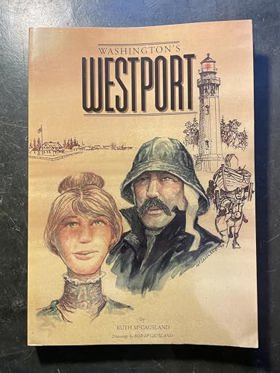
Authored by local historian Ruth McCausland, Washington’s Westport chronicles the dramatic transformation of the coastal Pacific Northwest town from a remote, seasonal fishing camp into a bustling commercial harbor and tourist destination. The book draws on vintage photographs, local archives, and personal interviews to detail the hazardous maritime conditions, resilient fishing families, and cannery operations that sustained the isolated community at the mouth of Grays Harbor. Through its vivid pictorial and narrative layout, the text captures the grit required to build a permanent settlement on a shifting, wave-battered spit of land. A keen insight drawn from the work is how coastal outposts maintained an uneasy economic dualism; by relying simultaneously on the volatile fortunes of commercial deep-sea fishing and the fleeting whims of summer tourists, towns like Westport were forced to constantly reinvent their identity to survive the unpredictable rhythms of the Pacific Ocean.
192 pages : illustrations, map ; 26 cm
CIRC [ 1 ]
Murder at Hogans Corner, Washington an American destiny by Wallace Louis Exum
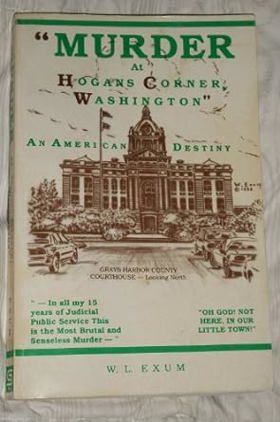
Authored by Wallace Louis Exum, Murder at Hogans Corner, Washington: An American Destiny investigates a dark, sensationalized 1930s homicide that sent shockwaves through a rural Grays Harbor County crossroads community. The book reconstructs the chilling details of the crime, the subsequent manhunt, and the local judicial proceedings that riveted the Pacific Northwest during the height of the Great Depression. Through meticulous archival research, the author uses the lens of a single sensational murder to expose the raw underbelly of an isolated frontier region wrestling with sudden economic despair. A keen insight drawn from the work is how true-crime narratives function as mirrors for societal anxiety; by probing a localized act of violence against the backdrop of economic collapse, the text reveals that the true horror of the era was not merely an isolated murder, but the pervasive social unraveling of a forgotten rural populace pushed to the brink by structural poverty.
xiii, 227 pages : portrait ; 21 cm
CIRC [ 1 ]
The river pioneers early days on Grays Harbor by Edwin Van Syckle, David A. James
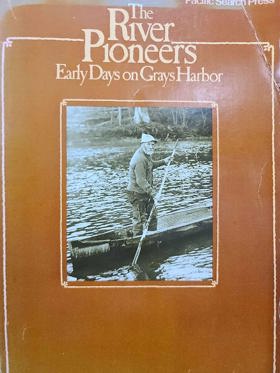
History of Grays Harbor, its coastal towns and river valleys in Grays Harbor County, Washington from 1775-1948. Narrative insights into the lives of the native Indians, early explorers and the pioneers who settled the valleys and established towns such as Aberdeen, Hoquiam, Cosmopolis and Grays Harbor City
423 pages, 48 unnumbered pages of plates : illustrations ; 24 cm
CIRC [ 1 ]
Grays Harbor, 1885-1913 by Robert A. Weinstein

Ocean Shores, Washington, the exciting growth years by Margaret L. Rasmussen (Compiler)
Grays Harbor County
- City of Aberdeen
- Aberdeen Gardens
- Aberdeen Junction
- Alder Grove
- Aloha
- Amanda Park
- Artic
- Axford
- Balch
- Bay City
- Bel-Aire
- Brady
- Broadway Heights
- Burrows
- Carlisle
- Carlisle East
- Carlisle West
- Cedarville
- Central Park
- Chehalis Village
- Cohassett
- Cohassett Beach
- Copalis Beach
- Copalis Crossing
- City of Cosmopolis
- East Aberdeen
- East Hoquiam
- City of Elma
- Fuller
- Garden City
- Gray Gables
- Grayland
- Grays Harbor City
- Greenwood
- Grisdale
- Herbig Heights
- Highland Heights
- City of Hoquiam
- Humptulips
- Iron Springs
- Junction City
- Laidlow
- Lankner
- Malone
- Markham
- City of McCleary
- McCleary Junction
- Melbourne
- Moclips
- City of Montesano
- Neilton
- New London
- Newton
- Nisson
- North Aberdeen
- Norwood
- City of Oakville
- Ocean City
- Ocean Grove
- City of Ocean Shores
- Ocosta
- Onslow
- Oyehut
- Pacific Beach
- Pilgrim Heights
- Porter
- Quinault
- Rayville
- Rony
- Saginaw
- Sampson
- Satsop
- Sine
- South Arbor
- South Elma
- South Montesano
- Sunset Beach
- Taholah
- Township 21-9
- Tulips
- Vesta
- Weatherwax
- Weikswood
- Westhaven
- City of Westport
- Wishkah
- Woodlawn
Political Boundaries
Last updated: 2025-09-23