Catalog of British Columbiana and Pacific Northwest Americana
Encyclopedia Cascadia Catalog contains book titles of mostly non-fiction Pacific Northwest Coast of North America Titles (primarially British Columbia, Idaho, Oregon and Washington State) in an easy-to-understand title catalog. If you see a link with this badge ONLINE CIRC it means that there is an online institution that provides free access to that title. In some cases there may be more than one institution hosting the title digitally.
| Catalog Title | Published |
|---|---|
|
Intermountain railroads, standard and narrow gauge by Merrill D. Beal
|
1962 |
|
Inside Oregon State Hospital a history of tragedy and triumph by Diane L. Goeres-Gardner 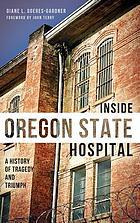
"A history of the Oregon State Hospital in Salem, Oregon, spanning from 1883 to 2012"--Provided by publisher 334 pages : illustrations ; 23 cm CIRC [ 0 ]
|
2013 |
|
Indians, fire, and the land in the Pacific Northwest by Robert T. Boyd , Frank K. Lake 
Instead of discovering a land blanketed by dense forests, early explorers of the Pacific Northwest encountered a varied landscape including open woods, meadows, and prairies. Far from a pristine wilderness, much of the Northwest was actively managed and shaped by the hands of its Native American inhabitants. Their primary tool was fire. This volume takes an interdisciplinary approach to one of the most important issues concerning Native Americans and their relationship to the land. Over more than 10,000 years, Native Americans in the Northwest learned the intricacies of their local environments and how to use fire to create desired effects, mostly in the quest for food. Drawing on historical journals, Native American informants, and ethnobotanical and forestry studies, this book’s contributors describe local patterns of fire use in eight ecoregions, representing all parts of the Native Northwest, from southwest Oregon to British Columbia and from Puget Sound to the Northern Rockies. Their essays provide glimpses into a unique understanding of the environment, one that draws on traditional ecological knowledge. Together, these writings also offer historical perspective on the contemporary debate over “prescribed burning” and management of public lands. This updated edition includes a foreword by Frank K. Lake and a new epilogue by editor Robert T. Boyd. Contributors include Stephen Arno, Stephen Barrett, Theresa Ferguson, David French, Eugene Hunn, Leslie Johnson, Jeff LaLande, Estella Leopold, Henry Lewis, Helen H. Norton, Reg Pullen, William Robbins, John Ross, Nancy Turner, and Richard White. About the author: Robert T. Boyd, , affiliated faculty in the Department of Anthropology, Portland State University, is author of The Coming of the Spirit of Pestilence: Introduced Diseases and Population Decline among Northwest Coast Indians, 1774–1874 and coeditor of Chinookan Peoples of the Lower Columbia. He lives in Portland, Oregon. xvii, 329 pages : illustrations, maps ; 23 cm CIRC [ 0 ]
|
2021 |
|
Indians of the Northwest Coast by Philip Drucker, American Museum of Natural History
|
1963 |
|
Indians of the North Pacific Coast by Tom McFeat (Editor, Writer of introduction) 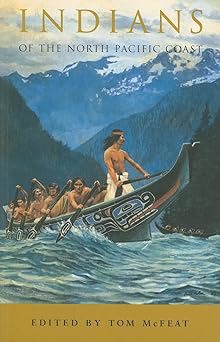
This book offers a many-faceted examination of the cultures of the Tlingit, the Haida, the Tsimshian, the Bella Coola, the Kwakiutl, the Nootka, and the Salish--Indian peoples of the coast running from the Canadian border area of Juan de Fuca Strait to Yakutat Bay in southeastern Alaska. Professor McFeat has brought together key writings by seventeen authorities including Franz Boas, Helen Codere, Viola E. Garfield, and Wayne Suttles. General readers as well as scholars have an opportunity to examine a wide range of literature and thereby to increase their understanding of one of the most interesting groups among the Indian peoples of North America. xv, 268 pages 21 cm CIRC [ 0 ]
|
1967 |
|
Indians of Idaho by Deward E. Walker 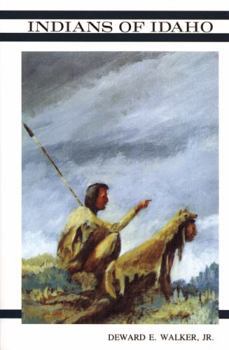
Historical information concerning the Kutenai, Kalispel, Coeur d'Alene, NEz Perce, Shoshone-Bannock and Northern Paiute tribes of Idaho 207 pages : illustrations ; 22 cm. CIRC [ 1 ]
|
1978 |
|
Indians in Washington by Washington Secretary of State Office
|
1961 |
|
Indians in the making ethnic relations and Indian identities around Puget Sound by Alexandra Harmon 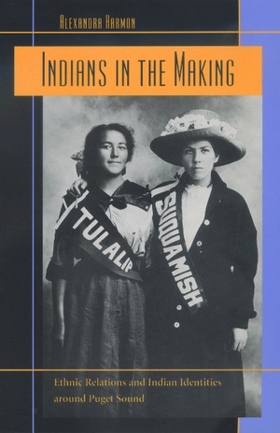
In the Puget Sound region of Washington state, indigenous peoples and their descendants have a long history of interaction with settlers and their descendants. Indians in the Making offers the first comprehensive account of these meetings, from the land-based fur trade of the 1820s to the Indian fishing rights activism of the 1970s. Thoroughly researched and theoretically sophisticated, this history shows how notions of Indian identity - both Indian and non-Indian - changed as relations changed. In the Puget Sound region of Washington state, indigenous peoples and their descendants have a long history of interaction with settlers and their descendants. Indians in the Making offers the first comprehensive account of these interactions, from contact with traders of the 1820s to the Indian fishing rights activism of the 1970s. In this thoroughly researched history, Alexandra Harmon also provides a theoretically sophisticated analysis that charts shifting notions of Indian identity, both in native and in nonnative communities. During the period under consideration, each major shift in demographic, economic, and political conditions precipitated new deliberations about how to distinguish Indians from non-Indians and from each other. By chronicling such dialogues over 150 years, this groundbreaking study reveals that Indian identity has a complex history. Examining relations in various spheres of lifelabor, public ceremony, marriage and kinship, politics and law. Harmon shows how Indians have continually redefined themselves. Her focus on the negotiations that have given rise to modern Indian identity makes a significant contribution to the discourse of contemporary multiculturalism and ethnic studies. xii, 393 pages : illustrations, maps ; 24 cm. CIRC [ 0 ]
|
1998 |
|
|
1978 |
|
Indianola a community memoir by Sarah M. Berry, Joan R. Henderson, Indianola Beach Improvement Club History Committee 
Authored by Sarah M. Berry and Joan R. Henderson alongside the Indianola Beach Improvement Club History Committee, Indianola: A Community Memoir chronicles the evolution of the historic waterfront enclave on Washington’s Kitsap Peninsula. The book traces the area’s transformation from an indigenous gathering place and a 20th-century mosquito-fleet resort destination into a tight-knit, fiercely protective seasonal and year-round community. Drawing on archival photographs, diaries, and local records, the text preserves the distinct social traditions and ferry-dependent isolation that shaped generations of cabin owners and residents. A keen insight drawn from the work is how recreational enclaves foster a unique brand of communal preservation; by relying on shared infrastructure like community docks and improvement clubs, residents turned their collective isolation into a deliberate tool for shielding their waterfront heritage from rapid commercial overdevelopment. 128 pages : illustrations, maps ; 21 x 27 cm CIRC [ 1 ]
|
1998 |
|
Indianische sagen von der nord-pacifischen küste Amerikas by Franz Boas 
Published in 1895, Franz Boas's Indianische Sagen von der Nord-Pacifischen Küste Amerikas is a foundational German-language compilation of indigenous myths, legends, and oral traditions gathered from numerous tribes along the Pacific Northwest coast. The text meticulously documents the folklore of groups such as the Tlingit, Haida, and Coast Salish, focusing heavily on widespread cultural narratives like the Raven cycle and various regional creation myths. A keen insight drawn from the work is Boas's pioneering use of these folktales to prove the theory of cultural diffusion, demonstrating how specific narrative motifs spread across distinct linguistic barriers through extensive trade and intermarriage rather than developing independently. By mapping these shared story elements across vast geographic areas, Boas fundamentally challenged the era's prevailing theories of unilineal cultural evolution and established a new standard for rigorous comparative anthropology. vi, 363, [1] pages map 26 cm ONLINE CIRC [ 1 ]
|
1895 |
|
Indian wars of the Pacific Northwest by Ray Hoard Glassley
|
1972 |
|
Indian tribes of Washington, Oregon & Idaho by John Reed Swanton
Reprint of the 1952 ed. published by the Govt. Print. Off., Washington, which was issued as Bulletin 145 of the Bureau of American Ethnology, Smithsonian Institution 81 pages : illustrations ; 24 cm CIRC [ 1 ]
|
1978 |
|
Indian tribes of Washington, Oregon & Idaho by John Reed Swanton
|
1979 |
|
Indian rock art of the Columbia Plateau by James D. Keyser 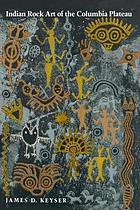
From the river valleys of interior British Columbia south to the hills of northern Oregon and east to the continental divide in western Montana, hundreds of cliffs and boulders display carved and painted designs created by ancient artists who inhabited this area, the Columbia Plateau, as long as seven thousand years ago. Expressing a vital social and spiritual dimension in the lives of these hunter-gatherers, rock art captivates us with its evocative power and mystery. At once an irreplaceable yet fragile cultural resource, it documents Native histories, customs, and visions through thousands of years. This valuable reference and guidebook addresses basic questions of what petroglyphs and pictographs are, how they were produced, and how archaeologists classify and date them. The author, James Keyser, identifies five regions on the Columbia Plateau, each with its own variant of the rock art style identifiable as belonging exclusively to the region. He describes for each region the setting and scope of the rock art along with its design characteristics and possible meaning. Through line drawings, photographs, and detailed maps he provides a guide to the sites where rock art can be viewed. In western Montana, rock art motifs express the ritualistic seeking of a spirit helper from the natural world. In interior British Columbia, rayed arcs above the heads of human figures demonstrate the possession of a guardian spirit. Twin figures on the central Columbia Plateau reveal another belief - the special power of twins - and hunting scenes celebrate successes of the chase. The grimacing, evocative face of Tsagiglalal, in lower Columbia pictographs, testifies to the Plateau Indians' "death cult" response to the European diseases that decimated their villages between 1700 and 1840. On the southeastern Plateau, images of horseback riders mark the adoption, after 1700, of the equestrian and cultural habits of the northwestern Great Plains Indians. Despite geographic differences in emphasis, similarities in design and technique link the drawings of all five regions. Human figures, animals depicting the numerous species known on the Plateau, geometric motifs, mysterious beings, and tally marks, whether painted or carved, appear throughout the Columbia Plateau 139 pages : illustrations, maps ; 26 cm CIRC [ 0 ]
|
1992 |
|
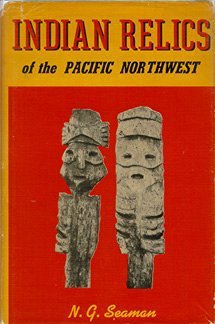
Indian relics of the Pacific Northwest by N. G. Seaman
|
1967 |
|
|
1972 |
|
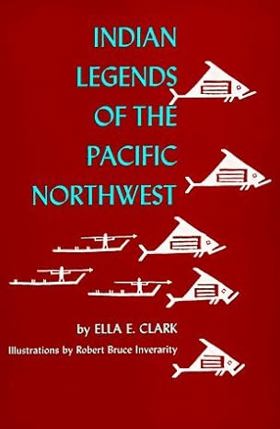
Indian legends of the Pacific Northwest by Ella E. Clark, Robert Bruce Inverarity
|
1984 |
|
Indian fishing early methods on the Northwest Coast by Hilary Stewart 
First published in 1977 and unavailable for several years, Indian Fishing is more than a sterile account of the technology of fishing; it considers the momentous role of fish and fishing in the lives of the Northwest Coast peoples. A classic, thoroughly researched and informative text, it examines fishing techniques of the peoples who have lived on the coast for over nine thousand years, revealing their rich and complex culture. Hilary Stewart gathered material from museum archives, fish camps, and coastal village elders to document the Native heritage of handmade hooks, lines, sinkers, lures, floats, clubs, spears, harpoons, nets, traps, rakes, gaffs, and more. With more than 300 clear and detailed drawings, she illustrated how these tools were made and used. She twisted cedar bark and nettle fibers into cod fishing lines, and steam-bent a stem of yew into a halibut hook. Here, reprinted in full, is her original work, covering everything from how the catch was butchered, cooked, and preserved, to the prayers and ceremonies in gratitude to the fish, as well as customs and taboos that demonstrated the peoples' respect for this life-giving resource. Though there have been transformations in knowledge and scholarship since its first publication, Stewart's benchmark work, with its usefulness, artistry, and appreciation of Native culture, will be welcomed back into print. 181 pages : illustrations, map, portraits ; 26cm CIRC [ 0 ]
|
2018 |
|
Indian battles along the Rogue River, 1855-56 one of America's wild and scenic rivers by Frank K. Walsh 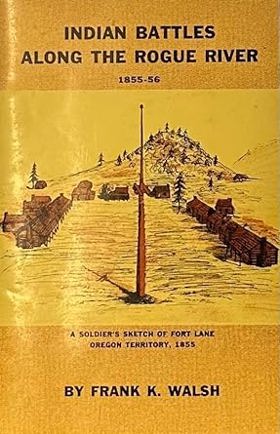
Authored by local historian Frank K. Walsh, Indian battles along the Rogue River, 1855-56: One of America's wild and scenic rivers details the violent armed conflict between regional indigenous bands and white miners and settlers during the height of the Oregon gold rush. The book combines historical accounts, maps, and archival photographs to chronicle the brutal military campaigns, displacement tactics, and fortified engagements that defined the Rogue River Indian War. Through a detailed chronology of the hostilities, the text illustrates the catastrophic human cost of rapid mineral exploitation and land seizure in southwest Oregon. A keen insight drawn from the work is how the romanticized iconography of wild western rivers deliberately obscures the bloody ethnic cleansing required to secure them; by contrasting the pristine, scenic beauty of the modern Rogue River with the suppressed history of the forced removal camps along its banks, the narrative exposes how modern recreational landscapes are frequently built directly over the hidden graves of frontier warfare. iv, 28 pages : illustrations, maps, portraits ; 22 cm CIRC [ 1 ]
|
1996 |
|
Indian affairs in Oregon and Washington territories, &c. message from the President of the United States by United States, James Buchanan, United States Army Division of the Pacific
|
1987 |
|
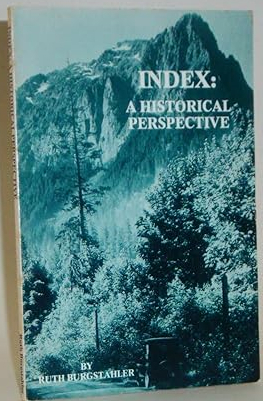
Index a historical perspective by Ruth Burgstahler
|
1979 |
|
In times past a history of the lower Jordan Creek communities. by Hazel R. Fretwell 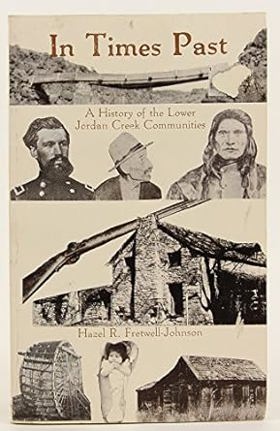
Author Hazel Danner Fretwell Johnson was a writer for the Owyhee Outpost for 21 years. An avid history buff, in this book she features the history of Arock, Danner and Rome. All are communities in Southern Malheur County. vi, 207, [4] pages : illustrations, map ; 21 cm CIRC [ 1 ]
|
1990 |
|
In the valley of mystic light an oral history of the Skagit Valley arts scene by Claire E. Swedberg , Rita Hupy 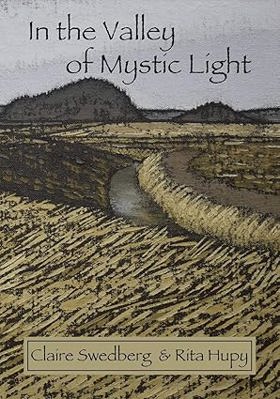
Claire Swedberg and Rita Hupy conducted hundreds of interviews to investigate what role a community plays in the arts, and what the arts can bring to a community. The result is In the Valley of Mystic Light, the first book to chronicle the unique story of the La Conner art scene, while exploring, on a personal level, what it means to be a Northwest artist. This remarkable story provides an illustration of the universal creative process as told by the mystic artists of the Northwest and the townspeople who provided them with support and inspiration. ix, 298 pages : illustrations (some color) ; 26 cm CIRC [ 0 ]
|
2017 |
|
In the spirit of the ancestors contemporary northwest coast art at the Burke Museum by Burke Museum of Natural History and Culture, Robin Kathleen Wright , Kathryn B. Bunn-Marcuse , Shaun Peterson 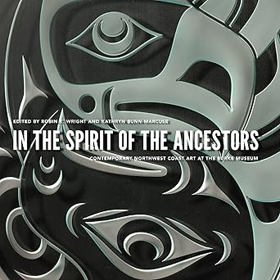
"In the Spirit of the Ancestors celebrates the vitality of contemporary Pacific Northwest Coast art by showcasing a selection of objects from the Burke Museum's collection of more than 2,400 late-twentieth- and early-twenty-first-century Native American works. Essays focus on contemporary art while exploring the important historical precedents on which so many artists rely for training and inspiration. Margaret Blackman reflects on building one of the largest collections of Northwest Coast serigraphs, and Joe David reminisces about his artistic journey through mask-making. Shaun Peterson, Lisa Telford, and Evelyn Vanderhoop discuss the historical precedents for working in styles that were kept alive only by a few critical artists and are now making a comeback. Robin K. Wright explores the history of box drums and their revival. Emily Moore discusses the repatriation of two stolen house posts and proposes a new concept of "propatriation" to describe the resulting commissioning of contemporary posts to take their place. Kathryn Bunn-Marcuse explores the power of adornment and how clothing, jewelry, and personal adornments like tattooing express tribal and personal identity in ways both connected to the past and grounded in the present. The diversity of approaches presented by these contributors speaks to artists, collectors, academics, tribal communities, and all those interested in Pacific Northwest Coast art. Splendid color photographs of works never before published will delight everyone. Robin K. Wright is curator of Native American art at the Burke Museum, director of the Bill Holm Center for the Study of Northwest Coast Art, and professor of art history at the University of Washington, Seattle. She is the author of Northern Haida Master Carvers. Kathryn Bunn-Marcuse is assistant director of the Bill Holm Center for the Study of Northwest Coast Art"-- Provided by publisher ix, 150 pages : illustrations ; 27 cm. CIRC [ 0 ]
|
2015 |