Catalog of British Columbiana and Pacific Northwest Americana
The Encyclopedia Cascadia Catalog indexes mostly non-fiction literature covering the Pacific Northwest coast of North America, with an emphasis on British Columbia, Idaho, Oregon, and Washington State.
| Catalog Title | Published |
|---|---|
|
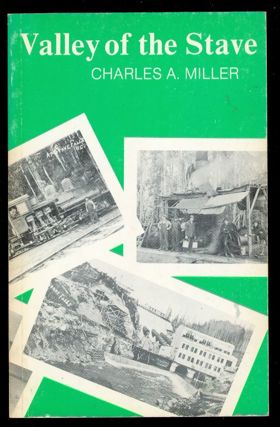
Valley of the Stave by Charles A. Miller
|
1981 |
|
Valley of the spirits the Upper Skagit Indians of western Washington by June M. Collins 
"Although the Upper Skagit Indians at one time controlled the great Skagit River drainage system in northwestern Washington, relatively little has been known about them, owing to the isolation in which many of them lived. When June Collins began her field work among the Upper Skagit in 1942, many precontact religious traditions and family and kinship practices had survived. Continuing her field work at intervals over a period of twenty years, she formed strong friendships with her informants. She is therefore able to present one of the most detailed and thorough ethnographic studies ever undertaken of a Northwest Coast people. Of particular interest is the exceptionally detailed description of Upper Skagit religious life, which was characterized by a belief in guardian spirits. Basing her analysis on dozens of case studies and descriptions by informants, Collins discusses the nature of the spirits, how they were acquired by the individual, the powers they conferred, and the dances held in their honor"--Book jacket xiii, 267 pages : illustrations ; 22 cm. Non-circulating [ 1 ]
|
1974 |
|
Valley of the red hand a western historical novel by Lowell Thomas Clay
Authored by Lowell Thomas Clay, Valley of the Red Hand is a sweeping western historical novel that plunges readers into the rugged, lawless frontier of the American West. The story follows hardened frontiersmen, desperate outlaws, and resilient settlers as they clash over disputed territory, valuable resources, and survival in an unforgiving landscape. Through vivid descriptive prose and fast-paced dramatic tension, the narrative captures the visceral danger and moral ambiguity of frontier expansion. A keen insight drawn from the work is how popular western fiction encodes historical anxiety; by framing territorial conquest through personal vendettas and blood feuds, the novel dramatizes the psychological toll of a violent nation-building process where justice was routinely forged outside the bounds of civilized law. 352 pages : illustrations ; 22 cm. Non-circulating [ 1 ]
|
1991 |
|
Utopias on Puget Sound, 1885-1915 by Charles Pierce LeWarne 
Postmaster General James A Farley's famous toast "to the forty-seven states and the soviet of Washington" introduces and sets the tone for this study of Washington State radicalism. The state's colorful reputation for radical movements was established in the 1920s and 1930s by free speech fights, strikes, strong labor organizations, and woman suffrage reforms. Charles LeWarne finds the roots of this radicalism in the communitarian experiments of the late nineteenth century. Through analyses of several of these experiments, LeWarne demonstrates that the influence of a coterie of liberals and radicals centered on Puget Sound in such communities as Home, Burley, Freeland, Equality, and Port Angeles was felt in the state long after the "utopias" they came to colonize had ceased to exist. Probably the most famous of the experiments was Home Colony on Joe's Bay near Tacoma. From a nucleus of three families, Home grew to over two hundred residents and lasted for more than twenty years. Its reputation for anarchism and flamboyance contributed to a jail sentence conviction for one editor of the Home newspaper for publishing an editorial called "The Nude and the Prudes." Readers interested in current social movements and lifestyles will find many enlightening parallels with recent communal attempts, particularly the rejection of traditional values and the belief in a perfectible world. Whatever the differences within individual colonies, the communitarian ideal has certain general characteristics that find their way into each of these attempts to form a perfect society. Historians will welcome this treatment of an important part of the social and cultural history of the area. The book contains a mine of previously scattered information on the subject. It is a delightful footnote to the history of the Puget Sound region. XXIV, 325 Seiten Illustrationen, Karten 23 cm Non-circulating [ 1 ]
|
1995 |
|
Urban Cascadia and the pursuit of environmental justice by Nik Janos , Corina McKendry 
How histories of environmental inequalities and settler colonialism undercut a famously “green” region. In Portland’s harbor, environmental justice groups challenge the EPA for a more thorough cleanup of the Willamette River. Near Olympia, the Puyallup assert their tribal sovereignty and treaty rights to fish. Seattle housing activists demand that Amazon pay to address the affordability crisis it helped create. Urban Cascadia, the infrastructure, social networks, built environments, and non-human animals and plants that are interconnected in the increasingly urbanized bioregion that surrounds Portland, Seattle, and Vancouver, enjoys a reputation for progressive ambitions and forward-thinking green urbanism. Yet legacies of settler colonialism and environmental inequalities contradict these ambitions, even as people strive to achieve those progressive ideals. In this edited volume, historians, geographers, urbanists, and other scholars critically examine these contradictions to better understand the capitalist urbanization of nature, the creation of social and environmental inequalities, and the movements to fight for social and environmental justice. Neither a story of green disillusion nor one of green boosterism, Urban Cascadia and the Pursuit of Environmental Justice reveals how the region can address broader issues of environmental justice, Indigenous sovereignty, and the politics of environmental change. vii, 296 pages : illustrations, maps ; 24 cm Desiderata
|
2021 |
|
Upriver voices tales of Skykomish by Nancy Cleveland, Anne Sekor, Jim Ojala, Skykomish Historical Society 
Published by the Skykomish Historical Society, Upriver Voices: Tales of Skykomish compiles local oral histories, archival photographs, and pioneer recollections to chronicle the dramatic evolution of the upper Skykomish River valley in Washington. The narrative captures the raw realities of a rugged mountain frontier shaped by the timber industry, the grueling construction of the Great Northern Railway, and the sheer grit required to carve isolated hamlets out of the Cascade foothills. Through the preserved voices of loggers, railway workers, and families, the volume documents the social fabric and daily hardships of a transient industrial community. A keen insight drawn from the text is how its grassroots, multi-author preservation approach exposes the fragile permanence of mountain boomtowns; by centering the firsthand accounts of ordinary workers rather than corporate boardrooms, the book illustrates how the relentless cycles of resource extraction left behind tight-knit communities defined just as much by communal resilience as by corporate transience. 166 pages : illustrations ; 20 cm Non-circulating [ 1 ]
|
2008 |
|
Up the Strait coastal British Columbia stories by Wayne J. Lutz 
Boating, hiking, and survival off the grid in coastal British Columbia, where mountains drop into the sea and people practice self-reliance and a different sense of purpose. Destinations on the Strait of Georgia that can be reached by boat, bicycle, all-terrain vehicle, and sea kayak. Contrarian views of the people and places of coastal British Columbia. A travelogue memoir based on off-the-grid living in a floating cabin, where the sublime beauty of British Columbia's lower mainland forms the setting, and the Strait of Georgia awaits on your doorstep. 223 p. : ill., maps, ports. ; 23 cm. Non-circulating [ 1 ]
|
2007 |
|
Up the Capitol steps a woman's march to the governorship by Barbara Roberts 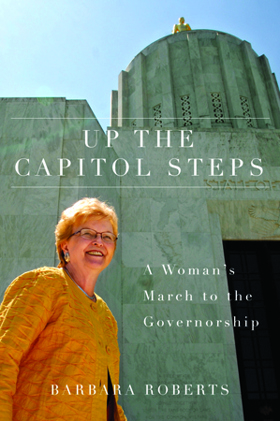
Up the Capitol Steps is a personal and political memoir by Oregon’s first (and only) woman governor, one of only thirty-four women who have served as state chief executives in the history of the United States. Barbara Roberts offers a behind-the-scenes glimpse of a woman’s life in politics and aims to “demystify” leadership by telling the story of her own unlikely rise to power. The mother of an autistic child before the advent of special education, Roberts began her life in public service as an advocate for the rights of children with disabilities. She documents her expanding political career from school board member to legislator to Secretary of State and finally, Governor. In this gripping and poignant memoir, hotly contested elections and tough policy decisions are interspersed with intimate details of personal ups and downs. Throughout, Roberts reveals the warmth and humor that show the “real” person behind the politician. Only the third published autobiography by an American woman head of state, Up the Capitol Steps is “a very significant contribution to Oregon history, the history of women in politics, and especially the history of women governors,” according to series editor Melody Rose. The book captures a period of our nation’s political history and a view of women’s expanding role in government that brings new understanding to the term, “social revolution.” x, 438 pages : illustrations ; 23 cm. Desiderata
|
2011 |
|
UNUSUAL ORCAS ISLAND ghost stories and other legends from the gem of the san juans by Joseph Reigel 
Orcas Island, Washington has long been celebrated for its rare beauty and colorful history—but for many visitors and locals alike, the feeling that something strange lurks beneath the surface is all too real. Does Sasquatch really stalk the remote woods? Did pirates bury a fortune on Turtleback Mountain? Is there a portal to a hidden world in Mount Constitution, and an Atlantean energy vortex in East Sound? With scores of articles, first-hand accounts, and historical photographs, Unusual Orcas Island attempts to shed light on these legends, and to uncover others that have never been collected before. Desiderata
|
2024 |
|
Untold tales of old British Columbia by Daniel Patrick Marshall 
"A collection of fascinating stories of the extraordinary and astonishing in BC's history. Daniel Marshall uncovers the stories of BC you've never heard. The award-winning Marshall captivates readers with intriguing and unknown stories, everything from Indigenous rights to Native gold; political intrigue to daring feats; the remarkable, mysterious traveller Harry (Harriet) Collins; the forgotten origin of Canada's oldest Chinatown; mysterious artifacts and confounding tales of the obscure and mysterious. Rigorously researched with interpretations that offer inclusive narratives while exploring surprising tales of great adventure."-- Provided by publisher 330 pages : illustrations, maps ; 23 cm Desiderata
|
2024 |
|
Unsettling Native art histories on the Northwest coast by Kathryn B. Bunn-Marcuse , Aldona Jonaitis 
Inseparable from its communities, Northwest Coast art functions aesthetically and performatively beyond the scope of non-Indigenous scholarship, from demonstrating kinship connections to manifesting spiritual power. Contributors to this volume foreground Indigenous understandings in recognition of this rich context and its historical erasure within the discipline of art history. By centering voices that uphold Indigenous priorities, integrating the expertise of Indigenous knowledge holders about their artistic heritage, and questioning current institutional practices, these new essays "unsettle" Northwest Coast art studies. Key themes include discussions of cultural heritage protections and Native sovereignty; re-centering women and their critical role in transmitting cultural knowledge; reflecting on decolonization work in museums; and examining how artworks function as living documents. The volume exemplifies respectful and relational engagement with Indigenous art and advocates for more accountable scholarship and practices. 334 pages : illustrations (chiefly color) ; 27 cm. Desiderata
|
2020 |
|
Unsettled ground the Whitman Massacre and its shifting legacy in the American West by Cassandra Tate 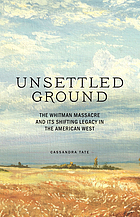
"Historian Cassandra Tate proposes to assemble the story of the Whitman Massacre from the many accounts while including the native point of view to provide a greater context to the event"-- Provided by publisher xx, 283 pages : illustrations, maps ; 23 cm Desiderata
|
2020 |
|
Unmooring the Komagata Maru charting colonial trajectories by Rita Dhamoon , Davina Bhandar , Renisa Mawani , Satwinder Kaur Bains 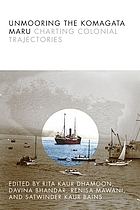
"In 1914, the SS Komagata Maru arrived in Vancouver Harbour and was detained for two months. Most of its 376 passengers were then forcibly returned to India. "Unmooring the Komagata Maru" challenges conventional Canadian historical accounts by considering the international colonial dimensions of the incident. By situating South Asian Canadian history within a global-imperial context, the contributors offer a critical reading of Canada's multicultural credentials. Ultimately, they caution against narratives that present the incident as a dark moment in the history of an otherwise redeemed nation. A hundred years later, the voyage of the Komagata Maru has yet to reach its conclusion."-- Provided by publisher xix, 329 pages : illustrations, map ; 24 cm Desiderata
|
2019 |
|
University of Idaho--then, now, tomorrow the heart of a hundred by Keith C. Petersen
Keith C. Petersen’s University of Idaho--then, now, tomorrow the heart of a hundred chronicles the establishment and century-long evolution of the state's flagship land-grant institution amidst the rolling agricultural hills of the Palouse region in northern Idaho. Set against the historically isolated frontier town of Moscow, the narrative details how dispersed farming families and pioneer settlers from across the sprawling territory coalesced to build a centralized academic community out of a rural wilderness. By tracing the collaborative construction of early campus infrastructure and the emergence of tight-knit student and alumni networks, the text reveals how this pioneering collegiate environment functioned as a vital cultural anchor for the Inland Northwest. Ultimately, this institutional history demonstrates how the shared pursuit of higher education and cooperative civic engagement successfully transformed a remote agrarian landscape into an enduring intellectual hub bound by deeply rooted regional lineages. 47 pages : illustrations ; 34 cm Desiderata
|
1989 |
|
University of Idaho The Campus History Series by Erin Passehl-Stoddart , Katherine G. Aiken 
Chroniclers have deemed the University of Idaho “The Beacon for Mountain and Plain” and “This Crested Hill”—both are apt monikers for Idaho’s land grant and comprehensive research university. For over 125 years, the University of Idaho has served the people of Idaho, the nation, and the world. As the state’s first university, the University of Idaho looks to a bright future of serving students and contributing to economic and social progress for Idaho and beyond. This book commemorates the proud heritage and innovative spirit of students, faculty, and staff who have shaped the history of the University of Idaho, featuring images from the library’s extensive Special Collections and Archives department. Erin Passehl-Stoddart is an associate professor and head of Special Collections and Archives. Katherine G. Aiken is a professor of history and a proud University of Idaho alumna. 127 pages : illustrations ; 24 cm. Desiderata
|
2016 |
|
UniverCity the city within city, the story of the University District by Roy G. Nielsen 
UniverCity: The City Within a City, The Story of the University District by Roy G. Nielsen is a detailed 1986 local history published by the University Lions Club Foundation that chronicles the evolution of Seattle's vibrant U-District. The book traces the neighborhood's dramatic transformation from a remote, wooded pioneer settlement originally known as Brooklyn into a bustling, self-sufficient urban enclave deeply intertwined with the 1895 relocation and subsequent expansion of the University of Washington. Nielsen meticulously details the commercial growth of "The Ave" (University Way), the establishment of local civic enterprises, and the unique social dynamic forged by the convergence of academics, students, and long-term residents. Ultimately, it serves as an invaluable, community-focused resource for regional historians seeking to understand the architectural, economic, and cultural forces that shaped one of Seattle's most distinct and historically rich neighborhoods. 167 pages : illustrations, maps ; 28 cm Non-circulating [ 1 ]
|
1986 |
|
Union Zindabad! South Asian Canadian labour history in British Columbia by Donna Sacuta , Bailey Garden , Anushay Malik , University of the Fraser Valley South Asian Studies Institute (Issuing body) 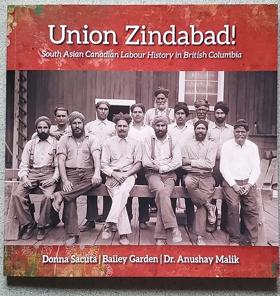
Union Zindabad focuses on the history of South Asian immigrants as workers, and their relationship to the labour movement in BC. It also explores the evolving attitudes of unions towards South Asian immigrant labour.--page xi xii, 118 pages : illustrations ; 21 x 21 cm Desiderata
|
2022 |
|
Union Pacific rails to the mines the Boise, Nampa & Owyhee Railway by Thornton Waite 
Authored by railroad historian Thornton Waite, Union Pacific Rails to the Mines: The Boise, Nampa & Owyhee Railway details the ambitious and financially volatile history of the late 19th-century rail line that connected southwestern Idaho's rich mining districts and agricultural valleys to the broader transcontinental network. The book traces the corporate maneuvers, engineering challenges, and economic battles required to construct and operate tracks through the rugged terrain between Nampa, Boise, and the Owyhee mountains. Drawing heavily on corporate archives, vintage maps, and historical photographs, the text illustrates how steel infrastructure dictated the survival and decline of regional boomtowns. A keen insight drawn from the work is how regional feeder railways acted as economic gatekeepers rather than mere public utilities; by holding a monopoly over mineral and crop transportation, independent lines like the Boise, Nampa & Owyhee held the ultimate power of life or death over local commerce, frequently leaving isolated communities at the mercy of distant corporate boardrooms. 64 pages : illustrations ; 28 cm Non-circulating [ 1 ]
|
1999 |
|
Union Bay, the life of a city marsh by Harry Wentworth Higman, Earl J. Larrison , Edmund J. Sawyer (Illustrator)
Harry Wentworth Higman and Earl J. Larrison’s Union Bay, the life of a city marsh chronicles the intense ecological collision and aggressive hydrological subjugation of a fragile wetland ecosystem trapped within the heavily industrialized, expanding urban grid of Seattle. The narrative maps how the severe environmental realities of this contested topography—defined by the massive artificial lowering of Lake Washington and the violent, mechanized dredging of the Montlake Cut—permanently shattered the natural aquatic boundaries of the bay, forcing the surviving flora and fauna into a desperate, hyper-compressed existence. By detailing the striking juxtaposition of resilient marshland wildlife struggling against the relentless encroachment of raw municipal landfills and the heavy maritime traffic of the ship canal, the text illustrates how the localized ecology was strictly dictated by the urgent necessity of radically re-engineering the region's massive hydrological arteries to serve trans-oceanic commerce. Ultimately, the account demonstrates that artificially domesticating these volatile inland waterways and violently carving navigable marine transit corridors through the sheer terrain of the Seattle isthmus were the absolute prerequisites for binding the once-isolated freshwater lake to the tidal anchor of Puget Sound, leaving Union Bay as a captive remnant of a fundamentally conquered landscape. 315 pages illustrations 22 cm Non-circulating [ 1 ]
|
1951 |
|
Underneath the bough collected poems of Kenneth B. Platt by Kenneth B. Platt 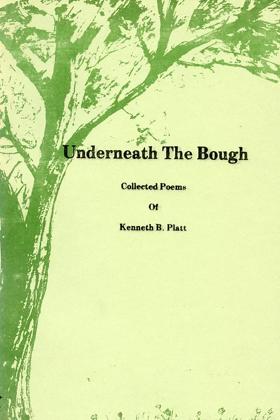
A collection of poems by Moscow resident and long-time Latah County Historical Society volunteer Kenneth B. Platt. It includes a section of sheet music to accompany various poems. 92 pages, 11 unnumbered leaves of plates, [18] pages (folded) : illustrations, music ; 22 cm Desiderata
|
1976 |
|
Undercurrents from oceanographer to university president by John Vincent Byrne 
Undercurrents recounts the life and career of John Byrne, who started as a geologist at an oil company and retired as president of a major land grant university. He came to Oregon State in 1960 as a faculty member, later becoming department chair, dean, director of the Hatfield Marine Science Center, and vice president for Research and Graduate Studies. Along the way, he took leave from the university to serve the US government, first as a program director for oceanography at the National Science Foundation, and later as the administrator of the National Oceanic and Atmospheric Administration, before returning to OSU in 1984 as its twelfth president. As president of OSU, John Byrne used the lessons learned in industry and government to guide the university through a period of turbulence caused by severe state budget restrictions. During this period of economic contraction, OSU continued under Byrne’s leadership to grow in programs, facilities, and external funding. Byrne was one of the first to introduce Total Quality Management techniques to higher education. He emphasized the importance of international education and was a supporter of significant academic reform in higher education. While focusing on his professional career, Byrne’s memoir also shares personal stories of a childhood and youth shaped by the Great Depression and World War II. Undercurrents demonstrates on every page the curiosity, intellect, and humanity that made John Byrne successful as a scientist, educator, and administrator. Anyone pursuing a career in science or academia, and anyone interested in the history and legacy of land grant universities will welcome this richly detailed and warmly written account of Byrne’s career. 1 online resource Desiderata
|
2018 |
|
Under Vancouver 1972-1982 by Greg Girard (Photographer), David Campany (Compiler) 
Greg Girard's photographs of Vancouver from the 1970s and early 1980s show us the city's final days as a port town at the end of the railway line. Soon after Vancouver began to be noticed by the wider world (Expo 86 is generally agreed on as the pivotal moment), the city began refashioning itself as an urban resort on nature's doorstep and attracting attention as a destination for real estate investment. At that time, long before post-9/11 security concerns sealed off the working waterfront from the city, many of Vancouver's downtown and east side streets ended at the waterfront, an area filled with commercial fishing docks, cargo terminals, and bars and cafes for waterfront workers and sailors. Pawn-shop windows downtown displayed outboard motors, chainsaws and fishing gear. Wandering these streets, living in cheap hotels, Girard photographed the workaday (and night) world of the city where he grew up. The photographs in Under Vancouver 1972-1982 were made before Girard began earning a living as a magazine photographer, later establishing a formal practice as an artist. They reveal an early interest in the hidden and the overlooked, the use of color film at night, and the extended photographic inquiry of a specific place, all of which became signature features of later books such as City of Darkness and City of Darkness Revisited (about the infamous Kowloon Walled City), Phantom Shanghai and Hanoi Calling. Under Vancouver 1972-1982 is the first comprehensive collection of Girard's early photographs of Vancouver. Made in and of the moment, a young photographer's earliest engagements (often featuring the underside of the city), the pictures now form an unintended photographic record of a Vancouver that has all but disappeared 196 pages : illustrations ; 26 cm Non-circulating [ 1 ]
|
2017 |
|
Under eleven governors by Howard C. Belton
Under eleven governors examines the political and agricultural evolution of Oregon through the autobiographical lens of Howard C. Belton, a long-serving state legislator whose public life was deeply rooted in the fertile, alluvial soils of the northern Willamette Valley. Belton details how the region’s specific geography—particularly the rich plains of Canby where he anchored his farming operations for over four decades—strictly dictated a rural, agrarian economy that frequently collided with the state's rapid mid-century industrialization. By mapping his legislative tenure in Salem, the central political nexus situated within this massive agricultural trough, the narrative highlights the immense logistical and economic challenges of governing a territory defined by extreme topographical divides, from the dense timber of the Coast Range to the vast, arid expanses of the eastern high desert. The book illustrates how statewide infrastructure, rural banking networks, and complex tax frameworks had to be deliberately engineered to bridge these profound geographical and environmental disparities. Ultimately, this political memoir serves as a localized spatial history, demonstrating how the immense physical scale and diverse microclimates of the Pacific Northwest inherently shaped the legislative strategies and enduring agrarian character of Oregon's statesmen. xii, 90 pages : illustrations ; 23 cm Non-circulating [ 1 ]
|
1977 |
|
Uncle Mike's guide to the real Oregon Coast by Michael Burgess , Steve McLeod (Illustrator) 
Authored by Michael Burgess and illustrated by Steve McLeod, Uncle Mike's Guide to the Real Oregon Coast offers an unconventional, highly personal travelogue that strips away polished resort gloss to reveal the quirky characters, hidden tide pools, and gritty working-waterfront towns of the Pacific Northwest shore. The book combines irreverent local lore, practical backroads navigation, and offbeat commentary to direct travelers toward authentic, uncommercialized coastal experiences. Through its humorous and direct prose, the text highlights the idiosyncratic cultural texture that survives just off the beaten highway. A keen insight drawn from the work is how true regional identity often exists in the overlooked margins between major tourist attractions; by celebrating the weathered fish shacks, eccentric locals, and forgotten roadside stops, the guide exposes how authentic coastal culture thrives precisely where commercial tourism fears to tread. xiii, 87 pages : illustrations ; 22 cm Non-circulating [ 1 ]
|
1997 |
|
Uncharted waters the explorations of José Narváez (1768-1840) by Jim McDowell 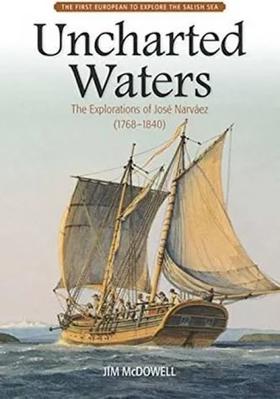
"Jim McDowell's new biography of the little-known Spanish explorer José María Narváez, reveals his significant discoveries during the European exploration of what is now Canada's Pacific Northwest Coast. Narváez was the first European to investigate a Russian fur-trading outpost in the Gulf of Alaska in 1788. The following year he became the first Spaniard to reconnoitre Juan de Fuca Strait. In 1791, he charted the interiors of three large inlets on Vancouver Island's West Coast, discovered a vast inland sea to the east (today's Salish Sea), mapped the entire gulf, made first contact with Aboriginal peoples in the area, and found the site of what became western Canada's largest city -- Vancouver, British Columbia. Narváez also undertook diplomatic missions around the Pacific Ocean, charted the waters of the Philippines, and engaged extensively in the political upheaval that transformed New Spain into Mexico between 1796 and his death in 1840"--Publisher's description 1 online resource Non-circulating [ 1 ]
|
2015 |