Catalog of British Columbiana and Pacific Northwest Americana
The Encyclopedia Cascadia Catalog indexes mostly non-fiction literature covering the Pacific Northwest coast of North America, with an emphasis on British Columbia, Idaho, Oregon, and Washington State.
| Catalog Title | Published |
|---|---|
|
George Gibbs northwest array full reports, place names, word list, artifact names, and guide by George Gibbs , Jay Miller 
Essential information for Northwest tribes, traditions, languages, place names, and systematic word study by George Gibbs from the 1850s 266 pages ; 27 cm Non-circulating [ 1 ]
|
2015 |
|
Geology underfoot in Southern Idaho by Shawn Willsey 
Geology professor Willsey aims to inspire more Idahoans and visitors to take an interest in one of the most compelling and fascinating regions of the earth. He aims to bridge the gap between geologists and the interested public by passing along a collection of fascinating stories told by southern Idaho's rocks and landscapes. Southern Idaho's geologic history spans about 2.5 billion years--more than half that of the Earth. Chapters represent a sampling of the unique geologic features that formed during this immense amount of time. Willsey selects accessible locations that are exceptional in terms of either location or geologic history. --Publisher xi, 290 pages : color illustrations, color maps ; 23 cm. Desiderata
|
2017 |
|
Geology of the San Juan Islands by Edwin H. Brown 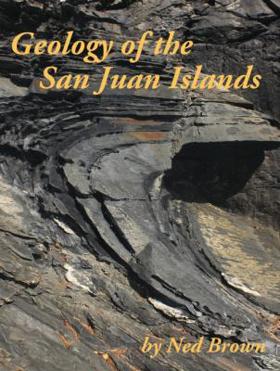
Nestled in the heart of the Salish Sea lie the picturesque San Juan Islands, an archipelago molded by eons of tectonic and glacial activity. Over the course of his nearly five-decade career, WWU geology professor Ned Brown has led countless research teams to decode this complex terrestrial heritage. In Geology of the San Juan Islands, Brown provides detailed, approachable, full color photos and diagrams to illuminate the complexities of these iconic islands. Author Ned Brown is an Emeritus Professor of geology at Western Washington University. He was raised in Minnesota, and went on to receive higher education at Dartmouth College, University of Otago, and U.C. Berkeley. He came to Bellingham in 1966, attracted by the landscape and mountain-building geology. In his nearly five-decade career, Ned, together with students, traversed and sampled much of the bedrock in the Cascades, San Juan Islands, and southern British Columbia Coast Mountains. This lifetime work is the basis for numerous student theses, and professional reports. 99 pages : illustrations (chiefly color), maps ; 28 cm Non-circulating [ 1 ]
|
2014 |
|
General William S. Harney prince of dragoons by George Rollie Adams 
"Between the War of 1812 and the Civil War, General William S. Harney became one of the best-known military figures in America. In a career aided by Andrew Jackson and the concept of an expansible army, Harney saw duty in virtually every part of the country and participated in most of the key military episodes of his time. He chased remnants of Lafitte pirates in Louisiana, campaigned with Abraham Lincoln and Jefferson Davis during the Black Hawk War, developed Vietnam-style riverine tactics that ended the Second Seminole War, and led Winfield Scott's cavalry in the Mexican War. In the 1850s Harney devised the army's largest and most successful pre-Civil War campaign against Plains Indians, commanded troops charged with upholding federal authority in Kansas and Utah, and almost provoked hostilities with Great Britain in the Pacific Northwest. Removed from command amid false charges of disloyalty during the Missouri secession crisis, he returned as a leading member of the Indian Peace Commission of 1867-68." "Harney was bold, ambitious, and innovative, but also impulsive, vindictive, and violent. His career illustrates the nineteenth oentury army's role in implementing federal policy, highlights its limited resources compared to its responsibilities, and illuminates key aspects of its organizational structure, the behavior of its officers, and its impact on personal lives."--Jacket xix, 389 pages : illustrations ; 24 cm Non-circulating [ 1 ]
|
2001 |
|
General history of Oregon through early statehood by Charles Henry Carey 
General history of Oregon through early statehood examines the sweeping territorial consolidation, mass pioneer migration, and nascent political formation situated across the profoundly diverse, highly fractured macro-geography of the Oregon Territory. Carey details how the region's formidable macro-topography—specifically the treacherous, shifting sandbars of the Columbia River bar, the towering, heavily timbered volcanic barrier of the Cascade Range, and the sprawling, fertile alluvial expanse of the Willamette Valley—strictly dictated the margins of indigenous displacement, grueling overland wagon transit, and concentrated agrarian settlement. By mapping the arduous transformation of a fiercely contested fur-trade frontier into an organized American state, reliant on the Columbia River gorge to funnel exhausted pioneers through the impassable mountain barricades and into the protected western valleys, the narrative highlights how this specific immense geography anchored a deeply enduring, valley-bound pioneer society. Ultimately, this comprehensive historical record serves as a macro-level spatial history, demonstrating how the immense overland distances, severe topographic barricades, and vital fertile river basins of this Pacific Northwest landscape fundamentally shaped the highly resilient, agrarian-driven character of early Oregon statehood. xii, 916 pages : illustrations, maps ; 24 cm Non-circulating [ 1 ]
|
1971 |
|
Gene Zema architect, craftsman by Grant Hildebrand, Gene Zema 
In the three decades following World War II, a group of architects centered in the Puget Sound region were designing buildings of extraordinary quality, whose most evident commonality was the use of wood in profusion, as exposed, meticulously detailed structure and as interior and exterior surface. Gene Zema, a 1950 graduate of the University of Washington and a student of the legendary Lionel Pries, was one of this group. In a career that spanned twenty years, Zema designed forty-six houses, seven clinics, two architectural offices, a nursery, and a golf clubhouse, and he participated in the design of two University buildings. He built several buildings with his own hands, developing a consummate sense of appropriate design in wood. The luxuriantly crafted details and uniquely dramatic spatial compositions of his work place it at the forefront of that remarkable movement. Zema was also a distinguished collector and retailer of Native American and Japanese antiquities. In 1983, relying on the sale of antiquities for income and limiting his architectural practice, he and his wife, Jane, bought a 70-acre meadow on Whidbey Island. On their property Zema built a workshop, a windmill and pump house, a chicken house, a home, a peacock house, and a kiln, all of which are as remarkable as his earlier masterpieces. Gene Zema is an iconic figure among those who know his work, but the region to which his work is intimately bound is far from the centers of architectural journalism and his story is little known. It is the story of a unique figure in an extraordinary American architectural movement and an exceptional figure in the history of the Pacific Northwest. x, 147 pages : illustrations (chiefly color) ; 26 cm Desiderata
|
2011 |
|
Gem minerals of Idaho by John A. Beckwith, Jane Beckwith 
Gem Minerals of Idaho, designed for beginners and for those collectors visiting Idaho for the first time, it is a guide to some of the countless collecting areas of the state. It is not a textbook of mineralogy and, so far as possible, avoids technical terminology. However, it does contain information of general value on the physical and optical characteristics of minerals, as well as facts concerning history, lore, and fashioning of many of the gems. 129 pages : illustrations, maps ; 23 cm Desiderata
|
1971 |
|
Gay Seattle stories of exile and belonging by Gary Atkins 
In 1893, the Washington State legislature quietly began passing a set of laws that essentially made homosexuality, and eventually even the discussion of homosexuality, a crime. A century later Mike Lowry became the first governor of the state to address the annual lesbian and gay pride rally in Seattle. Gay Seattle traces the evolution of Seattle’s gay community in those 100 turbulent years, telling through a century of stories how gays and lesbians have sought to achieve a sense of belonging in Seattle. Gary Atkins recounts the demonization of gays by social crusaders around the turn of the century, the earliest prosecutions for sodomy, the official harassment and discrimination through most of the twentieth century, and the medical discrimination and commitment to mental hospitals that continued into the 1970s as homosexuality was diagnosed as a disease that could be "cured." Places of refuge from this imposed social exile were created in underground theater and dance clubs: the Gold Rush-era burlesque shows, modern drag theater, and in mid-century the emergence of openly gay bars, from the Casino to Shelley’s Leg. Many of these were subjected to steady exploitation by corrupt police - until bar owner MacIver Wells and two Seattle Times reporters exposed the racket. The increasingly public presence of gays in Seattle was accompanied by the gradual coalescence of social services and self-help organizations such as the Dorian Society, gay businesses and advocacy groups including the Greater Seattle Business Association, and the stormy relationship between the Vatican, Seattle's Catholic hierarchy, and gay worshippers. Atkins’ narrative reveals the complex and often frustrating process of claiming a civic life, showing how gays and lesbians have engaged in a multilayered struggle for social acceptance against the forces of state and city politics, the police, the media, and public opinion. The emergence of mainstream political activism in the 1970s, and ultimately the election of Cal Anderson and other openly gay officials to the state legislature and city council, were momentous events, yet shadowed by the devastating rise of AIDS and its effect on the homosexual community as a whole. These stories of exile and belonging draw on numerous original interviews as well as case studies of individuals and organizations that played important roles in the history of Seattle’s gay and lesbian community. Collectively, they are a powerful testament to the endurance and fortitude of this minority community, revealing the ways a previously hidden sexual minority "comes out" as a people and establishes a public presence in the face of challenges from within and without. xl, 451 pages : illustrations ; 23 cm Desiderata
|
2013 |
|
Gastown's Gassy Jack the life and times of John Deighton of England, California and early British Columbia by Raymond Hull, Olga Ruskin 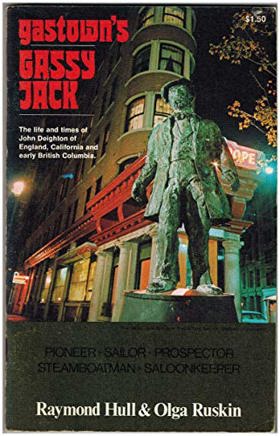
Gastown's Gassy Jack the life and times of John Deighton of England, California and early British Columbia examines the nascent frontier settlement and precarious maritime commerce situated along the sheltered southern shores of British Columbia's Burrard Inlet. Hull and Ruskin detail how the region's formidable coastal topography—specifically the deep, naturally protected marine basin of the inlet, the impenetrable, towering temperate rainforests of the surrounding mainland, and the tidal mudflats of the littoral margin—strictly dictated the margins of early pioneer homesteading, massive old-growth logging operations, and the establishment of opportunistic waterfront enterprise. By mapping the spontaneous growth of Deighton's improvised saloon enclave, which strategically leveraged the vital deep-water anchorage to intercept isolated Hastings Mill timber crews and coastal maritime traffic, the narrative highlights how this specific estuarine and coastal geography anchored the settlement's absolute reliance on marine connectivity. Ultimately, this biographical and civic record serves as a localized spatial history, demonstrating how the severe overland isolation, immense botanical scale, and critical deep-water access of this Pacific Northwest landscape fundamentally shaped the highly rugged, maritime-dependent character of early Gastown and the future city of Vancouver. 48 pages illustrations, maps, portraits 22 cm Desiderata
|
1971 |
|
Galena Bay odyssey reflections of a hippie homesteader by Ellen Schwartz 
"A writer and educator reflects on the idealistic, tumultuous, and eye-opening time she spent as a back-to-the-land hippie homesteader in Kootenays in the 1970s. What compelled a nice Jewish girl from the suburbs of New York to spend a decade of her life as a hippie homesteader in the BC wilderness? Galena Bay Odyssey traces Ellen Schwartz's journey from a born-and-raised urbanite who was terrified of the woods to a self-determined logger, cabin-builder, gardener, chicken farmer, apiarist, and woodstove cook living on a communal farm in the Kootenays. Part memoir, part exploration of what motivated the exodus of young hippies--including American expatriates, like Ellen and her husband, Bill--to go "back to the land" in remote parts of North America during the 1960s and '70s, this fascinating book explores the era's naivety, idealism, and sense of adventure. Like most "back to the land" books, Galena Bay Odyssey describes the physical work involved in clearing land, constructing buildings, and living off of what they produced, but it also traces the complicated journey of discovery this experience brought to Ellen and Bill. Now, nearly half a century later, Ellen reflects on what her homesteader experience taught her about living more fully, honestly, and ecologically."-- Provided by publisher 265 pages, 14 unnumbered pages of plates : illustrations ; 23 cm Desiderata
|
2023 |
|
Fusang The discovery of America by Chinese Buddhist priests in the fifth century by Charles G. Leland
This book, first published in 1875 and reissued in 1973, analyses the limited evidence from the works of early Chinese historians that explorers from China had discovered a country they called Fusang – possibly western America, and in all probability Mexico. The original document on which Chinese historians based their accounts of Fusang was the report of a Buddhist monk called Hoei-shin, who, in the year 499 AD, returned from a long journey to the east. xix, 212 pages ONLINE Circulation [ 1 ]
|
1875 |
|
Fur trading forts of Old Oregon, 1810-1834 by Katharine Berry Judson
Katharine Berry Judson’s Fur trading forts of Old Oregon, 1810-1834 provides a detailed logistical history of the early corporate outposts that initially anchored the region's lucrative pelt trade. The text chronicles how rival syndicates—including the Pacific Fur Company and the North West Company—strategically mapped their fortified stockades, such as Fort Astoria and Fort Nez Perces, directly onto the ancient riverine crossroads and seasonal gathering sites long managed by the Chinookan and Plateau peoples. To survive immense geographic isolation and fragile supply chains, these remote garrisons relied heavily on complex interdependent alliances and trade agreements with local indigenous leaders, whose geographic and environmental expertise was essential for navigating the Columbia Basin. Ultimately, Judson’s historical account illustrates how the aggressive expansion of these mercantile networks established the initial economic infrastructure that would eventually facilitate full-scale Euro-American settlement of the Pacific Northwest. 198 leaves Desiderata
|
1911 |
|
Fur traders from New England the Boston men in the North Pacific, 1787-1800 : the narratives of William Dane Phelps, William Sturgis, and James Gilchrist Swan by William Dane Phelps, William Sturgis, James G. Swan, Briton Cooper Busch, Barry M. Gough 
Examines the work of Boston mariners in the fur trade and other trades during the late eighteenth and early nineteenth century 137 pages ; 25 cm. Non-circulating [ 1 ]
|
1997 |
|
Fur trade and exploration opening the Far Northwest, 1821-1852 by Theodore J. Karamanski 
Discusses the role of the Hudson's Bay Company and its fur traders in the exploration of northern B.C., the western NWT, the Yukon and eastern Alaska xxii, 330 pages : illustrations, maps ; 23 cm Desiderata
|
1983 |
|
Fur trade and empire George Simpson's journal entitled Remarks connected with the fur trade in the course of a voyage from York Factory to Fort George and back to York Factory 1824-25, with related documents by George Simpson , Frederick Merk (Editor, Writer of introduction)
Simpson's reorganization of Oregon Territory after amalgamation with the Northwest Company. First published in 1931 lxii, 370 pages : folded map ; 24 cm Non-circulating [ 1 ]
|
1968 |
|
Frontiers of Vancouver Island by E. Blanche Norcross, Doris Farmer Tonkin 
Frontiers of Vancouver Island by E. Blanche Norcross and Doris Farmer Tonkin offers a detailed historical account of British Columbia's Vancouver Island from the late eighteenth century onward. The narrative explores the rugged coastal geography and interior valleys of the island, focusing heavily on the growth of early settlements and resource-based communities like Zeballos, Ladysmith, Campbell River, and Tofino. By chronicling the transformation of these isolated outposts and the ancestral lands of the Cowichan tribes into established coastal villages, the book vividly captures the frontier spirit of Canada's westernmost Pacific Northwest territory. 128 pages, [1] leaf of plates : illustrations, folded map ; 22 cm Non-circulating [ 1 ]
|
1969 |
|
Frontier history along Idaho's Clearwater River pioneers, miners & lumberjacks by John Bradbury 
The Clearwater River runs deep through northern Idaho's history. The Nez Perce tribe made its home along the river. Lewis and Clark's journey west took them through the Clearwater. In fact, the Nez Perce made the expedition's voyage from the Clearwater River to the Pacific Ocean possible by teaching them how to make dugout canoes from ponderosa pine logs. Fur traders like John Jacob Astor and William Ashley financed the first American commercial activity on the river, bringing trappers to the area and paving the way for the Oregon Trail. Later came the first gold rush, the Nez Perce war, statehood, homesteaders and the beginning of the logging industry. Join author John Bradbury as he recounts a time when native tribes, explorers, trappers, preachers, miners and lumberjacks made a life along the Clearwater, establishing the area for future generations. 157 pages : illustrations, maps ; 24 cm Desiderata
|
2014 |
|
From wilderness to suburbia an illustrated history of Parkland, Washington by Richard D. Osness
From wilderness to suburbia: an illustrated history of Parkland, Washington chronicles the grueling agricultural transformation and gradual civic expansion across the dense glacial outwash plains and heavily timbered lowlands of the southern Puget Sound. Osness details how the region's formidable physical barriers—specifically the towering, impenetrable stands of old-growth Douglas fir, the dense, root-choked prairie brush, and the heavily compacted, rocky glacial till soils—strictly dictated the margins of early human survival and initial agrarian development. By mapping the immense physical labor required to painstakingly extract massive stumps from the damp earth, break the unyielding glacial soil for rudimentary farming, and cut precarious plank roads through the dense wilderness toward the deepwater port of Tacoma, the narrative highlights the monumental cooperative effort necessary to forcibly convert this rugged terrain into a structured, habitable grid. The initial geographic isolation from established urban centers forced these remote pioneer homesteads and early institutional outposts into a strict reliance on the immediate topographical resources, completely anchoring their physical survival and gradual suburban integration to the arduous overland transport through the heavy maritime precipitation and muddy, forested corridors. Ultimately, this illustrated and civic record serves as a deeply localized spatial history, demonstrating how the immense botanical density and challenging glacial topography of this Pacific Northwest frontier fundamentally shaped the fiercely resilient, highly adaptable character of the Parkland community as it transitioned from an isolated forested enclave into a permanent suburban expanse. viii, 132 pages : illustrations, portraits ; 28 cm Non-circulating [ 1 ]
|
1976 |
|
From trails to rails the post offices, stage stops, & wagon roads of Union County, Oregon by Irene Barklow 
From Trails to Rails: The Post Offices, Stage Stops, & Wagon Roads of Union County, Oregon by Irene Barklow is a meticulously researched 1987 local history that chronicles the evolution of pioneer transportation and communication in Eastern Oregon. The book details the region's transformation from rugged frontier trails and early stagecoach routes into a modernized railway hub, specifically cataloging the establishment of local post offices and settlements along the way. Ultimately, it serves as an invaluable resource for regional historians and genealogists tracing the infrastructural growth and pioneer heritage of Union County. ix, 300 pages : illustrations, portraits ; 29 cm Non-circulating [ 1 ]
|
1987 |
|
From thorns to blossoms a Japanese American family in war and peace by Mitzi Asai Loftus , David Loftus , Oregon State University Press (Publisher) 
"Mitsuko "Mitzi" Asai was not yet ten years old in the spring of 1942 when President Roosevelt's Executive Order 9066 sent 120,000 people of Japanese ancestry--about two-thirds of them US citizens--from their homes on the West Coast to inland prison camps. They included Mitzi and most of her family, who operated a fruit orchard in Hood River, Oregon. The Asais spent much of World War II in the camps while two of the older sons served in the Pacific in the US Army. Three years later, when the camps began to close, the family returned to Hood River to find an altered community. Shop owners refused to serve neighbors they had known for decades; racism and hostility were open and largely unchecked. Humiliation and shame drove teenaged Mitzi to reject her Japanese heritage, including her birth name. More than a decade later, her life took another turn when a Fulbright grant sent her to teach in Japan, where she reconnected with her roots. In From Thorns to Blossoms, Mitzi recounts her rich and varied life, from a childhood surrounded by barbed wire and hatred to a successful career as a high school English teacher and college instructor in English as a Second Language. Today, Asai descendants continue to tend the Hood River farm while the town confronts its shameful history. Originally published in 1990 as Made in Japan and Settled in Oregon, this revised and expanded edition describes the positive influence Mitzi's immigrant parents had on their children, provides additional context for her story, and illuminates the personal side of a dark chapter in US history. It's the remarkable story of a transformation from thorns into blossoms, pain into healing."-- Provided by publisher x, 217 pages : illustrations, portraits ; 23 cm Desiderata
|
2024 |
|
From the Ganges to the Snake River an East Indian in the American West by D. Majumdar 
D. Majumdar’s From the Ganges to the Snake River: an East Indian in the American West explores the profound cross-cultural integration and active agricultural adaptation of South Asian immigrants within the demanding landscapes of the inland Pacific Northwest. The narrative illustrates how the contrasting environmental realities of this topography—spanning from the familiar river basins of the Indian subcontinent to the arid, sagebrush plains and intensely irrigated valleys of the Snake River basin—required immense physical resilience and thoughtful agrarian adaptation from early immigrant populations. By detailing the gradual transition from confronting severe cultural isolation and grueling manual labor to the cooperative participation in the region's expanding agricultural economy, the text highlights how the area's early prosperity relied on a diverse, community-driven workforce responding to its challenging geography. Ultimately, the account demonstrates that patiently navigating the complex social boundaries of the frontier and cooperatively harnessing the high desert's vital water resources were essential steps in forging a more inclusive, deeply rooted, and economically integrated civic society in the American West. A collection of essays about various experiences of the author while living in Idaho Falls, Idaho xii, 244 pages : illustrations ; 23 cm Desiderata
|
2000 |
|
From sojourner to citizen Chinese of the Inland Empire by Edith E. Erickson, Eddy Ng
Edith E. Erickson and Eddy Ng’s From sojourner to citizen: Chinese of the Inland Empire examines the profound demographic integration of Chinese immigrants across the arid plains of the Columbia Plateau and the rugged mining districts of eastern Washington and northern Idaho. Set against the burgeoning railway hubs of Spokane and the dispersed agricultural settlements of the Palouse, the narrative details how early laborers utilized tight-knit family associations and merchant networks to survive severe social isolation and physical hardship. By tracing their deliberate transition from transient frontier workers to established local residents, the text demonstrates how these resilient immigrant kinship bonds successfully forged lasting neighborhoods and enduring civic roots within the demanding geography of the Inland Pacific Northwest. xi, 200 pages : illustrations, maps ; 28 cm Non-circulating [ 1 ]
|
1989 |
|
From homestead to lakebed Kosmos, The Town That Drowned by LaVonne M. Sparkman 
Authored by LaVonne M. Sparkman, From Homestead to Lakebed: Kosmos—The Town that Drowned chronicles the rise and deliberate inundation of Kosmos, a small logging and milling community in Washington State that was wiped off the map to make way for the Mayfield Dam. The book utilizes historical records, photographs, and accounts from former residents to trace how a thriving early-twentieth-century industrial settlement was systematically dismantled, evacuated, and submerged beneath the Cowlitz River. Through these local archives, the text preserves the poignant human cost of hydroelectric progress on rural Pacific Northwest ecosystems and neighborhoods. A keen insight drawn from the work is how corporate and state infrastructure projects treat localized working-class history as entirely disposable collateral; by documenting how a self-sustaining town was erased by utility planning, the narrative underscores how modern energy demands have repeatedly required the literal burial of regional heritage. viii, 242 pages : illustrations, maps, portraits ; 28 cm Non-circulating [ 1 ]
|
1994 |
|
From Here to There and In-Between From the Log of S.V. Stone Spirit by Donna Winter 
From the logbook of the 33’ ferro-cement, cutter-rigged “Stone Spirit“. Follow Donna, her husband Dave, and Montague the cat as they travel around the southern inside passage of British Columbia, Canada. 99 pages illustrations, map Non-circulating [ 1 ]
|
1998 |
|
From Frontier Village To World Metropolis: Seattle by Lancaster Pollard, Durwood Lapham, Lloyd Spencer
|
1939 |