Catalog of British Columbiana and Pacific Northwest Americana
Encyclopedia Cascadia Catalog contains book titles of mostly non-fiction Pacific Northwest Coast of North America Titles (primarially British Columbia, Idaho, Oregon and Washington State) in an easy-to-understand title catalog. If you see a link with this badge ONLINE CIRC it means that there is an online institution that provides free access to that title. In some cases there may be more than one institution hosting the title digitally.
| Catalog Title | Published |
|---|---|
|
Adventures of Captain Bonneville by Washington Irving, Benjamin Louis Eulalie de Bonneville 
This is the deluxe Klickitat edition of this great classic a hundred and seventeen years after the first edition. It has come by its popularity, far beyond that of most books, even of most good books, by it having the frontier fur trade for a subject, by being a first hand record, by receiving a final enchantment from the one who could write Rip Van Winkle and the Legend of Sleepy Hollow. The "father of American literature" tells with gusto and charm the amazing travels of a picturesque soldier of fortune in the Far West during 1832-1835. Robert Reynolds, talented Northwest artist, did the original illustrations which make this book a collector's item. Adventures of Captain Bonneville is a companion volume to our Astoria 375pp. 357 pages illustrations CIRC [ 1 ]
|
1954 |
|
Adventure roads of BC’s Northwest Heartland by Liz Bryan 
"An off-the-beaten track exploration of Interior BC, full of scenic photography, maps, and fascinating information for tourists and armchair travellers alike. From lush forests to majestic mountains, sleepy ghost towns to pastoral farmland, Adventure Roads of BC’s Northwest Heartland captures the beauty, history, and unexpected twists and turns of a region often overlooked by tourists and ideal for would-be road trippers. Fuelled by the philosophy that any road can lead to adventure—not always of the visceral sort, but of the mind and heart—travel writer, historian, and photographer Liz Bryan takes readers on a virtual tour. Taking scenic routes from Merritt to Barkerville, Kamloops to Bella Coola, and into the valleys of the Bulkley and Skeena Rivers, Bryan tells the story of this land, its peoples, and their history. With stunning photography and fascinating prose, this book will compel anyone to follow their own adventure road, wherever it may take them."-- Provided by publisher 221 pages : color illustrations, color maps ; 23 cm CIRC [ 0 ]
|
2022 |
|
Across the Olympic Mountains the Press Expedition, 1889-90 by Robert L. Wood 
In 1889 Washington's then governor, Elisha Ferry, called on men of adventure to cross the Olympic Mountains, a range shrouded in mystery. The Seattle Press, the state's primary newspaper, stepped up to the challenge, sponsoring the Press Expedition.And soon departed a band of men into the mountains during one of the worst winters in recorded history. 220 pages : illustrations, maps ; 22 cm CIRC [ 1 ]
|
1989 |
|
Abraham Lincoln and the Washington Territory by H. D. Smiley 
Abraham Lincoln and the Washington Territory by H. D. Smiley is a 1987 historical study published by Ye Galleon Press that explores the 16th president's political and administrative relationship with the remote Pacific Northwest. The book delves into Lincoln's federal appointments, policies, and the legislative actions during the Civil War era that shaped the region, including the 1863 creation of the Idaho Territory that established Washington's modern boundaries. Ultimately, it provides a specialized look at how national wartime leadership and federal governance influenced the early frontier development of the Washington Territory. 38 pages : illustrations ; 25 cm CIRC [ 1 ]
|
1987 |
|
Above the falls an oral and folk history of the Upper Glenn Creek, Coos County, Oregon by Lionel Youst 
Thousands of visitors have been enthralled by the beauty and grandeur of the 378-foot Golden Falls of Glenn Creek, about 25 miles east of Coos Bay. They are part of the Golden and Silver Falls State Park, one of the treasures of western Oregon. Very few of the visitors have had any idea of the land, nor of the history of the land above those falls. Above the Golden and Silver Falls is a lovely valley about three miles long. For 60 years a few families lived their lives in that remote and idyllic location. In 1958 the bridge at the base of Silver Falls was removed and the road was closed. The land above the falls became uninhabited timberland, inaccessible to the public. This book contains scores of verbatim interviews from the survivors and their descendants, 160 photographs, and exhaustive research into original documents. Fully indexed, bibliography, maps, and charts. viii, 320 pages : illustrations, maps, portraits ; 28 cm CIRC [ 1 ]
|
1992 |
|
Aboriginal peoples and politics the Indian land question in British Columbia, 1849-1989 by Paul Tennant 
Aboriginal claims remain a controversial but little understood issue in contemporary Canada. British Columbia has been, and remains, the setting for the most intense and persistent demands by Native people, and also for the strongest and most consistent opposition to Native claims by governments and the non-aboriginal public. Land has been the essential question; the Indians have claimed continuing ownership while the province has steadfastly denied the possibility. This book presents the first comprehensive treatment of the land question in British Columbia and is the first to examine the modern political history of British Columbia Indians. It covers the land question from its very beginnings and gives detailed attention to the most recent court decisions, government policies, land claim developments, and Indian protest blockades. Providing a new interpretation of Governor James Douglas, Paul Tennant views him as less generous to the Indians than have most other historians and demonstrates how Douglas was largely responsible for the future course of the land question. In contrast to what many non-Indians are assuming, the Indians of British Columbia began their land claims at the start of white settlement and persevered despite the massive efforts of missionaries and government officials to suppress Indian culture and despite Parliament's outlawing of claim-related activities. The Indians emerge in this book as political innovators who maintained their identity and ideals and who today have more strength and unity than ever before. The author has conducted extensive interviews with many Indian leaders and has examined the inner workings of government agencies and Indian political organizations. While sympathetic to Native claims, he focuses as much on failures and deficiencies as on strengths and successes. xvi, 305 pages ; 24 cm CIRC [ 0 ]
|
1990 |
|
Aboard the Portland a history of the Northwest Steamers by Rebecca Harrison 
In her latest book, Rebecca Harrison takes you back in time over 150 years to ride the grand Columbia and Willamette Rivers on the the sternwheelers of the mid 1800's. Meticulously researched, Aboard the Portland: A history of the Northwest Steamers tells the exciting story of these trade and transport ships, and explores how the Portland survived time and harsh work to become one of the last operating steam sternwheelers in America 1 online resource (171 pages : black and white illustrations) CIRC [ 1 ]
|
2016 |
|
A year right here adventures with food and family in the great nearby by Jess Thomson , Hannah Viano (Illustrator) 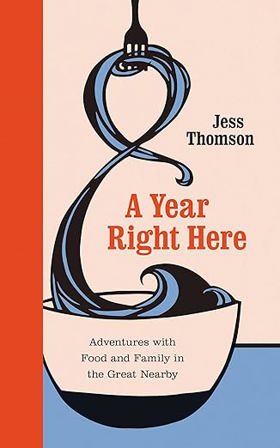
Armed with “The Here List” and a Type-A personality, Seattle-based writer and cookbook author Jess Thomson sets out to spend a year exploring the food of the Pacific Northwest with her family. Planning to revel in the culinary riches of the region and hoping to break her son, Graham, of his childhood pickiness, the adventures into the great nearby include building a backyard chicken coop, truffle hunting in Oregon, and razor clamming on the Washington coast. Her plans to spend “a year right here” are complicated by efforts to help Graham overcome some of the mobility limitations of cerebral palsy, and thwarted further by her own limitations that come to the fore when she attempts the “Gourmet Century,” a hilly one-hundred-kilometer bike ride with gourmet food stops along the way. With touching, funny, sometimes devastating stories that we all can relate to, Jess pulls the reader in as she abandons “The Here List” and learns that letting go can be just as important as holding on. xii, 304 pages : illustrations ; 23 cm CIRC [ 0 ]
|
2017 |
|
A Yankee on Puget Sound pioneer dispatches of Edward Jay Allen, 1852-1855 by Karen L. Johnson, Dennis M. Larsen 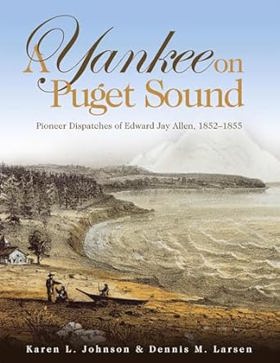
In 1852 twenty-two-year-old Edward Jay Allen completed a difficult overland trek to Oregon. His exploits during a three-year stay in Washington Territory featured unique twists and left a distinct, indelible mark. The young Yankee traveled north from the Columbia River to Cowlitz Landing and was promptly drafted as a delegate to the Monticello Convention. After claiming donation land north of Olympia, he led survey and construction teams laying out the Naches Pass wagon road, initiated relief efforts for Longmire wagon train families, explored Puget Sound on a whaleboat, ran for the Territorial Council, and with two others, made the first documented ascent of Mount Adams. Allen recorded his adventures in letters and a diary, deftly weaving in descriptive passages, humor, and poetry while eloquently reflecting social, political, racial, and religious views of his time. His hometown newspaper, the Pittsburgh Daily Dispatch, published his correspondence. Pasted into a recently-discovered scrapbook, his observations deliver new insight into Pacific Northwest history. xviii, 188 pages : illustrations ; 28 cm CIRC [ 1 ]
|
2013 |
|
A will to serve stories of patience, persistence, and friends made along the way by James R. Ellis , Jennifer Ott 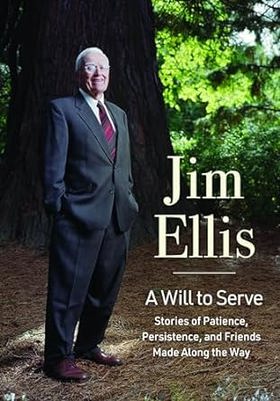
"Jim Ellis was one of the most influential and impactful civic leaders of Seattle's and Washington's recent history. Without ever seeking elected office, Ellis' vision and drive was the key force behind many major projects defining our city, county, and region from the 1960s through today. From cleaning up Lake Washington, establishing King County Metro, and implementing the broad array of community centered Forward Thrust improvement initiatives, to forward-thinking regional projects like the Mountains to Sound Greenway and the Washington State Convention Center, Ellis was astute at bringing together leaders across political divides to create consensus and change. A Will to Serve is a story about the balance and interconnectivity of personal life and civic life. It's about how the individual people--family, friends, neighbors, colleagues--their shared challenges, and how they worked together to effect change for regional progress. A Will to Serve is Ellis' first-person insight into a tumultuous and dynamic period of our regional history and a window into how patience, persistence, and vision can effect change. Ellis kept notes on his life and projects, wrote extensively about his experiences, and built a deep portfolio of public speeches. He drew from these to shape his detailed and engaging autobiography, a compelling telling of regional history. The Will to Serve, in Ellis' own words, is introduced and framed by former Secretary of the Interior, and Jim Ellis mentee, Sally Jewell. Several key accomplishments of his later life are presented by HistoryLink historian Jennifer Ott"-- Provided by publisher pages cm CIRC [ 0 ]
|
2024 |
|
A white man's province British Columbia politicians and Chinese and Japanese immigrants, 1858-1914 by Patricia Roy 
A White Man’s Province examines how British Columbians changed their attitudes towards Asian immigrants from one of toleration in colonial times to vigorous hostility by the turn of the century and describes how politicians responded to popular cries to halt Asian immigration and restrict Asian activities in the province. White workingmen objected to Asian sojourning habits, to their low living standards and wages, and to their competition for jobs in specific industries. Because employers and politicians initially supported Asian immigrants, early manifestations of antipathy often appeared just as another dispute between capital and labour. But as their number increased, complaints about Asians became widespread, and racial characteristics became the nucleus of such terms as a “white man’s province” – a “catch phrase” which, as Roy notes, “covered a wide variety of fears and transcended particular economic interests.” The Chinese were the chief targets of hostility in the nineteenth century; by the twentieth, the Japanese, more economically ambitious and backed by a powerful mother country, appeared more threatening. After Asian disenfranchisement in the 1870s, provincial politicians, freed from worry about the Asian vote, fueled and exploited public prejudices. The Asian question also became a rallying cry for provincial rights when Ottawa disallowed anti-Asian legislation. Although federal leaders such as John A. Macdonald and Wilfrid Laurier shared a desire to keep Canada a “white man's country,” they followed a policy of restraint in view of imperial concerns. The belief that whites should be superior, as Roy points out, was then common throughout the Western world. Many of the arguments used in British Columbia were influenced by anti-Asian sentiments and legislation emanating from California, and from Australia and other British colonies. Drawing on almost every newspaper and magazine report published in the province before 1914, and on government records and private manuscripts, Roy has produced a revealing historical account of the complex basis of racism in British Columbia and of the contribution made to the province in these early years by its Chinese and Japanese residents. xvii, 327 pages : illustrations ; 24 cm CIRC [ 0 ]
|
1989 |
|
A whale hunt by Robert Sullivan 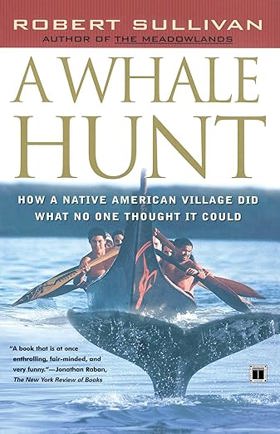
For centuries the hunting of the whale was what defined the Makah, a Native American tribe in Neah Bay, but when commercial whaling drove the gray whale to near extinction in the 1920s, the Makah voluntarily discontinued their tradition and hung up their harpoons. In 1994, after the gray whale was taken off the endangered species list, the Makah decided to hunt again. The problem was that all the old whalers were dead—no one knew how to go about hunting a whale. A Whale Hunt chronicles the two years Robert Sullivan spends with the Makah as they prepare for and stage the first hunt. Combating tribal infighting and inexperience, they must also face passionate, furious animal rights activists and swarming reporters. Before the ragtag group of hunters even pursues a whale, there are clashes, disappointments, and defeats, small triumphs and unexpected heroes. A book of many layers and revelations, A Whale Hunt is the story of the demise and attempted resurrection of a Native American nation and of the individuals on the reservation whose lives are forever changed. 285 p. ; 24 cm. CIRC [ 1 ]
|
2000 |
|
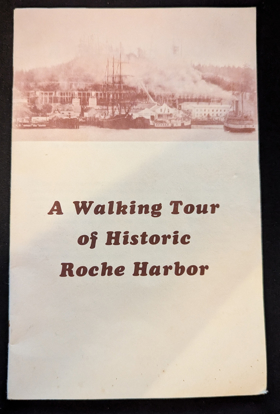
A walking tour of historic Roche Harbor by Lynette Evans
|
1979 |
|
A voyage to the Pacific ocean undertaken, by the command of His Majesty, for making discoveries in the Northern Hemisphere : to determine the position and extent of the west by James Cook, James King 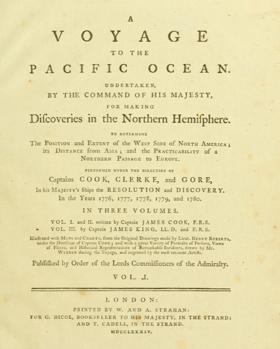
First edition of the account of Captain James Cook's third voyage (1776-1780), consisting of three quarto volumes of text and plates, and one folio atlas, the latter without title-page 3 volumes : 25 illustrations, maps (some folded) ; 30 cm (4to) + 1 atlas (63 leaves of plates (2 folded) : all illustrations, 2 maps, portraits ; 58 cm (folio)) ONLINE CIRC [ 3 ]
|
1784 |
|
A Voyage to the Northwest Side of America The Journals of James Colnett, 1786-89 by James Colnett, Robert Galois 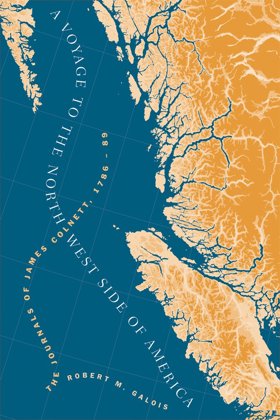
The journal of James Colnett is the last unpublished account of the early maritime fur trade on the Northwest Coast. Between 1786 and 1789, Colnett's expedition traversed the coast from Prince William Sound to the Strait of Juan de Fuca. Its members were the first Europeans to encounter the Tsimshian and the southern Heiltsuk, and the first to land on the southern Queen Charlotte Islands. The journal is reproduced with full scholarly apparatus, as well as extracts from a second journal by Andrew Bracey Taylor, 3rd mate on one of the ships in Colnett's command. Focusing on the expedition's remarkable encounters with the Native peoples of the Northwest Coast, Galois' introductory essay also addresses the geopolitical context of the voyage and the intellectual background that shaped the writing of the journals. This fascinating account gives us a new understanding of early European presence in the Northwest and of Native responses to these developments. It will interest historians, geographers, and ethnographers of the Northwest Coast and beyond. xiii, 441 pages : illustrations, maps ; 24 cm CIRC [ 1 ]
|
2004 |
Having begun his naval career as a midshipman in Captain Cook's second and third voyages (1772-1778), in 1791 George Vancouver was commissioned by the Admiralty to travel to the Pacific north-west coast of Canada to negotiate a solution to the escalating trade conflict between Britain and Spain in the Nootka Sound and to further and explore the coastline of the region. In April 1791, Vancouver, commanding the sloop HMS Discovery, set sail from Britain under the escort of the gunship HMS Chatham. Following brief stops in Tenerife, Cape Town and Australia, the ships arrived in the Pacific Northwest in June 1792 and Vancouver began to survey the rugged coast of the Straits of Georgia. Landing at the site of the present-day city of Vancouver on 13 June, the expedition encountered a welcoming Coast Salish community, who fed and accompanied them while they spent the night ashore. The voyage later circumnavigated and surveyed the island now known as Vancouver Island before returning to Britain in 1795. The extensive account of the voyage was edited by Vancouver's brother, John, and published in three volumes in 1798. Though not as gripping as earlier travel accounts, tending to focus on surveys and nautical charts, Vancouver's surveys were nevertheless important in establishing British dominance in the region into the nineteenth century. 3 volumes : illustrations (engravings), map (engraving) ; 32 cm (4to) + 1 atlas ([16] leaves of plates (6 folded) : illustrations, maps ; 46 cm) ONLINE CIRC [ 3 ]
|
1798 |
|
A voice for justice writings of David Schuman by David Schuman , Sharon Schuman , Wayne Morse Center for Law and Politics 
As an educator, speaker, deputy attorney general, and judge, David Schuman was known for his ability to clarify difficult legal concepts. According to James Egan, chief judge of the Oregon Court of Appeals, he was the “intellectual giant of our generation.” A Voice for Justice reveals how David Schuman’s unique jurisprudence came to be. His friends and associates knew that Oregon Supreme Court Justice Hans Linde convinced Schuman to turn to the Oregon Constitution rather than the federal one to protect individual rights. But even some of Schuman’s closest friends were unaware of his fiction, which provides a window into his deep capacity for empathy and casts new light on his ability to write elegant, sometimes funny, judicial opinions. His legal thinking also had deep roots in literature and political theory. Schuman’s 672 judicial opinions are not just brilliant, but written so that anyone can understand them. Like Ruth Bader Ginsberg, he knew there was nothing to gain by communicating only to specialists. He wanted citizens to be able to make up their own minds about important issues. A Voice for Justice brings together for the first time writings that span over fifty years. Lawyers and laypeople alike will appreciate Schuman’s lucid, engaging observations, which are highly relevant to our current anxieties about institutional racism and democracy under stress. The short stories, speeches, op-eds, articles, legal opinions, and dissents selected for this volume constitute a call to action for everyone to become voices for justice. xviii, 237 pages : illustrations ; 23 cm CIRC [ 0 ]
|
2021 |
|
A view of the Methow from Moccasin Lake Ranch by James C. Pigott 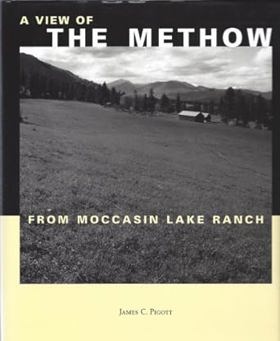
Published in local editions, James C. Pigott’s A View of the Methow from Moccasin Lake Ranch offers an evocative reflection on the landscape, history, and stewardship of Washington’s rugged Methow Valley. The book weaves personal memoir with regional lore, capturing the distinct seasonal rhythms of high-desert ranching, wildlife conservation, and the quiet isolation of the north-central Cascades. Through detailed observations of the local terrain and watershed, Pigott chronicles the delicate balance required to live harmoniously within a stunning yet demanding environment. A keen insight drawn from the text is how multi-generational ranching memoirs serve as intimate ecological barometers; by documenting decades of subtle shifts in local water availability and wildlife patterns, the author reveals that true land stewardship requires a profound, lived surrender to the cyclical limits of the natural world rather than attempts to conquer it. 167 pages : color illustrations, maps ; 25 cm CIRC [ 1 ]
|
2005 |
|
A Victorian tapestry impressions of life in Victoria, B.C., 1880-1914 by Janet Cauthers, Provincial Archives of British Columbia Aural History 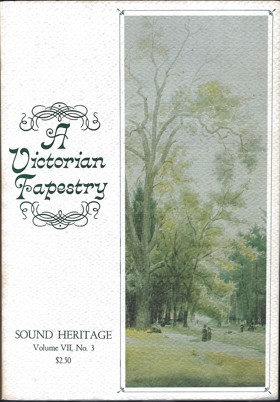
A Victorian Tapestry: Impressions of Life in Victoria, B.C., 1880-1914 by Janet Cauthers is a 1978 historical compilation published by the Provincial Archives of British Columbia. The book utilizes aural history and conversational impressions, accompanied by archival sepia photographs, to capture the everyday experiences of residents in Victoria from the 1880s through the onset of the First World War. It offers an intimate, firsthand look at the social fabric and daily life of the city during its transformation into a modern metropolitan center. 77 pages : illustrations, portraits, map ; 27 cm CIRC [ 1 ]
|
1978 |
|
A union list of manuscripts in libraries of the Pacific Northwest by Charles W. Smith, Pacific Northwest Library Association 
Compiled in 1931 by University of Washington librarian Charles W. Smith and published under the auspices of the Pacific Northwest Library Association, A Union List of Manuscripts in Libraries of the Pacific Northwest serves as a foundational archival inventory designed to formalize and professionalize regional historical research. Building on his earlier bibliographies of published works, Smith meticulously aggregated and mapped the locations of unpublished primary sources—such as pioneer diaries, missionary letters, fur trade ledgers, and territorial government correspondence—scattered across various regional institutions. The catalog effectively centralized the disparate, raw textual artifacts of early Anglo-American settlement, transforming them into a cohesive, searchable database for academic historians. A keen insight drawn from the work is how the bureaucratic cataloging of unpublished archival material functioned as a profound mechanism of epistemological enclosure; by strictly defining authentic historical "manuscripts" as the written, paper artifacts generated exclusively by white settlers, bureaucrats, and missionaries, Smith’s inventory institutionalized the absolute supremacy of the colonial written word. This seemingly neutral archival project structurally barred Indigenous oral histories, material records, and active cultural memory from the realm of legitimate, academically recognized "primary sources." Consequently, it guaranteed that the definitive history of the Pacific Northwest would be researched, written, and validated almost entirely through the literal handwriting of the very people who engineered its colonization. 57 pages 23 cm. CIRC [ 0 ]
|
1931 |
|
A traveller's guide to historic British Columbia by Rosemary Neering 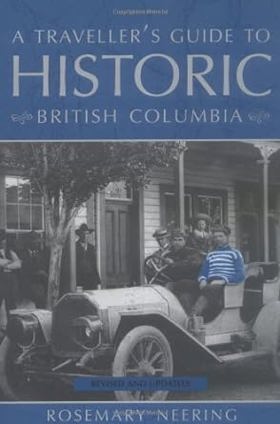
Published by Whitecap Books, Rosemary Neering's A Traveller's Guide to Historic British Columbia serves as an engaging geographical and historical companion that maps the province's rich tapestry of past human endeavors. The book navigates the reader across various regional landscapes—from the gold-rush trails of the Cariboo and the rugged mountain passes of the interior to coastal Indigenous settlements and early European trading posts. By intertwining travel logistics with historical vignettes, anecdotes, and archival context, the text brings physical landmarks and forgotten settlements vividly back to life. A keen insight drawn from the work is how travel guides to historical frontiers function as chronological bridges; by grounding sweeping provincial history in specific, visitable coordinates on a modern map, the book demonstrates that physical travel through British Columbia is inherently an act of temporal exploration across layers of competing human ambitions. xvii, 334 pages : illustrations (some color), maps ; 23 cm CIRC [ 1 ]
|
2002 |
|
A Traveler's History of Washington A Roadside Historical Guide by Bill Gulick 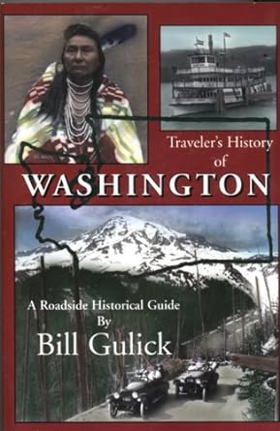
What happened here? Travelers interested in history want to know about the history of the sites that they pass in the Evergreen State. Who but veteran author Bill Gulick could write the premier historical travel book on Washington? xxviii, 559 pages : illustrations, maps ; 23 cm CIRC [ 1 ]
|
1996 |
|
A tour of duty in the Pacific Northwest E.A. Porcher and H.M.S. Sparrowhawk, 1865-1868 by Edwin A. Porcher, Dwight L. Smith 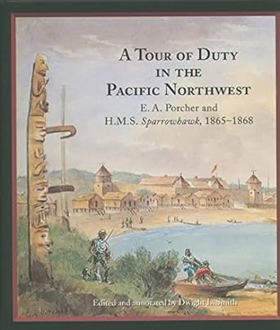
"Working with Commander Porcher's manuscript journal, now in the Beinecke Rare Book and Manuscript Collection of Yale University, as well as other documents of the time, editor Smith has conjured an era through the unique voice of one of its standard bearers. Porcher's journal reveals a man who strived to do his duty by the lights of the British Empire, then at full bloom but - caught between vulnerable Russian America to the north, and the rambunctious and expanding United States to the south, and the French virtually everywhere - in slightly precarious position on North America's Pacific coast xvii, 172 pages, approximately [52] leaves of plates : illustrations (some color), map ; 27 cm CIRC [ 1 ]
|
2000 |
|
A touch of Oregon by Ralph Friedman
|
1970 |
|
A time of gathering native heritage in Washington State by Robin Kathleen Wright, Thomas Burke Memorial Washington State Museum 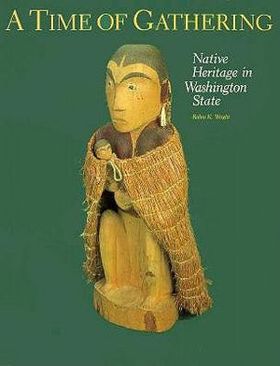
Published by the Burke Museum and edited by art historian Robin Kathleen Wright, A Time of Gathering: Native Heritage in Washington State serves as a profound celebration and catalog of Indigenous art, culture, and enduring sovereignty across the Pacific Northwest. The volume brings together tribal elders, artists, and scholars to document centuries of rich material culture, including intricate basketry, carved wooden regalia, and contemporary artistic expressions that defy historical erasure. Through stunning photographic plates and deeply contextual essays, the text emphasizes that Native communities are not relics of a static past, but dynamic, living cultures actively revitalizing their ancestral traditions. A keen insight drawn from the work is how museum archives can be radically decolonized through collaborative curation; by returning interpretive authority to the descendant communities who created these sacred objects, the publication transforms a traditional anthropological collection into a powerful instrument of indigenous self-determination. 280 pages : illustrations (some color), maps, portraits ; 29 cm CIRC [ 1 ]
|
1991 |