Ninstints North Coast Regional District, British Columbia
Locality - A named place or area, generally with a scattered population of 50 or less. E side of Anthony Island, off S tip of Moresby Island, Queen Charlotte Land District
Mapped Location
Ninstints: The mapped location is an approximation and should not be used for navigation or wayfinding.
Information
General information on Ninstints
- Feature Type: Place
Official, historical, colloquial and alternative toponyms for Ninstints
A brief list of names that this geographic feature has been named
| Name | Description |
|---|---|
| Ninstints | Official |
Origin Notes and History of Ninstints
References to Ninstints that document the origin of its place name
Ninstints adopted in the 1966 BC Gazetteer, as long-identified on maps and in journals.
"A Haida town which formerly stood on Anthony Island, as the south end of Queen Charlotte Islands. The native name was Sga'nguai ('Red-cod island' ), Ninstints being the white man's corruption of the town-chief's name, Nungstins ( Nañ stîns, meaning 'he who is two' ). All the people from this end of Moresby Island gathered here in comparatively recent times. The remnant have since abandoned the place and settled at Skidegate. It is impossible to identify absolutely the name of this town with that of any given in John Wark's list of 1836-41, but it is probably referred to as "Quee-ah", a town to which he assigned 20 houses and a population of 308. At the present day there are probably not a dozen Ninstints people left. The family to which the chief of this town belonged was the Sakikegawai." Nensti'ns (Boas, 1898); Ninstance (Dawson, 1880); Ninstence (Poole, 1872); Sg'a'nguai (Boas, 1898).
The corruption of the name of the head chief of the village, Nañ stins ( "he who is two" ); the Haida name for the village was Sqa'ngwa-i Inaga'i ("Red Cod Island Town"). Designated a National Historic Site of Canada in 1981. Declared a World Heritage Site 27 October 1981. See also "Anthony Island Totems: the last big stand" (Canadian Geographic magazine, vol 101, no 5, Oct/Nov 1981, p.26).
The Haida called this village and the island it sits on S'Gaang Gwaii, meaning "Red-Cod-Island (Town)". Early European traders named the village Nan Sdins [spelled Ninstints in early documents] after the head chief of the village. S'Gaang Gwaii was the main village of the Kunghit Haida, the most southerly of the Haida, who lived along the shores of this island until smallpox wiped out 90% of the more than 300 inhabitants. Although the island is exposed to the open Pacific, the village is protected by a sheltered bay and a rocky islet on the east side of the island. In 1957 eleven of the best preserved poles of S'Gaang Gwaii were removed and shipped to museums in the south. Despite this, the village is considered to provide the most magnificent display of standing Haida Mortuary poles in the world and in 1981 was declared a World Heritage Site by UNESCO. In 1995 a number of the poles were straightened to prolong the period before they returned naturally to the earth. Wandering amidst the fragments of the old longhouses and over two dozen remaining totem poles, many of them toppled or tilted, one feels the presence of the past. One cannot help but be touched by the beauty and dignity of these weathered poles lining the shore, as they look out over the small crescent shaped beach beyond the shoreline to the sea. At low tide canoe runs are still visible on the beach in front of the village." (Information from Parks Canada website, 1999). See also Parks Canada brochure for interpretive history.
Related Catalog Titles
A Bibliography for Ninstints, North Coast Regional District, British Columbia
Ninstints, Haida world heritage site by George F. MacDonald
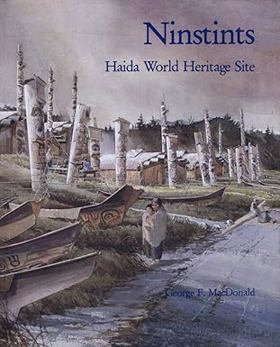
Ninstints, located on Anthony Island, one of the smallest and most southerly of the Queen Charlotte chain, contains the vestiges of the great wooden structures and houses of the Kunghit Haida people who abandoned the village in the late 1800s. George MacDonald combines archival material and scientific and photographic evidence to record what is known of the history of Ninstints and its people. Details are given of their houses, of their great chiefs, and finally of their exodus from Ninstints.
60 pages : illustrations (some color) ; 26 cm
CIRC [ 0 ]
North Coast Regional District
- Alliford Bay
- Chaatl
- Cumshewa
- Dadens
- Delkatla
- Digby Island
- Dodge Cove
- Georgetown Mills
- Haina
- Hartley Bay
- Hippa
- Hunts Inlet
- Jedway
- Juskatla
- Kaisun
- Kitkatla
- Kiusta
- Kung
- Lawnhill
- Lax Kw'alaams
- Lockeport
- Village of Masset
- Masset
- Metlakatla
- Moresby Camp
- New Clew
- Ninstints
- Old Massett
- Oona River
- Osland
- Porcher Island
- Village of Port Clements
- District of Port Edward
- Port Essington
- City of Prince Rupert
- Queen Charlotte
- Village of Queen Charlotte
- Rose Harbour
- Sandspit
- Sewall
- Sewell Inlet
- Shannon Bay
- Skedans
- Skidegate
- Skidegate Landing
- Tanu
- Tasu
- Thurston Harbour
- Tlell
- Yaku
Political Boundaries
Last updated: 2025-09-23