City of Prince Rupert North Coast Regional District, British Columbia
City - A populated place with legally defined boundaries, incorporated as a city municipality under the provincial Municipal Act. NW side of Kaien Island, just N of mouth of Skeena River, Range 5 Coast Land District
Mapped Location
City of Prince Rupert: The mapped location is an approximation and should not be used for navigation or wayfinding.
Information
General information on City of Prince Rupert
- Feature Type: Incorporated
Official, historical, colloquial and alternative toponyms for City of Prince Rupert
A brief list of names that this geographic feature has been named
| Name | Description |
|---|---|
| City of Prince Rupert | Official |
Origin Notes and History of City of Prince Rupert
References to City of Prince Rupert that document the origin of its place name
Incorporated as City of Prince Rupert 3 March 1910. Confirmed in the 17th Report of the Geographic Board of Canada, 1922, and 28 June 1946 on C.3702.
Named in 1906 by the officers of the Grand Trunk Pacific Railway on the establishment of the western terminus of the Company's transcontinental line, after Prince Rupert, the first governor of the Hudson's Bay Company. The name was selected by open competition, the prize offered by the railway company for a suitable name being $250. Prince Rupert Post Office was opened 1 December 1906." See also the municipality's own website.
Construction [for the railway terminus] began 7 May 1906 with the building of a tool shed, and the next day Mr. Pillsbury began the survey for the docks and Company houses. As soon as the camp was established they started clearing the foreshore for the building of the wharf....completed on July 1st. There was still no sign of a townsite, but in October 1907, the work of clearing land started. By the time the lots were all cleared and surveyed in May 1909, the town had acquired 1000 inhabitants. The Company buildings grouped around the dock were known as "Baconville", named after GTP's harbour engineer James H. Bacon. Most inhabitants were clustered at "Knoxville" on the mining claim of John Knox, and the remainder at "Vickersville", named after the police constable. With the establishment of an official townsite, the old [names] disappeared. (Large, R.G., The Skeena-River of Destiny, Mitchell Press, Vancouver).
GTPR....stipulated that the [contest entries] not exceed 3 syllables and 10 letters. The winner out of some 5000 entries was that of Miss Eleanor MacDonald of Winnipeg, who suggested "Prince Rupert" after the first governor of the Hudson's Bay Company. Since Miss MacDonald's entry exceeded the set number of letters, the company awarded two other prizes to the contestants who had suggested "Port Rupert" which [did not exceed] the required number of letters. Prince Rupert of the Rhine (1619 - 1682), cousin of King Charles II, was a dashing leader of the Royalist cavalry during the Civil War. After the Restoration he was an important person at court and headed the syndicate to which on 2 May 1670 the King granted a charter constituting them as "The Company of Adventurers of England Trading into Hudson's Bay."
Related Catalog Titles
A Bibliography for City of Prince Rupert, North Coast Regional District, British Columbia
The City of Rainbows a colourful history of Prince Rupert by Blair Mirau
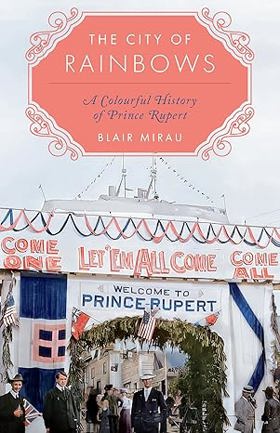
"A vivid and comprehensive history of the City of Prince Rupert, from its ancient roots as a rich, multicultural trading hub between different Indigenous Nations to its current state as an ethnically diverse community set against the stunning natural backdrop of the Great Bear Rainforest. Since time immemorial, rain has defined life on Kaien Island, now known as the townsite of Prince Rupert. As the rainiest and cloudiest city in Canada, Prince Rupert is the perfect environment for rainbows--and the rainbow is an apt metaphor for the city: a symbol of diversity and inclusion, a supernatural gateway between worlds, and a universal sign of hope and calm after a storm. From its original Ts'mysen inhabitants to the first European explorers and fur traders, the building of dozens of salmon canneries to the construction of the transcontinental railway, the global upheaval of two World Wars to decades of industrial boom and bust, Kaien Island, and Prince Rupert, has always been a rich, multicultural trading hub that has weathered countless storms. By weaving together historical events illustrated by compelling archival photographs, The City of Rainbows strives to tell the story of Prince Rupert from a modern perspective, one that confronts the impact of colonization head-on and moves away from a romanticized account of the development of a "pioneer" town. Balancing the histories of Indigenous Peoples, European and Asian settlers, and recent immigrants, this book reveals powerful, intriguing, uncomfortable, and beautiful truths about an undoubtedly colourful city."-- Provided by publisher
vi, 251 pages, 14 unnumbered pages of plates : illustrations, map ; 22 cm
CIRC [ 0 ]
North Coast odyssey the Inside Passage from Port Hardy to Prince Rupert by Kenneth Campbell
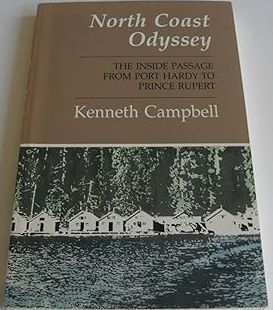
Published by Kenneth Campbell, North Coast Odyssey: The Inside Passage from Port Hardy to Prince Rupert captures the dramatic geography and rich maritime heritage of British Columbia's isolated northern marine highway. The book chronicles a coastal voyage through labyrinthine fjords, treacherous narrows, and wind-swept archipelagos, blending nautical adventure with local history, Indigenous lore, and observations of the region's abundant marine wildlife. Through vivid descriptive prose, the author details the weathered cannery towns, lighthouses, and remote settlements that cling to a magnificent yet unforgiving coastline. A keen insight drawn from the work is how the Inside Passage functions as a liquid highway that simultaneously isolates and connects; by relying entirely on maritime transit through a maze of stone and water, coastal inhabitants experience a profound sense of remoteness that can only be bridged by a deep, respectful attunement to the fickle rhythms of the Pacific tides.
202 pages : illustrations, maps, portrait ; 23 cm
CIRC [ 1 ]
Memories of the Skeena by Walter Wicks

Prince Rupert, a gateway to Alaska by R. Geddes Large
North Coast Regional District
- Alliford Bay
- Chaatl
- Cumshewa
- Dadens
- Delkatla
- Digby Island
- Dodge Cove
- Georgetown Mills
- Haina
- Hartley Bay
- Hippa
- Hunts Inlet
- Jedway
- Juskatla
- Kaisun
- Kitkatla
- Kiusta
- Kung
- Lawnhill
- Lax Kw'alaams
- Lockeport
- Village of Masset
- Masset
- Metlakatla
- Moresby Camp
- New Clew
- Ninstints
- Old Massett
- Oona River
- Osland
- Porcher Island
- Village of Port Clements
- District of Port Edward
- Port Essington
- City of Prince Rupert
- Queen Charlotte
- Village of Queen Charlotte
- Rose Harbour
- Sandspit
- Sewall
- Sewell Inlet
- Shannon Bay
- Skedans
- Skidegate
- Skidegate Landing
- Tanu
- Tasu
- Thurston Harbour
- Tlell
- Yaku
Political Boundaries
Last updated: 2025-09-23