Catalog of British Columbiana and Pacific Northwest Americana
The Encyclopedia Cascadia Catalog indexes mostly non-fiction literature covering the Pacific Northwest coast of North America, with an emphasis on British Columbia, Idaho, Oregon, and Washington State.
| Catalog Title | Published |
|---|---|
|
A drum in one hand, a sockeye in the other stories of indigenous food sovereignty from the Northwest Coast by Charlotte Coté 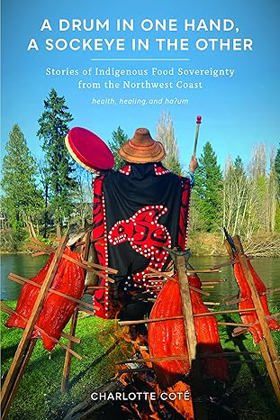
In the dense rainforest of the west coast of Vancouver Island, the Somass River (c̓uumaʕas) brings sockeye salmon (miʕaat) into the Nuu-chah-nulth community of Tseshaht. C̓uumaʕas and miʕaat are central to the sacred food practices that have been a crucial part of the Indigenous community's efforts to enact food sovereignty, decolonize their diet, and preserve their ancestral knowledge. In A Drum in One Hand, a Sockeye in the Other, Charlotte Coté shares contemporary Nuu-chah-nulth practices of traditional food revitalization in the context of broader efforts to re-Indigenize contemporary diets on the Northwest Coast. Coté offers evocative stories of her Tseshaht community's and her own work to revitalize relationships to haʔum (traditional food) as a way to nurture health and wellness. As Indigenous peoples continue to face food insecurity due to ongoing inequality, environmental degradation, and the Westernization of traditional diets, Coté foregrounds healing and cultural sustenance via everyday enactments of food sovereignty: berry picking, salmon fishing, and building a community garden on reclaimed residential school grounds. This book is for everyone concerned about the major role food plays in physical, emotional, and spiritual wellness. xxi, 184 pages : illustrations, maps ; 24 cm. Desiderata
|
2022 |
|
A dictionary of the Chinook jargon, or Indian trade language, of the north Pacific Coast by George Gibbs 
Published in 1863 by the Smithsonian Institution, George Gibbs’s A Dictionary of the Chinook Jargon serves as a foundational linguistic catalog of the widespread pidgin used for commerce and communication between Indigenous tribes and European settlers across the Pacific Northwest. The text systematically standardizes the vocabulary of this highly adaptable contact language, meticulously tracing the etymological roots of its words back to their original Nuu-chah-nulth, lower Chinookan, French, and English sources. A keen insight drawn from the publication is how Gibbs’s rigorous codification of the Jargon was not merely a disinterested scholarly exercise, but a highly utilitarian tool designed to serve the federal government's expansionist agenda. By formalizing a fluid trade pidgin into a standardized, legible dictionary, Gibbs provided federal agents and treaty commissioners with the exact linguistic infrastructure required to efficiently negotiate the sweeping land cessions that systematically dispossessed the region's Indigenous populations 29 pages 21 cm ONLINE Circulation [ 1 ]
|
1871 |
|
A deadly wind the 1962 Columbus Day storm by John Dodge 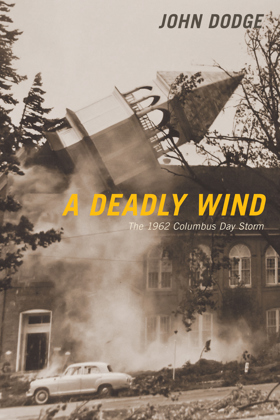
The Columbus Day Storm of 1962 was a freak of nature, a weather outlier with deadly winds topping one hundred miles per hour. The storm killed dozens, injured hundreds, damaged more than fifty thousand homes, and leveled enough timber to build one million homes. To find an equally ferocious storm of its kind, fast-forward fifty years and cross the continent to Superstorm Sandy's 2012 attack on the East Coast. While Superstorm Sandy was predicted days in advance, the Columbus Day Storm caught ill-equipped weather forecasters by surprise. This unrivalled West Coast windstorm fueled the Asian log export market, helped give birth to the Oregon wine industry, and influenced the 1962 World Series. It remains a cautionary tale and the Pacific Northwest benchmark for severe windstorms in this era of climate change and weather uncertainty. From its genesis in the Marshall Islands to its final hours on Vancouver Island, British Columbia, the storm plowed an unparalleled path of destruction. In A Deadly Wind, veteran journalist John Dodge tells a compelling story spiced with human drama, Cold War tension, and Pacific Northwest history. This is a must-read for the tens of thousands of storm survivors, for history buffs, and for anyone interested in the intersection of severe weather events and climate change xvii, 238 pages : illustrations, maps ; 23 cm Desiderata
|
2018 |
|
A country strange and far the Methodist Church in the Pacific Northwest, 1834-1918 by Michael C. McKenzie 
In 1834 the weary missionary Jason Lee arrived on the banks of the Willamette River and began to build a mission to convert the local Kalapuya and Chinook populations to the Methodist Church. The denomination had become a religious juggernaut in the United States, dominating the religious scene throughout the mid-Atlantic and East Coast. But despite its power and prestige and legions of clergy and congregants, Methodism fell short of its goals of religious supremacy in the northwest corner of the continent. In A Country Strange and Far Michael C. McKenzie considers how and why the Methodist Church failed in the Pacific Northwest and how place can affect religious transplantation and growth. Methodists failed to convert local Native people in large numbers, and immigrants who moved into the rural areas and cities of the Northwest wanted little to do with Methodism. McKenzie analyzes these failures, arguing the region itself—both the natural geography of the place and the immigrants’ and clergy’s responses to it—was a primary reason for the church’s inability to develop a strong following there. The Methodists’ efforts in the Pacific Northwest provide an ideal case study for McKenzie’s timely region-based look at religion. xviii, 330 pages : illustrations ; 24 cm Desiderata
|
2022 |
|
A concise dictionary of the Nuuchahnulth language of Vancouver Island by John T. Stonham 
For some 20 years, Stonham (linguistics, U. of Newcastle-upon-Tyne) has been researching the language of the Nuuchahnulth, a group of First Nations peoples occupying the west coast of Vancouver Island. His dictionary is the first attempt to provide a detailed account of the lexicon of the Nuuchahnulth language, complete with examples and grammatical information. The work is based primarily on fieldnotes gathered by Edward Sapir between 1910 and 1922, fieldnotes by Morris Swadesh in the 1940s, and Stonham's own field research since the 1980s. The volume includes a Nuuchahnulth-English dictionary with some 7,000 main entries, an English-Nuuchahnulth glossary of some 8,500 entries consisting of English headwords and their Nuuchahnulth equivalents, and appendices of grammatical paradigms and place names. Annotation : 2004 Book News, Inc., Portland, OR (booknews.com) xviii, 537 pages ; 24 cm Non-circulating [ 1 ]
|
2005 |
|
A coastal range by Charles Lillard
Charles Lillard’s A coastal range examines how early families and resource workers established resilient, enduring communities along the formidable maritime landscapes of the Pacific Northwest. By detailing the transition from temporary logging and fishing camps to permanent settlements, the narrative illustrates how residents navigated the physical isolation of the Inside Passage's dense rainforests and steep fjords through cooperative labor and tight-knit kinship networks. The text highlights the critical role of shared local folklore and neighborly bonds in helping these isolated groups cope with frontier hardships, leaving behind a rich, traceable record of settlement. Ultimately, the book demonstrates how collective adaptation and regional storytelling transformed a demanding wilderness into a cohesive society defined by deeply rooted family histories and a unique coastal identity. 100 pages ; 23 cm Desiderata
|
1984 |
|
A century of Coos County railroads by Steven Greif
Published by local historian Steven Greif, A Century of Coos County Railroads chronicles the ambitious, logistically treacherous, and economically volatile history of rail development along southwest Oregon’s rugged coast. The book details the immense engineering feats required to carve rail lines through dense timber, cross treacherous waterways, and connect isolated coastal timber and shipping towns to the national grid. Through detailed archival photographs, corporate records, and local lore, the text charts how steel tracks served as the primary economic lifeline that transitioned the region from maritime isolation into a heavy industrial timber economy. A keen insight drawn from the work is how railroads on the Pacific Northwest frontier acted as both liberators and tyrants; while steel lines successfully shattered geographic isolation, they simultaneously bound local communities to boom-and-bust corporate monopolies, making the region's economic survival entirely dependent on external market demands. 57 pages : illustrations, facsimiles, map ; 28 cm Non-circulating [ 1 ]
|
2001 |
|
A century of Coos and Curry history of southwest Oregon by Emil R. Peterson, Alfred Powers, Coos Curry Pioneer & Historical Association 
The nearly 600 pages of the pioneer history includes a 100+ page alphabetical Biographical Appendix with short entries for several hundred people. The history section begins with descriptions of Coos and Curry counties. This history proper starts in 1795 and includes a number of anecdotes, reminiscences, biographical portraits, and city histories, as well as historical narratives. Topics include Battle Rock, Rogue River, southern Curry County, report of an Indian agent, Coos Bay Colony, Bandon Beach, Coos Bay, Coquille Valley, Coos economic activity for 1897, Curry County, Nosler emigration, mineral belt, and crimes, casualties and miscellaneous happenings. Includes photographs of significant buildings and local residents. 599 pages : illustrations, portraits, maps ; 23 cm Non-circulating [ 1 ]
|
1952 |
|
A centennial history of the Kendrick-Juliaetta area by Kenrick-Juliaetta Centennial Committee (Publisher) 
Published by the Kendrick-Juliaetta Centennial Committee, A Centennial History of the Kendrick-Juliaetta Area chronicles the agricultural settlement, rugged pioneer endurance, and community-building along the steep, fertile canyon lands of north-central Idaho's Potlatch River valley. The book details how hardy homesteaders transformed an isolated wilderness into a thriving agrarian hub driven by wheat farming, timber harvesting, and the arrival of regional railroad lines. Through extensive family histories, rare photographs, and local archives, the text preserves the granular records of everyday survival in a striking canyon landscape. A keen insight drawn from the work is how topographical isolation forced early farming communities to engineer their own economic survival; by relying on narrow-gauge railroads to bridge the seemingly impassable gorges of the Palouse region, these rural settlements proved that agricultural prosperity in the Inland Northwest depended entirely on conquering hostile vertical geography. vii, [3], 246 pages : illustrations, maps, portraits ; 29 cm Non-circulating [ 1 ]
|
1990 |
|
A brief history of Waldron Island by Charles H. Ludwig 
HISTORY OF A SEASONAL CAMPING SITE OF THE LUMMI INDIANS. The second edition was published in 1972 in response to requests for copies of the original mimeographed first edition. The preface to the second edition contains some comments on the more recent history of the island and Frederick Marks, one of the very early settlers on Waldron. 44 pages map, table Desiderata
|
1959 |
|
A brief history of Franklin, first permanent settlement in the state of Idaho by Idaho Pioneer Association, Boise Public Library Idaho Collection 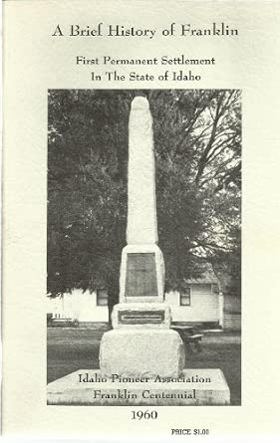
The Idaho Pioneer Association’s A brief history of Franklin chronicles the grueling agrarian colonization of Cache Valley, where Mormon pioneers established Idaho’s first permanent settlement in an isolated, high-altitude basin just north of the Utah border. The narrative maps how the formidable geography of the surrounding Bear River Range and the region's punishing alpine winters forced these early colonizers to immediately undertake massive, cooperative hydrological engineering projects to divert mountain streams for vital crop irrigation. By detailing the communal construction of protective forts and localized agricultural infrastructure, the text illustrates how an absolute reliance on the fertile but climatically severe valley floor dictated early survival strategies in a deeply isolated frontier environment. Ultimately, the account captures how mastering this localized geography and conquering the harsh climatic realities of the inland empire were the absolute prerequisites for establishing a lasting, agriculturally independent pioneer foothold in the rugged topography of southeastern Idaho. 41 pages illustrations with photographs 23 cm Non-circulating [ 1 ]
|
1960 |
|
A brief historical sketch of Port Townsend, Washington by William D. Welsh, Port Townsend Chamber of Commerce, Crown Zellerbach Corporation
William D. Welsh’s A brief historical sketch of Port Townsend, Washington chronicles the dramatic economic arc of a Victorian seaport whose destiny was absolutely dictated by its strategic but isolated marine geography. The narrative maps how the settlement's commanding position on the precipitous northeastern tip of the Olympic Peninsula initially guaranteed immense prosperity, allowing it to monopolize early pioneer commerce as the vital deep-water customs gateway bridging the Strait of Juan de Fuca and the inland sea. However, the text illustrates that the very same rugged, heavily timbered topography that framed the harbor ultimately proved fatal to its metropolitan ambitions, as the impenetrable coastal mountains effectively blocked any viable overland connection to the transcontinental railroad. Ultimately, the account demonstrates how this inescapable geographic isolation forced the bypassed maritime hub to adapt to severe continental detachment, permanently tethering its survival to localized timber and paper extraction industries that could leverage the remaining oceanic highway. 24 pages : illustrations (some color), map ; 21 cm Non-circulating [ 1 ]
|
1959 |
|
A bridge back the early days of Florence, Oregon by Ellen Traylor 
A Bridge Back, The Early Days of Florence, Oregon is an entertaining romp into the early history of a rollicking town, at once "wild west" and "gentle natured." It was a small town with a big heart and many colorful characters. They followed in the footsteps of greatness, on the trail of Lewis and Clark, Jedediah Smith and in the shadow of railroad barons and spruce-winged airplanes. Meet the adventuresome dreamer-founder and his bandito-turned-poet brother; meet the bold editor of the town paper, who went on to be a senator; meet the brave settler who saved a wagon master from mob attack; meet the lovely Rhododendron Queen who married the founder's nephew; meet the fishermen who blew up bombs in the river and the young man who sauntered nude down the beach; meet the greedy publisher who sided with grasping barons to his own downfall; and meet the bumbling Romeo who snapped a photo of his girl as she sank in quicksand. If you know Florence, you will never see her the same way again. If you do not know Florence, prepare to fall in love. A project of Merchants of Old Town Florence for the 150th Anniversary of Oregon. 110 pages : illustrations ; 28 cm Non-circulating [ 1 ]
|
2009 |
|
A bit off center by Margaret Philbrick 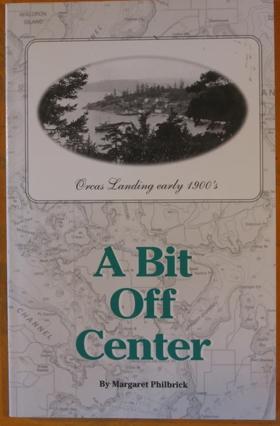
Authored by longtime resident and community historian Margaret Philbrick, A Bit Off Center presents a personal, highly localized history of Orcas Island in Washington's San Juan archipelago. Drawing on vintage photographs, maps, and oral recollections, the book chronicles the development of local landmarks, marine transport, small cottage industries, and the eccentric characters who anchored early island life. Through intimate vignettes of community hubs like the Orcas Hotel and Grindstone Harbor, the text captures the peculiar charm and texture of self-reliant island living. A keen insight drawn from the work is how insular communities derive their unique resilience from eccentricity; by documenting the colorful, non-conformist personalities that populated the margins of society, the narrative reveals that living "off center" was not just a geographic descriptor, but a vital cultural ethos that allowed isolated pioneers to thrive. 97 pages : illustrations, maps ; 21 cm Non-circulating [ 1 ]
|
2000 |
|
A Bibliography of The Pacific Northwest by Washington State School Library Association
The Washington State School Library Association’s A Bibliography of The Pacific Northwest serves as a comprehensive reference guide that catalogs the extensive written record of the region's diverse physical and cultural landscapes. While fundamentally an educational directory, the volume effectively maps the intellectual topography of the Pacific Northwest, directing researchers through the vast array of texts that document the rugged maritime inlets of the coastal rainforests, the towering, glaciated barrier of the Cascade Mountains, and the expansive, arid basins of the inland empire. By meticulously curating pioneer chronicles, indigenous histories, and industrial records of early timber, mining, and salmon harvesting operations, the compilation illustrates how educators systematically organized the region's collective memory. Ultimately, the text captures the profound geographical identity of the western frontier, demonstrating how the structured preservation of these foundational narratives is essential for understanding how human populations historically navigated, exploited, and adapted to the formidable environments of Washington, Oregon, Idaho, and British Columbia. 88 pages Non-circulating [ 1 ]
|
1964 |
|
A bibliography of Pacific Northwest history by Oregon Historical Society (Compiler), Thomas Vaughan (Compiler), Priscilla Knuth (Compiler)
"This bibliography of Pacific Northwest history has been compiled by the staff of the Oregon Historical Society, especially for high school and college students and teachers. Necessarily the range is broad and qualified by what is available for various study levels. Included are books, articles and documents published up to the fall of 1957."--Page i 44 leaves ; 28 cm. Non-circulating [ 1 ]
|
1958 |
|
A bibliography of British Columbia laying the foundations, 1849-1899 by Barbara J. Lowther (Compiler), Muriel Laing (Compiler), University of Victoria (B.C.). Social Sciences Research Centre
Compiled by Barbara J. Lowther and Muriel Laing, A Bibliography of British Columbia: Laying the Foundations, 1849-1899 serves as a comprehensive guide to the historical texts documenting the province's formative half-century. The catalogued works extensively map the colonial expansion across this rugged Pacific Northwest terrain, from the early maritime hub of Victoria on Vancouver Island to the burgeoning mainland ports of the Burrard Inlet. Furthermore, the bibliography highlights literature detailing the arduous inland routes forged by prospectors navigating the treacherous Fraser River canyon and the remote Cariboo goldfields. Through its exhaustive collection of early regional literature, the book offers a foundational literary geography of how British Columbia transitioned from isolated coastal fur-trading outposts into a unified Canadian province. Every effort has been made to include the government publications of the two colonies of Vancouver Island and British Columbia and, after their union in 1866, of the united colony of British Columbia to 1871. xii, 328 pages ; 29 cm ONLINE Circulation [ 1 ] Non-circulating [ 1 ]
|
1968 |
|
A bibliography of American county histories by P. William Filby 
The intention of this work is to compile a work which contains bibliographical references to all county histories of any consequence up to 1984. The author has attempted to give full bibliographical information as accurate as possible on each title xiv, 449 pages ; 24 cm Non-circulating [ 1 ]
|
1985 |
|
7,003 days 21 years in the Frank Church River of No Return Wilderness by Jim Akenson , Holly Akenson 
"Deep in the Idaho wilderness the last vestiges of Old Idaho linger. In 1982, an eager young couple seeking adventure and challenge, Jim and Holley Akenson, moved to a log cabin in the back country to manage Taylor Ranch, the University of Idaho's wilderness research station. In 7,003 Days, Jim describes their encounters with wildlife and nature: tracking wolves and cougars, using mules for transportation and ranch work, and introducing university stuedents to life in the rugged Salmon River Mountains of Central Idaho"--Provided by publisher 266 pages : illustrations, map ; 23 cm Desiderata
|
2016 |
|
50 years on the Klamath by John C. Boyle 
1982 marked the 50th anniversary for the Boyd family on the Klamath River. The family has continued to visit the camp in almost all of the years between then and today. This book tells many stories and tells of many events and happenings that occurred during these years: the burgeoning growth of the families, the construction of additional cabins at the camp, good fishing years and not so good years, and the varied and interesting experiences of life at the Klamath. Most importantly, this book portrays the incalculable value that spending time with family and friends at a place without electricity, television, phones, computers or other modern distractions provides to both young and old. 59, [8] pages of plates : illustrations, maps (some folded) ; 26 cm Non-circulating [ 1 ]
|
1976 |
|
50 keystone flora species of the Pacific Northwest a pocket guide by Collin Varner 
A keystone species is an organism that defines and supports an entire ecosystem, filling a vital ecological niche. Without these species, ecosystems would be radically altered or even collapse. This full-color, pocket-sized field guide by best-selling naturalist Collin Varner highlights fifty keystone trees, flowering plants, fruit-bearing plants, marine plants, and fungi found across the Pacific Northwest bioregion. Each entry features clear photography, etymology, descriptions, habitat information, and risks and warnings. This convenient and easy-to-use reference is perfect for walkers, hikers, campers, and beachcombers and important for raising awareness of the need to conserve and protect these vital species. -- back cover 123 pages : color illustrations, color map ; 18 cm Desiderata
|
2024 |
|
50 keystone fauna species of the Pacific Northwest a pocket guide by Collin Varner 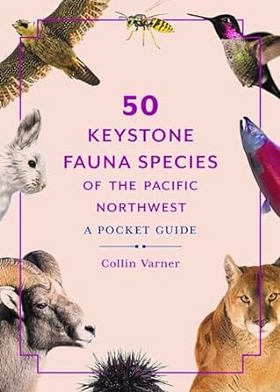
A keystone species is an organism that defines and supports an entire ecosystem, filling a vital ecological niche. Without these species, ecosystems would be radically altered or even collapse. This full-color, pocket-sized field guide by best-selling naturalist Collin Varner highlights fifty keystone birds, mammals, amphibians, insects, fish, shellfish, and mollusks found across the Pacific Northwest bioregion. Each entry features clear photography, etymology, descriptions, habitat information, and risks and warnings. This convenient and easy-to-use reference is perfect for walkers, hikers, campers, beachcombers, sailors, paddlers, and whale watchers and important for raising awareness of the need to conserve and protect these vital species. -- back cover 123 pages : color illustrations, color map ; 18 cm Desiderata
|
2024 |
|
21 Things You May Not Know about the Indian Act Helping Canadians Make Reconciliation with Indigenous Peoples a Reality by Bob Joseph 
Since its creation in 1876, the Indian Act has dictated and constrained the lives and opportunities of Indigenous Peoples, and is at the root of many enduring stereotypes. Bob Joseph's book comes at a key time in the reconciliation process, when awareness from both Indigenous and non-Indigenous communities is at a crescendo. Joseph examines how Indigenous Peoples can return to self-government, self-determination, and self-reliance and why doing so would result in a better country for every Canadian. He dissects the complex issues around the Indian Act, and demonstrates why learning about its cruel and irrevocable legacy is vital for the country to move toward true reconciliation. Bob Joseph, founder of Indigenous Corporate Training Inc., has provided training on Indigenous relations since 1994. As a certified Master Trainer, Bob has assisted both individuals and organizations in building Indigenous relations. His Canadian clients include all levels of government, Fortune 500 companies, financial institutions, including the World Bank, small and medium-sized corporate enterprises, and Indigenous Peoples. He has worked internationally for clients in the United States, Guatemala, Peru, and New Caledonia in the South Pacific. Bob Joseph is an Indigenous person, or more specifically a status Indian, and is a member of the Gwawaenuk Nation. The Gwawaenuk is one of the many Kwakwaka'wakw tribes located between Comox and Port Hardy on Vancouver Island and the adjacent mainland of British Columbia. He comes from a proud potlatch family and is an initiated member of the Hamatsa Society. As the son of a hereditary chief, he will one day, in accordance with strict cultural laws, become a hereditary chief. Advance praise: "I have a deep hope for Canada that there can be reconciliation. I want every Canadian to imagine a Canada in which every person will live with dignity, value, and purpose. But to do that, there must be reflection on our shared history and the harmful periods and events that continue to haunt us as a nation. Understanding the Indian Act is fundamental to understanding why those harmful periods and events took place. Bob Joseph's book is an invaluable tool for Canadians who want to understand the past in order to contribute to reconciliation in our country." ?Chief Dr. Robert Joseph, O.B.C., Ambassador, Reconciliation Canada "From declaring cultural ceremonies illegal, to prohibiting pool hall owners from granting Indigenous Peoples entrance, from forbidding the speaking of Indigenous languages, to the devastating policy that created residential schools, Bob Joseph reveals the hold this paternalistic act, with its roots in the 1800s, still has on the lives of Indigenous Peoples in Canada in the twenty-first century. This straightforward book is an invaluable resource. There is much for non-Indigenous people to learn and to do. But equally important, there is much to unlearn and to undo. The time is right for this book. Thank you, Bob Joseph. Gilakas'la." Shelagh Rogers, O.C., Truth and Reconciliation Commission of Canada "Increasing Canadians' knowledge about the terrible foundation this country has been built on is a critical part of reconciliation. Bob Joseph has highlighted some of the unbelievable provisions of the Indian Act and how they have impacted First Nations in Canada, and gives a brief overview of what we may replace it with going forward. His book provides helpful context to the dialogue that needs to take place in Canada." ?Kim Baird, O.C., O.B.C.; Owner, Kim Baird Strategic Consulting; Member of the Tsawwassen First Nation 160 pages Desiderata
|
2018 |
|
18th century maritime influences on the history and place names of British Columbia by C. H. Little 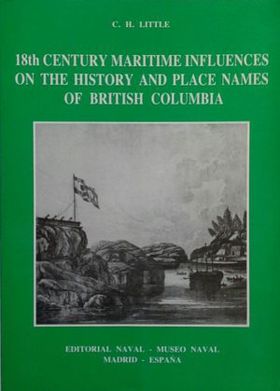
C. H. Little’s 18th century maritime influences on the history and place names of British Columbia explores the intense early maritime navigation and foundational cartographic integration of the Pacific Northwest's complex coastline. The narrative illustrates how the profound environmental realities of this coastal topography—defined by labyrinthine glacial fjords, treacherous hidden reefs, and unpredictable North Pacific weather systems—required immense nautical resilience and shared navigational adaptation from early European explorers. By detailing the gradual transition from a vast, uncharted maritime frontier to a meticulously mapped and named network of vital navigational corridors, the text highlights how the cooperative, albeit often competitive, efforts of British and Spanish naval expeditions laid the vital groundwork for future settlement. Ultimately, the account demonstrates that patiently charting these severe maritime boundaries and collaboratively standardizing the region's geographical nomenclature were essential steps in transforming a remote, isolated coastline into a structured, globally connected, and enduringly recognized territory of the maritime Pacific Northwest. 133 pages : illustrations, maps ; 22 cm Non-circulating [ 1 ]
|
1991 |
|
110 years with Josephine the history of Josephine County, Oregon, 1856-1966 by Jack Sutton, Josephine County Historical Society
Jack Sutton’s 110 Years with Josephine provides a comprehensive pioneer history of Josephine County, a rugged and resource-rich enclave nestled among the Klamath and Siskiyou mountain ranges of southwestern Oregon. The narrative meticulously maps the region's defining topography, stretching from the deep, forested canyons carved by the wild Rogue and Illinois rivers to the fertile agricultural expanses of the Applegate Valley. By detailing the mid-nineteenth-century gold rush camps that sprouted in remote gulches and the subsequent rise of the local timber industry, the book illustrates how early settlers navigated and harvested this formidable inland wilderness. Ultimately, this account captures the physical and economic evolution of this specific southern Oregon landscape, tracing its transformation from isolated mining claims into a thriving network of logging and agricultural communities. 205 pages : illustrations ; 23 cm Non-circulating [ 1 ]
|
1966 |