Catalog of British Columbiana and Pacific Northwest Americana
Encyclopedia Cascadia Catalog contains book titles of mostly non-fiction Pacific Northwest Coast of North America Titles (primarially British Columbia, Idaho, Oregon and Washington State) in an easy-to-understand title catalog. If you see a link with this badge ONLINE CIRC it means that there is an online institution that provides free access to that title. In some cases there may be more than one institution hosting the title digitally.
| Catalog Title | Published |
|---|---|
|
William Lovell Finley champion of Oregon's wildlife refuges by Joe R. Blakely 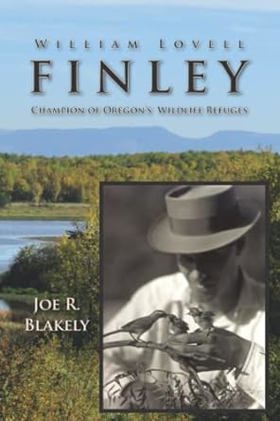
This biography of the pioneer photographer and conservationist, William Finley, not only tells the astonishing story of his efforts to save Oregon wildlife in the early 1900s, but includes the original photographs of birds that made his work so successful. William Finley and Herman Bohlman climbed 150-foot trees, scaled cliffs, crawled through poison oak, and paddled on mosquito-infested lakes carrying heavy camera gear in search of wild birds to photograph. Finley worked for over 25 years to save the Malheur National Wildlife Refuge in Eastern Oregon. Finley fought to clean up the Willamette River. Possibly every wildlife refuge in Oregon -- including the one named in his honor south of Corvallis -- owes its existence to this man's struggle to provide sanctuaries for wild animals 208 pages : illustrations, photographs, maps ; 23 cm. CIRC [ 0 ]
|
2021 |
|
Tales of the public domain a history of the United States General Land Office in Oregon by Champ Clark Vaughan , Jerome E. Perez 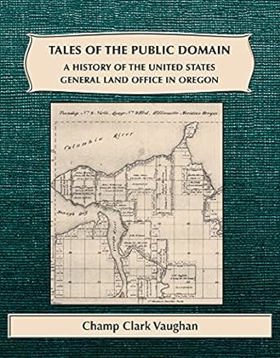
"From his perspective as a geographer and expert in public land law, Vaughan provides the reader with historical context to the GLO, a summary of key public land laws, an understanding of the mission, roles, and administrative responsibilities of the GLO, and a review of the controversies involving migration, settlement, and American Indian title."--Page 4 of cover x, 101 pages : illustrations some color, maps some color ; 26 cm CIRC [ 0 ]
|
2021 |
|
Portland public sculptors monuments, memorials and statuary, 1900-2003 by Fred F. Poyner 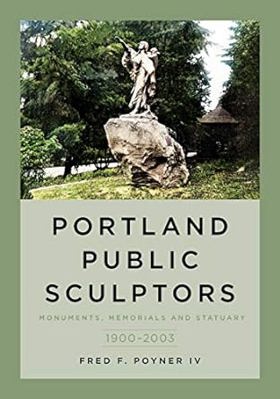
"This book is a non-fiction study of the lives of ten different sculptors and the key public sculptures each contributed to the landscape and identity of Portland, Oregon, between 1900 and 2003. Each chapter examines the history of how these artworks were created, the challenges each sculptor faced, and how these artworks in a variety of sculpture media have contributed to the public arts scene of Portland into the twenty-first century. For its discussion of historical sculpture unique to Portland, a researched examination is made into those subjects selected by each sculptor, where influences of national identity, patriotism, symbolic representation, and the lives of each sculptor help to better understand the history and forces at work which brought these sculptures into existence. Interviews with two of the sculptors offer personal insights into their creative process: from the studio design to final installation in Portland. From Roland Hinton Perry and Alice Cooper, to James Lee Hansen and Raymond Kaskey, sculptures ranging from bronze castings of U.S. presidents, to other historical and allegorical figures in copper and marble, the author provides an in-depth review and presentation of Portland's public art as never seen before"-- Publisher's website 128 pages : illustrations (some color), portraits ; 24 cm CIRC [ 0 ]
|
2021 |
|
Pioneering Oregon architect W.D. Pugh by Terence Emmons 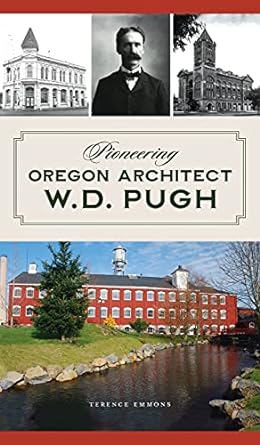
"The son of Oregon pioneers, Walter D. Pugh spent his career as an architect building landmarks throughout his home state. From designing the Thomas Kay Woolen Mill and supervising the installation of the state capitol dome in Salem to drawing the plans for the Crook County Courthouse in Prineville, Pugh had a hand in a wide variety of buildings. In less than twenty-five years, he worked on more than one hundred projects before fading into obscurity. Many of these structures are still standing, a testament to his skill even after his contributions have been all but forgotten. Join author and historian Terence Emmons as he explores the life and legacy of one of Oregon's foremost architects"-- Publisher's website 171 pages : illustrations, plans ; 23 cm CIRC [ 0 ]
|
2021 |
|
Sounding for Harry Smith early Pacific Northwest influences by Bret Lunsford , John F. Szwed, Phil Elverum (Writer of preface) 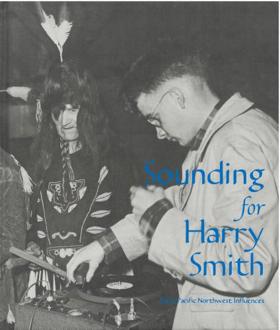
Pacific Northwest musician-historian Bret Lunsford (Beat Happening/D+) unravels a string of mysteries to reveal the avant-garde shards of a 20th century alchemist in his hometown. Harry Everett Smith (1923-1991) was a boyhood resident of Anacortes, Washington for ten years of the Great Depression. Sounding for Harry Smith: Early Pacific Northwest Influences is a visually compelling oral history-based biography that immerses the reader in Salish Sea traditions and discord to explore the myths of a countercultural shaman whose strange impacts on art, music and film resound from studies of place to beat improvisation, through brain paintings to a Grammy Award for his folk music bible. -from back cover 231 pages : illustrations (some color), maps, portraits (some color) ; 26 cm. CIRC [ 0 ]
|
2021 |
|
Written in the snows across time on skis in the Pacific Northwest by Lowell Skoog 
"The story of the development of skiing in the Pacific Northwest from the late 19th century through the early 21st century told by a Seattle-based skier and historian. Includes photos, personal anecdotes, and an appendix of ski mountaineering race results"-- Provided by publisher 333 pages : illustrations (some color), maps ; 23 cm CIRC [ 0 ]
|
2021 |
|
Plants of Haida Gwaii = X̲aadaa gwaay gud gina k̲'aws (Skidegate) = X̲aadaa gwaayee guu ginn k̲'aws (Massett) by Nancy J. Turner , Florence Edenshaw Davidson , John Enrico 
"For many thousands of years the lands and waters of Haida Gwaii have been home to the Haida. Plants of Haida Gwaii, written with the cooperation and collaboration of Haida knowledge holders and botanical experts, is a detailed and insightful record of the traditional uses of over 150 species of native plants. Moreover, it explains the systems of knowledge and understanding that enabled the Haida to use the resources of their islands sustainably from one generation to the next over millennia. The Haida names of these plants indicate their importance, as do the many narratives featuring them. From the ts'uu--massive western red-cedars--of the forests which provide wood used for canoes, house posts, poles and boxes, and bark carefully harvested for weaving mats, baskets and hats, to the ngaal--tough, resilient fronds of giant kelp--used to harvest herring eggs, the botanical species used by the Haida are found from the ocean to the mountain tops, and are as important today as ever before. With over 250 photographs and illustrations, this book is both beautiful and informative."-- Provided by publisher 262 pages : illustrations (some colour), colour maps, portraits (some colour) ; 24 cm CIRC [ 0 ]
|
2021 |
|
Chiru sakura = falling cherry blossoms a mother and daughter's journey through racism, internment and oppression by Grace Eiko Thomson , Meg Yamamoto 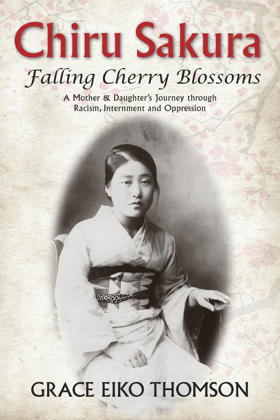
"At eight years old, Grace Eiko Nishikihama was forcibly removed from her Vancouver home and interned with her parents and siblings in the BC Interior. Chiru Sakura--Falling Cherry Blossoms is a moving and politically outspoken memoir written by Grace, now a grandmother, with passages from a journal kept by her late mother, Sawae Nishikihama. An educated woman, Sawae married a naturalized Canadian man and immigrated to Canada in 1930. They came with great hopes and dreams of what Canada could offer them. However, within just a little more than a decade after settling happily in Paueru Gai (Powell Street) area, her dreams, and those of her husband's, were completely shattered. It was 1942 and more than 22,000 Japanese Canadians on the West Coast were interned and had their belongings, property and homes confiscated, and then sold off by the Government of Canada. After the war ended, restrictions on Japanese Canadians' movement continued for another four years and the Government ordered anyone of Japanese ancestry to move 'east of the Rockies,' or be deported to Japan. There was nothing on the West Coast to return to, so the Nishikihama family moved first to rural Manitoba and, when government restrictions were lifted, later to Winnipeg. At eighty-four years of age, Sawae began writing her memories for her children, ensuring they would know their family's story. While translating her mother's journal, Grace began to add her own experiences alongside her mother's, exploring how generational trauma can endure, and how differently she and her mother interpreted those years of struggle. Despite her years spent studying art and working as a gallery director and curator, translating her mother's writings, and her country's perceived efforts to simply move on from a dark period in Canada's history, Grace continues to seek an understanding of her past, while facing both sexism and racism. As an advocate for reconciliation, she openly shares her story with the next generations; throughout, Grace returns to her mother's teachings of hope and resilience symbolized in the cherry blossoms around what was once their home."-- Provided by publisher 198 pages : illustrations, portraits (black and white) ; 23 cm CIRC [ 0 ]
|
2021 |
|
In the company of sisters Canada's women in the war zone, 1914-1919 by Dianne Graves 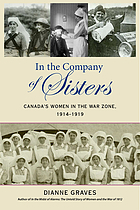
"When Canada entered the First World War in August 1914, it embarked on a major war effort at home and abroad. The nation's women worked tirelessly to help and support the troops fighting overseas, and among them were many who chose to 'do their bit' overseas by serving and volunteering in areas of the war zone from Britain and the European mainland to the Middle East and Russia. In the Company of Sisters chronicles their endeavours and achievements amid the drama of a life-and-death struggle that claimed millions of lives. Spearheaded by the nurses who were sent to various theatres of war, plenty of other determined souls channelled their energy into a wide range of much-needed work and, in so doing, broke new ground. Whether driving ambulances in range of enemy shelling, nursing sick soldiers in the heat and disease of the eastern Mediterranean, clothing destitute Belgian refugees or cheering up the troops with concerts, care packages and a cup of tea, these remarkable women played an important part in a multitude of ways. Canadian nurses at the Anglo-Russian Hospital in St. Petersburg watched the Russian Revolution taking place at their front door and cared for people wounded in the streets. Four remarkable Canadian 'women with a mission' are covered in detail: Julia Drummond, who became 'mother' to the Canadian forces; actress and theatre producer Lena Ashwell, who took concerts and theatre to the troops in the front lines; Julia Grace Wales, pacifist and peace worker, who inspired peace negotiations even as the battles raged; and Mary Riter Hamilton, pioneer among Canadian women artists, who documented the devastated battlefields for posterity. What the Canadian women who went overseas experienced had a marked impact on their own lives, and in some cases acted as a catalyst for what they went on to accomplish in later life. The legacy they bequeathed to future generations was one of selfless and positive action that remains an inspiration to this day. In the Company of Sisters celebrates the 'sisters' - military and civilian - who ventured overseas from 1914 to 1919 and highlights their courageous march along the path towards the equality and self-determination that Canadian women later went on to achieve."-- Provided by publisher xx, 363 pages : illustrations, maps ; 23 cm CIRC [ 0 ]
|
2021 |
|
Pinkerton's and the hunt for Simon Gunanoot double murder, secret agents and an elusive outlaw by Geoff Mynett 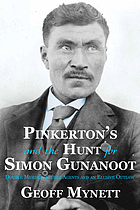
"Pinkerton's and the Hunt for Simon Gunanoot throws new light on the extensive manhunt for an accused murderer in northern British Columbia in the early 1900s. After a double murder in 1906, Gitxsan trapper and storekeeper Simon Gunanoot fled into the wilderness with his family. Despite lack of proof, the police pursued Gunanoot for nearly three years, sending search parties and police operatives into the wilds of northern BC. The hunt was covered by numerous newspapers at the time, describing a melodramatic cat-and-mouse chase--a not-entirely-accurate account. Frustrated by Gunanoot's ability to evade capture, the Attorney General of BC asked Pinkerton's National Detective Agency in Seattle to assist in the pursuit. In May 1909, two Pinkerton's operatives disguised as prospectors were sent to Hazelton, BC, to find and apprehend Gunanoot. From 1909-1910, they delivered regular reports to Pinkerton's office in Seattle detailing their progress. Many of these confidential reports, written around campfires on the treks in the wilderness, provided a vivid picture of life in the frontier town, relations of the settlers and prospectors, and of the conflicting loyalties and tensions in both the Indigenous and non-Indigenous communities. One of the most famous fugitives in BC history, Gunanoot's story has taken on the status of legend. Pinkerton's and the Hunt for Simon Gunanoot is a fascinating tale of turn-of-the-century crime-solving techniques, rural politics and backwoods survival, based on never-before published, firsthand accounts of the two undercover operatives."-- Provided by publisher 214 pages : illustrations, maps ; 23 cm CIRC [ 0 ]
|
2021 |
|
Reading the diaries of Henry Trent the everyday life of a Canadian Englishman, 1842-1898 by J. I. Little , Henry Trent 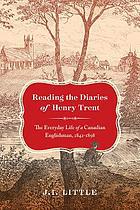
"The personal journals examined in Reading the Diaries of Henry Trent are not the witty, erudite, and gracefully written exercises that have drawn the attention of most biographers and literary scholars. Prosaic, ungrammatical, and poorly spelled, the fifteen surviving volumes of Henry Trent's hitherto unexamined diaries are nevertheless a treasure for the social and cultural historian. Henry Trent was born in England in 1826, the son of a British naval officer. When he was still a boy, his father decided to begin a new life as a landed gentleman and moved the family to Lower Canada. At the age of sixteen Trent began writing in a diary which he maintained, intermittently, for more than fifty years. As a lonely youth he narrates days spent hunting and trapping in the woods owned by his father. On the threshold of manhood and in search of a vocation, he writes about his experiences in London and then on Vancouver Island during the gold rush. And finally, as the father of a large family, he describes the daily struggle to make ends meet on the farm he inherited in Quebec's lower St Francis valley. As it follows Trent through the different stages of his long life, Reading the Diaries of Henry Trent explores the complexities of class and colonialism, gender roles within the rural family, and the transition from youth to manhood to old age. The diaries provide a rare opportunity to read the thoughts and follow the experiences of a man who who, like many Victorian-era immigrants of the privileged class, struggled to adapt to the Canadian environment during the rise of the industrial age."-- Provided by publisher 1 online resource. CIRC [ 0 ]
|
2021 |
|
"The object's the thing..." the writings of Yorke Edwards : a pioneer of heritage interpretation in Canada by Yorke Edwards , Richard Kool , Robert A. Cannings , Royal British Columbia Museum (Publisher) 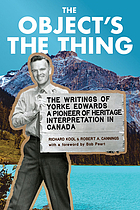
"R. Yorke Edwards was a pioneer in the field of heritage interpretation in Canada. First with BC Parks and then with the Canadian Wildlife Service, throughout the 1960s Edwards developed an approach to the interpretation of natural and cultural history with a focus on the "real thing"--the object, the place, the process, the person--in front of a visitor. Almost everyone who has visited a Canadian park or museum has been touched by Edwards's legacy--but few know his name. Through essays and photographs, a biography and sections from Edwards's unpublished notebook, The Object's the Thing introduces "the father of nature interpretation in Canada," whose work still affects how we experience our heritage today."-- Provided by publisher xx, 316 pages : illustrations, maps ; 23 cm CIRC [ 0 ]
|
2021 |
|
Writing the Hamat̓sa ethnography, colonialism, and the cannibal dance by Aaron Glass , William Cranmer, Andy Everson 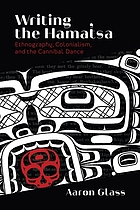
"Writing the Hamat̓sa critically surveys more than two centuries worth of published, archival, and oral sources to trace the attempted prohibition, intercultural mediation, and ultimate survival of one of Canada’s most iconic Indigenous ceremonies"-- Back cover xviii, 489 pages : illustrations (black and white), maps ; 24 cm CIRC [ 0 ]
|
2021 |
|
Waterfall hikes in southern British Columbia by Steve Tersmette 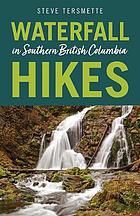
A guide to hiking routes to and around waterfalls and cascades in the BC Rockies, Southern Interior and Okanagan 224 pages : colour illustrations, colour maps ; 22 cm CIRC [ 0 ]
|
2021 |
|
Psychiana man a mail-order prophet, his followers, and the power of belief in hard times by Brandon R. Schrand 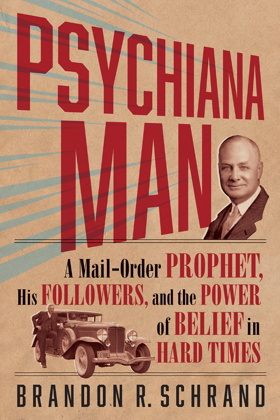
Six weeks after the 1929 stock market crash, Frank Bruce Robinson created a self-help religion he called Psychiana. An ingenious mass-marketing pioneer, he sold a correspondence course promising health, wealth, and happiness to those who believed in the “God Power.” In the midst of the Great Depression, his mail-order religion with a money-back guarantee swept the United States and spread to some sixty-seven countries – or so its founder claimed – to become one of the most successful twentieth century New Thought religions. Facing charges of passport fraud in May 1936, an immaculately dressed Robinson arrived at the federal building in rural Moscow, Idaho. A person of considerable local and regional significance, he was Latah County’s largest private employer. Throngs lined the streets and sidewalks waiting for him. He exited his sleek green Duesenberg, waved to the crowd, and smiled for pictures. His son later wrote that the charismatic leader possessed “an insatiable appetite for publicity.” Central to the investigation was Robinson’s true identity. He was not all he claimed to be, and his small-town trial captivated the country and made national headlines. A full-length biography of Robinson combined with an in-depth historical examination of Psychiana, this book traces the improbable rise and fall of a master charlatan while also giving voice to his unwavering followers – from a Dust Bowl farmer to a former heavyweight boxing champion – who clung to their beliefs despite ongoing financial and emotional costs. Their stories reveal how adversity can galvanize faith in a false prophet, and paint an intriguing, intimate portrait of a nation challenged by a brutal depression and war. Brandon R. Schrand is the local, award-winning author of The Enders Hotel: A Memoir and Works Cited: An Alphabetical Odyssey of Mayhem and Misbehavior. His nonfiction has appeared in Sports Illustrated, Utne Reader, the Georgia Review, North American Review, and numerous other publications. A winner of the Pushcart Prize, he has also been a resident at Yaddo. xv, 397 pages : illustrations, portraits ; 23 cm CIRC [ 0 ]
|
2021 |
|
This is not for you an activist's journey of resistance and resilience by Richard J. Brown , Brian Benson 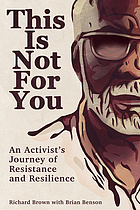
"This is Not For You: An Activist's Journey of Resistance and Resilience is the memoir of activist and photographer Richard Brown, an eighty-year-old Black Portlander who has worked to bridge the divide between police and the Black community. Originally from Harlem, Brown served in the Air Force for twenty years before landing in Portland. As he recalls his childhood in the 1940s, his radicalization in the newly desegregated Air Force, and his decades of activism in one of America's whitest cities, he questions whether he's got the strength to continue doing this work, and he wonders who, if anyone, will take his place"-- Provided by publisher 1 online resource (258 pages) : illustrations, portraits CIRC [ 0 ]
|
2021 |
|
I have not loved you with my whole heart by Cris Harris 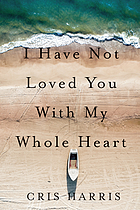
"I Have Not Loved You With My Whole Heart is a memoir of trauma, healing, faith, and violence. At its center is the author's father, the Rev. Renne Harris, a heavy-handed, alcoholic, Episcopal priest who came out in the height of the AIDS crisis and died of HIV in 1995. In a book rich with remembrances of the Pacific Northwest of the 1970s-1990s, Cris Harris pulls the reader through turning points in a household crowded with abuse, addiction, neglect, acceptance, and grief, as well as the healing that comes after reconciliation. In recognizing perpetrators of violence as complex people-as selves we can recognize-Harris wrestles with paradox: the keening dissonance of loving people with hard edges, the humor of horrible situations, and how humor can cover for anger. He shows how violence can mark us and courageously lays bare those marks, owning them as his own precious history, born of a fierce species of love. I Have Not Loved You With My Whole Heart will speak to readers whose family members came out late in life, and to those who lost loved ones in the AIDS crisis of the late 1980s and 1990s. Those with complicated relationships to faith, survivors of abuse, and anyone who has lived with family crisis will also find healing in these pages"-- Provided by publisher 224 pages ; 23 cm CIRC [ 0 ]
|
2021 |
|
Western lands, western voices essays on public history in the American West by Gregory E. Smoak , Gregory C. Thompson 
"This collection of essays explores the meanings and uses of contemporary public history in the American West"-- Provided by publisher xii, 232 pages : illustrations ; 24 cm CIRC [ 0 ]
|
2021 |
|
Oregon painters landscape to modernism, 1859-1959 by Ginny Allen , Jody Klevit 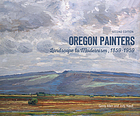
"Since the first edition of Oregon Painters was published in 1999, it has served as an invaluable reference to the early history of Northwest art, with well-worn and closely guarded copies found in libraries and art collections throughout Oregon and nationally. The original volume was an encyclopedia and index of Oregon painters, with historical data about the evolution of painting styles, educational institutions, and exhibition venues in the Northwest. Oregon Painters: Landscape to Modernism, 1859-1959 expands the focus on the history of painting in Oregon by adding essays on Impressionism and Modernism while using more and better visual examples to illustrate the strength of the state's early painters. In addition, the original indexed content has been edited and condensed. Essays address Indigenous art, the Lewis and Clark Exposition, the Impressionist and Modernist movements, New Deal Art, and the Federal Art Projects in Oregon. The biographical section is now fully illustrated with color images of the majority of the 630 painters' works. A list with an additional 4000 names is also included. Little has been written about the early history of Northwest art and this volume serves as a valuable resource for discovering artists who remain largely unknown but whose works continue to gain in reputation and value. With faithful full-color reproductions from institutional and private collections, it will be treasured by art students, scholars, teachers, gallery owners, museumgoers, collectors, and art lovers everywhere"-- Provided by publisher 372 pages : illustrations (chiefly color) ; 25 x 30 cm CIRC [ 0 ]
|
2021 |
|
The Northwest gardens of Lord & Schryver by Valencia Libby , Oregon State University Press (Issuing body) 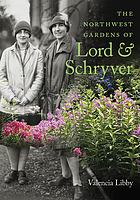
"Lord & Schryver, the first landscape architecture firm founded and operated by women in the Pacific Northwest, designed more than two hundred gardens in Oregon and Washington, including residential, civic, and institutional landscapes. Elizabeth Lord and Edith Schryver met as young women and in 1929 established their highly successful firm in Salem; their work is acknowledged as one of the milestones in the history of garden design in the Northwest and beyond. Theirs is the only Oregon firm recognized in Pioneers of Landscape Architecture, compiled by the National Park Service. The Cultural Landscape Foundation describes them as "consummate professionals in the broadest sense, as they worked to raise the profile of landscape architects by involving an audience beyond their clients. Their work represented a transition from a formal symmetrical style of garden design to one which responded in a distinctive way to the unique features of Northwest climate, soil, topography, and plant material." Gaiety Hollow, their purpose-built Salem home, garden, and studio, is now owned by the Lord & Schryver Conservancy and is open to the public. The conservancy has lovingly restored the gardens at Gaiety Hollow according to Lord & Schryver's original plans. They have also restored and now maintain the gardens at Deepwood, a former residence that is now a public park. Students of landscape architecture, garden design, Pacific Northwest history, ornamental horticulture, and general readers who are interested in the contributions of women to once male-dominated professions will find inspiration in these pages. Learn more about Elizabeth Lord and Edith Schryver at www.lordschryver.org"-- Provided by publisher xi, 220 pages, 24 unnumbered pages of plates : illustrations (some color) ; 26 cm CIRC [ 0 ]
|
2021 |
|
The archaeology of Manila galleons in the American continent the wrecks of Baja California, San Agustín, and Santo Cristo de Burgos (Oregon) by Scott S. Williams , Roberto Junco 
This is the first book devoted to the topic of Manila galleon shipwrecks; previous research on Manila galleons either has focused on the economics of the Manila galleon trade or has been limited to reports of the galleon wreck sites in the western Pacific salvaged for their cargoes. All three North American shipwrecks are protected under the historic preservation laws of the United States or Mexico, and each shipwreck site has been investigated by professional archaeologists seeking to answer research questions posed in peer-reviewed research designs. The majority of Manila galleon wrecks are found in the western Pacific and were salvaged by treasure hunters rather than recovered by archaeologists. The three North American shipwrecks represent the most protected Manila galleon archaeological sites, so their potential for future archaeological research is higher than for many of the extant shipwrecks of the western Pacific ix, 100 pages : illustrations (chiefly color), maps ; 24 cm CIRC [ 0 ]
|
2021 |
|
Providence and the invention of American history by Sarah Koenig 
"In 1847, Protestant missionary Marcus Whitman was killed after a disastrous eleven-year effort to evangelize the indigenous peoples of the Pacific Northwest. By 1897, Whitman was a national hero, celebrated in textbooks, monuments, and historical scholarship as the 'Savior of Oregon.' But his fame was based on a tall tale--one that was about to be exposed. Sarah Koenig traces the rise and fall of Protestant missionary Marcus Whitman's legend, revealing two patterns in the development of American history. On the one hand is providential history, marked by the conviction that God is an active agent in human history and that historical work can reveal patterns of divine will. On the other hand is objective history, which arose from the efforts of Catholics and other racial and religious outsiders to resist providentialists' pejorative descriptions of non-Protestants and nonwhites. Koenig examines how these competing visions continue to shape understandings of the American past and the nature of historical truth."-- Provided by publisher xii, 280 pages : illustrations ; 25 cm CIRC [ 0 ]
|
2021 |
|
Murder at the mission a frontier killing, its legacy of lies, and the taking of the American West by Blaine Harden , Jeffrey L. Ward (Cartographer) 
"The New York Times bestselling author of Escape From Camp 14 returns with the riveting and revealing story of one of the most persistent "alternative facts" in American history: the story of a missionary, a tribe, a massacre, and a myth that shaped the American West In 1836, two missionaries and their wives were among the first Americans to cross the Rockies by covered wagon on what would become the Oregon Trail. Dr. Marcus Whitman and Reverend Henry Spalding were headed to present-day Washington state and Idaho, where they aimed to convert members of the Cayuse and Nez Perce tribes. Both would fail spectacularly as missionaries. But Spalding would succeed as a propagandist, inventing a story that recast his friend as a hero, and helped to fuel the massive westward migration that would eventually lead to the devastation of those they had purportedly set out to save. As Spalding told it, after uncovering a British and Catholic plot to steal the Oregon Territory from the United States, Whitman undertook a heroic solo ride across the country to alert the President. In fact, he had traveled to Washington to save his own job. Soon after his return, Whitman, his wife, and eleven others were massacred by a group of Cayuse. Though they had ample reason--Whitman supported the explosion of white migration that was encroaching on their territory, and seemed to blame for a deadly measles outbreak--the Cayuse were portrayed as murderous savages. Five were executed. This fascinating, impeccably researched narrative traces the ripple effect of these events across the century that followed. While the Cayuse eventually lost the vast majority of their territory, thanks to the efforts of Spalding and others who turned the story to their own purposes, Whitman was celebrated well into the middle of the 20th century for having "saved Oregon." Accounts of his heroic exploits appeared in congressional documents, The New York Times, and Life magazine, and became a central founding myth of the Pacific Northwest. Exposing the hucksterism and self-interest at the root of American myth-making, Murder at the Mission reminds us of the cost of American expansion, and of the problems that can arise when history is told only by the victors"-- Provided by publisher xxxi, 432 pages : illustrations, map ; 24 cm CIRC [ 0 ]
|
2021 |
|
Liberty factory the untold story of Henry Kaiser's Oregon shipyards by Peter J. Marsh 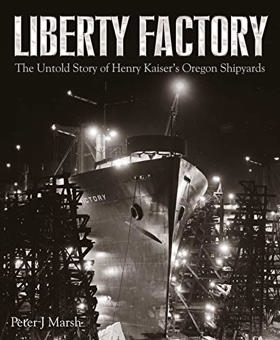
The extraordinary story of one of the keystones of victory in WW2. Churchill famously claimed that the only thing that had really frightened him during the war was the Battle of the Atlantic. Keeping open the lifeline between the US “arsenal of democracy” and the UK was essential to preparations for the invasion of Europe and in the final analysis this came down to building merchant ships faster than German U-boats could sink them. Crucial to this achievement was the British-designed “Liberty Ship,” a simple cargo ship that could be built rapidly, combined with the untapped industrial potential of the U.S. that could build them in vast numbers. Undoubtedly the most important individual in the rapid expansion of U.S. wartime shipyard capacity was Henry Kaiser, a man with no previous shipbuilding experience but an entrepreneur of vision and drive. This book tells the story of how he established huge new yards using novel mass-production techniques in the most surprising location―Oregon, one of the least industrially developed areas of the US and one without an existing pool of skilled labor to draw on. 256 pages : illustrations, maps ; 27 cm CIRC [ 0 ]
|
2021 |
|
1, 2, 3 Salish Sea a pacific northwest counting book by Nikki McClure 
This beautiful natural history counting book features artist Nikki McClure's stunning papercut artwork of flora and fauna found in and alongside the Salish Sea. A celebration of the unique Salish Sea ecosystem, this counting book will inspire kids to learn more about the creatures who are found here, like stubby squids, lumpsuckers, banana slugs, orcas, nudibranchs, and sculpin. Each image is lovingly created by artist Nikki McClure in her intricate papercut style and captures her passion for this special place in the Pacific Northwest. 1 volume (unpaged) : illustrations (some color) ; 24 cm CIRC [ 0 ]
|
2021 |