Catalog of British Columbiana and Pacific Northwest Americana
The Encyclopedia Cascadia Catalog indexes mostly non-fiction literature covering the Pacific Northwest coast of North America, with an emphasis on British Columbia, Idaho, Oregon, and Washington State.
| Catalog Title | Published |
|---|---|
|
Your public beaches, San Juan Islands by Washington (State). Department of Natural Resources 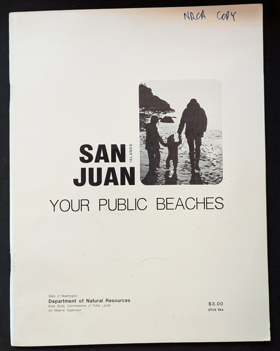
Your Public Beaches, San Juan Islands by the Washington State Department of Natural Resources is a practical 1985 recreational and environmental guide published to systematically document the state-owned tidelands and accessible shorelines across the archipelago. The volume serves as an expansive directory for boaters, beachcombers, and outdoor enthusiasts, detailing specific marine parks, hidden public access points, and the diverse coastal ecosystems of the San Juans. By carefully mapping out the often-unclear boundaries between private waterfronts and public lands, the book highlights the state's early conservation efforts to balance rapidly growing recreational tourism with environmental stewardship. Ultimately, it functions as an invaluable late 20th-century civic resource for maritime historians and regional geographers seeking to understand the foundational policies and infrastructural efforts used to manage and guarantee public shoreline access in Washington's most heavily navigated island region. 88 pages in various pagings : illustrations, maps ; 28 cm Non-circulating [ 1 ]
|
1985 |
|
You're at liberty here mines and miners of the Swauk by Josee Jordan 
Josee Jordan’s You're at liberty here: Mines and miners of the Swauk chronicles the rugged pioneer history of the historic gold-mining town of Liberty, nestled deep within the eastern slopes of Washington's Cascade Mountains. The narrative maps the challenging topography of the Swauk Creek basin, detailing the extensive placer mining operations that transformed this remote, forested enclave in northern Kittitas County. By documenting the daily lives and arduous labor of prospectors navigating the steep, timbered gulches just south of Blewett Pass, the book illustrates the severe environmental realities of the region's late-nineteenth-century gold rush. Ultimately, the text captures the distinct geographical footprint of this inland Washington landscape, preserving the legacy of one of the Pacific Northwest's most enduring historic mining districts. v, 103 pages : illustrations, map, portrait ; 22 cm Non-circulating [ 1 ]
|
1967 |
|
Yesterday's promises a history of the district of Port Hardy by David Lewis 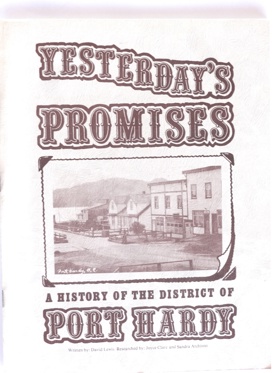
Yesterday's promises: a history of the district of Port Hardy chronicles the challenging pioneer settlement and resource-driven evolution of a remote outpost situated near the rugged northeastern tip of British Columbia’s Vancouver Island. Lewis details how the area's profound physical isolation—bounded by dense, impenetrable coastal rainforests to the south and the turbulent marine waters of Queen Charlotte Strait to the north—dictated an economy and lifestyle entirely reliant on the sea. The narrative highlights how the steep, heavily timbered shorelines and naturally protected bays served as vital staging grounds for the region's intense extractive industries, particularly commercial salmon fishing, copper mining, and large-scale logging operations. Because overland travel to the island's southern population centers was virtually impossible for decades, the community depended absolutely on coastal steamers and precarious maritime supply chains to navigate the perilous shoreline. Ultimately, the book serves as a localized spatial history, demonstrating how the unforgiving, storm-battered topography of this extreme Pacific Northwest coastal frontier inherently shaped the resilient, heavily industrialized character of its early inhabitants. 41 pages : illustrations ; 28 cm Non-circulating [ 1 ]
|
1978 |
|
Yester years by Gordon Ross 
Published locally by longtime Coos County dairy farmer, historian, and former commissioner Gordon Ross, Yester Years is a collection of humorous and homespun stories documenting the trials, eccentricities, and daily realities of early rural life in southwest Oregon. Drawing heavily on family lore, handed-down anecdotes, and personal recollections of the Ross Slough and Coos Bay regions, the book captures a vanishing landscape where neighbors survived through grit, improvisation, and close-knit community cooperation. Through lighthearted and unpretentious prose, the text preserves the rich oral history of pioneers, farmers, and loggers who shaped the rugged frontier. A keen insight drawn from the work is how regional humor functions as an essential survival mechanism; by chronicling the absurdities and hardships of frontier isolation with witty storytelling, the narrative reveals that laughter was just as vital as physical labor in subduing an unforgiving wilderness. 93 pages : illustrations ; 22 cm Non-circulating [ 1 ]
|
2001 |
|
Yellow Wolf, his own story by Yellow Wolf, Lucullus Virgil McWhorter 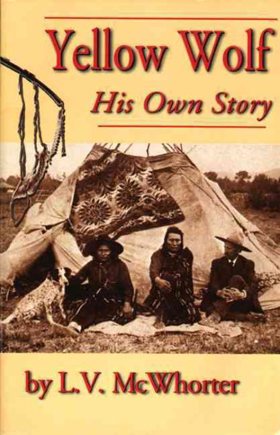
The Nez Perce Indian War was the outstanding front-page story in American newspapers during the late summer of 1877. Chief Joseph's supposedly impossible retreat from Idaho into Montana across the impregnable Bitterroots was a piece of military strategy so spectacular as to elicit comparisons with the greatest of Napoleon's maneuvers. It is fitting that Yellow Wolf, the last great Nez Perce warrior, should be the one to reveal the entire history of the Nez Perce revolt against oppression, their ultimate gesture against the loss of their immemorial homeland, as it culminated in this dramatic struggle. In addition to Yellow Wolf's day-by-day account of the entire war, this volume includes a special appendix of more than a dozen eye-witness narratives by Indians who witnessed the decisive battle of the Big Hole 328 pages, 35 unnumbered pages of plates : illustrations, map, portraits ; 24 cm Desiderata
|
2020 |
|
Years plowed under by Leo F. Vogel
Years plowed under chronicles the grueling agricultural transformation and precarious pioneer settlement across the arid, sweeping expanse of the Columbia Basin in eastern Washington. Vogel details how the region's formidable environmental constraints—specifically the profound lack of surface water, sweeping sagebrush steppes, and the severe rain shadow of the Cascade Range that defined the Connell area—strictly dictated the margins of early dryland farming and human survival. By mapping the decades-long struggle of these isolated communities and their eventual salvation through the massive hydrological engineering of the Columbia Basin Project, the narrative highlights the immense physical labor required to carve a permanent agrarian economy from this unforgiving inland desert. The utter lack of natural precipitation initially forced homesteaders into a fragile existence of seasonal boom and bust, eventually requiring an absolute dependence on massive federal irrigation networks to forcibly convert the arid landscape into a controlled, highly productive agricultural grid. Ultimately, this compilation of pioneer experiences serves as a deeply localized spatial history, demonstrating how the severe climatic extremes and vast, open topography of the Pacific Northwest's inland frontier inherently shaped the fiercely resilient character of its farming communities. 167 pages : illustrations ; 24 cm Non-circulating [ 1 ]
|
1977 |
|
Yankee steamboats on the Fraser River, British Columbia by Frank Raymond Coutant
|
1966 |
|
Yakima, Washington Jubilee, 1885-1960 by Click Relander, George M. Martin , Yakima Diamond Jubilee, Inc (Issuing body), Yakima Diamond Jubilee 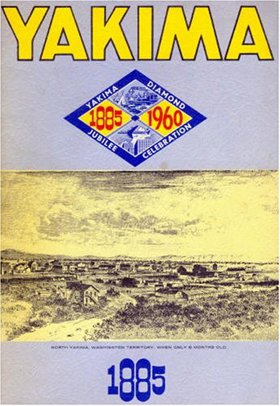
Click Relander and George M. Martin’s Yakima, Washington Jubilee, 1885-1960 chronicles the dramatic agricultural transformation of an arid, sun-baked basin trapped within the profound rain shadow of the towering Cascade Range. The narrative maps how the severe climatic realities of this sprawling sagebrush steppe forced early pioneers to execute massive hydrological projects, systematically diverting the glacier-fed Yakima River into extensive, life-sustaining irrigation networks. By detailing the physical relocation of the entire pioneer settlement to intercept the newly constructed Northern Pacific Railway, the text illustrates how a total reliance on engineered waterways and mechanized overland transit strictly dictated the region's economic viability. Ultimately, the account demonstrates that artificially mastering this localized hydrology to conquer a punishing high-desert climate was the absolute prerequisite for transitioning a barren inland expanse into a lucrative, globally recognized agricultural epicenter. iv, 25, [12], 26-50, [2] pages : illustrations, portraits ; 25 cm Non-circulating [ 1 ]
|
1960 |
|
Yakima, a centennial reflection, 1885-1985 by George M. Martin, Paul Schäfer, William E. Scofield, Yakima Centennial Commission 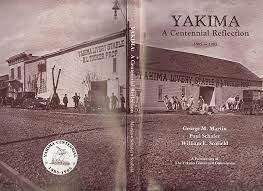
Yakima, a Centennial Reflection, 1885-1985 by George M. Martin, Paul Schäfer, and William E. Scofield is a comprehensive 1985 local history, published by the Yakima Centennial Commission, that commemorates the foundational growth and civic evolution of this central Washington city. The book chronicles the region's dramatic transformation from an arid sagebrush frontier into a globally recognized agricultural powerhouse, driven by the arrival of the Northern Pacific Railway and the implementation of massive, federally funded irrigation projects in the Yakima Valley. The authors meticulously detail the unique early history of the town—including the literal, physical relocation of early pioneer buildings from the original settlement to the new "North Yakima" townsite to meet the railroad tracks—alongside a century of industrial expansion in the apple, hop, and broader agricultural sectors. Ultimately, richly illustrated with archival photographs and grassroots community documentation, it serves as an indispensable resource for regional historians seeking to understand the infrastructural ambition, pioneer resilience, and agrarian heritage that defined the commercial heart of central Washington. x, 233 pages : illustrations ; 23 cm Non-circulating [ 1 ]
|
1985 |
|
Yakama Rising Indigenous Cultural Revitalization, Activism, and Healing by Michelle M. Jacob 
"The Yakama Nation of present day Washington State has responded to more than a century of historical trauma with a resurgence of grass roots activism and cultural revitalization. This path-breaking ethnography shifts the conversation from one of victimhood to one of ongoing resistance and resilience as a means of healing the soul wounds of settler colonialism"--Page 4 of cover xii, 139 pages : illustrations ; 23 cm. Desiderata
|
2014 |
|
Written in the snows across time on skis in the Pacific Northwest by Lowell Skoog 
"The story of the development of skiing in the Pacific Northwest from the late 19th century through the early 21st century told by a Seattle-based skier and historian. Includes photos, personal anecdotes, and an appendix of ski mountaineering race results"-- Provided by publisher 333 pages : illustrations (some color), maps ; 23 cm Desiderata
|
2021 |
|
Writing the Hamat̓sa ethnography, colonialism, and the cannibal dance by Aaron Glass , William Cranmer, Andy Everson 
"Writing the Hamat̓sa critically surveys more than two centuries worth of published, archival, and oral sources to trace the attempted prohibition, intercultural mediation, and ultimate survival of one of Canada’s most iconic Indigenous ceremonies"-- Back cover xviii, 489 pages : illustrations (black and white), maps ; 24 cm Desiderata
|
2021 |
|
Wrecked unsettling histories from the graveyard of the Pacific by Coll-Peter Thrush , Center for the Study of the Pacific Northwest (Issuing body) 
The Northwest Coast of North America is a treacherous place. Unforgiving coastlines, powerful currents, unpredictable weather, and features such as the notorious Columbia River bar have resulted in more than two thousand shipwrecks, earning the coastal areas of Oregon, Washington, and Vancouver Island the moniker “Graveyard of the Pacific.” Beginning with a Spanish galleon that came ashore in northern Oregon in 1693 and continuing into the recent past, Wrecked includes stories of many vessels that met their fate along the rugged coast and the meanings made of these events by both Indigenous and settler survivors and observers. Commemorated in museums, historical markers, folklore, place-names, and the remains of the ships themselves, the shipwrecks have created a rich archive. Whether in the form of a fur-trading schooner that was destroyed in 1811, a passenger liner lost in 1906, or an almost-empty tanker broken on the shore in 1999, shipwrecks on the Northwest Coast opens up conversations about colonialism and Indigenous persistence. Thrush’s retelling of shipwreck tales highlights the ways in which the three central myths of settler colonialism—the disappearance of Indigenous people, the control of an endlessly abundant nature, and the idea that the past would stay past—proved to be untrue. As a critical cultural history of this iconic element of the region, Wrecked demonstrates how the history of shipwrecks reveals the fraught and unfinished business of colonization on the Northwest Coast. pages cm Desiderata
|
2025 |
|
Working the wilderness early leaders for wild lands by John McCarthy 
"EARLY LEADERS FOR WILD LANDS tells true stories about four men and one woman who established how to work in and be in the wilderness. They were guides for protection of wilderness and for the protectors who followed them. Their lives were immersed in service -- to wild land and the American people. They worked for the U.S. Forest Service, centered in the vast Selway-Bitterroot Wilderness of Idaho and Montana. Three were active before and after the Wilderness Act of 1964. The younger two came in at the beginning of the modern wilderness era. They all adapted skills of the pioneers to the new land designation. Their stories celebrate heroes for the enduring resource of wilderness and point to the future to keep their legacies thriving"-- Provided by publisher 282 pages : illustrations, map ; 23 cm Desiderata
|
2019 |
|
Working boats an inside look at ten amazing watercraft by Tom Crestodina (Author, Illustrator) 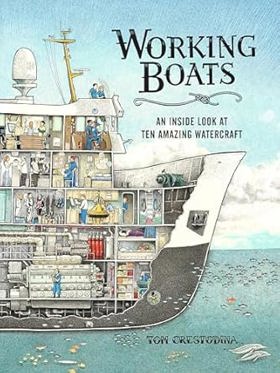
"Want to know what happens during a Coast Guard rescue, what it's like to work on a scientific research vessel, or what's involved when crabbing in the cold waters of the North Pacific? This visually engaging book includes cross sections and exploded views showing in great detail what it's like to live and work aboard ten amazing boats."-- Publisher's description 56 pages : color illustrations, color maps ; 32 cm Desiderata
|
2022 |
|
Words marked by a place local histories in Central Oregon by Jarold Ramsey 
Words Marked by a Place is a book of interconnected writings reflecting on the human and natural history of central Oregon. This chronological collection presents the reader with key episodes of central Oregon history, from nineteenth-century exploration to the railroading and homesteading era to the era of community-building and development that followed. While telling these local stories, Jarold Ramsey explores alternative ways of engaging history in the act of writing, breaking new ground by discovering and exploring primary sources that bear on the region’s colorful but little-known past. Throughout the collection, he interrogates “local history” as a subject. What is local history? How is it related to mainstream academic history? What are legitimate ways of doing it? How do the details of what we call local history inform “history-at-large,” and vice-versa? From the opening narrative concerning Lieutenant Henry Larcom Abbot’s “Railroad Survey” of the region in 1855 to the concluding account of Lieutenant Robert Cranston’s last months and dramatic death, when his “Airacobra” fighter plane crashed near Madras in 1944, Words Marked by a Place sheds new light on the ongoing story of central Oregon by illuminating forgotten corners of its past. Through both theory and example, it represents an important contribution to the history of the region and the endeavors of local historians, wherever they happen to work. About the authorJAROLD RAMSEY was born in central Oregon and grew up on his family’s ranch there. He left the ranch to attend college, and became an award-winning essayist and poet, as well as a published playwright and a respected authority on traditional American Indian literature. He is professor emeritus of English at the University of Rochester and the author of several books. In 2017, he received the Charles Erskine Scott Wood Distinguished Writer Award for lifetime achievement from Literary Arts. He lives in Madras, Oregon. xviii, 204 pages : illustrations, maps ; 23 cm Non-circulating [ 1 ]
|
2018 |
|
Wood, water & grass Meek Cutoff of 1845 by James H. Hambleton , Theona J. Hambleton , Stafford J. Hazelett, Caxton Press (Caldwell, Idaho) (Issuing body), Caxton Printers (Printer) 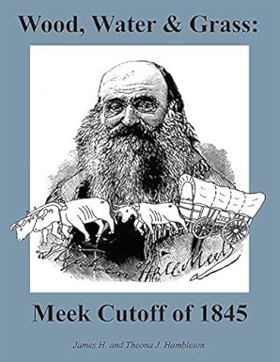
Researchers James H. and Theona J. Hambleton relate the history of the Meek Cutoff through the words of the diarists that lived through the ordeal. Included in the book are 53 USGS Quadrangle maps showing the actual trail location and many color photos of the remains of the trail itself xiv, 192 pages : illustrations (chiefly color), color maps ; 28 cm Desiderata
|
2014 |
|
Wood chips by Clark Wood, Arthur L. Crookham
Clark Wood and Arthur L. Crookham’s Wood Chips chronicles the rigorous cultural colonization and aggressive civic subjugation of a vast, geographically isolated agrarian frontier situated at the rugged base of Oregon's Blue Mountains. The narrative maps how the severe environmental realities of this unforgiving inland topography—defined by sprawling, arid high-desert wheatlands, plunging winter extremes, and the sheer terrestrial barricades of the eastern inland empire—initially paralyzed cultural cohesion and dictated a profoundly disconnected pioneer existence. By detailing the relentless, decades-long deployment of heavy, mechanized printing infrastructure—specifically the grueling physical operation of the Weston Leader press to aggressively broadcast standardized vernacular and administrative order across an untamed landscape—the text illustrates how the social survival and intellectual anchoring of the settlement were strictly dictated by the urgent necessity of mastering this remote geographic void. Ultimately, the account demonstrates that systematically domesticating the scattered pioneer consciousness and engineering a robust, localized communications grid to conquer the profound continental detachment of Umatilla County were the absolute prerequisites for binding a fragmented agricultural outpost to the broader civic machinery of the Pacific seaboard. xvii, 77 pages : illustrations ; 22 cm Non-circulating [ 1 ]
|
1950 |
|
Women in Pacific Northwest history by Karen J. Blair 
A collection of essays exploring women's experiences in Northwest history. This new edition of Karen Blair’s popular anthology originally published in 1989 includes thirteen essays, eight of which are new. Together they suggest the wide spectrum of women’s experiences that make up a vital part of Northwest history. ix, 324 pages, 4 unnumbered pages of plates : illustrations (some color), portraits ; 23 cm Desiderata
|
2001 |
|
Wiyáx̣ayx̣t/Wiyáakaảawn = As days go by our history, our land, and our people--the Cayuse, Umatilla, and Walla Walla by Jennifer Karson, Confederated Tribes of the Umatilla Reservation, Oregon, Tamástslikt Cultural Institute 
"This book represents a new vista, looking past the days when there were two distinct groups-those who were studied and those who studied them. This history of the Umatilla, Cayuse, and Walla Walla people had its beginnings in October 2000, when elders sat side by side with native students and native and non-native scholars to compare notes on tribal history and culture. Through this collaborative process, tribal members of the Confederated Tribes of the Umatilla Indian Reservation have taken on their own historical retellings, drawing on the scholarship of non-Indians as a useful tool and external resource. Primary to this history are native voices telling their own story. Beginning with ancient teachings and traditions, moving to the period of first contact with Euro-Americans, the Treaty council, war, and the reservation period, and then to today's modern tribal governance and the era of self-determination, the tribal perspective takes center stage. Throughout, readers will see continuity in the culture and in ways of life that have been present from the earliest times, all on the same landscape. Wiyaxayxt (Columbia River Sahaptin) and Wiyaakaa'awn (Nez Perce) can be interpreted to mean "as the days go by," "day by day," or "daily living." They represent the meaning of the English term "history" in two of the common languages still spoken on the Umatilla Indian Reservation."--Amazon.com viewed Mar. 16, 2023 xix, 263 pages : illustrations, maps ; 23 cm Desiderata
|
2006 |
|
With Vancouver in inland Washington waters journals of 12 crewmen, April-June 1792 by Richard W. Blumenthal 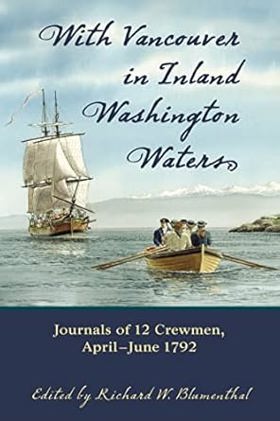
Publisher description: Picking up the narrative from his earlier volume, The Early Exploration of Inland Washington Waters: Journals and Logs from Six Expeditions, 1786-1792, Richard Blumenthal once again offers the reader a fascinating, firsthand look at the Northwest's earliest maritime history. This volume reproduces twelve individual journals, each composed by one of George Vancouver's men as they explored the Washington area in 1792. Providing additional details of exploration in inland areas not previously described, it contains a record of Peter Puget's observations and explorations of Puget Sound and a detailed description of William Broughton's passage through San Juan Islands. These journals also provide detail regarding the day-to-day onboard activities of both officers and enlisted men. A brief biographical note is provided at the beginning of each man's journal vii, 230 pages : maps ; 23 cm Desiderata
|
2007 |
|
With pride in heritage history of Jefferson County, a symposium by Jefferson County (Wash) Historical Society 
The Jefferson County Historical Society's With Pride in Heritage provides a collaborative pioneer and maritime chronicle of one of Washington State’s most geographically extreme regions. The narrative heavily maps the dramatic cross-peninsular topography of the Olympic Peninsula, stretching from the sheltered, deep-water maritime hub of Port Townsend on Puget Sound, westward across the towering, glacier-capped barrier of the Olympic Mountains, to the remote, storm-battered river valleys of the Pacific coast. By detailing the booming nineteenth-century shipping and military defense networks anchored in the eastern bays, alongside the arduous timber and homesteading operations isolated within the dense western temperate rainforests, the book illustrates how early development was dictated by this polarized environment. Ultimately, the text captures the profound physical divide of Jefferson County, demonstrating how its formidable mountain ranges and vital marine inlets shaped the distinct cultural and industrial histories of its eastern and western shores. xii, 422, [18] pages illustrations, maps, portraits 24 cm Non-circulating [ 1 ]
|
1966 |
|
With our good will 30 years of Shakespeare in Idaho by Doug Copsey 
In 1977 a group of talented young artists came together with the hope of establishing a self-sustaining theater group in Boise, Idaho. Three decades later, the Idaho Shakespeare Festival has become a nationally recognized community happening. In this beautifully designed and written book, Doug Copsey, one of the founders, tells the story of how it evolved. 249 pages : illustrations ; 30 x 27 cm Desiderata
|
2006 |
|
With hearts and minds Maillardville, 100 years of history on the west coast of B.C. by A. J. Boire 
In 1907, A.D McRae, a wealthy businessman and entrepreneur, has come to the west coast of British Columbia to build the Fraser River Lumber Company into one of the largest operations in the British Commonwealth. But McRae has a problem. At a time when anti-Asian sentiment is at fever pitch in Vancouver, his mill is populated with Chinese, Japanese and East Indian workers. Determined to correct this “intolerable” situation he sends two recruiters, a Catholic priest and a night-watchman, to Ontario and Quebec to lure French Canadian lumbermen to his mill to displace the Asians. Promised higher wages, land and lumber for house and church the first contingent arrives at Millside station in September, 1909. The great experiment to displace the Asian labour force begins. It is an experiment watched closely by the provincial government, the Catholic Church and the entire lumber industry in BC and across the nation. Will McRae be successful? Will the French Canadians prosper in their new English world? This is the exciting story of Canada’s two founding nations in the far west of the country coming together to form the quintessential Canadian experience in the early twentieth century. Set against the backdrop of many of the major events of the times, this epic 100 year history is sweeping in its scope as it examines racism and multiculturalism, the growth of the lumber industry, grass roots union movement, communism and the Catholic Church.Above all, the history of Maillardville, BC is a bright illustration of that elusive and sometimes tragic Canadian ideal of “two founding nations”. 311 pages : illustrations, portraits ; 26 cm. Non-circulating [ 1 ]
|
2016 |
|
With grit and by grace breaking trails in politics and law, a memoir by Betty Roberts , Gail Wells 
"In the 1950s, Betty Roberts did what most of her contemporaries considered audacious and inappropriate when she returned to college as a 32-year-old wife and mother. This was only the start of Roberts' lifetime commitment to overcoming obstacles to women's equality. With Grit and By Grace follows Betty Roberts' rise from a Depressionera childhood on the Texas plains to become a teacher, lawyer, state legislator, candidate for governor, and eventually Oregon's first woman Supreme Court Justice. In this memoir, Justice Roberts reflects on her role as a mother, wife, and political trailblazer. Her story is important to the history of women's struggles to challenge prevailing stereotypes, but it is also a deeply personal story of a life sometimes stark, sometimes humorous, often exhausting, and always brightened with friendships and family. Her story is a vivid reminder of times too quickly forgotten, when a woman could not keep her own name or stay at a motel alone. Justice Roberts began her career during a politically complex time: the Civil Rights Movement was in full swing, sentiment against the Vietnam War was growing, and the nascent women's movement would soon burst on the scene. During her 13 years as a legislator, she was instrumental in the passage of Oregon's first legalized right to abortion and the state's ratification of the Equal Rights Amendment, as well as pathbreaking environmental and land-use legislation. Roberts tells her engrossing story with honesty and warmth. With Grit and By Grace is about life's disappointments and promises, its rejections and rewards, and its demand for the determination and commitment that bring success. Politicians, civic leaders, feminists, and anyone interested in Oregon's twentieth-century political history will be fascinated by this recounting of events that influenced the political and social landscape of Oregon and beyond"--Publisher xii, 276 pages : illustrations ; 23 cm Desiderata
|
2008 |