Catalog of British Columbiana and Pacific Northwest Americana
Encyclopedia Cascadia Catalog contains book titles of mostly non-fiction Pacific Northwest Coast of North America Titles (primarially British Columbia, Idaho, Oregon and Washington State) in an easy-to-understand title catalog. If you see a link with this badge ONLINE CIRC it means that there is an online institution that provides free access to that title. In some cases there may be more than one institution hosting the title digitally.
| Catalog Title | Published |
|---|---|
|
The pioneering life of Peter Kirk from Derbyshire to the Pacific Northwest by Saundra Middleton 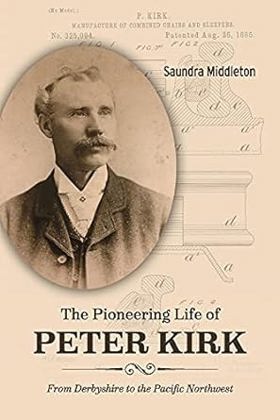
Peter Kirk, Esq. tracked the world iron markets diligently. He had to. Kirk employed 1000 men and boys in his integrated iron and steel works in Workington, England. Britain's market share was losing ground to America's burgeoning steel industry. In 1886, he sailed from Workington flush with decades of success in Britain's Victorian era rail expansion. - from the publisher ix, 293 pages : illustrations ; 23 cm CIRC [ 1 ]
|
2021 |
|
Anakú Iwachá Yakama legends and stories by Virginia Beavert , Michelle M. Jacob , Joana W. Jansen 
An expanded collection of foundational Yakama stories. Central to the Yakama oral tradition, storytelling enables Tribal Elders to share lessons, values, and customs with younger generations across the Columbia River plateau and the Pacific Northwest. Drawn from a time before the coming of human beings when animals were like people, the stories present characters and motifs that paint a bigger picture of the world as Yakama ancestors knew it. The original edition of Anakú Iwachá featured stories that Yakama Tribal Elders recorded in several dialects of the Ichishkíin language that were collected and translated into English by renowned linguist and scholar Virginia Beavert. This new edition adds a preface from the Yakama Nation and essays on the history of the project and on Ichishkíin-language education. It includes four additional legends in Ichishkíin and English, annotations, an updated glossary, and more artwork by Tribal artists, helping readers, teachers, and students engage with the legends as teaching and learning tools and as a precious gift to current and future Yakama generations. xxi, 372 pages : illustrations (some color), maps (some color) ; 23 cm CIRC [ 1 ]
|
2021 |
|
Resilience through writing a bibliographic guide to Indigenous-authored publications in the Pacific Northwest before 1960 by Robert E. Walls , Darby C. Stapp , Alexandra L.C. Martin (Book designer), Victoria M.R. Boozer (Book designer) 
Resilience Through Writing: A Bibliographic Guide to Indigenous-Authored Publications in the Pacific Northwest before 1960 includes nearly 2,000 entries by over 700 individuals, 29% of them women, most of which were largely unknown. Coverage has been thorough, with writings from coastal and interior regions of Alaska, British Columbia, Washington, Idaho, Oregon, and northern California. Entries include newspaper letters to the editors, school compositions, speeches, legal statements, and articles in miscellaneous relatively obscure publications. These materials thus provide new perspectives on Native American/First Nations cultures in the Pacific Northwest. The potential value of this material to descendants; tribal members; tribal historians; and scholars of Indigenous literature, political science, and culture change is enormous. By producing this bibliography and allowing the Journal of Northwest Anthropology (JONA) to publish it in our Memoir series, Robert Walls has given those interested in Northwest Indigenous writings the roadmap to years of research. xiv, 481 pages : illustrations ; 28 cm CIRC [ 0 ]
|
2021 |
|
Always pack a candle a nurse in the Cariboo-Chilcotin by Marion Crook 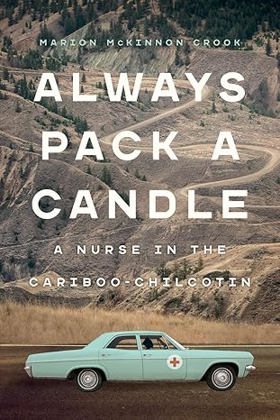
"The true story of an adventurous young nurse who provided much-needed health care to the rural communities of the Cariboo-Chilcotin in the 1960s. In 1962, newly minted public health nurse Marion McKinnon arrived in the small community of Williams Lake in BC's Cariboo region. Armed with more confidence than experience, she got into her government-issued Chevy--packed with immunization supplies, baby scales, and emergency drugs--and headed out into her 9,300-square-kilometre territory, inhabited by ranchers; mill workers; and many vulnerable men, women, and children who were at risk of falling through the cracks of Canada's social welfare system. At twenty-two, a naïve yet enthusiastic Marion relied entirely on her academic knowledge and her common sense. She doled out birth control and parenting advice to women who had far more life experience than she. She routinely dealt with condescending doctors and dismissive or openly belligerent patients. She immunized school children en masse and made home visits to impoverished communities. She drove out into the vast countryside in freezing temperatures, with only a candle, antifreeze, chains, and chocolate bars as emergency equipment. In one year, Marion received a more rigorous education in the field than she had at university. She helped countless people, made many mistakes, learned to recognize systemic injustice, and even managed to get into a couple of romantic entanglements. Pack a Candle is an unforgettable and eye-opening memoir of one frontline worker's courage, humility, and compassion."-- Provided by publisher 278 pages : maps, portrait ; 23 cm CIRC [ 0 ]
|
2021 |
|
Survival and resistance in Evangelical America Christian reconstruction in the Pacific Northwest by Crawford Gribben 
"Over the last thirty years, conservative evangelicals have been moving to the north-west of the United States in an effort to survive and resist the impact of secular modernity. Their activity coincides with the promotion by prominent survivalist authors of a programme of migration to the "American Redoubt," a region encompassing Idaho, Montana, eastern parts of Washington and Oregon, and Wyoming, as a location within which to endure hostile social change or natural disaster. These migration movements have independent origins, but they overlap in their influences and aspirations, working in tandem and sometimes in mutual dependence to offer a vision of the present in which Christian values must be defended, if necessary, by force, and a vision of the future in which American society will be rebuilt according to biblical law. Drawing on Calvinist theology, the social theory of Christian Reconstruction, and libertarian politics, these believers are projecting significant soft power, with their books being promoted by leading secular publishers and being listed as New York Times bestsellers. The strategy is gaining momentum, making an impact in local political and economic life, while being repackaged for a wider audience in publications by a broader coalition of conservative commentators and in American mass culture. These believers recognise that they have lost the culture war - but another kind of conflict is beginning. This book examines the origins, evolution, and cultural reach of the migration that might tell us most about the future of American evangelicalism." -- Publisher, page four of cover xii, 210 pages : map ; 25 cm CIRC [ 0 ]
|
2021 |
|
Mark O. Hatfield Oregon statesman by Richard W. Etulain 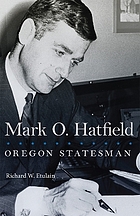
"Focusing on Mark O. Hatfield as a force in Oregon politics, this brief biography explores the evolution of this moderate Republican politician from his upbringing to his election to the Oregon House of Representatives in 1950, then through his service as an Oregon state senator and as Oregon's secretary of state, governor for two terms, and United States senator for five terms"-- Provided by publisher xv, 212 pages : illustrations ; 22 cm. CIRC [ 0 ]
|
2021 |
|
The York Factory Express Fort Vancouver to Hudson Bay, 1826-1849 by Nancy Marguerite Anderson 
"Every March between 1826 and 1854, the York Factory Express began its journey from the Hudson's Bay Company's headquarters on the Pacific Ocean. From Fort Vancouver, the express-men paddled their boats up the Columbia River to the base of the Rocky Mountains at Boat Encampment, a thousand miles to the east. At Jasper's House they were 3,000 feet above sea level. Their river route would return them to salt water once more, at York Factory, on the shores of Hudson Bay. It was an amazing climb and an amazing descent, and they would do another climb and descent on their journey home. The stories of the York Factory Express, and of the Saskatchewan Brigades they joined at Edmonton House, are told in the words of the Scottish traders and clerks who wrote the journals. However, the men who made the journey possible are the invisible, unnamed Canadiens, Orkney-men, Iroquois, and their Métis children and grand-children, who powered the boats across the continent every year. The voyageurs did all the heavy work and were almost entirely responsible for the success of the 5,400-mile journey. But their history was oral. If the traders had not preserved the stories the voyageurs told them, we would not know this history today."-- Provided by publisher 295 pages, 24 unnumbered pages of plates : illustrations, maps ; 23 cm CIRC [ 0 ]
|
2021 |
|
Leveraging an empire settler colonialism and the legalities of citizenship in the Pacific Northwest by Jacki Hedlund Tyler 
"Leveraging an Empire examines the process of settler colonialism in the developing region of Oregon through an evaluation of Oregon's exclusionary laws between the years 1841 and 1859"-- Provided by publisher xxx, 382 pages : illustrations ; 24 cm CIRC [ 0 ]
|
2021 |
|
The warden's son growing up at the Idaho State Penitentiary by Jerry Clapp 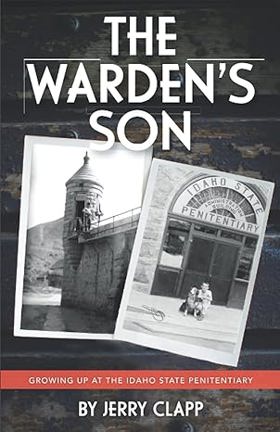
"When Jerry Clapp’s father became warden of the Idaho State Penitentiary in 1945, the young boy quickly learned the rules and boundaries of roaming one of the most dangerous grounds in the West. Through his school years, Jerry would become the confidante to many a wild tale from friendly inmates—an old man serving life for multiple assassinations, a beautiful teenager in the women’s prison, and an incarcerated war hero who became a lifelong role model. These are the stories Jerry would tell his grandchildren—from chilling recollections of riots, escapes, and hangings to the profound remembrances of inmates, guards, and the warden. This fascinating “family portrait” truly brings the Old Idaho Penitentiary roaring back to life" -- from publisher 151 pages : illustrations ; 22 cm CIRC [ 0 ]
|
2021 |
|
Coming home to Nez Perce country the Niimíipuu campaign to repatriate their exploited heritage by Trevor James Bond 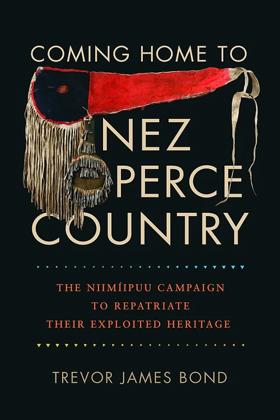
Missionary Henry Spalding shipped two barrels of "Indian curiosities" to Ohio in 1847. The author delves into the story of the exquisite Nez Perce shirts, dresses, baskets, and horse regalia, the tribe's grassroots campaign to restore their exploited cultural heritage, and the ethics of acquiring and selling Native cultural history- In 1847, two barrels of “Indian curiosities” were shipped by missionary Henry Spalding to Dr. Dudley Allen in Kinsman, Ohio. The items inside included exquisite Nez Perce shirts, dresses, baskets, and horse regalia—some decorated with porcupine quills and others with precious dentalium shells and rare elk teeth. Donated to Oberlin College in 1893 and transferred to the Ohio Historical Society (OHS) in 1942, the Spalding-Allen Collection languished in storage until Nez Perce National Historic Park curators rediscovered it in 1976. The OHS loaned most of the artifacts to the National Park Service, where they received conservation treatment and were displayed in climate-controlled cases. Josiah Pinkham, Nez Perce cultural specialist, notes that they embody “the earliest and greatest centralization of ethnographic objects for the Nez Perce people. You don’t have a collection of this size, this age, anywhere else in the world.” Twelve years later, the OHS abruptly recalled the collection, but after public pressure and extended negotiations, agreed to sell the articles to the Nez Perce at their full appraised value of $608,100 and a six-month deadline. The tribe formed the Nez Perce Heritage Quest Alliance and mounted a brilliant grassroots fundraising campaign. One day before the deadline, they met their goal. The author draws on interviews with Nez Perce experts and extensive archival research to tell the Spalding-Allen Collection story. He also examines the ethics of acquiring, bartering, owning, and selling Native cultural history, as Native American, First Nation, and Indigenous communities continue their efforts to restore their exploited cultural heritage from collectors and museums—pieces that are living, breathing, intimately connected to their home region, and inspirational for sustaining cultural traditions.- Provided by publisher 206 pages : illustrations (chiefly color) ; 23 cm CIRC [ 0 ]
|
2021 |
|
Mount Rainier National Park an artist's tour by Molly Hashimoto (Author, Illustrator) 
"Illustrated with Molly Hashimoto's color sketches and watercolors, 'Mount Rainier National Park: An Artist's Tour' is a personal account of some of the human and natural history and flora and fauna found in the areas that are accessible via the main roads that encircle Mount Rainier National Park"-- Provided by publisher 131 pages : color illustrations ; 17 x 21 cm CIRC [ 0 ]
|
2021 |
|
Manzanita, Nehalem, and Wheeler by Mark Beach , Nehalem Valley Historical Society 
"Manzanita, Nehalem, and Wheeler are three villages in Oregon that function as one community. Located in the Nehalem Bay area of Oregon's Pacific coast, they share many essential services while maintaining different personalities as cities. The Nehalem Bay area includes Oswald West and Nehalem Bay State Parks, Neahkahnie Mountain, and a large bay where the Nehalem River enters the ocean. A few hardy souls made this area--the last part of the coast to be settled--in north Tillamook County their home starting in the 1870s. The new residents used industries such as dairy, logging, and tourism to harness the natural resources of their picturesque surroundings and develop their communities. Organizations such as the Pine Grove Community Club, the North County Recreation District, and the Hoffman Center for the Arts are just a few of the reasons these three villages attract thousands of tourists and visitors every year"-- Publisher's website 127 pages : illustrations, maps, portraits ; 24 cm. CIRC [ 0 ]
|
2021 |
|
Urban Cascadia and the pursuit of environmental justice by Nik Janos , Corina McKendry 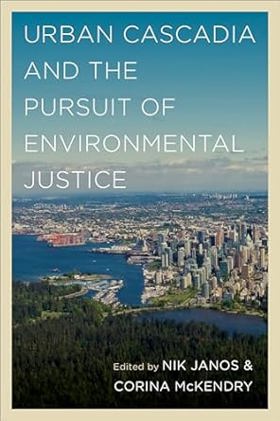
How histories of environmental inequalities and settler colonialism undercut a famously “green” region. In Portland’s harbor, environmental justice groups challenge the EPA for a more thorough cleanup of the Willamette River. Near Olympia, the Puyallup assert their tribal sovereignty and treaty rights to fish. Seattle housing activists demand that Amazon pay to address the affordability crisis it helped create. Urban Cascadia, the infrastructure, social networks, built environments, and non-human animals and plants that are interconnected in the increasingly urbanized bioregion that surrounds Portland, Seattle, and Vancouver, enjoys a reputation for progressive ambitions and forward-thinking green urbanism. Yet legacies of settler colonialism and environmental inequalities contradict these ambitions, even as people strive to achieve those progressive ideals. In this edited volume, historians, geographers, urbanists, and other scholars critically examine these contradictions to better understand the capitalist urbanization of nature, the creation of social and environmental inequalities, and the movements to fight for social and environmental justice. Neither a story of green disillusion nor one of green boosterism, Urban Cascadia and the Pursuit of Environmental Justice reveals how the region can address broader issues of environmental justice, Indigenous sovereignty, and the politics of environmental change. vii, 296 pages : illustrations, maps ; 24 cm CIRC [ 0 ]
|
2021 |
|
Pushed out contested development and rural gentrification in the US West by Ryanne Pilgeram 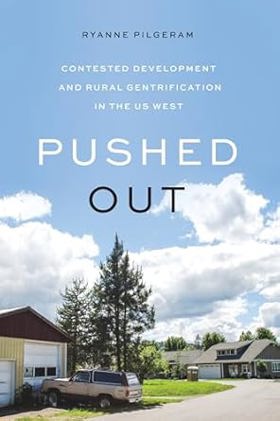
"What happens to rural communities when their traditional economic base collapses? When new money comes in, who gets left behind? Pushed Out offers a rich portrait of Dover, Idaho, whose transformation from "thriving timber mill town" to "economically depressed small town" to "trendy second-home location" over the past four decades embodies the story and challenges of many other rural communities. Sociologist Ryanne Pilgeram explores the structural forces driving rural gentrification and examines how social and environmental inequality are written onto these landscapes. Based on in-depth interviews and archival data, she grounds this highly readable ethnography in a long view of the region that takes account of geological history, settler colonialism, and histories of power and exploitation within capitalism. Pilgeram's analysis reveals the processes and mechanisms that make such communities vulnerable to gentrification and points the way to a radical justice that prioritizes the economic, social, and environmental sustainability necessary to restore these communities"-- Provided by publisher xv, 194 pages : illustrations (black and white), maps (black and white) ; 24 cm CIRC [ 0 ]
|
2021 |
|
Hiking Washington's history by Judith M Bentley , Craig Romano 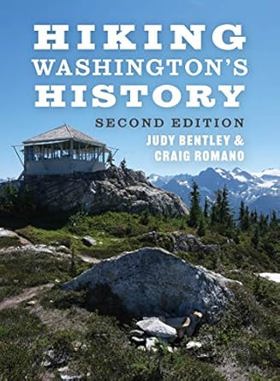
"For thousands of years people have traveled across Washington's spectacular terrain, establishing footpaths and roads to reach hunting grounds and coal mines high in the mountains, fishing sites and trade emporiums on the rivers, forests of old growth, and homesteads and towns on prairies. These traditional routes have been preserved in national parks, restored by cities and towns, salvaged from old railroad tracks, and opened to hikers by Indigenous communities. In this new, full-color edition of the first-ever hiking guide to650 the state's historic trails, historian and hiker Judy Bentley teams up with veteran guidebook author Craig Romano to lead adventurers of all abilities along trails on the coast, over mountains, through national forests, across plateaus, and on the banks of the Columbia River. Features include: 44 hikes, including 12 new additions Full-color trail maps A trails timeline that connects hikes to key events Updated trail descriptions Accounts from diaries, journals, and archives Historical overviews of 8 regions of the state Contemporary and historical photographs Bentley and Romano offer an essential boots-on-the ground history of some of the state's most fascinating places"-- Provided by publisher 336 pages : illustrations, maps ; 19 cm CIRC [ 0 ]
|
2021 |
|
The weather of the Pacific Northwest by Cliff Mass 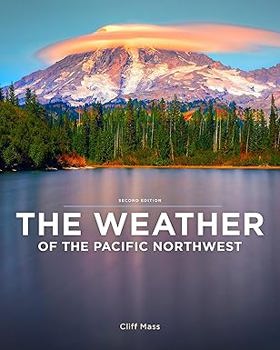
""Fridays at ten of four is when we listen to our favorite person ever, Cliff Mass. If you don't know who Cliff Mass is, well, he's this thing me and Mom have, this awesome weather geek who loves weather so much you have no choice but to love him in return." - from Maria Semple's novel, Where'd You Go, Bernadette? This is a lavishly illustrated guide to making sense of the region's unique atmospheric and geographic forces. For the new edition of this contemporary classic, Cliff Mass has extensively revised and updated, as well as expanding his coverage of British Columbia as well as considering the impact of wildfires on the region's meteorology. A fascinating read, the book is indispensable to anyone who seeks a deeper understanding of the region's is weather"-- Provided by publisher ix, 299 pages : illustrations (chiefly color), maps (chiefly color) ; 26 cm CIRC [ 0 ]
|
2021 |
|
Saving the Willamette a history of Oregon heartland river by Joe R. Blakely 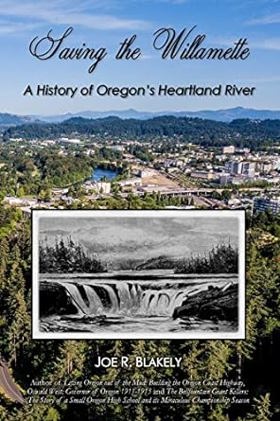
"This is the story of the Willamette River from its birth to the 21st century. Confined in the Willamette Basin, the river has been a way of life for valley inhabitants. From early Native Americans to modern man the river has been a vital source of nourishment, floods, steamboats, agriculture, pollution, conservation, and recreation. In the mid-20th century pollution reigned. Governors McCall and Straub fought for a clean river, and the Willamette Greenway-a strip of land 150 feet wide on both banks of the Willamette from Eugene to Portland. Farmers fought that plan which resulted in a 1970s compromise. That solution still exists today."--Back cover 167 pages : illustrations ; 23 cm CIRC [ 1 ]
|
2020 |
|
Silver rush British Columbia's silvery Slocan, 1891-1900 by Peter J. Smith 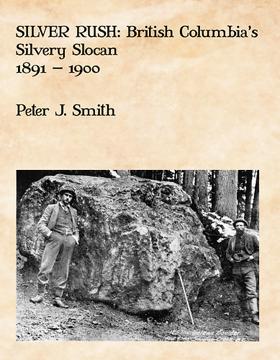
Silver Rush tells the story of British Columbia’s “Silvery Slocan.” In the 1890s, mining camps like Sandon, Three Forks, Whitewater and their neighbours; New Denver, Silverton, Slocan City, Kaslo and Nakusp, thrived. Once the most productive mining region in British Columbia, prospectors and miners came from Idaho, Montana and other mining centres to reap the silver harvest. Capitalists flooded in from Spokane, Seattle, Vancouver, and investment centres across North America and the world. Plummeting silver prices, labour troubles and the Klondike gold rush eventually put an end to the silver rush but the legacy of that rush endures to this day. vi, 642 pages : illustrations (some colour), maps ; 28 cm CIRC [ 0 ]
|
2020 |
|
The final voyage of the Valencia by Michael C. Neitzel 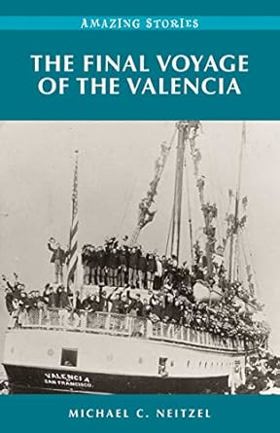
"A dynamic retelling of the deadly 1906 sinking of the SS Valencia off the southwest coast of Vancouver Island, one of the worst maritime disasters in Canadian history. There are few places on earth that have such a high record of marine casualties as the short yet treacherous stretch of coastline known as the Graveyard of the Pacific. In the late nineteenth and early twentieth century, the fifty-six kilometres between Port Renfrew and Cape Beale off Vancouver Island saw dozens of shipwrecks and claimed hundreds of lives. On a blustery night in late January 1906, the steamship SS Valencia, heading from San Francisco to Seattle and Victoria, met its tragic fate on the rocks near Pachena Point. With over one hundred passengers and sixty-five crew members on board, only thirty-seven people survived the wreck. All of the women and children perished. With journalistic precision, compassion for the victims, and condemnation for those who neglected to prevent the tragedy, author Michael C. Neitzel recounts the Valencia's ill-fated final voyage, drawing heavily on first-hand accounts of the survivors and witnesses. The Final Voyage of the Valencia is a must-read for anyone interested in the maritime history of Canada's west coast."-- Provided by publisher 139 pages : illustrations, map ; 22 cm CIRC [ 0 ]
|
2020 |
|
Landscapes of injustice a new perspective on the internment and dispossession of Japanese Canadians by Jordan Stanger-Ross 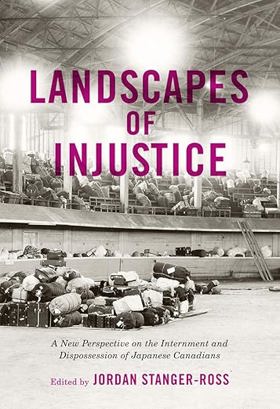
"In 1942, the Canadian government forced more than 21,000 Japanese Canadians from their homes in British Columbia. They were told to bring only one suitcase each and officials vowed to protect the rest. Instead, Japanese Canadians were dispossessed, all their belongings either stolen or sold. The definitive statement of a major national research partnership, Landscapes of Injustice reinterprets the internment of Japanese Canadians by focusing on the deliberate and permanent destruction of home through the act of dispossession. All forms of property were taken. Families lost heirlooms and everyday possessions. They lost decades of investment and labour. They lost opportunities, neighbourhoods, and communities; they lost retirements, livelihoods, and educations. When Japanese Canadians were finally released from internment in 1949, they had no homes to return to. Asking why and how these events came to pass and charting Japanese Canadians' diverse responses, this book details the implications and legacies of injustice perpetrated under the cover of national security. In Landscapes of Injustice the diverse descendants of dispossession work together to understand what happened. They find that dispossession is not a chapter that closes or a period that neatly ends. It leaves enduring legacies of benefit and harm, shame and silence, and resilience and activism."-- Provided by publisher ix, 501 pages : illustrations ; 25 cm. CIRC [ 0 ]
|
2020 |
|
Facing the world defense spending and international trade in the Pacific Northwest since World War II by Christopher P. Foss 
"Before the Second World War, the states of Washington and Oregon were thinly populated economic backwaters of the United States. Even the major cities of Portland and Seattle were dependent on agricultural industries, especially timber, for their economic health. That all changed during World War II and the Cold War. By the dawn of the twenty-first century, the Pacific Northwest boasted a more diversified economy. Beer, tourism, and high tech moved in alongside timber and wheat as the region's mainstay industries. In Washington, especially, a Cold War-driven military and national security state set up shop as an economic behemoth even as debates over the costs and consequences of the new Atomic Age raged. Facing the World highlights these changes, as well as the politicians, business leaders, and ordinary people who helped bring them about. At the center of the story, Senators Henry Jackson, Wayne Morse, Slade Gorton, and Mark Hatfield; Congressman Tom Foley; and Governor Vic Atiyeh worked diligently for a generation to transform the region from insular and backward to cosmopolitan and forward-looking. Aligning the region with national security and international trade policies, these politicians made the Pacific Northwest economy what it is today. Through extensive research in congressional and federal archives, historian Christopher P. Foss vividly brings to life the discussions, conflicts, and controversies that shaped this political era. Though it wasn't perfect, its fading legacy of leadership is a lesson for our own time. Facing the World will prove a valuable resource to historians, political scientists, and civic-minded residents of the Pacific Northwest"-- Provided by publisher x, 338 pages : illustrations, maps ; 23 cm CIRC [ 0 ]
|
2020 |
|
The big run life aboard a salmon seiner by Ray Fadich 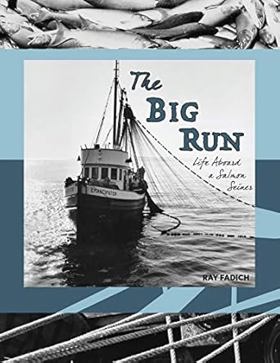
"The mighty salmon runs that worked their way through Puget Sound each season on their way to British Columbia's Fraser River provided a way of life for fishermen in the Pacific Northwest for more than a century. Commercial gillnetters and purse seiners pursued millions of Sockeye salmon each season hoping to harvest a portion of the massive schools of fish that migrated through the region each season. It was demanding, and often dangerous work, but the knowledgeable captain and crew could hit it big by being in the right place at the right time to capitalize on this natural bonanza. In 1958, when captain Nick Foreigner Barhanovich hired greenhorn Ray Fadich to work as a skiffman on Barhanovich's purse seiner, The Emancipator, Fadich had little clue of what that fishing season would hold for him. As the newest member of the Emancipator's crew Fadich had to deal with a steep learning curve, days of backbreaking physical labor, and the practical jokes and daily initiation into the brotherhood of the commercial fisherman that came with the territory."--Amazon iii, 89 pages : illustrations, map ; 28 cm CIRC [ 0 ]
|
2020 |
|
Polly Bemis the life and times of a Chinese American pioneer by Priscilla Wegars , Asian American Comparative Collection (University of Idaho Laboratory of Anthropology) (Publisher), Caxton Press (Caldwell, Idaho) (Publisher) 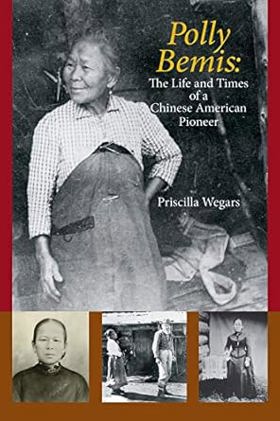
"Polly Bemis, the mistakenly named 'Lalu Nathoy' of books and film, was forcibly brought to the United States, and to Idaho Territory, in 1872 when she was just eighteen. In 1894 she married a Euroamerican man, Charlie Bemis, and they moved to a mining claim on the remote Salmon River; Charlie died in 1922 and Polly died in 1933. Since her death, Polly Bemis's life has been greatly romanticized. Supposedly, she was a prostitute, 'Hong King' was her Chinese owner, and Charlie Bemis 'won her in a poker game.' Not one of these statements is true. Polly's life was genuinely fascinating, and it is time to both celebrate the known facts about her and allow the stereotypical, undocumented legends to die out"--Provided by publisher xxvi, 529 pages : illustrations, maps ; 23 cm. CIRC [ 0 ]
|
2020 |
|
Idaho rocks! a guide to geologic sites in the Gem State by Reed S. Lewis , John Burch , Mark D. McFaddan , Chelsea McRaven Feeney 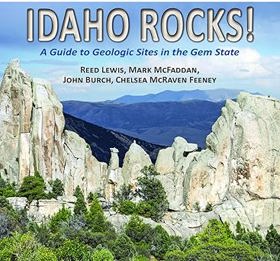
"To discover the unworldly geologic novelties of the Gem State, all that is required is a good map, a sense of adventure, and Idaho Rocks!, a guide to 60 of the most compelling geologic sites in Idaho. The well-chosen destinations span the state's geologic history from the 2.6-billion-year-old gneiss in the Panhandle to 2,000-year-old lava at Craters of the Moon, and from gold and silver deposits hidden in Idaho's mountains to visible scars from recent earthquakes and landslides. With its beautiful photographs and informative figures and maps, this guidebook will get you up to speed on every aspect of Idaho's diverse geology"-- Provided by publisher v, 153 pages : color illustrations, color maps ; 22 cm. CIRC [ 0 ]
|
2020 |
|
The port of missing men Billy Gohl, labor, and brutal times in the Pacific Northwest by Aaron Goings 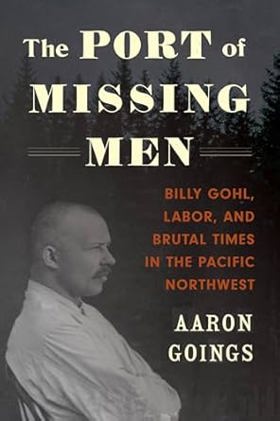
"The true story behind a labor leader reputed to be a serial killer. Aaron Goings offers a vivid biography of Billy Gohl (1873-1927), a prominent union official in Grays Harbor, Washington who came to be known for killing dozens of people, maybe even more than one hundred. In a cruel twist, many victims were his union members. "These anonymous dead men, culled from the hordes of migrant laborers who had flocked to Grays Harbor to cut trees, came to be known as the floater fleet. Billy Gohl was credited with launching most of them," Murray Morgan wrote in The Last Wilderness: A History of the Olympic Peninsula. "If he was responsible for even half of the floaters found in the harbor during his day, Gohl was America's most prolific murderer. Over a ten-year period the fleet numbered 124." A union leader turned serial killer? As a labor historian, author Aaron Goings felt compelled to get to the bottom of the story. So he dug into the archives. In this popular biography, Goings uses Gohl's life to illuminate the brutal nature of everyday life in that era: the Yukon gold rush, the brutally dehumanizing lives of sailors and loggers, and the heated clashes between pro- and anti-union forces in Grays Harbor, the world's busiest lumber shipyard, where millions of dollars were at stake. Goings carefully examines court records and other archival sources to sort through the lore and legends surrounding Gohl, painting the story of a violent man in a violent time who did kill someone-maybe even more than one-but comes almost comically short of his storied reputation. Why did people believe such outrageous things about Gohl, then and now? And where did all those dead bodies come from? Goings shows how powerful economic players help build the myth of "Gohl the Ghoul" to undercut the credibility of union advocates. By pinning all these deaths on one man and building up the story of an extreme pathology, no one had to confront the structural violence of capitalism. The resulting book is not a grisly true crime tale; but an equally intriguing mystery about the creation of myth and the cost in human bodies in the making of the Pacific Northwest"-- Provided by publisher xiv, 277 pages : illustrations ; 24 cm CIRC [ 0 ]
|
2020 |