Catalog of British Columbiana and Pacific Northwest Americana
Encyclopedia Cascadia Catalog contains book titles of mostly non-fiction Pacific Northwest Coast of North America Titles (primarially British Columbia, Idaho, Oregon and Washington State) in an easy-to-understand title catalog. If you see a link with this badge ONLINE CIRC it means that there is an online institution that provides free access to that title. In some cases there may be more than one institution hosting the title digitally.
| Catalog Title | Published |
|---|---|
|
The Oregonian railway by Ed Austin 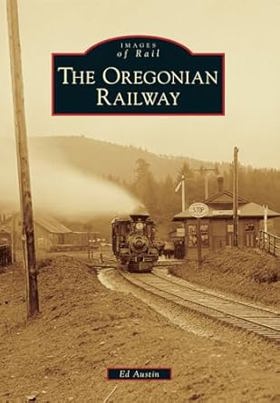
To those with an interest in railroad history in the United States, mention of the words "narrow gauge" may bring to mind the extensive three-foot-gauge railroads of Colorado and Utah or perhaps the famous two-foot-gauge lines in Maine. However, few would think first of Oregon and the Pacific Northwest. Nonetheless, between 1877 and 1893, an extensive narrow-gauge railroad developed in Oregon" one that had aspirations of crossing the Cascade Mountains and connecting with the Central Pacific Railroad, thus giving Oregon its first access to the transcontinental railroad system. It is this railroad system, from its inception in 1877 to the present day, that Ed Austin explores herein. 127 pages : illustrations, maps ; 24 cm. CIRC [ 0 ]
|
2014 |
|
The Oregon weather book a state of extremes by George H. Taylor, Raymond R. Hatton 
Oregonians are nuts for weather. They're hungry for weather news, anecdotes, statistics, trivia, and, of course, forecasts. The Oregon Weather Book will whet Oregonians' insatiable appetite. A comprehensive and fact-filled resource for anyone who watches, studies, enjoys, or simply endures Oregon weather, this book offers a history of significant weather events and a guide to the forces that create and govern our weather. The authors consider perceptions (and misperceptions) about Oregon weather by residents and outsiders, including the origins of the term, "webfoot." An invaluable reference, The Oregon Weather Book is intended for all Oregonians, from die-hard weather watchers and professionals to those who look to the skies to make recreation, travel or business plans. Tips on interpreting atmospheric conditions will allow amateur forecasters to analyze and predict weather with greater accuracy. xiv, 242 pages : illustrations ; 26 cm CIRC [ 0 ]
|
1999 |
|
The Oregon water handbook a guide to water and water management by Rick Bastasch 
"To make a long story short, Oregon's out of easy water." So begins this timely look at how water is managed in Oregon. Rick Bastasch's in-depth examination of Oregon's water law and water issues provides a compelling perspective on a major environmental issue in the American West - the region's diminishing water supply. Starting with answers to the questions of where Oregon's water comes from and how much there really is, The Oregon Water Handbook explores how these water resources are used and what that has meant for Oregon - its people, environment, and economy. Bastasch offers thorough yet accessible explanations of a variety of water issues and controversies, bringing focus and clarity to a murky, complex subject. The book also features a comprehensive index to Oregon's water laws, a detailed listing of the state's water regulations cross-referenced to appropriate agencies, and a glossary of water terms. The handbook offers a key to understanding how we use this precious and scarce resource. It will be valuable to a range of readers, from Oregonians seeking interesting facts about their state's water riches to water specialists and users in need of a handy reference to Oregon's water law. viii, 352 pages : illustrations, maps ; 23 cm CIRC [ 0 ]
|
2006 |

The book covers the period from the early exploration of the region by European explorers to the signing of the Convention of the Escurial in 1846, which settled the territorial dispute between the United States and Great Britain. The book begins by providing an overview of the geography and natural resources of the region, including the Columbia River and its tributaries, the Cascade Mountains, and the fertile Willamette Valley. It then delves into the early exploration and settlement of the territory by Spanish, Russian, and British explorers and traders, as well as the interactions between these groups and the native tribes of the region.The book also covers the territorial dispute between the United States and Great Britain, which began in the early 19th century and was finally resolved by the Convention of the Escurial in 1846. The convention established the 49th parallel as the border between the United States and British North America, and granted the United States control over the Oregon Territory. 264, iv pages + 24 pages publisher's catalogue ; 21 cm ONLINE CIRC [ 1 ]
|
1846 |
|
The Oregon territory by C. G. Nicolay, Robert Hitchman (Writer of introduction)
|
1967 |
|
The Oregon question by Albert Gallatin
Published in 1846 at the height of the border crisis, Albert Gallatin’s The Oregon Question is a masterful diplomatic treatise advocating for a peaceful resolution to the fierce territorial dispute between the United States and Great Britain. Writing in direct opposition to the aggressive "Fifty-four Forty or Fight" expansionists, the elderly statesman systematically reviewed decades of treaties, geographic surveys, and international law to argue for a pragmatic partition of the Pacific Northwest. A keen insight drawn from the text is how Gallatin effectively weaponized his own unparalleled institutional memory—having personally negotiated the original 1818 joint occupation agreement—to expose the legal frailty of America's maximum territorial claims and demonstrate that a compromise at the 49th parallel was the only sound outcome. Ultimately, this rigorous pamphlet served as a crucial voice of reason that helped defuse jingoistic war fever and provided the exact diplomatic blueprint later adopted in the 1846 Oregon Treaty. 75 pages ; 23 cm ONLINE CIRC [ 1 ]
|
1846 |
|
The Oregon question essays in Anglo-American diplomacy and politics by Frederick Merk
|
1967 |
|
The Oregon desert by E. R. Jackman, R. A. Long 
xiii, 407 pages : illustrations (some color) facsimile, map (on lining papers), portraits ; 24 cm CIRC [ 0 ]
|
1964 |
|
The Oregon country under the Union Jack a reference book of historical documents for scholars and historians by B. C. Payette, Alexander Henry
|
1962 |
|
The Oregon constitution and proceedings and debates of the Constitutional Convention of 1857 by Oregon, Charles Henry Carey , Oregon Historical Society (Issuing body), Oregon Constitutional Convention (1857)
Edited by prominent jurist and historian Charles Henry Carey and published by the Oregon Historical Society in 1926, The Oregon Constitution and Proceedings and Debates of the Constitutional Convention of 1857 serves as the definitive legal archive of the state's founding legislative assembly. The massive volume meticulously compiles the daily transcripts, committee reports, and fierce political arguments that culminated in Oregon's 1857 constitution, capturing the territory's transition to formal statehood. The detailed records highlight the pressing political concerns of the pioneer delegates: state finance, the regulation of corporations, and, most prominently, the deeply contested issues of slavery, suffrage, and racial exclusion in the looming shadow of the Civil War. A keen insight drawn from the work is how the archive explicitly exposes the foundational legal architecture of the state as a meticulously engineered white supremacist project. By preserving the raw, unvarnished debates of the delegates, the text inadvertently shatters the myth of the pioneer as a purveyor of universal democratic liberty; instead, it reveals how the architects of Oregon statehood utilized the highest form of democratic bureaucracy to systematically codify racial exclusion—most notably through the infamous constitutional clause banning free Black people from the state, alongside strict prohibitions denying suffrage and property rights to Native Americans and Chinese immigrants. The preservation and publication of these proceedings in the 1920s subtly institutionalized this exclusionary heritage, framing the calculated legal construction of a white utopia not as a profound moral failure, but as a sober, deliberate act of frontier statesmanship. 543 pages : facsimile ; 24 cm CIRC [ 1 ]
|
1926 |
|
|
1981 |
|
The Olympic seashore by Ruth Kirk, Olympic Natural History Association, United States National Park Service
|
1962 |
|
The Official Illustrated Orcas-American Dictionary and Phrase Book and Gazetteer by Mike & Maxim Hurwicz 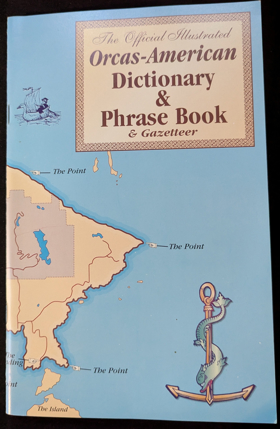
Authored by Mike and Maxim Hurwicz, The Official Illustrated Orcas-American Dictionary and Phrase Book and Gazetteer presents a witty, satirical lexicon capturing the distinct cultural quirks, local geography, and insider vernacular of Orcas Island in Washington's San Juan archipelago. Through humorous definitions, phrase guides, and custom illustrations, the book lampoons the everyday realities of ferry schedules, rainwater catchment systems, and the peculiar friction between lifelong islanders and seasonal newcomers. The text uses self-deprecating humor to decode the unwritten social codes of a fiercely independent, geographically isolated community. A keen insight drawn from the work is how regional dialects and specialized humor serve as cultural gatekeeping tools in rapidly gentrifying rural areas; by codifying local jargon into a satirical dictionary, island residents establish a linguistic boundary that playfully rebuffs outsiders while reinforcing a shared, resilient identity. 17 pages : portrait CIRC [ 1 ]
|
1997 |
|
The nude beach notebook by Barbara J. Scot 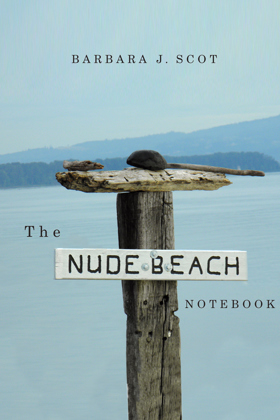
"In this engaging new memoir, a loose sequel to her earlier Prairie Reunion, Barbara J. Scot explores her reluctance and longing to reconnect with a much-loved brother, lost to alcoholism for thirty years. Scot uses long, meditative walks on the 'clothing optional' beach of the idyllic Sauvie Island near Portland, Oregon, to explore family responsibility, time' passage, and faith. She weaves entries from her notebook--a record of the island's wildlife, descriptions of the "Odd Ones" she encounters on the beach, and stories about the native people who once lived on the river--with the main narrative, tracing her search for her brother, her close friendship with a fellow writer, and daily life on the moorage. Scot considers the uses of fiction and non-fiction in memory as well as in writing, the brevity and beauty of human existence, and the inscrutable, enduring mystery of death"--Provided by publisher 198 pages ; 23 cm CIRC [ 0 ]
|
2014 |
|
The notorious Georges crime and community in British Columbia's northern interior, 1909-25 by Jonathan Swainger 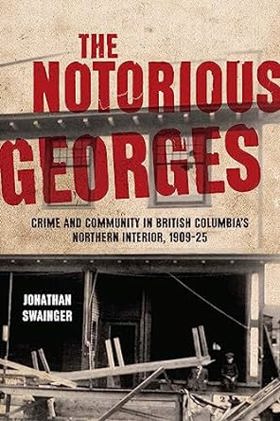
"Boozy and boisterous. The Georges--the communities of South Fort George and Fort George that ultimately became Prince George--have had a seedy reputation since before the First World War, branded Canada's "most dangerous city" more than once. Is Prince George really such a bad lad? The Notorious Georges takes another look, exploring how the local pursuit of respectability collided with caricatures of a riotously ill-mannered settlement frontier in its early years. Anxious that the Georges were being overlooked by the provincial government and venture capitalists, municipal leaders blamed Indigenous and mixed-heritage people, non-preferred immigrants, and transient laborers for local crime. Jonathan Swainger combs through police and legal records, government publications, and media commentary to demonstrate that the reputation was not only exaggerated but also unfair. Repeatedly cast as the bad apple, there was actually little to distinguish the Georges from the rest of a province that was admittedly a truculent place before the 1930s. And "respectable" white residents were responsible for the lion's share of the disorder. This lively account ultimately tells us about more than a particular community's identity. It also sheds light on small-town disaffection and unease with a diminished place in modern Canada."-- Provided by publisher xix, 288 pages : illustrations, maps ; 23 cm. CIRC [ 0 ]
|
2023 |
|
The Northwest salmon crisis a documentary history by Joseph Cone , Sandy Ridlington 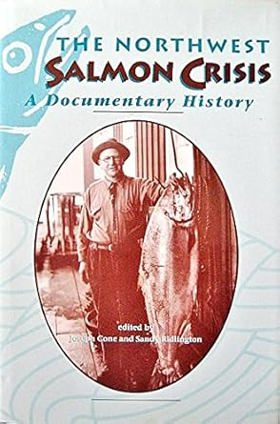
This acclaimed volume offers a key to understanding the historic roots of one of today's most closely watched environmental issues, the fate of salmon in the Pacific Northwest. The history of the current salmon crisis is long and disturbingly consistent, with concern over declining salmon runs beginning in the 1800s. This book focuses on the human actions--and failures to act--that have helped drive many wild salmon stocks in the Pacific Northwest to the brink of extinction. For this first documentary history of the salmon crisis, knowledgeable observers of salmon history have chosen and commented upon the documents that they feel most clearly reveal the causes and implications of today's crisis. The eighty documents span a period of 140 years and address such issues as habitat, hatcheries, dams, fisheries, Indian fishing rights, and watershed management. Together, these mileposts in the sorry journey of the salmon provide a compelling perspective on an environmental crisis of growing national concern. v, 374 pages : illustrations, maps ; 24 cm. CIRC [ 0 ]
|
1996 |
|
The Northwest gardens of Lord & Schryver by Valencia Libby , Oregon State University Press (Issuing body) 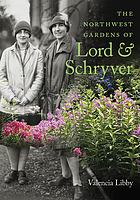
"Lord & Schryver, the first landscape architecture firm founded and operated by women in the Pacific Northwest, designed more than two hundred gardens in Oregon and Washington, including residential, civic, and institutional landscapes. Elizabeth Lord and Edith Schryver met as young women and in 1929 established their highly successful firm in Salem; their work is acknowledged as one of the milestones in the history of garden design in the Northwest and beyond. Theirs is the only Oregon firm recognized in Pioneers of Landscape Architecture, compiled by the National Park Service. The Cultural Landscape Foundation describes them as "consummate professionals in the broadest sense, as they worked to raise the profile of landscape architects by involving an audience beyond their clients. Their work represented a transition from a formal symmetrical style of garden design to one which responded in a distinctive way to the unique features of Northwest climate, soil, topography, and plant material." Gaiety Hollow, their purpose-built Salem home, garden, and studio, is now owned by the Lord & Schryver Conservancy and is open to the public. The conservancy has lovingly restored the gardens at Gaiety Hollow according to Lord & Schryver's original plans. They have also restored and now maintain the gardens at Deepwood, a former residence that is now a public park. Students of landscape architecture, garden design, Pacific Northwest history, ornamental horticulture, and general readers who are interested in the contributions of women to once male-dominated professions will find inspiration in these pages. Learn more about Elizabeth Lord and Edith Schryver at www.lordschryver.org"-- Provided by publisher xi, 220 pages, 24 unnumbered pages of plates : illustrations (some color) ; 26 cm CIRC [ 0 ]
|
2021 |
|
The Northwest coast, or, Three years' residence in Washington Territory by James Gilchrist Swan
Published in 1857, James Gilchrist Swan's The Northwest Coast provides a vivid, firsthand account of early pioneer life and indigenous culture during his three-year residence around Shoalwater Bay in the Washington Territory. The narrative details the grueling yet lucrative early oyster trade that connected the isolated coastal settlements to San Francisco, while simultaneously offering meticulous records of the daily customs, language, and social structures of the local Chinook and Chehalis tribes. A keen insight drawn from the text is how Swan's approach profoundly contrasted with the era's prevailing settler hostility; rather than viewing Indigenous peoples merely as obstacles to Manifest Destiny, he actively integrated into their communities and learned the Chinook Jargon, rendering his account an exceptionally rare and empathetic ethnographic record of pre-reservation coastal life. Ultimately, the book stands as an indispensable primary source that captures the complex, interdependent, and multicultural reality of the Pacific Northwest frontier before large-scale American colonization fundamentally altered the region. xxiii, 435 pages : illustrations ; 21 cm ONLINE CIRC [ 1 ]
|
1857 |
|
The Northwest Coast British navigation, trade, and discoveries to 1812 by Barry M. Gough 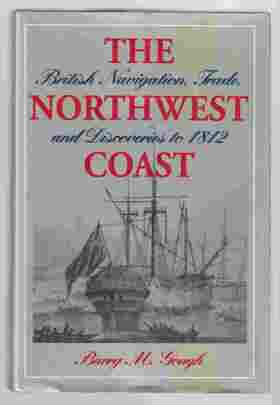
"The Northwest Coast was irrevocably changed the day that Captain James Cook sailed into Nootka Sound in 1778. Cook's discovery of the sea otter population along the coast initiated the maritime fur trade, which in turn led to feverish competition among several nations, especially Britain, Russia, and the United States, as well as the celebrated rivalry between Spain and Britain for control of Nootka. By 1812, a toehold of British empire was established, and the aboriginal way of life was shattered." "The Northwest Coast documents Britain's rise to pre-eminence in this far-flung corner of empire. It shows how the relentless activities of its commercial interests, the adroit use of its naval power, and the steely resolve of its diplomats secured British claims to dominion and rights to trade along the Northwest Coast. Written by a leading maritime scholar and based on fresh research into all known manuscripts and printed works on Pacific trade and exploration, this book incorporates new interpretations on exploration and commercial activity in this area, significantly updating and expanding the author's award-winning book, Distant Dominion. The Northwest Coast documents the interaction, often violent, between British sailors and aboriginal people; depicts many of the rivalries among British mariners; and examines various claims to the discovery of the Northwest Passage. Gough's compelling narrative combined with his extensive use of quotations from the journals and correspondence of explorers and merchant traders provide insights into the motives and attitudes of these early pioneers of empire."--Jacket 1 online resource (xiv, 265 pages, 8 unnumbered pages of plates) : illustrations, maps CIRC [ 1 ]
|
1992 |
|
The Northern Shoshoni by Brigham D. Madsen 
Brigham D. Madsen examines four distinct groups which comprise the Northern Shoshoni, focusing on the tribe since the arrival of the first white settlers. He describes the early days on the reservation and the tribe’s struggle to adapt to massive cultural changes. 259 pages : illustrations ; 29 cm CIRC [ 0 ]
|
1980 |
|
The northern and central Nootkan tribes by Philip Drucker
Account of Indians of west coast of Vancouver Island ix, 480 pages, 6 unnumbered pages of plates (1 folded) : illustrations, maps ; 24 cm CIRC [ 1 ]
|
1951 |
|
The North Cascades Highway a roadside guide to America's Alps by Jack McLeod 
Each year thousands of drivers travel Washington State’s breathtakingly beautiful North Cascades Highway (State Route 20), observing the region’s alpine flora and fauna and its dramatic geologic features. The North Cascades Highway, an illustrated natural history guide, helps travelers and readers to appreciate the deeper beauty behind the landscape. Organized as a series of stops at eye-catching sites along eighty miles of the highway, The North Cascades Highway reveals the geological story of each location. Plate tectonics, rock formation, erosion, and glaciation are explored to show how the features of the North Cascades landscape came into being as they exist today. Human history is also included, as the book describes how miners, climbers, and poets have been inspired by the geology and terrain of the North Cascades. For travelers on the road, the easy-to-use guidebook format includes mileage, parking information, and detailed maps. Stunning color photographs allow armchair travelers to enjoy the journey as well. Appendices provide detailed information on geologic time, rock types, glaciers, and the geologists who have decoded stories hidden in rock and ice. The North Cascades Highway provides a unique experience of a striking landscape that is also a rich, interwoven system of living things, climate, and geology. xv, 104 pages : color illustrations color maps ; 29 cm CIRC [ 0 ]
|
2013 |
|
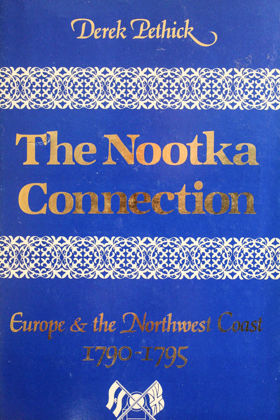
The Nootka connection Europe and the Northwest coast, 1790-1795 by Derek Pethick
|
1980 |
|
The Nootka scenes and studies of savage life by Gilbert Malcolm Sproat , Charles Lillard
|
1987 |
|
The night Bandon burned by Curt Beckham 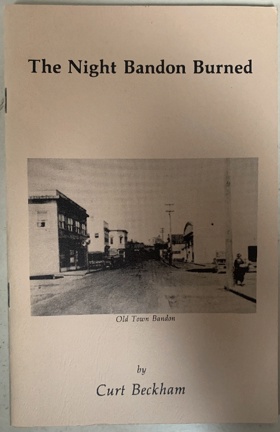
This small booklet details the disastrous fire that destroyed Bandon, Oregon on September 26, 1936. Includes several black and white photographs of the town before and after the fire. 45 pages : photographs ; 22 cm CIRC [ 1 ]
|
1985 |