Catalog of British Columbiana and Pacific Northwest Americana
Encyclopedia Cascadia Catalog contains book titles of mostly non-fiction Pacific Northwest Coast of North America Titles (primarially British Columbia, Idaho, Oregon and Washington State) in an easy-to-understand title catalog. If you see a link with this badge ONLINE CIRC it means that there is an online institution that provides free access to that title. In some cases there may be more than one institution hosting the title digitally.
| Catalog Title | Published |
|---|---|
|
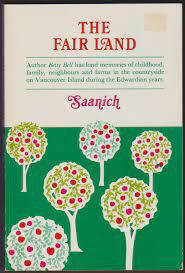
The fair land, Saanich by Betty Bell
|
1982 |
|
The faces of history Portraits of the men and women who shaped life in Boundary County, Idaho by Stan DeHart 
Authored by local historian Stan DeHart, The Faces of History: Portraits of the Men and Women Who Shaped Life in Boundary County, Idaho compiles a rich photographic and biographical archive of the pioneers, homesteaders, and laborers who carved a community out of the remote panhandle of northern Idaho. The book uses vintage portrait photography and detailed oral histories to resurrect the individual stories of those who braved isolation, harsh winters, and demanding resource industries near the Canadian border. Through these personal profiles, the text honors the human grit that transformed an untamed river valley into a permanent, functioning society. A keen insight drawn from the work is how frontier portraiture functioned as a deliberate act of civilizing permanence; by meticulously dressing up and sitting for traveling photographers, isolated homesteaders used visual self-representation to project dignity and social order onto an unforgiving wilderness that constantly threatened to swallow their hard-won achievements. Oversized paperback CIRC [ 0 ]
|
1996 |
|
The exploring expedition to the Rocky Mountains by John Charles Frémont
|
1988 |
|
The evergreen islands a history of the islands of the Inside Passage by Doris Andersen
|
1985 |
|
The Evergreen Fleet a pictorial history of Washington State Ferries by Harre W. Demoro
This book has more than 270 illustrations including maps and timetables. The complete history of the Washington State Ferry system with each route outlined and descriptions of each vessel 136 pages illustrations, maps 29 cm CIRC [ 1 ]
|
1971 |
|
The Evergreen Collection exceptional stories from across Washington State by Larry Clark , Adriana Janovich 
"While working for Washington State Magazine, eleven journalists traveled throughout the region to interview farmers, chefs, wine tasters, mountain climbers, scientists, and more. The resulting stories highlight the Evergreen State's captivating people, industries, and history, describing influential programs, cities from Aberdeen to Zillah, as well as a wide variety of trends, research, and innovative solutions"-- xiii, 273 pages : color illustrations ; 23 cm CIRC [ 0 ]
|
2023 |
|
The environmental justice William O. Douglas and American conservation by Adam M. Sowards 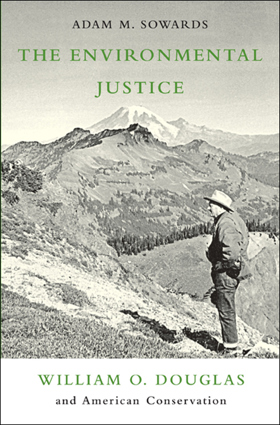
From the late 1940s to the mid-1970s, American conservation politics underwent a transformation — and Supreme Court Justice William O. Douglas was at the heart of this shift toward modern environmentalism. The Environmental Justice explores how Douglas, inspired by his youthful experiences hiking in the Pacific Northwest, eventually used his influence to reshape American conservation thought, politics, and law. One of the nation’s most passionate conservationists, Douglas wrote eloquent testimonies to the value of wilderness and society’s increasing need for it, both in his popular books and in his heartfelt judicial opinions celebrating nature and condemning those who would destroy it. He led public protests in favor of wilderness. He worked tirelessly to secure stronger legal protections for the environment, coordinating with a national network of conservationists and policymakers. As a sitting Supreme Court Justice, Douglas brought both prestige and the enormous symbolic power of legal authority to conservation crusades at a time when the nation's laws did not favor environmental protection. He understood the need for national solutions that included public involvement and protections of minority interests; the issues were nationally important and the forces against preservation were strong. In myriad situations Douglas promoted democratic action for conservation, public monitoring of government and business activities, and stronger laws to insure environmental and political integrity. x, 198 pages : illustrations, maps ; 23 cm CIRC [ 0 ]
|
2009 |
|
The enemy never came the Civil War in the Pacific Northwest by Scott McArthur 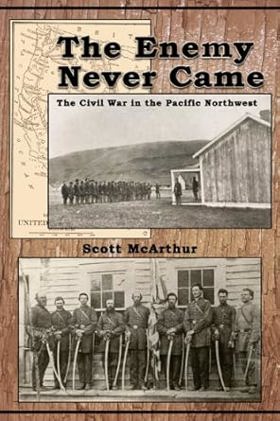
"Although the Pacific Northwest was the area furthest removed from the actual battles of the Civil War, it was nonetheless profoundly affected by the war. The Enemy Never Came examines the everyday lives of the volunteer soldiers who battled Native American renegades of the region and of the settlers who were deeply affected by the war yet unable to do much about it." - Back cover xviii, 268 pages : illustrations, map ; 23 cm CIRC [ 0 ]
|
2012 |
|
The encyclopedia of raincoast place names a complete reference to coastal British Columbia by Andrew Scott 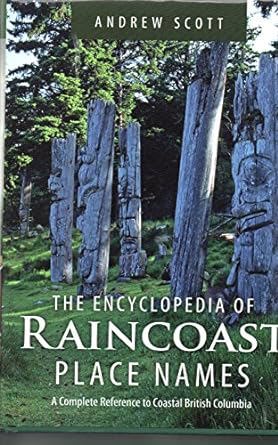
In 1909 Captain John T. Walbran published one of the most beloved and enduring of all BC books, British Columbia Coast Names. Harbour Publishing celebrates the hundredth anniversary of that landmark work by presenting the first book to update Walbran's classic, Andrew Scott's Raincoast Place Names. Like its progenitor, Raincoast Place Names is much more than simply a catalogue of name origins because it tells the often fascinating stories behind the names and in so doing serves as a history of the region in capsule form. It is also a monumental work, twice the size of Walbran's and including more than three times as many places. Four thousand entries consider, in intriguing detail, the stories behind over five thousand place names: how they were discovered, who named them and why, and what the names reveal. It describes the original First Nations cultures, the heroics of the 18th-century explorers and fur traders, the gruelling survey and settlement efforts of the 19th century, the lives of colonial officials, missionaries, gold seekers and homesteaders, and the histories of nearly every important vessel to sail or cruise the coast. 661 pages : illustrations (some color), maps, portraits ; 26 cm CIRC [ 1 ]
|
2009 |
|
The Emigrants' guide to Oregon and California by Lansford Warren Hastings
A notorious bit of historical esoterica, this 1845 handbook for travelers heading westward from the civilized United States for the freedom of the wild, unsettled frontier is remembered today mainly for its small role in one of the most horrific stories of the American West: it suggested the untried "shortcut," now known as the Hastings Cutoff, through Utah that led the Donner Party to its dreadful end. Absent the book's footnote position in the history of the West, this would still be a remarkable document of mid-19th-century America and the machinations and politicking that went into the American expansion across the continent. Written and published by Ohio-born lawyer Lansford Warren Hastings (1819-1870), it sets out glowing, idyllic descriptions of the bountiful landscapes of California and Oregon, offering almost irresistible enticements to settlers looking to make a new start. Hastings' motives were less than noble, however: he hoped to establish an independent Republic of California ... with himself as its ruler. He failed in his efforts, but the evidence of his ambition, in the form of this fascinating work, remains must reading for anyone looking for a deeper understanding of what drove the settling of the frontier ONLINE CIRC [ 1 ]
|
1845 |
|
The elusive Mr. Pond the soldier, fur trader and explorer who opened the Northwest by Barry M. Gough 
Sir Alexander Mackenzie is known to schoolchildren as a great Canadian explorer who gave his name to the country’s longest river, but hardly anyone could name the man who mentored Mackenzie and mapped much of northwestern Canada before him. Soldier, fur trader and explorer Peter Pond, the subject of this long overdue book, is a man whose legend has been forgotten in favor of those who came after him. Much of Pond’s life is shadowed in mystery. Historian Barry Gough uses Pond’s surviving memoirs, explorers’ journals, letters written by acquaintances of Pond, publications in London magazines and many other sources to track and reconstruct the life of one of the last of the tough, old-style explorers who ventured into the wilderness with little more than a strong instinct for survival and helped shape the modern world. xxv, 230 pages : illustrations, maps, portraits ; 24 cm CIRC [ 1 ]
|
2014 |
|
The Eastside story by Hugo M. Dickerman
|
1984 |
|
The early exploration of inland Washington waters journals and logs from six expeditions, 1786-1792 by Richard W. Blumenthal 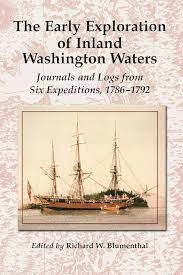
"For those armchair historians interested in the initial nautical exploration of inland Washington waters, this text is an addition to Northwest maritime history. Beginning in 1786 and continuing through 1792, The Early Exploration of Inland Washington Waters includes annotated transcriptions of all the logs and journals of the area's earliest explorers. This text follows the initial journey of John Meares, four intervening expeditions by the Spanish, and culminates with George Vancouver's voyage in 1792." vii, 214 pages ; 23 cm CIRC [ 1 ]
|
2004 |
|
The Duwamish diary, 1849-1949 by Grover Cleveland High School (Seattle, Wash) 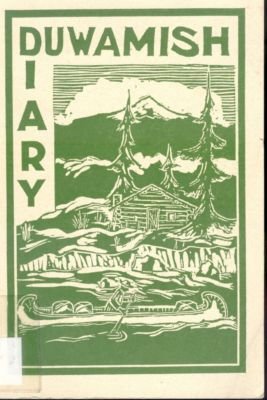
This book compiles a project originally started by a laboratory writing class of Cleveland High School in 1947. It collects an amazing amount of history from books, pamphlets, newspapers, and word-of-mouth stories about Seattle's earliest pioneers: John Holgate, Luther Collins, Henry Van Asselt, and Jacob and Samuel Maple, as well a lot of other history. If you supersize the contents pages, you should be able to read all of the entries. Generously illustrated with b/w photos and a fold-out map of the Duwamish River before and after straightening in the rear xiv, 119 pages : illustrations, maps (1 folded) ; 23 cm CIRC [ 1 ]
|
1996 |
|
|
1893 |
|
The disputed islands Ordinary life in extraordinary times the San Juans, 1850-1874 by Boyd C. Pratt 
An American farmer shoots an English pig, sparking a war over an international boundary. Explore the disputed islands through the ordinary lives of the multi-ethnic, polyglot communities that lived in the San Juans during this conflict: how these islanders make their homes, work and socialize, and resolve their differences. (from the back cover) 475 pages : illustrations, maps ; 22 cm CIRC [ 0 ]
|
2024 |
|
The deadliest Indian war in the West the Snake conflict, 1864-1868 by Gregory Michno 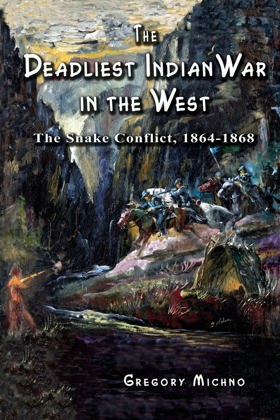
The Snake War is one of the least known of the many clashes of culture that occurred in the American West during the 19th Century. Most Americans have heard of famous chiefs like Sitting Bull, Red Cloud, Geronimo, Cochise, and Crazy Horse. Few have heard of Paulina, Weahwewa, Howluck, or Ocheho. To most people, Winnemucca is simply the name of a lonely stop on the Nevada Interstate. These were the men who led their people in a fight for survival in the Great Basin between the Rockies and the Sierras. The author gives readers the first comprehensive look at the natives, soldiers, and settlers who clashed on the high desert of Idaho, Nevada, Utah, Oregon, and Northern California in a struggle that, over a 4-year period, claimed more lives than any other Western Indian war xviii, 380 pages : illustrations, maps ; 23 cm CIRC [ 0 ]
|
2007 |
|
The Days of the Hercules by John Fahey
The title, The Days of the Hercules, is an obvious play on words. It can mean the story of the Day family or the days of the Hercules mine. This book is about both family and mine and about the first forty years of the Coeur d'Alene mining district in northern Idaho. -- adapted from jacket viii, 324 pages : illustrations, maps, portraits ; 24 cm CIRC [ 1 ]
|
1978 |
|
|
1978 |
|
The day Seattle burned June 4, 1889 by James R. Warren 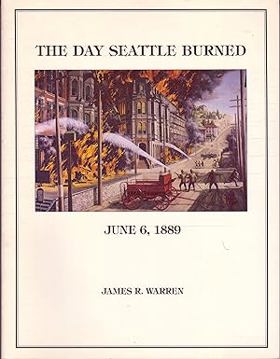
"The great fire of 1889 devoured the business heart of Seattle. The story of how it began, who actually started it, how the fire department reacted, and why the fire roared out of control make fascinating reading."--Amazon.com viewed Oct. 3, 2022 69 pages : illustrations ; 28 cm CIRC [ 1 ]
|
1989 |
|
The curve of time by M. Wylie Blanchet 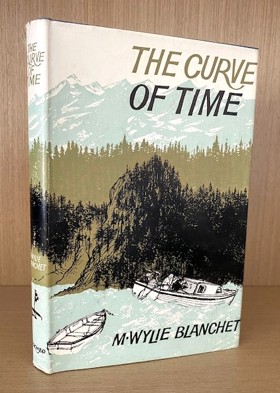
Widowed at the age of thirty-five, Muriel Wylie Blanchet packed up her five children in the summers that followed and set out aboard the twenty-five-foot Caprice. For fifteen summers, in the 1920s and 1930s, the family explored the coves and islands of the West Coast, encountering settlers and hermits, hungry bears and dangerous tides, and falling under the spell of the region’s natural beauty. Driven by curiosity, the family followed the quiet coastline, and Blanchet—known as Capi, after her boat—recorded their wonder as they threaded their way between the snowfields, slept under the bright stars and wandered through Indigenous winter villages left empty in the summer months. The Curve of Time weaves the story of these years into a memoir that has inspired generations to seek out their own adventures on the wild West Coast. First published in 1961, less than a year before the author died, Blanchet’s captivating work has become a bestselling classic of travel writing. 202 pages 22 cm CIRC [ 0 ]
|
1961 |
|
The curious passage of Richard Blanshard first governor of Vancouver Island by Barry M. Gough 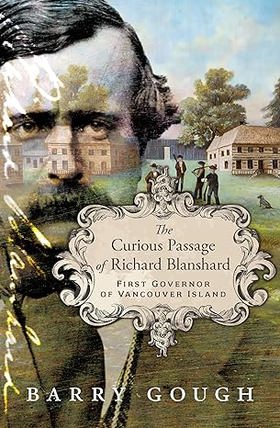
"Celebrated historian Barry Gough brings a defining era of Pacific Northwest history into focus in this biography of Richard Blanshard, the first governor of Vancouver Island--illuminating with intriguing detail the genesis and early days of Canada’s westernmost province. Early one wintry day in March 1850, after seven weary weeks out of sight of land, a well-dressed Londoner, a bachelor aged thirty-two, stood at the ship’s rail taking in the immensity of the unfolding scene. From Her Britannic Majesty’s paddlewheel sloop-of-war Driver, steadily thumping forth on Imperial purpose, all that Richard Blanshard could make out to port, in reflected purple light upon the northern side, was a forested, rock-clad island rising to considerable height. Vancouver’s Island they called it in those far-off days. This was his destination. Richard Blanshard was governor of the young colony for three short, unhappy years--only one and a half of which were spent in the colony itself. From the very beginning he was at odds with the vastly influential Hudson’s Bay Company, run by its Chief Factor James Douglas, who succeeded Blanshard as governor of the colony of Vancouver Island and later became the first governor of the colony of British Columbia. While James Douglas is remembered, for better or worse, as a founding father of British Columbia, Richard Blanshard’s name is now largely forgotten, despite his vitally important role in warning London of American cross-border aggressions, including a planned takeover of Haida Gwaii. However, his failures highlight the fascinating struggles of the time--the supreme influence of commerce, the disparity between expectations and reality, and the bewildering collision of European and Pacific Northwest culture."-- Provided by publisher 368 p. CIRC [ 0 ]
|
2023 |
|
The Cowichan Duncan, Chemainus, Ladysmith and region : including Cobble Hill, Cowichan Bay, Cowichan Lake and communities, Crofton, Glenora, Maple Bay, Mill Bay and Shawnigan Lake by Georgina Montgomery, Kevin Oke 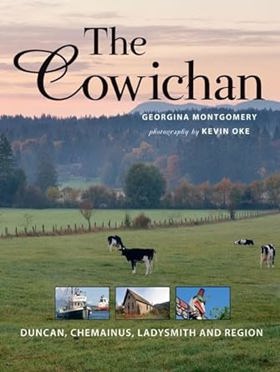
The Cowichan Region is the large area that lies between the cities of Victoria and Nanaimo on Vancouver Island, reaching from the protected eastern shores of the island nearly all the way west to the Pacific Ocean. Its cornucopia-like shape is fitting for a place of such remarkable bounty, and this area is home to a growing number of newcomers seeking its pleasant climate, recreational activities and culinary delights. Sometimes referred to as Canada's Provence, the name Cowichan is derived from a Coast Salish word meaning "warm land" or "basking in the sun." 143 pages : illustrations (chiefly color), maps, portraits ; 29 cm CIRC [ 1 ]
|
2009 |
|
The correspondence and journals of Captain Nathaniel J. Wyeth, 1831-6 a record of two expeditions for the occupation of the Oregon Country, with maps, introduction and index by F.G. Young, Nathaniel J. Wyeth
Describes the famous Battle of Pierre's Hole of that year between the Blackfeet and the trappers and their Indian allies (including the Flatheads). The second section covers Wyeth's observations camping with a Flathead camp during April and May 1833 xix, 262 pages, 3 unnumbered leaves of plates (2 folded) : maps ; 25 cm ONLINE CIRC [ 1 ]
|
1899 |
|
The Coos Bay region, 1890-1944 life on a coastal frontier by Nathan Douthit 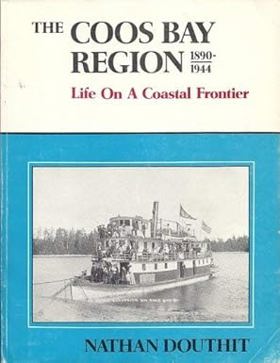
About two-thirds of the way from San Francisco Bay to the Columbia River lies Coos Bay, the larges natural harbor on the Oregon coast.... the subject of this book. It is a book about the social and economic development of a small corner of the Pacific Northwest from a coastal frontier into a major population and forest industrial center of Oregon. 163 pages : illustrations ; 28 cm CIRC [ 0 ]
|
1981 |