Catalog of British Columbiana and Pacific Northwest Americana
Encyclopedia Cascadia Catalog contains book titles of mostly non-fiction Pacific Northwest Coast of North America Titles (primarially British Columbia, Idaho, Oregon and Washington State) in an easy-to-understand title catalog. If you see a link with this badge ONLINE CIRC it means that there is an online institution that provides free access to that title. In some cases there may be more than one institution hosting the title digitally.
| Catalog Title | Published |
|---|---|
|
Imprisoned in Paradise Japanese internee road workers at the World War II Kooskia Internment Camp by Priscilla Wegars, Michiko Midge Ayukawa, University of Idaho Asian American Comparative Collection (Publisher) 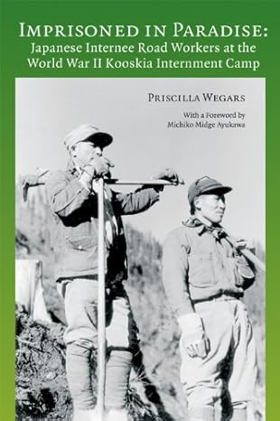
The Kooskia Internment Camp, a unique, virtually forgotten, World War II Detention and road building facility, was located on the remote, wild, and scenic Lochsa River in north central Idaho. Between mid-1943 and mid-1945 the Kooskia camp held an all-male contingent of some 265 so-called "enemy aliens" of Japanese ancestry. Most came from 21 states and 2 territories, but others were from Mexico; some were even kidnapped from Panama and Peru. Two alien internee doctors, an Italian and later a German, provided medical services; 25 Caucasian employees included several women; and a Japanese American man censored the mail. Despite having committed no crimes, but suspected of potential sabotage, these noncitizen U.S. residents of Japanese descent had been interend elsewhere in the U.S. following Japan's attack on Pearl Harbor in December 1941. They volunteered for transfer to the Kooskia Internment Camp and received wages for helping construct the Lewis-Clark Highway, now Highway 12, supervised by U.S. Bureau of Public Roads employees. Knowledge of their rights under the 1929 Geneva Convention empowered the Kooskia internees to successfully challenge administrative mistreatment, thereby regaining much of the self-respect they had lost by being so unjustly interned. Here, finally, is their story. --back cover xxxiv, 323 pages : illustrations, maps, portraits ; 23 cm CIRC [ 0 ]
|
2010 |
|
A force for change Beatrice Morrow Cannady & the struggle for civil rights in Oregon, 1912-1936 by Kimberley Mangun 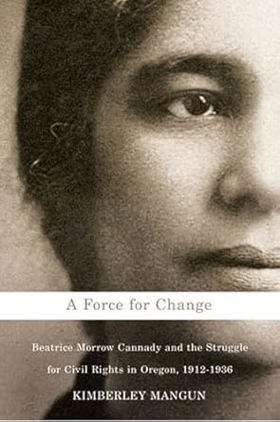
"A Force for Change is the first full-length study of the life and work of one of Oregon's most dynamic civil rights activists, Beatrice Morrow Cannady." "Between 1912 and 1936, Cannady tirelessly promoted interracial goodwill and fought segregation and discrimination. She gave hundreds of lectures to high school and college students and shared her message with radio listeners across the Pacific Northwest. She was assistant editor, and later publisher, of The Advocate, Oregon's largest African American newspaper. Cannady was the first black woman to graduate from law school in Oregon, and the first to run for state representative. She held interracial teas in her home in Northeast Portland and protested repeated showings of the racist film The Birth of a Nation. And when the Ku Klux Klan swept into Oregon, she urged the governor to act quickly to protect black Oregonians' right to live and work without fear. Despite these accomplishments, Beatrice Cannady fell into obscurity when she left Oregon in the late 1930s." "A Force for Change illuminates Cannady's key role in advocating for better race relations in Oregon in the early decades of the twentieth century. It describes her encounters with the period's leading black artists, editors, politicians, and intellectuals, including W. E. B. Du Bois, Langston Hughes, Oscar De Priest, Roland Hayes, and James Weldon Johnson. It dispels the myth that African Americans played little part in Oregon's history and it enriches our understanding of the black experience in Oregon and the civil rights movement across the country."--BOOK JACKET [vii], 344 pages : illustrations, portraits ; 23 cm CIRC [ 0 ]
|
2010 |
|
The lumberman's frontier three centuries of land use, society, and change in America's forests by Thomas R. Cox 
With The Lumberman’s Frontier, Thomas Cox has reconstructed a groundbreaking history that stands apart from all previous studies of American forests. Forests were ubiquitous in early America, but it was only in selected areas that trees, rather than farming, ranching, or mining, attracted settlement. These areas constitute the lumberman’s frontier, which appeared first in northern New England in the seventeenth century, followed by upstate New York, the Allegheny Plateau, the upper Great Lakes states, the Gulf South, and the Far West. The forest frontiers generated capital and building materials important in the nation’s development, but they also left a legacy of environmental problems, class and urban-rural divisions, and economic frictions. The 1930s marked the end of the lumberman’s frontier, but these consequences continue to shape attitudes and policies toward forests, most notably the questions “Whose forests are they?” and “How and by whom should forests be used?” Drawing upon recent work in social and economic history, as well as a wealth of historical data on forest industries and individuals, The Lumberman’s Frontier neither glorifies economic development nor falls into the maw of ecological gloom-and-doom. It puts individual actors at center stage, allowing the points of view of the workers and lumbermen to emerge. xi, 531 pages : illustrations, maps ; 23 cm CIRC [ 0 ]
|
2010 |
|
A river without banks place and belonging in the Inland Northwest by William C. Johnson 
A River Without Banks chronicles one family’s journey to Idaho, with all of its uncertainties, promises, and hopes. The book explores their encounters with a place still partly wild, whose communities and landscapes teach them how to respect the earth and each other. William Johnson’s essays move from a family vacation spent observing moose, to a comparison of the creation myths from Genesis and the Nez Perce, to watching a raptor seeking prey. Johnson meditates on how places, animals, and people teach us “how to see, and how we do, and don’t, belong.” In prose that reveals a poet’s eye, Johnson examines how family relationships affect how we see the natural world. He explores the power of words to divide and to heal. He illuminates the challenges of sustaining a vital relationship with a home place. A River Without Banks will appeal to readers interested in the literature of place, ecology, natural history, indigenous culture, and conservation. 160 pages ; 22 cm CIRC [ 0 ]
|
2010 |
|
To the woods sinking roots, living lightly, and finding true home by Evelyn Searle Hess 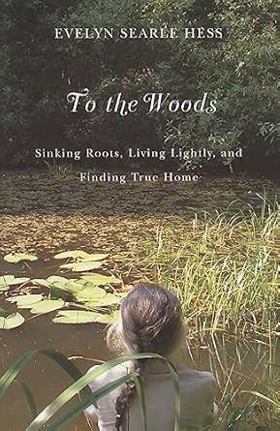
To the Woods is a tale of adventure, inspiration, and living life in concert with nature. It is the true story of Evelyn Searle Hess, who, in her late fifties, walks away from the world of modern conveniences to build a new life with her husband on twenty acres of wild land in the foothills of Oregon's Coast Range. To the Woods tracks the natural history of place through the seasons. It describes Hess's day-to-day challenges, from living in a trailer without electricity or indoor plumbing to excavating a pond to dealing with health crises. It explores the joys of living simply, building a relationship with the natural world, and awakening to the interconnectedness of all life. Hess's careful attention to detail, her extensive knowledge of local flora and fauna, and her thoughtful philosophical meditations add richness to her engaging prose. To the Woods will appeal to readers interested in the environment and sustainable living, and to anyone who has ever considered fleeing the city for a life closer to nature. xvi, 175 pages ; 23 cm CIRC [ 0 ]
|
2010 |
|
Discovering Main Street travel adventures in small towns of the Northwest by Foster Church 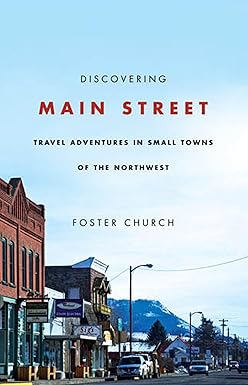
Small towns punctuate the landscape of Oregon and Washington. They burrow in crinkles of hills, sit alongside mighty rivers, survive in desert canyons and sagebrush plains, dot the fertile Willamette Valley, and perch at the edge of the Pacific Ocean. In Discovering Main Street, Foster Church reveals the unexpected and unique pleasures of exploring small towns, what he calls “the last frontier of American tourism.” Organized by region—Willamette Valley, Oregon Coast, Southern Oregon, Eastern Oregon, and Southern Washington—the profiles in Discovering Main Street begin with route tips and end with comments on where to stay and eat. Church’s engaging narratives provide history, highlights, and insights into each of the nearly fifty profiled communities. A useful introduction summarizes Church’s recommendations for a small town visit, which include hanging out at the local cafe, attending a school sports event, and hiking the surroundings—because without exception, small towns in the Northwest are set in hauntingly beautiful environments, from stark deserts to deep, mossy forests. Discovering Main Street provides an alternative to the outdoor adventure guides that dominate bookshelves in the Northwest. It will appeal to armchair travelers, to Northwest enthusiasts, and to any curious explorers seeking adventure in hidden—and unexpected—places. 192 pages : maps ; 22 cm CIRC [ 0 ]
|
2010 |
|
Where the Crooked River rises a high desert home by Ellen Waterston 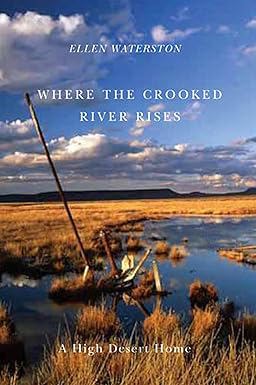
There is an otherness to the high desert, something momentous and sacred in the purity of the silence. In this compelling collection of personal essays, award-winning poet and author Ellen Waterston illuminates the people, places, and landscape of Central Oregon’s vast high desert. In Where the Crooked River Rises, Waterston reveals the blessings and challenges of decades spent as a rancher and town resident in a place that “has been, and remains,” her touchstone and crucible. The high desert is Waterston’s teacher, and she describes its lessons with grace and care, inviting readers to look at their own lives through a lens of wide-open spaces, sagebrush and juniper, pumice and rabbit brush. 142 pages : illustrations ; 22 cm CIRC [ 0 ]
|
2010 |
|
Shadow tribe the making of Columbia River Indian identity by Andrew H. Fisher 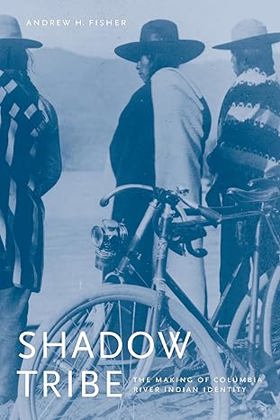
Shadow Tribe offers the first in-depth history of the Pacific Northwest’s Columbia River Indians -- the defiant River People whose ancestors refused to settle on the reservations established for them in central Oregon and Washington. Largely overlooked in traditional accounts of tribal dispossession and confinement, their story illuminates the persistence of off-reservation Native communities and the fluidity of their identities over time. Cast in the imperfect light of federal policy and dimly perceived by non-Indian eyes, the flickering presence of the Columbia River Indians has followed the treaty tribes down the difficult path marked out by the forces of American colonization. Based on more than a decade of archival research and conversations with Native people, Andrew Fisher’s groundbreaking book traces the waxing and waning of Columbia River Indian identity from the mid-nineteenth through the late twentieth centuries. Fisher explains how, despite policies designed to destroy them, the shared experience of being off the reservation and at odds with recognized tribes forged far-flung river communities into a loose confederation called the Columbia River Tribe. Environmental changes and political pressures eroded their autonomy during the second half of the twentieth century, yet many River People continued to honor a common heritage of ancestral connection to the Columbia, resistance to the reservation system, devotion to cultural traditions, and detachment from the institutions of federal control and tribal governance. At times, their independent and uncompromising attitude has challenged the sovereignty of the recognized tribes, earning Columbia River Indians a reputation as radicals and troublemakers even among their own people. Shadow Tribe is part of a new wave of historical scholarship that shows Native American identities to be socially constructed, layered, and contested rather than fixed, singular, and unchanging. From his vantage point on the Columbia, Fisher has written a pioneering study that uses regional history to broaden our understanding of how Indians thwarted efforts to confine and define their existence within narrow reservation boundaries. xi, 337 pages, 16 unnumbered pages of plates : illustrations, maps ; 23 cm. CIRC [ 1 ]
|
2010 |
|
History of Weston, Idaho by Jay D. Schvaneveldt 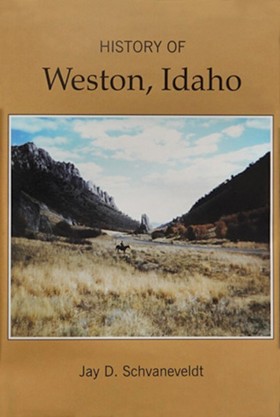
Published in 2010, Jay D. Schvaneveldt’s History of Weston, Idaho chronicles the founding and evolution of one of the Gem State’s oldest permanent European-American settlements, established by Mormon pioneers in the mid-1860s. The book meticulously documents the community's early trials—ranging from harsh frontier winters and tense resource management to its strategic growth as an agricultural and freighting hub along the route to northern mining camps. Drawing on rich local lore, diaries, and genealogical records, Schvaneveldt captures the grit and resilience required to transform a rugged southeastern Idaho wilderness into a tightly knit farming community. A keen insight drawn from the text is how it illuminates the profound, everyday impact of religious and familial cohesion on frontier survival, demonstrating that tight kinship networks and shared communal values were just as vital to subduing the rural West as physical labor and infrastructure. xvi, 702 pages : illustrations ; 24 cm CIRC [ 1 ]
|
2011 |
|
Win-Quatt a brief history of The Dalles, Oregon by Philip Klindt, Linda Klindt, Widge Johnson, Carolyn Wood 
About 80 miles east of Portland, Oregon, in the heart of the majestic Columbia River Gorge, lies a small community with great significance. Surrounded by rolling hills, scenic mountains, abundant orchards and fields, The Dalles is a treasure trove of beauty and home to many recreational activities. However, the less apparent gems are found in its lavish history. Authors Philip and Linda Klindt, teachers and owners of the oldest bookstore in Oregon, trace the fascinating 10,000 year story of this vital trade center. --Cover 128 pages : illustrations, maps ; 23 cm CIRC [ 1 ]
|
2011 |
|
Sechelt dictionary by Ronald C. Beaumont, Sechelt Nation 
Sechelt (shashishalhem) is the ancestral language of the Sechelt people (shishalh), whose territory extends from Jervis Inlet to Howe Sound on the south coast of British Columbia. Like many other indigenous languages, Sechelt has been in decline for over a century and is now in peril of becoming extinct. The Sechelt Dictionary is part of an ongoing effort to preserve a knowledge of this language and to encourage a revival of its use by present and future generations of Sechelt people. Ronald C. Beaumont has been studying the Sechelt language since 1970. The Sechelt Dictionary and an earlier work, she shashishalhem: the Sechelt Language (1985), are based on information given to the author by more than thirty elders representing the last generations of speakers to learn Sechelt as their first language. NOTE: The material in this file is for personal information only. Any use of this material, for research or any other purpose that is intended for publication, must be approved by the Sechelt Indian Band. www.secheltnation.ca xv, 1005 p. ; 26 cm. ONLINE CIRC [ 1 ]
|
2011 |
|
An independent folk a history of early Wheeler County, Oregon by Mary Fitzgerald 
The settling of Wheeler County, Oregon, makes for rich storytelling combined with the historical facts. Excerpting from interviews with old timers, their stories are told in their own words. The story tells of the courageous and very independent people that still populate Wheeler County,. These folks are representative of the pioneer spirit that gives such backbone and character to rural life in America. 336 pages : illustrations, map ; 23 cm CIRC [ 1 ]
|
2011 |
|
Cecil Andrus Idaho's greatest governor by Chris Carlson, ProQuest (Firm) 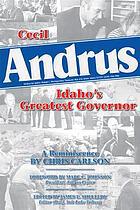
Cecil Andrus is Idaho's only 4-term governor. A biography and political reminiscence of the life and career of Idaho s only four-term governor, written by his friend and former press secretary, Chris Carlson. Carlson reveals the political rules Andrus practiced and unveils the exceptional personal qualities of the man who arguably has had the greatest impact on Idaho in modern times. xx, 269 p. : ill. CIRC [ 0 ]
|
2011 |
|
Remembering the power of words the life of an Oregon activist, legislator, and community leader by Avel Louise Gordly, Patricia Ann Schechter 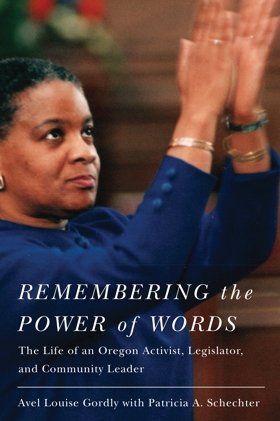
Remembering the Power of Words recounts the personal and professional journey of Avel Gordly, the first African-American woman elected to the Oregon State Senate. The book is a brave and honest telling of Gordly’s life. She shares the challenges and struggles she faced growing up black in Portland in the 1950s and 1960s, as well as her determination to attend college, the dedication to activism that took her from Portland to Africa, and her eventual decision to run for a seat in the state legislature. That words have power is a constant undercurrent in Gordly’s account and a truth she learned early in life. “Growing up, finding my own voice,” she writes, “was tied up with denying my voice or having it forcefully rejected and in all of that the memory of my father is very strong. To this day—and I am today a very experienced public speaker—preparation to speak takes a great deal of energy.” That this memoir has its origins as an oral history is fitting since Gordly has used her voice, out loud, to teach and inspire others for so many years. Important as a biographical account of one significant Oregonian’s story, the book also contributes “broader narratives touching on Black history (and Oregon’s place within it), and most particularly the politics associated with being an African American woman,” according to series editor Melody Rose. 176 pages : illustrations ; 23 cm. CIRC [ 0 ]
|
2011 |
|
Potluck community on the edge of wilderness by Ana Maria Spagna 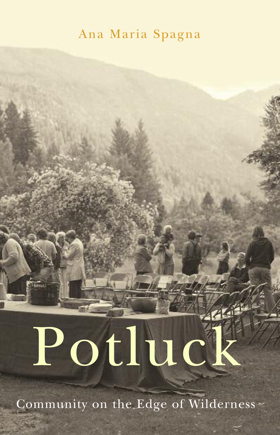
In Potluck, Ana Maria Spagna explores the enduring human connection to place, journeying from Tijuana to a California beach to Utah’s canyon country—and, always, back to the sparsely populated valley in the North Cascades that she calls home. Potluck homes in on the everyday gatherings that, over time, define a community: a makeshift wedding, an art gallery opening, a farewell potluck, a work party, a work party, a campfire, a political caucus, a funeral. “What connects us?” Spagna asks, and she reveals, again and again, the gift of community—easy and uneasy, deep and enduring and essential. 175 pages ; 22 cm CIRC [ 0 ]
|
2011 |
|
Dragonflies and damselflies of Oregon a field guide by Cary Kerst, Steve Gordon 
Growing interest in watching and identifying dragonflies and damselflies has sharpened the need for an authoritative resource like Dragonflies and Damselflies of Oregon, a definitive field guide devoted solely to dragonflies and damselflies found in the state. Cary Kerst and Steve Gordon include information on identification, as well as biology and behavior, using common terms useful to the novice and experienced enthusiast alike. The book features stunning color photographs of male and female of all species currently known in Oregon, along with helpful illustrations and charts with important identification characteristics. Dragonflies and Damselflies of Oregon presents the life cycle and larval habits of dragonflies and damselflies, along with photographs of the larvae of families. The Oregon range for each species is mapped, and the size range of adults is provided in text and illustration. The book also includes a description of the best sites in Oregon to observe these amazing insects, a useful tool for viewing uncommon species in spectacular settings. Dragonflies and Damselflies of Oregon is an essential reference for Odonatists, entomologists, birders, butterfly watchers, fishermen, wetland experts, naturalists, gardeners, artists, photographers, and all outdoor enthusiasts. xi, 304 pages : color illustrations, maps ; 22 cm. CIRC [ 0 ]
|
2011 |
|
Voodoo vintners Oregon's astonishing biodynamic winegrowers by Katherine Cole 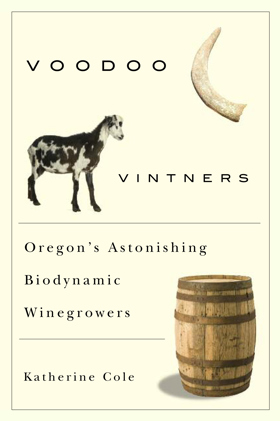
Could cow horns, vortexes, and the words of a prophet named Rudolf Steiner hold the key to producing the most alluring wines in the world—and to saving the planet? In Voodoo Vintners, wine writer Katherine Cole reveals the mysteries of biodynamic winegrowing, tracing its practice from Paleolithic times to the finest domaines in Burgundy today. At the epicenter of the American biodynamic revolution are the Oregon winemakers who believe that this spiritual style of farming results in the truest translations of terroir and the purest pinot noirs possible. Cole introduces these “voodoo vintners,” examining their motivations and rationalizations and explaining why the need to farm biodynamically courses through their blood. Her engaging narrative answers the call of oenophiles everywhere for more information about this “beyond organic” style of winemaking. x, 182 pages ; 23 cm CIRC [ 0 ]
|
2011 |
|
Toward one Oregon rural-urban interdependence and the evolution of a state by Michael Hibbard 
Every state in the nation has geographic divisions—upstate/downstate, urban/rural, major city/rest of the state—that loom large as barriers to common cause. Toward One Oregon examines the prospects for uniting one geographically diverse state in the years ahead. When Oregon became a state in 1859, its role in the nation and the global economy was quite different than it is today. Boundaries that made sense in the nineteenth century don’t always serve twenty-first century needs productively. Current times demand a new, strategic understanding of the state and its role in the nation and the world if its people—all of its people—are to thrive. Oregon, like many states, is faced with recovering and rediscovering a sense of shared purpose as it attempts to meet the needs of its diverse communities, peoples, and landscapes. Toward One Oregon explores Oregon’s urban and rural history and assesses the current situation through political, economic, and demographic lenses. The book’s contributors include historians, urban planners, journalists, economists, sociologists, and political scientists. They explore the links and splits between urban and rural Oregon and together offer a collaborative path forward—for Oregon and for any state faced with similar, seemingly insurmountable, geographic divisions—using the best of urban and rural policies in strategic and complementary ways. 183 pages : illustrations, charts, maps ; 23 cm CIRC [ 0 ]
|
2011 |
|
Up the Capitol steps a woman's march to the governorship by Barbara Roberts 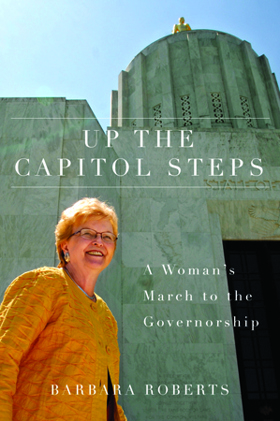
Up the Capitol Steps is a personal and political memoir by Oregon’s first (and only) woman governor, one of only thirty-four women who have served as state chief executives in the history of the United States. Barbara Roberts offers a behind-the-scenes glimpse of a woman’s life in politics and aims to “demystify” leadership by telling the story of her own unlikely rise to power. The mother of an autistic child before the advent of special education, Roberts began her life in public service as an advocate for the rights of children with disabilities. She documents her expanding political career from school board member to legislator to Secretary of State and finally, Governor. In this gripping and poignant memoir, hotly contested elections and tough policy decisions are interspersed with intimate details of personal ups and downs. Throughout, Roberts reveals the warmth and humor that show the “real” person behind the politician. Only the third published autobiography by an American woman head of state, Up the Capitol Steps is “a very significant contribution to Oregon history, the history of women in politics, and especially the history of women governors,” according to series editor Melody Rose. The book captures a period of our nation’s political history and a view of women’s expanding role in government that brings new understanding to the term, “social revolution.” x, 438 pages : illustrations ; 23 cm. CIRC [ 0 ]
|
2011 |
|
Wild in the city exploring the intertwine, the Portland-Vancouver region's network of parks, trails, and natural areas by Michael C. Houck, M. J. Cody, Audubon Society of Portland 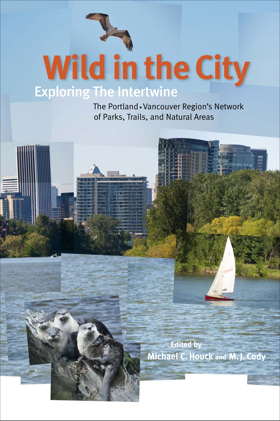
The second edition of the highly acclaimed Wild in the City brings more than one hundred of the best parks, trails and natural areas to your fingertips. This comprehensive “must-have” reference will be the go-to field guide for hikers, cyclists, paddlers, bird watchers, and nature enthusiasts. This revised and updated edition contains new maps organized according to watershed and includes twenty-eight unique “rambles” that explore multiple sites for recreation, wildlife viewing, or simply contemplating the joys of nature. New natural history essays by Ursula K. Le Guin, Kim Stafford, Robin Cody, Judy BlueHorse Skelton, Robert Michael Pyle, Jonathan Nicholas, and Richard Louv, author of Last Child in the Woods, offer fresh perspectives on the little pockets and expansive corridors of Portland’s wild environs. The book also examines the innovative strategies that cities, agencies, and nonprofits are using to create an ecologically sustainable metropolitan region. This invaluable resource will be an essential guide for educators and parents who want to explore the region’s natural wonders with their students and children. Included are tips on living with wildlife, as well as a new section that provides essential information on how urban living and green spaces intersect. xx, 427 pages : illustrations, maps ; 23 cm CIRC [ 0 ]
|
2011 |
|
Oregon archaeology by C. Melvin Aikens, Thomas J. Connolly, Dennis L. Jenkins 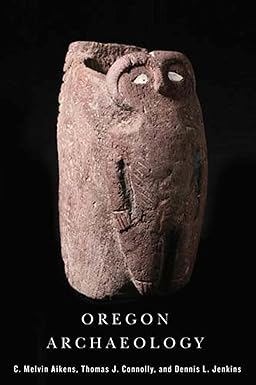
Oregon Archaeology tells the story of Oregon’s human history beginning more than 14,000 years ago with the earliest evidence of human occupation and continuing into the twentieth century. An historical narrative informed by evidence from critical sites, Oregon Archaeology carries the story forward, describing aspects of first encounters between Native Americans and newcomers of European and Asian heritage, as well as important trends in the development of modern Oregon. Oregon’s early human history is linked to four of the five major cultural regions of western North America: the Great Basin, the Columbia Plateau, the Northwest Coast, and the western valleys that share features with California’s Central Valley. Oregon Archaeology offers a coherent and unified history of an area that is highly differentiated geographically and culturally. Enriched with maps, photographs, line drawings, and an extensive bibliography, Oregon Archaeology is an essential reference for archaeology professionals and students and for general readers interested in Oregon’s Native American culture and history. Oregon Archaeology offers a coherent and unified history of an area that is highly differentiated geographically and culturally. A historical narrative informed by evidence from critical sites, Oregon Archaeology is enriched with maps, photographs, line drawings, and an extensive bibliography. Oregon Archaeology is an essential reference for archaeology professionals and students, and also for general readers interested in Oregon’s Native American culture and history. 496 pages : illustrations, maps ; 23 cm CIRC [ 0 ]
|
2011 |
|
Life histories of Cascadia butterflies by David G. James, D. Nunnallee, Robert Michael Pyle 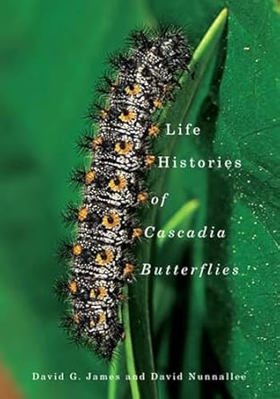
David G. James and David Nunnallee present the life histories of the entire butterfly fauna of a North American geographic region in exceptional and riveting detail for the first time in Life Histories of Cascadia Butterflies. Virtually all of the 158 butterfly species occurring in southern British Columbia, Washington, northern Idaho, and northern Oregon are included in the book. Color photographs of each stage of life—egg, every larval instar, pupa, adult—accompany information on the biology, ecology, and rearing of each species. Life Histories of Cascadia Butterflies will appeal to naturalists, hikers, amateur entomologists, butterfly gardeners, conservationists, students, and general readers of natural history. For scientists and dedicated lepidopterists, the book provides an unparalleled resource on the natural history of immature stages of butterflies in the Pacific Northwest—and beyond, as many of Cascadia’s butterflies occur in other parts of North America as well as Europe and Asia. 447 pages : illustrations (some color) ; 26 cm CIRC [ 0 ]
|
2011 |
|
Finding the river an environmental history of the Elwha by Jeff Crane 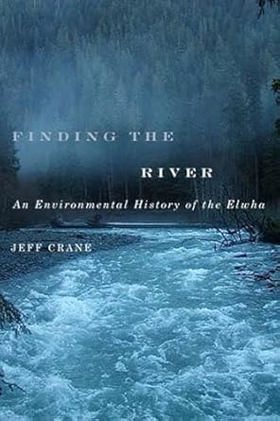
In 1992 landmark federal legislation called for the removal of two dams from the Elwha River to restore salmon runs. Jeff Crane dives into the debate over development and ecological preservation in Finding the River, presenting a long-term environmental and human history of the river as well as a unique look at river reconstruction. Finding the River examines the ways that different communities—from the Lower Elwha Klallam Indians to current-day residents—have used the river and its resources, giving close attention to the harnessing of the Elwha for hydroelectric production and the resulting decline of its fisheries. Crane describes efforts begun in the 1980s to remove the dams and restore the salmon. He explores the rise of a river restoration movement in the late twentieth century and the roles that free-flowing rivers could play in preserving salmon as climate change presents another set of threats to these endangered fish. A significant and timely contribution to American Western and environmental history—removal of the two Elwha River dams began in September 2011—Finding the River will be of interest to historians, environmentalists, and fisheries biologists, as well as to general readers interested in the Puget Sound, the Olympic Peninsula, and environmental issues. 250 pages : illustrations, map ; 23 cm CIRC [ 0 ]
|
2011 |
|
A look to the past Kirkland by Matthew W. McCauley, Kirkland Heritage Society 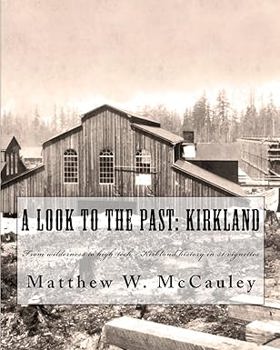
Fifty of the best of Matt McCauley's "A Look to the Past: Kirkland" newspaper columns, edited to present new information and many photos from the prized collection of the Kirkland Heritage Society.In 1870 two teenage boys claim homesteads on Juanita Bay, and to pay for improvements on their homesteads, struggle for the rest of their short lives logging timber on Lake Washington’s eastern shore. In 1872 a couple and their 22-year-old son stake claims at Houghton, carving homes out of dark, dense, first-growth timber. Other pioneers arrive and claim homesteads on the eastern shore. In 1887 a flamboyant young newspaper publisher convinces an even-tempered English steel manufacturer to locate a new, world-class steel mill on a tiny lake between Houghton and Juanita, and to plat a town site on Lake Washington’s shore, which will become Kirkland. Their vision is big. They want to create nothing less than a “Pittsburgh of the Pacific,” but reality intervenes. The speculative bubble bursts and fortunes are lost, lives are broken, and in the shambles of their dreams the scrappy pioneers refuse to quit. They build their town anyway.Kirkland’s past reads like a great western novel, peopled as it is by pioneer settlers, land speculators, loggers, stump ranchers, land developers, steam boatmen, boat builders, WWII Rosie-the-riveters, finally, the suburbanites of post-WWII.Kirkland native Matthew W. McCauley wrote a popular newspaper column, “A Look to the Past,” in the 1990s in which he tells these stories. Here are 50 of the best, updated with new research, and accompanied by many of images from the Kirkland Heritage Society’s prized collection."It is a pleasure having Matt McCauley’s A Look to the Past articles finally gathered together in one volume. When they were first published in the Kirkland Courier two decades ago, they were such a joy to read that I saved most of them in my clippings file. I say “most” because I now see that I missed a few, and I was delighted to read some “new” ones after all these years. What a treat!" — Alan Stein, Staff Historian, HistoryLink.org"Matt is ... an old soul. As a young boy he seemed to show wisdom only seen in older people. Matt always loved older people and their stories. Today, Kirkland is the beneficiary of his interest in the people and history of Kirkland. Matt is a stickler for detail and accuracy. He wants people remembered and respected." — Loita Hawkinson, Kirkland Heritage Society 271 pages : illustrations, maps ; 26 cm CIRC [ 1 ]
|
2011 |
|
Is it a house? archaeological excavations at English Camp, San Juan Island, Washington by Amanda K. Taylor, Julie K. Stein, Burke Museum of Natural History and Culture 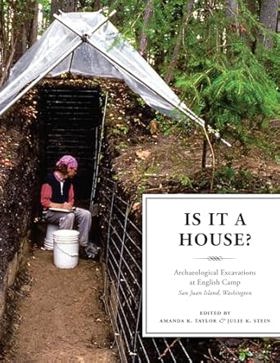
Prehistoric houses on the Northwest Coast were built from wood, often within piles of discarded shells, leaving little archaeological evidence from which to confirm their presence. Is It a House? uses multiple lines of evidence to investigate whether the U-shaped depression surrounded by shells at the English Camp site on San Juan Island was originally a house constructed by native peoples. Each chapter addresses a different kind of evidence, including artifacts, sediment, faunal remains, and stratigraphy. The quantitative and qualitative analyses used to examine the evidence reveal new directions and insights for identifying houses in similar contexts. The editors introduce the research in the context of current and past Gulf of Georgia (Coast Salish) archaeology, and end by synthesizing the research evidence. x, 170 pages : illustrations, maps ; 28 cm. CIRC [ 1 ]
|
2011 |