Catalog of British Columbiana and Pacific Northwest Americana
Encyclopedia Cascadia Catalog contains book titles of mostly non-fiction Pacific Northwest Coast of North America Titles (primarially British Columbia, Idaho, Oregon and Washington State) in an easy-to-understand title catalog. If you see a link with this badge ONLINE CIRC it means that there is an online institution that provides free access to that title. In some cases there may be more than one institution hosting the title digitally.
| Catalog Title | Published |
|---|---|
|
Forgotten tales of Idaho by Andy Weeks, Cait Brennan (Illustrator) 
Idaho was the forty-third state admitted to the Union, but it just might lead the nation in strange stories and offbeat legends. Author and Idaho resident Andy Weeks fills this collection of tales with stories ranging from compelling and heartfelt to outlandish and bizarre. Discover the boxcar that carried the alleged body of John Wilkes Booth through Idaho. Uncover the identity of Lady Bluebeard, the unassuming Twin Falls housewife who allegedly murdered four husbands. Find out how cars ended up at the bottom of Lake Coeur d'Alene. Learn the grisly story of Gobo Fango, a black Mormon sheepherder whose late 1800s bloody dispute with a cattleman on the open range proved fatal. These tales and many others bring to light Idaho's unruly past in fascinating detail 204 pages : illustrations ; 18 cm CIRC [ 0 ]
|
2015 |
|
Forgotten Cusheon Cove, Salt Spring Island by Charles Kahn, C. T. Hatfield 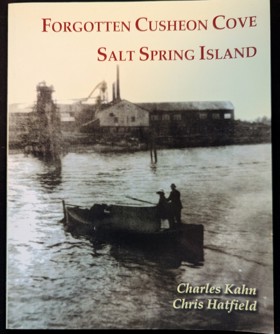
Imagine it's 1915 and you're on a small island in the Strait of Georgia with a population of just over 900. Now imagine a large sawmill with what was then state-of-the-art machinery on an isolated cove on the southeast side of the island. The mill employs up to 150 workers, many of them non-resident Norwe-gians, Swedes, Japanese, and Chinese. This is only a fragment of the story Chris Hatfield researched after he acquired the 100-acre site in 1984 and began finding items discarded by the different communities that had once lived there. Chris partly donated and partly sold most of the land to BC Parks in 2006. This little book explores the property's history. 53 p. : ill., maps, ports. ; 26 cm. CIRC [ 1 ]
|
2007 |
|
Forest under story creative inquiry in an old-growth forest by Nathaniel Brodie , Charles Goodrich , Frederick J. Swanson 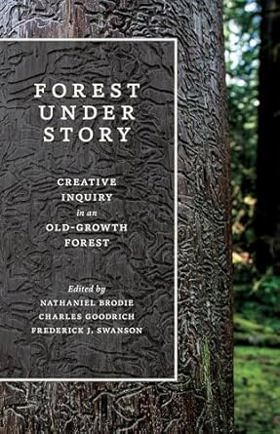
Two kinds of long-term research are taking place at the H. J. Andrews Experimental Forest, a renowned research facility in the temperate rain forest of the Oregon Cascades. Here, scientists investigate the ecosystem’s trees, wildlife, water, and nutrients with an eye toward understanding change over varying timescales up to two hundred years or more. And writers from both literary and scientific backgrounds spend time in the forest investigating the ecological and human complexities of this remarkable and deeply studied place. This anthology—which includes work by some of the nation’s most accomplished writers, including Sandra Alcosser, Alison Hawthorne Deming, Jane Hirshfield, Linda Hogan, Freeman House, Robin Wall Kimmerer, Kathleen Dean Moore, Robert Michael Pyle, Pattiann Rogers, and Scott Russell Sanders—grows out of the work of the Long-Term Ecological Reflections program and showcases the insights of the program’s thoughtful and important encounters among writers, scientists, and place. These vivid essays, poems, and field notes convey a landscape of moss-draped trees, patchwork clear-cuts, stream-swept gravel bars, and hillsides scoured by fire, and also bring forward the ambiguities and paradoxes of conflicting human values and their implications for the ecosystem. Forest Under Story offers an illuminating and multifaceted way of understanding the ecology and significance of old-growth forests, and points the way toward a new kind of collaboration between the sciences and the humanities to better know and learn from special places. 251 pages : illustrations, maps ; 23 cm CIRC [ 0 ]
|
2016 |
|
Forest under siege the story of old growth after Gifford Pinchot by Rand Schenck 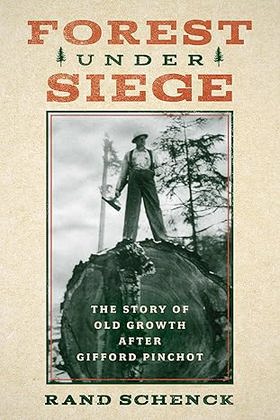
"The first chief of the United States Forest Service marveled at the Cascades' ancient forests, but by 1990, relentless logging left a mere thirteen percent of the Pacific Northwest's original old growth. Focusing primarily on the Gifford Pinchot National Forest, an environmental activist examines one hundred years of Pacific Northwest forestry-revealing just how close the region's ancient forests came to extinction-and offering his perspective on the decades of stewardship, the period of unabated harvest, and efforts toward old growth rebirth"-- Provided by publisher pages cm CIRC [ 0 ]
|
2024 |
|
Forest primeval the natural history of an ancient forest by Chris Maser 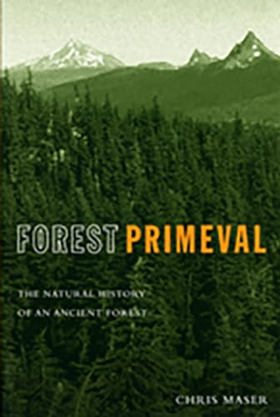
In this classic work of ecology, Chris Maser traces the growth of an ancient forest in Oregon's Cascade mountains from its fiery birth in the year 987 to present. A unique "biography" of an ecosystem, Forest Primeval portrays a diverse fabric of plants, animals, and microorganisms working in unison. Maser offers precise yet evocative accounts of the lives and events within the burgeoning forest: the habits of deer mice who help reseed the burned earth, the seemingly accidental but vitally necessary symbiotic associations between fungus and tree root tips that stimulate growth, the constant predation among wildlife. He revels how over the course of a millennium, "microbes and fungi change a forest just as surely as a raging fire, only inconspicuously and more slowly." As the life cycles of the forest progress, Maser's minute scientific observations unfold against the backdrop of history, a chronology of "humans struggle and suffering that is paralleled in the life of ..." a single 1000-year-old Douglas fir." In taking this millennial view, Maser shows how the forest represents our spiritual and historical roots as human beings. Arguing that our survival is as intertwined with the forests as are the myriad interlocking life cycles that created them, Maser makes a plea for the immediate global implementation of restoration forestry. Selected by School Library Journal as one of the year's "Best Science and Technical Books." xxi, 282 pages : illustrations ; 23 cm CIRC [ 0 ]
|
2001 |
|
Forest park exploring Portland's natural sanctuary by Marcy Cottrell Houle 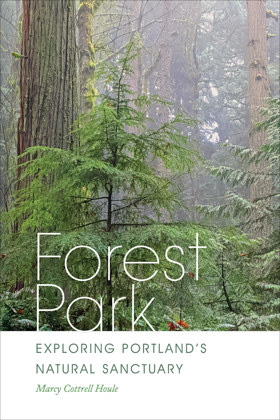
"Situated in the rugged hills west of downtown Portland, Forest Park is the nation's premier urban natural sanctuary. It supports essential habitat for hundreds of native plants and animals, including species at risk, and is one of the largest city parks in the world. While extending critical ecosystem services to the region, it covers miles of outstanding hiking trails, all within minutes of the downtown core. Forest Park: Exploring Portland's Natural Sanctuary showcases this treasure in a new light, offering a compendium of the most up-to-date and comprehensive information available. Twenty-one hikes covering seventy-five miles bring a full awareness of the park's outstanding attributes. Hikes are grouped by theme to encourage people to explore Forest Park's watersheds, geology, lichens and mosses, vegetation, amphibians and reptiles, pollinators, native wildlife, and wildlife corridors. Beautiful photographs and full-color maps accompany each trail description. Forest Park is a shining example of the Pacific Northwest western hemlock community-an ecosystem unique among all temperate forests of the world. It is also an exciting model for a future Urban Biodiversity Reserve, a concept that would recognize the park's scientific, natural, and cultural qualities. Forest Park will help all visitors discover the beauty and wonders of this extraordinary natural resource"-- Provided by publisher xv, 216 pages : color illustrations, color maps ; 23 cm CIRC [ 0 ]
|
2023 |
|
Forest of time a century of science at Wind River Experimental Forest by Margaret J. Herring, Sarah Greene 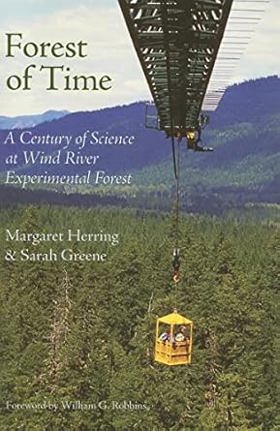
The Wind River Experimental Forest has been called the cradle of forestry in the Pacific Northwest, a place of groundbreaking discoveries in forest genetics and ecology. Forest of Time follows 100 years of forest science at Wind River, as social and scientific changes transformed the 20th century and the Pacific Northwest forest itself. It is a story of discovery and blindness, of opportunities taken and missed, in a forest dedicated to long-term research. The Forest Service began research at Wind River in 1908 to learn the secrets of the giant Douglas fir. During the course of the century, generations of scientists studied the forest, and their conclusions changed through time. Initially, Wind River scientists saw the region in need of protection from fire and careless logging. They saw scorched, cutover land that required replanting. Later they saw the forest in need of improvement, needing to be freed from pests and unprofitable species and replaced with thrifty, fast-growing plantations. Wind River soon became a laboratory where foresters from around the world came to learn how to grow the best possible lumber in the shortest amount of time. As plantations replaced natural stands, scientists came to Wind River to explore the complexity of old-growth forest ecosystems. And today, Wind River is the center of a 21st century exploration of forest canopies and the global connection between forests and atmosphere. In Forest of Time, Margaret Herring and Sarah Greene show readers how science grows and changes in unexpected ways, much like a forest through time. ix, 188 pages : illustrations, maps ; 23 cm CIRC [ 0 ]
|
2007 |
|
Forest dreams, forest nightmares the paradox of old growth in the Inland West by Nancy Langston 
Across the inland West, forests that once seemed like paradise have turned into an ecological nightmare. Fires, insect epidemics, and disease now threaten millions of acres of once-bountiful forests. Yet no one can agree what went wrong. Was it too much management—or not enough—that forced the forests of the inland West to the verge of collapse? Is the solution more logging, or no logging at all? In this gripping work of scientific and historical detection, Nancy Langston unravels the disturbing history of what went wrong with the western forests, despite the best intentions of those involved. Focusing on the Blue Mountains of northeastern Oregon and southeastern Washington, she explores how the complex landscapes that so impressed settlers in the nineteenth century became an ecological disaster in the late twentieth. Federal foresters, intent on using their scientific training to stop exploitation and waste, suppressed light fires in the ponderosa pinelands. Hoping to save the forests, they could not foresee that their policies would instead destroy what they loved. When light fires were kept out, a series of ecological changes began. Firs grew thickly in forests once dominated by ponderosa pines, and when droughts hit, those firs succumbed to insects, diseases, and eventually catastrophic fires. Nancy Langston combines remarkable skills as both scientist and writer of history to tell this story. Her ability to understand and bring to life the complex biological processes of the forest is matched by her grasp of the human forces at work—from Indians, white settlers, missionaries, fur trappers, cattle ranchers, sheep herders, and railroad builders to timber industry and federal forestry managers. The book will be of interest to a wide audience of environmentalists, historians, ecologists, foresters, ranchers, and loggers—and all people who want to understand the changing lands of the West. xii, 368 pages : illustrations, maps ; 25 cm. CIRC [ 0 ]
|
1995 |
|
Forest and stream management in the Oregon coast range by Stephen D. Hobbs 
The Oregon Coast Range is an area that contains a diversity of plant and animal life and a wealth of natural resources. However, faced with a growing population and increasing demands on these resources, land managers today feel the need for new policies and practices aimed at ensuring their sustainability. Until recently there has been little scientific knowledge upon which to base these new approaches. In 1987 a major cooperative research effort called the Coastal Oregon Productivity Enhancement (COPE) Program was launched to fill this void. Forest and Stream Management in the Oregon Coast Range is the capstone of this effort and the synthesis of years of collaborative research. The book's ten chapters, written by scientists from leading research institutions, offer a thorough grounding in Coast Range geophysical processes, plant community ecology and dynamics, fisheries, wildlife, forest diseases, silviculture, and timber harvest operations. The book also describes a variety of management strategies and practices appropriate to the area and discusses the social and economic dimensions of sustainable management. Unlike other books dealing with natural resource management, this volume focuses exclusively on the Oregon Coast Range, an area of singular ecological assets and high economic importance. This has allowed the authors to provide specific and detailed information about the Coast Range and its particular resources and challenges. Written primarily for managers and resource specialists, the book will also appeal to resource scientists, forest landowners, the conservation community, and university students interested in forestry, fisheries, and wildlife sciences. This book is a result of the Coastal Oregon Productivity Enhancement (COPE) Program, a cooperative research and education effort between federal and state agencies, the forest products industry, city, county, and tribal governments, and small woodland owners. From 1987 to 1999, COPE sponsored 60 studies involving 130 researchers from 14 organizations and produced more than 300 publications. xii, 276 pages : illustrations (some color), maps (some color) ; 29 cm CIRC [ 0 ]
|
2002 |
|
Forces of prejudice in Oregon, 1920-1925 by Lawrence J. Saalfeld
|
1984 |
|
For Wood River or bust Idaho's silver boom of the 1880s by Clark C. Spence 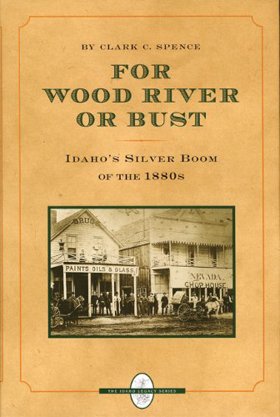
Chronicles the history of the silver rush in the Wood River area of Idaho during the late nineteenth century, describing the mining companies, settlements, and prospectors. The moment of brilliance of Idaho's Wood River mining towns spanned roughly the decade of the 1880s. Noted mining historian Clark C. Spence details the mining history of the Wood River region and captures the bedlam of the early camps and communities. Copublished with the Idaho State Historical Society. xi, 260 pages : illustrations, map ; 24 cm. CIRC [ 1 ]
|
1999 |
|
|
1964 |
|
For honor & country the diary of Bruno de Hezeta by Bruno de Hezeta, H. K. Beals 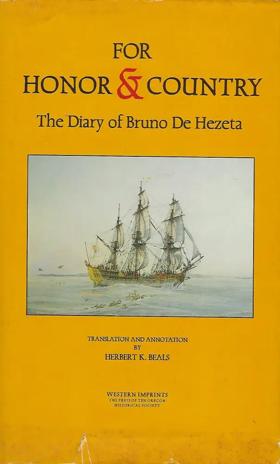
For Honor & Country: The Diary of Bruno de Hezeta by 18th-century Spanish naval officer Bruno de Hezeta, translated and extensively annotated by Herbert K. Beals, is a significant 1985 maritime and colonial history volume published by the Oregon Historical Society. The book provides the first complete English translation of Hezeta’s original 1775 expedition journal, chronicling a secret naval mission ordered by the Viceroy of New Spain to assert Spanish sovereignty over the Pacific Northwest coast and investigate rumors of Russian encroachment. The narrative meticulously details the arduous voyage of the frigate Santiago, capturing critical moments of early European contact with coastal Indigenous populations, severe outbreaks of scurvy among the crew, and foundational geographic discoveries—most notably Hezeta's sighting of the treacherous mouth of the Columbia River, which he originally named the Rio de San Roque, and early landfalls along the rugged Washington shoreline. Ultimately, it serves as an indispensable primary-source resource for maritime historians and regional scholars seeking to understand the imperial ambitions, navigational challenges, and earliest recorded European encounters that shaped the complex colonial history of the Pacific Northwest. xxiii, 167 pages : illustrations (some color), maps ; 27 cm. CIRC [ 1 ]
|
1985 |
|
Footprints in the Olympics an autobiography by Chris Morgenroth, Katherine Morgenroth Flaherty 
The books illustrated here with a picture on the cover are all soft-cover. The hardcovers are all dark green with gold letters. Also these books are by Chris Morgenroth (my Grandfather), edited by my mother (Katherine Morgenroth Flaherty). Whoever Pauline Battien is, she had nothing to do with this book. I helped my mother publish the book and we sold over 7,000 copies. I have a small inventory of both hard and soft cover books in my possession. Thanks for taking the time to read this. I've tried, unsuccessfully, to get Amazon to correct the master listing but it hasn't happen yet. 215 pages : illustrations, maps ; 26 cm CIRC [ 1 ]
|
1991 |
|
Fool's hill a kid's life in an Oregon coastal town by John Quick 
Port Orford, Oregon, in the 1930s and 40's. Here a curious, blabbermouth boy learns more at the bottom of a ditch than in kindergarten and finds real home in a booth at Red's Bar holding hands with Dorothy, who he is never supposed to talk to. With a little help from his friends, young Johnny learns about life and death and sex and Indians. And, with his help, we remember what it is to be a kid viii, 304 pages : illustrations ; 24 cm CIRC [ 0 ]
|
1995 |
|
Fool's gold the life and legacy of Vancouver's official town fool by Jesse Donaldson 
"Fool's Gold explores the life and times of Joachim Foikis, Vancouver's "Official Town Fool" who spread "joy and confusion" during the late 60s and early 1970s."-- Provided by publisher 123 pages : illustrations ; 17 cm. CIRC [ 0 ]
|
2020 |
|
Following the Nez Perce trail a guide to the Nee-Me-Poo National Historic Trail, with eyewitness accounts by Cheryl Wilfong 
The 1877 flight of the Nez Perce from their homelands while pursued by U.S. soldiers and citizen volunteers is one of the most compelling and sorrowful events in American history. The Nez Perce (Nee-Me-Poo) National Historic Trail traces the route taken by the 800 Nez Perce men, women, and children from May to October 1877. Drawing on eyewitness accounts, this unique book chronicles the heartbreaking retreat of Chief Joseph and his people. It offers an essential guide for anyone who wishes to follow all or part of the Trail. The Nez Perce Trail stretches for 1,500 miles from Wallowa Lake, Oregon, through Idaho and Yellowstone Park, ending at the Bear Paw Battlefield, near Chinook, Montana. This historical guidebook splits the Trail into thirteen segments, each with its own historical chronology and travel plan, with alternative routes for "mainstream," "adventurous," and "intrepid" travelers. Each route includes maps, GPS coordinates, and recommendations for side trips. Period photographs and firsthand accounts from those who first traveled the trail--the Nez Perce, soldiers, settlers--bring history to life. For more than fifteen years, Following the Nez Perce Trail has led travelers and historians as they've retraced the flight of the Nez Perce from their homeland in the Pacific Northwest to their exile in Oklahoma and Canada. This new edition has been updated and expanded by author Cheryl Wilfong, and includes a new emphasis on the experiences of the Nez Perce women and children. Her detailed knowledge of the Nez Perce Trail informs every page of this indispensable guide. xiv, 493 pages : illustrations, maps ; 26 cm CIRC [ 0 ]
|
2006 |
|
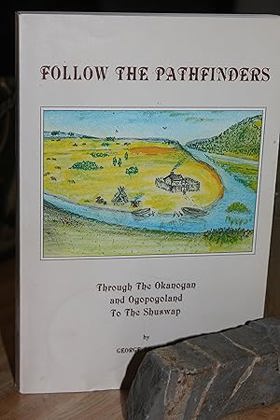
Follow the pathfinders through the Okanogan and Ogopogoland to the Shuswap by George Bechtold
|
1980 |
|
Flying to extremes memories of a northern bush pilot by Dominique F. Prinet 
"The adventures and misadventures of Arctic bush pilot Dominique Prinet in the Northwest Territories make for a bracing read. Writing with clarity, humour, and precision, Prinet, an economist and engineer, flies us into a world of endless snow and ice and dim grey winter days over sparsely settled tundra. Flying into bad weather, his single-engine plane icing up and heading down, Prinet wonders if he should tell the sports fishermen snoozing in the cabin amid boxes of fish and fishing gear they are about to crash. Maybe not. Or while rescuing his bride from their plane sinking through the ice, he meets an Indigenous trapper who drove his dogsled through the bush to find out why a plane had landed but not taken off."-- Provided by publisher 279 pages : colour illustrations, maps ; 22 cm CIRC [ 0 ]
|
2021 |
|
Flourishing and free more true stories of trailblazing women of Vancouver Island by Haley Healey 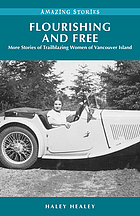
"An inspiring and eye-opening collection of true stories about fourteen women who blazed their own trails in life and contributed in a fundamental way to the history of Vancouver Island and the surrounding islands. In this fascinating follow-up to On Their Own Terms, author Haley Healey chronicles the lives of a whole new crop of resilient, hard-working, rule-breaking, diverse women who lived on and around Vancouver Island. Flourishing and Free introduces readers to Sylvia Stark (1839-1944), who was born into slavery in Missouri and went on to become a homesteader on Salt Spring Island; Mary Ann Croft (1865-1935), the first female lighthouse keeper in all of Canada; Victoria Chung (1897-1966), the first Asian-Canadian person to earn a medical degree, who provided urgent care during the Second World War; Dr. Ellen White (1922-2018), a renowned Coast Salish educator, author, and storyteller; and Isabel Kimoto (1921-), a cook, who was sent to a Japanese-Canadian internment camp in 1942 with her three-month-old baby; and many more. Uplifting, empowering, and entertaining, this concise collection of stories will appeal to anyone interested in learning more about the unsung heroines of the West Coast."-- Provided by publisher 144 pages : illustrations ; 22 cm. CIRC [ 0 ]
|
2021 |
|
Flora of the Pacific Northwest an illustrated manual by C. Leo Hitchcock , Arthur Cronquist , Jeanne R. Janish (Illustrator) 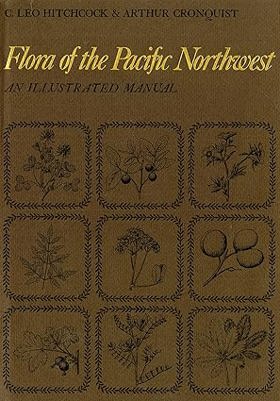
A comprehensive manual with illustrations and descriptions of the vascular plants of the Pacific Northwest xix, 730 pages : illustrations ; 27 cm CIRC [ 0 ]
|
1973 |
|
Flora of Mount Rainier National Park by David Biek 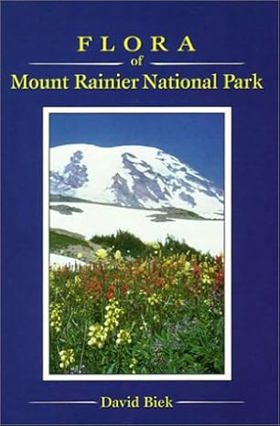
"Every one of these parks... is a garden filled knee-deep with fresh, lovely flowers of every hue, the most luxuriant and the most extravagantly beautiful of all the alpine gardens I ever beheld in all my mountain-top wanderings," wrote John Muir, describing his ascent of Washington's Mount Rainier, the highest peak in the Cascade Mountains. So impressed was Muir with the beauty of Rainier's meadows and forests that he joined others in calling for the establishment of a national park. Coinciding with this year's centennial of the founding of Mount Rainier National Park is a publication of a comprehensive new flora for the Park. Flora of Mount Rainier National Park provides a complete listing of the 866 species of native and introduced plants found in the Park, with keys, line drawings, and descriptions for identification, as well as a guide to plant location. It includes information on the Park's natural history, as well as sections on botanical exploration, rare plants, and the ecological impact of the Park's 2 million annual visitors. This authoritative treatment of the Park's flora offers a complete reference and field guide for visitors, as well as naturalists, resource managers, and conservationists. It will prove invaluable to professional and amateur students of Northwest flora. vi, 506 pages : illustrations, maps ; 23 cm CIRC [ 0 ]
|
2000 |
|
Floodland and forest memories of the Chilliwack Valley by Imbert Orchard 
This book is based upon 15 tape recorded interviews with people of the Chilliwack area conducted in the early 1960s. Well-illustrated with historical photos and maps. iv, 92 pages : illustrations ; 27 cm. CIRC [ 1 ]
|
1983 |
|
Flood tide of empire Spain and the Pacific Northwest, 1543-1819 by Warren L. Cook
|
1973 |
|
Flagstaff Hill on the national historic Oregon Trail, Baker City, Oregon an interpretive guide by James R. Evans, Bert Webber 
Published by historians James R. Evans and Bert Webber, Flagstaff Hill on the National Historic Oregon Trail, Baker City, Oregon: An interpretive guide serves as an informative companion to one of the most prominent overland trail sites in the American West. The book explores the dramatic geography and historic significance of Flagstaff Hill, which overlooks the historic ruts carved by thousands of covered wagons descending toward the Snake River valley. Utilizing archival photographs, maps, and trail diaries, the guide details the grueling final stretches of the Oregon Trail where pioneers faced exhaustion, disease, and the daunting transition from wilderness trekkers to exhausted settlers. A keen insight drawn from the work is how interpretive monuments freeze a complex historical tragedy into a romanticized pioneer narrative; by elevating Flagstaff Hill as a scenic monument to manifest destiny, the site risks reducing a violent process of indigenous displacement into a sanitized spectacle of rugged perseverance. 143 pages : illustrations, maps ; 22 cm CIRC [ 1 ]
|
1992 |