Catalog of British Columbiana and Pacific Northwest Americana
Encyclopedia Cascadia Catalog contains book titles of mostly non-fiction Pacific Northwest Coast of North America Titles (primarially British Columbia, Idaho, Oregon and Washington State) in an easy-to-understand title catalog. If you see a link with this badge ONLINE CIRC it means that there is an online institution that provides free access to that title. In some cases there may be more than one institution hosting the title digitally.
| Catalog Title | Published |
|---|---|
|
Nooksack place names geography, culture, and language by Allan Richardson, Brent Douglas Galloway 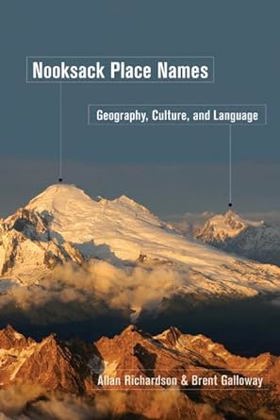
Place names convey a people's relationship to the land, their sense of place. For indigenous peoples, place names can also help to revive endangered languages. This book takes readers on a voyage into the history, language, and culture of the Nooksack people of Washington State and BC as it documents more than 150 places named by elders and mentioned in key historical texts. Descriptions of Nooksack history and naming patterns - with maps, photographs, and linguistic analyses of the place names - give life to a nearly extinct language and illuminate the intertwined relationships of place, culture, language, and identity xviii, 228 pages : illustrations, maps, portraits ; 24 cm. CIRC [ 1 ]
|
2011 |
|
Historical atlas of Washington and Oregon by Derek Hayes, Iva Cheung 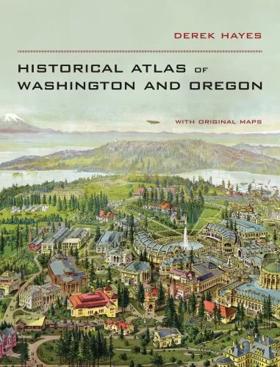
This gorgeous atlas, illustrated throughout with more than 500 colorful images and maps, provides a visually rich and textually engaging history of the states of Oregon and Washington. Derek Hayes brings his enthusiasm and expertise to a full range of topics, beginning with the first inhabitants and tracing the westward expansion, conflict between settlers and Native Americans, and the establishment of the Oregon Trail. We see in vivid images, old maps, and lively text the coming of the railroads and the rapid establishment of the coastal ports, northwest cities and roads, the fur and lumber industries, and the large farms. We also witness the twentieth-century development of the war industries, the establishment of the aviation industry, and the celebratory 1962 Seattle World’s Fair. At once a valuable reference and an exhilarating adventure through history, the Historical Atlas of Washington and Oregon presents readers with a fascinating chronicle of how these proud states came into their own and how they each look toward the future. 240 pages : illustrations (some color), maps (some color) ; 33 cm CIRC [ 1 ]
|
2011 |
|
Texada tapestry a history by Heather Harbord 
"Texada is the largest island in the Strait of Georgia, a long strip of richly mineralized granite and limestone dividing the upper gulf. Travel time from Vancouver is six hours via three ferries. A newcomer's first impression is of an idyllic place with a big sandy beach, a Sunday farmer's market and a scant population of aging loggers, miners, pot-growers and other retirees, but this belies Texada's intriguing history. Although today Texada is better known as the home of the illegal agricultural product called Texada Gold, it was once the focus of a real gold rush that lured no less a figure than cookie tycoon William Christie. Later, Texada was the site of British Columbia's first major political scandal when squabbles over a rich iron ore claim forced the resignation of Premier Amor de Cosmos in February 1874. The rich mineral deposits in time gave rise to three booming towns--Gillies Bay, Blubber Bay and Van Anda, noted as the town with everything: not just a whorehouse, but an opera house. Population ebbed and flowed with mineral prices and Texada went in and out of the news. Its association with illegal intoxicants dates back to 1928 when the biggest whisky still north of Vancouver was busted in romantic Pocahontas Bay. The bitter Blubber Bay strike of 1938 put Texada in the news again as the Pacific Lime Company faced off against the International Woodworkers' Association labour union in a bloody riot. This is also the feisty island that repelled the might of the Greater Vancouver Regional District when it wanted to dump metropolitan garbage in the abandoned pit of the once-famous Texada Mine. Author Heather Harbord has dedicated years to research, including over a hundred interviews of locals and old-timers to create a captivating book full of unforgettable characters, humorous anecdotes and well-researched fact, accompanied by many previously unpublished photographs. Once again, she has created a valuable volume on the history of the BC coast." --Publisher's description 288 p. : ill., map, ports. ; 24 cm. CIRC [ 1 ]
|
2011 |
|
The Kelowna story an Okanagan history by Sharron J. Simpson 
The Kelowna Story is a comprehensive full-length history of the largest metropolitan centre outside BC's Lower Mainland, a labour of love by a leading local historian whose family roots have been entwined with Kelowna's for five generations. It embraces the full sweep of central Okanagan history, starting with the days of the S-Ookanhkchinx, who enjoyed a largely peaceful existence along the shores of the lakes and rivers before the earliest explorers came to trade, followed by Father Pandosy and his Okanagan Mission in 1859. It was the mission that attracted Kelowna's first homesteaders, soon followed by cattle ranchers and orchardists, and much later by the empire-builders like the Bennett family who paved the way for today's budding metropolis. Author Sharron J. Simpson believes "history is best told through the stories of ordinary people," while allowing today's readers may not think it 'ordinary' to walk over mountain ranges to collect mail, or consider it 'ordinary' to climb into a narrow irrigation pipe to scrape the rust off the inside as it runs up and down the hillsides, or to row freight from one end of Okanagan Lake to the other. "In their time," she writes, "those who did extraordinary things were simply doing what needed to be done to get ahead. Their stories are fascinating and tell of the remarkable investment early settlers made in this community." 320 p. : ill., maps, ports. ; 28 cm. CIRC [ 1 ]
|
2011 |
|
Company, crown and colony the Hudson's Bay Company and territorial endeavour in western Canada by Stephen A. Royle 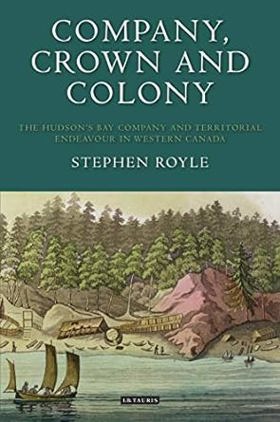
Trading companies played a vital role in colonial endeavour. The great English, Dutch and French merchant companies took the risks of trade and travel in a dangerous world, opening up trading routes to the Farthest corners of the globe. The Hudson's Bay Company was just such an enterprise. Established under a charter granted by Charles II in 1670, with Prince Rupert, the king's cousin, as one of its directors, the company was granted 4m square kilometres of what was to become Canada, over which huge territory they were given sole trading rights 304 pages : illustrations, maps ; 24 cm CIRC [ 1 ]
|
2011 |
|
Sechelt dictionary by Ronald C. Beaumont, Sechelt Nation 
Sechelt (shashishalhem) is the ancestral language of the Sechelt people (shishalh), whose territory extends from Jervis Inlet to Howe Sound on the south coast of British Columbia. Like many other indigenous languages, Sechelt has been in decline for over a century and is now in peril of becoming extinct. The Sechelt Dictionary is part of an ongoing effort to preserve a knowledge of this language and to encourage a revival of its use by present and future generations of Sechelt people. Ronald C. Beaumont has been studying the Sechelt language since 1970. The Sechelt Dictionary and an earlier work, she shashishalhem: the Sechelt Language (1985), are based on information given to the author by more than thirty elders representing the last generations of speakers to learn Sechelt as their first language. NOTE: The material in this file is for personal information only. Any use of this material, for research or any other purpose that is intended for publication, must be approved by the Sechelt Indian Band. www.secheltnation.ca xv, 1005 p. ; 26 cm. ONLINE CIRC [ 1 ]
|
2011 |
|
British Columbia's magnificent parks the first 100 years by James D. Anderson 
"In 1910 a highly unlikely party of politicians, poets, social butterflies and an overweight cook, all led by a Shakespeare-quoting bushrat named Hughie Horatio Nelson Baron Bacon, set out from the Willows Hotel in Campbell River to explore the wild interior of Vancouver Island. They were launched on a noble, and for its time, highly imaginative mission: to assess the fitness of the region to become a wilderness park, the first in BC history. They survived with only minor injuries and produced such a glowing report that Strathcona Park, BC's first provincial park, was duly created on 19 March 1911"--Jacket 264 p. : ill. (chiefly col.), map ; 28 cm. CIRC [ 0 ]
|
2011 |
|
The pathfinder A.C. Anderson's journeys in the West by Nancy Marguerite Anderson 
Fifteen years before the 1858 Fraser River gold rush, a Hudsons Bay Company clerk named Alexander Caulfield Anderson threaded his way through mountain passes and down rapids-filled rivers in search of a safe all-British route through the mountains that separated the HBC fort at Kamloops from Fort Langley on the Pacific coast. Eventually, Anderson discovered four routes, succeeding where Alexander Mackenzie and Simon Fraser before him had failed. Without his explorations, historian Derek Pethick once wrote, British Columbia may never have come into being or become a part of the Dominion of Canada. For Anderson, the cross-country expeditions he undertook were welcome antidotes to a fur-trade life that wasnt quite what hed expected it to be. By the time he joined, in 1831, the fur trade was in fact a tightly controlled business that was very different from the adventurous trade that had inspired him. But though he may not have had his dream life, his spirit of adventure kept him going. As explorer, map-maker, artist and writer, he created a wealth of information to guide those of his time and far beyond, and his work—first in the fur trade, then in the communities in which he lived, and finally as Fisheries Inspector and Indian Reserve Commissioner for British Columbia—was always aimed at improving the future of the people he lived among. 239 pages, [8] pages of plates : illustrations, facsimiles, maps, portraits ; 23 cm CIRC [ 0 ]
|
2011 |
|
Sonny Montes and Mexican American activism in Oregon by Glenn Anthony May 
This textn tells the story of Oregon's most prominent Chicano activist, which also illustrates the formation of a significant Mexican-American community in the state between the 1960s and 1980's, and the ensuing rise of Oregon's Chicano movement x, 326 pages : illustrations ; 23 cm CIRC [ 0 ]
|
2011 |
|
Cecil Andrus Idaho's greatest governor by Chris Carlson, ProQuest (Firm) 
Cecil Andrus is Idaho's only 4-term governor. A biography and political reminiscence of the life and career of Idaho s only four-term governor, written by his friend and former press secretary, Chris Carlson. Carlson reveals the political rules Andrus practiced and unveils the exceptional personal qualities of the man who arguably has had the greatest impact on Idaho in modern times. xx, 269 p. : ill. CIRC [ 0 ]
|
2011 |
|
Treaties and treachery the Northwest Indians' Resistance to Conquest by Kurt R. Nelson 
The seven years from 1853 to 1859 are probably more important to the Pacific Northwest than any period of its recorded history. It was in the 1850s that officials began carving the Oregon Territory into the states. It was the period when most Indian tribes signed treaties that were supposed to protect their future. It was also when the natives of the region learned that no matter what the treaties promised, they would have little control over their destiny. So they fought a hopeless battle to preserve their way of life. Both settlers and natives believed they were God s chosen people. With hindsight, we can see with clarity the injustices done. But neither side can claim purity of action. Atrocities were committed by both. For almost every major tribe of the Northwest the 1850s marked the end of their way of life. This is the story of how cultures clashed. This is the story of one corner of our country, and how its history shapes its course today. --Publisher xiv, 280 pages : illustrations, maps ; 23 cm CIRC [ 0 ]
|
2011 |
|
The long journey of the Nez Perce a battle history from Cottonwood to the Bear Paw by Kevin Carson 
"In 1877, the U.S. Government opened the Nez Perce lands in Oregon to settlers and ordered the tribe to move to a reservation in Idaho Territory. Although reluctant to leave their homeland, the Nez Perce began the long trek eastward. A small band of young warriors vented their frustration, however, in two days of deadly attacks on settlements along the Salmon River. Realizing that the U.S. response would be overwhelming--particularly in light of Custer's defeat the year before--the Nez Perce leaders, including Chiefs Joseph, Looking Glass, and White Bird, prepared their people for war. A U.S. Army battalion led by Civil War general Oliver O. Howard along with several other coordinated army units began pursuit in an effort to subdue the Nez Perce and forceably move them to the reservation. The Nez Perce resolved to escape to freedom in Canada. Using their intimate knowledge of the land and their native Appaloosa horses skillfully, the Nez Perce were able to successfully check and elude the much larger American force for more than three months as they wound their way across the Rocky Mountains, through the newly established Yellowstone National Park, and into Montana. The war finally ended when the exhausted Indian--men, women, and children--were surrounded in the Bear Paw Mountains. Looking Glass was shot dead, and at this point, Chief Joseph relinquished and gave his famous address of surrender to General Howard. While most of the Nez Perce ended up on a reservation, the band led by White Bird was able to make their way to Canada and freedom. The Nez Perce War is one of the most important and emotional campaigns of the Indian Wars. It essentially closed an era in American history, and the amount of time, money, and troops required to subdue the Nez Perce brought the plight of American Indians and the reservation system to the front pages of newspapers around the world. In The Long Journey of the Nez Perce: A Battle History from Cottonwood to Bear Paw, former U.S. Army engineering officer Kevin Carson brings his intimate knowledge of the territory crossed by the Nez Perce along with his skill as a cartographer to reconstruct in detail the battles and skirmishes along the entire route of the conflict"--Publisher's website xvii, [1], 293 pages : illustrations, maps, portraits ; 25 cm CIRC [ 0 ]
|
2011 |
|
Sumpter Valley logging railroads by Alfred Mullett, Leonard Merritt 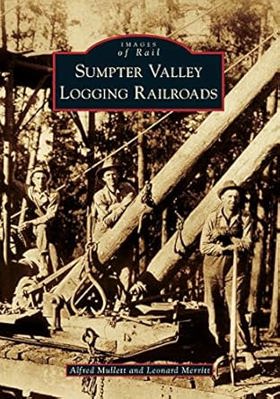
"In 1889, David Eccles chartered the Oregon Lumber Company, an organization that produced many mills and railways and whose influence was felt from Salt Lake City to Northern California and Idaho. Through family connections, Eccles was also involved with many other logging enterprises, and he influenced the growth of the Inter-Mountain region as well as the Pacific Northwest. Sumpter Valley Logging Railroads is a pictorial history of the Oregon operations, focusing on the operations along the Sumpter Valley Railway. It explores the rails, mills, and people, as well as the logging practices of a bygone era 127 pages : chiefly illustrations, maps ; 24 cm. CIRC [ 0 ]
|
2011 |
|
Light on the devils coming of age on the Klamath by Louise Wagenknecht 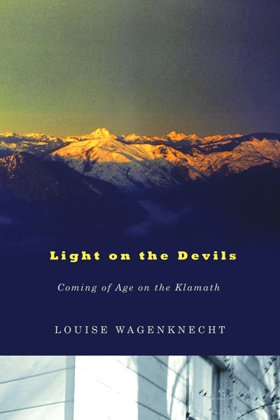
When Louise Wagenknecht’s family arrived in the remote logging town of Happy Camp in 1962, a boundless optimism reigned. Whites and Indians worked together in the woods and the lumber mills of northern California’s Klamath country. Logging and lumber mills, it seemed, would hold communities together forever. But that booming prosperity would come to an end. Looking back on her teenage years spent along the Klamath River, Louise Wagenknecht recounts a vanishing way of life. She explores the dynamics of family relationships and the contradictions of being female in a western logging town in the 1960s. And she paints an evocative portrait of the landscape and her relationship with it. Light on the Devils is a captivating memoir of place. It will appeal to general readers interested in the rural West, personal memoir, history, and natural history. vii, 216 pages : illustrations ; 23 cm CIRC [ 0 ]
|
2011 |
|
Seeking salaam Ethiopians, Eritreans, and Somalis in the Pacific Northwest by Sandra M. Chait 
Prolonged violence in the Horn of Africa, the northeastern corner of the continent, has led growing numbers of Ethiopians, Eritreans, and Somalis to flee to the United States. Despite the enmity created by centuries of conflict, they often find themselves living as neighbors in their adopted cities, with their children as class-mates in school. In many ways, they are successfully navigating life in their new home; however, they continue to struggle to bridge old ethnic divisions and find salaam, or peace, with one another. News from home fuels historical grievances and perpetuates tensions within their communities, delaying acculturation, undermining attempts at reconciliation, and sabotaging the opportunity to reach the American Dream. In conversations with forty East African immigrants living in Seattle, Washington, and Portland, Oregon, Sandra Chait captures the immigrants' struggle for identity in the face of competing stories and documents how some individuals have been able to transcend the ghosts from the past and extend a tentative hand to their former enemies. xviii, 298 pages : map ; 24 cm CIRC [ 0 ]
|
2011 |
|
Seattle geographies by Michael Brown, Richard L. Morrill 
Seattle is located on the northwest edge of the continental United States, flanked by two mountain ranges and set on the calm shores of Puget Sound. It is remote from the country's hub but a portal to Alaska and Asia. It is widely considered liberal and green, but such a characterization oversimplifies a city of many idiosyncrasies and contradictions. Seattle Geographies explores the human geography of the city and region to examine why Seattle is Seattle. The contributors to this volume look into Seattle's social, economic, political, and cultural geographies across a range of scales from neighborhoods to the world. They tackle issues as diverse as economic restructuring, gay space, trade with China, skateboarding, and P-patches. They apply a geographic perspective to uniquely Seattle events and movements such as the WTO protests and grunge. They also look at homelessness, poverty, and segregation. Guided by a strong sense of accountability to place, these geographers offer a wide, multifaceted portrayal of the city and its region. ix, 209 pages : illustrations (chiefly color), maps (chiefly color) ; 26 cm CIRC [ 0 ]
|
2011 |
|
Atomic frontier days Hanford and the American West by John M. Findlay, Bruce William Hevly 
On the banks of the Pacific Northwest’s greatest river lies the Hanford nuclear reservation, an industrial site that appears to be at odds with the surrounding vineyards and desert. The 586-square-mile compound on the Columbia River is known both for its origins as part of the Manhattan Project, which made the first atomic bombs, and for the monumental effort now under way to clean up forty-five years of waste from manufacturing plutonium for nuclear weapons. Hanford routinely makes the news, as scientists, litigants, administrators, and politicians argue over its past and its future. It is easy to think about Hanford as an expression of federal power, a place apart from humanity and nature, but that view distorts its history. Atomic Frontier Days looks through a wider lens, telling a complex story of production, community building, politics, and environmental sensibilities. In brilliantly structured parallel stories, the authors bridge the divisions that accompany Hanford’s headlines and offer perspective on today’s controversies. Influenced as much by regional culture, economics, and politics as by war, diplomacy, and environmentalism, Hanford and the Tri-Cities of Richland, Pasco, and Kennewick illuminate the history of the modern American West. xv, 368 pages : illustrations, maps ; 23 cm. CIRC [ 0 ]
|
2011 |
|
Field guide to the rare plants of Washington by Pamela Camp, John Gamon, Joseph Arnett 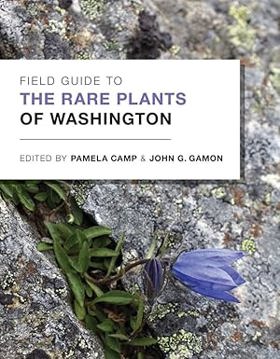
Field Guide to the Rare Plants of Washington offers a window into the beauty and diversity of the rarest plants in the state. The field guide includes: 317 vascular plants, six mosses, and one lichen; Full-color photographs of the plants and their habitats, line drawings, and distribution maps; Detailed species descriptions, identification tips, and easiest times to identify the plants; Current conservation status and state rank; Complete reference list and glossary. Each rare plant is fully characterized according to its appearance, reproductive strategy, associated plants, habitat, current threats, and scarcity in areas outside the state. A trip across Washington presents an array of habitats, from dripping spruce and hemlock forests along the coast to arid grasslands, shrub-steppe, and sand dune systems east of the mountains, from low-elevation outwash prairies to alpine slopes, from basalt flows and rocky islands to salt marshes and riverbanks. This book brings attention to the rarest and least understood plant species that find niches in this complex landscape. xi, 392 pages : illustrations (some color), color maps ; 23 cm CIRC [ 0 ]
|
2011 |
|
Seattle in Black and white the Congress of Racial Equality and the fight for equal opportunity by Joan Singler 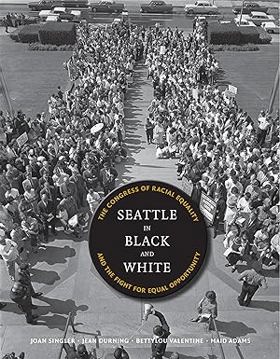
Seattle was a very different city in 1960 than it is today. There were no black bus drivers, sales clerks, or bank tellers. Black children rarely attended the same schools as white children. And few black people lived outside of the Central District. In 1960, Seattle was effectively a segregated town. Energized by the national civil rights movement, an interracial group of Seattle residents joined together to form the Seattle chapter of the Congress of Racial Equality (CORE). Operational from 1961 through 1968, CORE had a brief but powerful effect on Seattle. The chapter began by challenging one of the more blatant forms of discrimination in the city, local supermarkets. Located within the black community and dependent on black customers, these supermarkets refused to hire black employees. CORE took the supermarkets to task by organizing hundreds of volunteers into shifts of continuous picketers until stores desegregated their staffs. From this initial effort CORE, in partnership with the NAACP and other groups, launched campaigns to increase employment and housing opportunities for black Seattleites, and to address racial inequalities in Seattle public schools. The members of Seattle CORE were committed to transforming Seattle into a more integrated and just society. Seattle was one of more than one hundred cities to support an active CORE chapter. Seattle in Black and White tells the local, Seattle story about this national movement. Authored by four active members of Seattle CORE, this book not only recounts the actions of Seattle CORE but, through their memories, also captures the emotion and intensity of this pivotal and highly charged time in America’s history. xiii, 279 pages : illustrations, map ; 24 cm. CIRC [ 0 ]
|
2011 |
|
Dark rose organized crime and corruption in Portland by Robert C. Donnelly 
In April 1956, Portland Oregonian investigative reporters Wallace Turner and William Lambert exposed organized crime rackets and rampant corruption within Portland’s law enforcement institutions. The biggest scandal involved Teamsters officials and the city’s lucrative prostitution, gambling, and bootlegging operations. Turner and Lambert blew the cover on the Teamsters’ scheme to take over alcohol sales and distribution and profit from these fringe enterprises. The Rose City was seething with vice and intrigue. The exposé and other reports of racketeering from around the country incited a national investigation into crime networks and union officials headed by the McClellan Committee, or officially, the U.S. Senate Select Committee on Improper Activities in the Labor or Management Field. The commission discovered evidence in Portland that helped prove Teamsters president Dave Beck’s embezzlement of union funds and union vice president Jimmy Hoffa’s connection to the mob. Dark Rose reveals the fascinating and sordid details of an important period in the history of what by the end of the century had become a great American city. It is a story of Portland’s repeated and often failed efforts to flush out organized crime and municipal corruption - a familiar story for many mid-twentieth-century American cities that were attempting to clean up their police departments and municipal governments. Dark Rose also helps explain the heritage of Portland’s reform politics and the creation of what is today one of the country’s most progressive cities. xiii, 202 pages : illustrations ; 22 cm CIRC [ 0 ]
|
2011 |
|
Exploring Fort Vancouver by Douglas Calvin Wilson, Theresa E. Langford 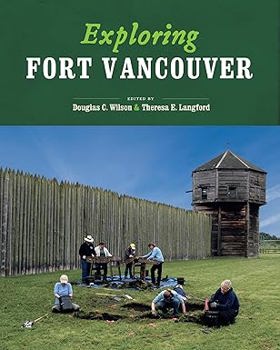
To explore the sweep of human history at Fort Vancouver is to grasp some of the essentials of the North American experience. The fort has been part of the major historical trends of the Pacific Northwest for over 150 years, from the effects of colonialism native peoples to the role of the U.S. Army. Native Americans, traders, homesteaders, and soldiers lived and worked at the fort, their lives interwoven and their stories imbedded in the objects they left behind. Exploring Fort Vancouver uses some of the most intriguing objects from the fort's extensive archaeological and archival collections to tell the history of technology, material culture, globalization, health and diet, and the National Park Service at this significant place. xii, 116 pages : illustrations (some color), color maps ; 26 cm CIRC [ 0 ]
|
2011 |
|
Gene Zema architect, craftsman by Grant Hildebrand, Gene Zema 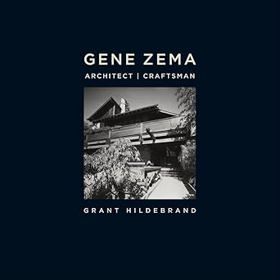
In the three decades following World War II, a group of architects centered in the Puget Sound region were designing buildings of extraordinary quality, whose most evident commonality was the use of wood in profusion, as exposed, meticulously detailed structure and as interior and exterior surface. Gene Zema, a 1950 graduate of the University of Washington and a student of the legendary Lionel Pries, was one of this group. In a career that spanned twenty years, Zema designed forty-six houses, seven clinics, two architectural offices, a nursery, and a golf clubhouse, and he participated in the design of two University buildings. He built several buildings with his own hands, developing a consummate sense of appropriate design in wood. The luxuriantly crafted details and uniquely dramatic spatial compositions of his work place it at the forefront of that remarkable movement. Zema was also a distinguished collector and retailer of Native American and Japanese antiquities. In 1983, relying on the sale of antiquities for income and limiting his architectural practice, he and his wife, Jane, bought a 70-acre meadow on Whidbey Island. On their property Zema built a workshop, a windmill and pump house, a chicken house, a home, a peacock house, and a kiln, all of which are as remarkable as his earlier masterpieces. Gene Zema is an iconic figure among those who know his work, but the region to which his work is intimately bound is far from the centers of architectural journalism and his story is little known. It is the story of a unique figure in an extraordinary American architectural movement and an exceptional figure in the history of the Pacific Northwest. x, 147 pages : illustrations (chiefly color) ; 26 cm CIRC [ 0 ]
|
2011 |
|
Before Seattle rocked a city and its music by Kurt E. Armbruster 
Seattle is a music town with rich, deep roots that have influenced the culture and identity of its civic life for decades. In a society that appreciates music but is ambivalent toward the profession of making it, the importance and contribution of Seattle's musicians have been routinely overlooked in historical accounts of the city. Kurt Armbruster fills that gap in this far-reaching and entertaining panorama of Seattle music from the 1890s to the 1960s, "before Seattle rocked." For this once-remote city, music forged links as real as those created by railroads and steamships. Classical music embodied the middle-class aspirations for gentility and cosmopolitan stature; jazz and blues gave Seattle's small African American community a vehicle for affirmation and economic advancement; ethnic music helped immigrants adjust to a new home; songs and drumming kept the memories of the Duwamish alive in a changing world. Before Seattle Rocked is enlivened by personal anecdotes and memories from many of Seattle's most beloved musicians and is enriched by historic photos of the changing music scene. ix, 374 pages : illustrations ; 23 cm CIRC [ 0 ]
|
2011 |
|
A look to the past Kirkland by Matthew W. McCauley, Kirkland Heritage Society 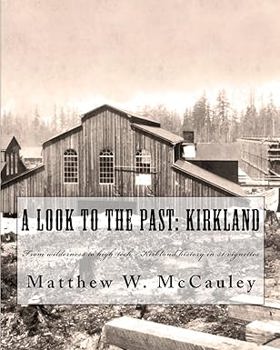
Fifty of the best of Matt McCauley's "A Look to the Past: Kirkland" newspaper columns, edited to present new information and many photos from the prized collection of the Kirkland Heritage Society.In 1870 two teenage boys claim homesteads on Juanita Bay, and to pay for improvements on their homesteads, struggle for the rest of their short lives logging timber on Lake Washington’s eastern shore. In 1872 a couple and their 22-year-old son stake claims at Houghton, carving homes out of dark, dense, first-growth timber. Other pioneers arrive and claim homesteads on the eastern shore. In 1887 a flamboyant young newspaper publisher convinces an even-tempered English steel manufacturer to locate a new, world-class steel mill on a tiny lake between Houghton and Juanita, and to plat a town site on Lake Washington’s shore, which will become Kirkland. Their vision is big. They want to create nothing less than a “Pittsburgh of the Pacific,” but reality intervenes. The speculative bubble bursts and fortunes are lost, lives are broken, and in the shambles of their dreams the scrappy pioneers refuse to quit. They build their town anyway.Kirkland’s past reads like a great western novel, peopled as it is by pioneer settlers, land speculators, loggers, stump ranchers, land developers, steam boatmen, boat builders, WWII Rosie-the-riveters, finally, the suburbanites of post-WWII.Kirkland native Matthew W. McCauley wrote a popular newspaper column, “A Look to the Past,” in the 1990s in which he tells these stories. Here are 50 of the best, updated with new research, and accompanied by many of images from the Kirkland Heritage Society’s prized collection."It is a pleasure having Matt McCauley’s A Look to the Past articles finally gathered together in one volume. When they were first published in the Kirkland Courier two decades ago, they were such a joy to read that I saved most of them in my clippings file. I say “most” because I now see that I missed a few, and I was delighted to read some “new” ones after all these years. What a treat!" — Alan Stein, Staff Historian, HistoryLink.org"Matt is ... an old soul. As a young boy he seemed to show wisdom only seen in older people. Matt always loved older people and their stories. Today, Kirkland is the beneficiary of his interest in the people and history of Kirkland. Matt is a stickler for detail and accuracy. He wants people remembered and respected." — Loita Hawkinson, Kirkland Heritage Society 271 pages : illustrations, maps ; 26 cm CIRC [ 1 ]
|
2011 |
|
Is it a house? archaeological excavations at English Camp, San Juan Island, Washington by Amanda K. Taylor, Julie K. Stein, Burke Museum of Natural History and Culture 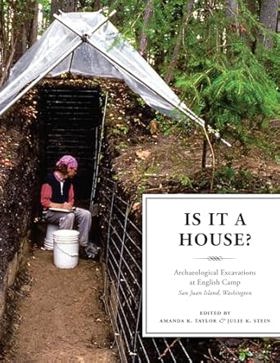
Prehistoric houses on the Northwest Coast were built from wood, often within piles of discarded shells, leaving little archaeological evidence from which to confirm their presence. Is It a House? uses multiple lines of evidence to investigate whether the U-shaped depression surrounded by shells at the English Camp site on San Juan Island was originally a house constructed by native peoples. Each chapter addresses a different kind of evidence, including artifacts, sediment, faunal remains, and stratigraphy. The quantitative and qualitative analyses used to examine the evidence reveal new directions and insights for identifying houses in similar contexts. The editors introduce the research in the context of current and past Gulf of Georgia (Coast Salish) archaeology, and end by synthesizing the research evidence. x, 170 pages : illustrations, maps ; 28 cm. CIRC [ 1 ]
|
2011 |