City of Kelowna Regional District of Central Okanagan, British Columbia
City - A populated place with legally defined boundaries, incorporated as a city municipality under the provincial Municipal Act. E side of Okanagan Lake, between Vernon and Penticton, Osoyoos Division Yale Land District
Mapped Location
City of Kelowna: The mapped location is an approximation and should not be used for navigation or wayfinding.
Information
General information on City of Kelowna
- Feature Type: Incorporated
Official, historical, colloquial and alternative toponyms for City of Kelowna
A brief list of names that this geographic feature has been named
| Name | Description |
|---|---|
| City of Kelowna | Official |
Origin Notes and History of City of Kelowna
References to City of Kelowna that document the origin of its place name
City of Kelowna incorporated 4 May 1905. Incorrectly adopted as Kelowna (Town) 6 October 1936. Corrected to Kelowna (City) 6 October 1955 on 82/SW, in keeping with incorporated status, and as listed in the 1909 BC Gazetteer and as labelled on BC map 1EM, 1915. Boundary change effective 15 December 1993; confirmed 13 July 1994 on 82 E/14, 82 E/13 and 82 L/3.
Kelowna is an [Indigenous] word meaning "grizzly bear". The name was selected by the late John Coryell, CE, who surveyed the site of the present city in 1891-92 for Laquime Bros, the owners of the land. Prior to this survey the nearest settlement was Okanagan Mission. The first hotel and store were erected in 1892. About the time the Kelowna townsite was surveyed, Mr. G.G. MacKay purchased from John McDougall certain lands adjoining the Kelowna townsite, and sold a portion of same to Lord Aberdeen, who gave the name Guisachan [to his property]. Kelowna Post Office opened 1 February 1893 (17th Report of the Geographic Board of Canada, 1922). See also the municipality's own website.
An Okanagan ... word meaning grizzly bear, but no bear had anything to do with the naming. It is the story of Augustus Gillard's nickname. Gillard, a husky, hairy Frenchman who pre-empted here in 1862, dwelt in a primitive hut, partly underground [the traditional kekuli/keekwillee/kickwilly]. One day some passing [Indigenous Peoples] saw him emerge from it like a bear from its den. 'Kimache Touche' they said to one another, meaning 'brown bear' or 'bear face', and this became the name for him and for the place. When the embryo city began in 1892, the few white residents thought this to awkward and chose instead another native bear-name, that of the grizzly bear, "kelowna". The Okanagan name for the area around Kelowna was Nor-kwa-stin, "hard black rock" used by the [Indigenous Peoples] for sharpening flints for their arrowheads. The fur traders called it L'Anse au Sable (Sandy Cove). (Okanagan Historical Society 12th Report, 1948, citing Ok. 6:45, 153 162-163; Kelowna Courier, August 25, 1938).
The name Kelowna (originally pronounced so that the second syllable rhymed with "allow") entails a curious story. In 1862 one August Gillard pre-empted here. For his abode he had a strange dwelling, half shanty and half underground [Indigenous] "keekwillee". Gillard was a great hairy man and one day, when he crawled out of his dugout, some passing [Indigenous Peoples], seeing the resemblance to a bear coming out of its den, laughing cried out, "kemxtús" (anglicized as "kimach touche" and meaning "black bear's face"). This became the local name for Gillard and his residence. In 1892 when Bernard Lequime had John Coryell, CE, lay out the townsite, the question arose as to the name for the new settlement. The old story of Kimach Touche was recalled, but this name seemed too uncouth. Then someone came up with the bright idea of substituting kelowna, from the Okanagan ... word meaning "female grizzly bear", and Kelowna it became.
Related Catalog Titles
A Bibliography for City of Kelowna, Regional District of Central Okanagan, British Columbia
Popular Day Hikes: South-Central Okanagan Kelowna, Penticton, Oliver by Gerry Shea
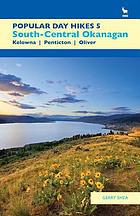
Gerry Shea’s Popular Day Hikes: South-Central Okanagan serves as an accessible, comprehensive trail guide for exploring the diverse landscapes stretching from Kelowna and Penticton down to Oliver. The book details 35 distinct routes through the region, providing practical maps, elevation profiles, and trailhead directions across a striking cross-section of semi-arid bunchgrass, ponderosa pine forests, and dramatic canyon country. A keen insight drawn from the text is how outdoor recreation guidebooks in the interior Pacific Northwest function as quiet instruments of ecological management; by systematically channeling foot traffic onto designated paths, the guide helps protect fragile desert-ecosystem flora and sensitive wildlife habitats from the pressures of a booming regional tourism economy.
143 pages : colour illustrations, maps ; 22 cm.
CIRC [ 0 ]
Regional District of Central Okanagan
- Benvoulin
- Braeloch
- Caesars
- Carrs
- Cedar Grove
- East Kelowna
- Ellison
- Ewing
- Fintry
- Gellatly
- Glenrosa
- Greata
- City of Kelowna
- Killiney Beach
- District of Lake Country
- Lakeview Heights
- McCulloch
- McKinley Landing
- Myra
- Nahun
- Okanagan Centre
- Okanagan Mission
- Oyama
- District of Peachland
- Pixie Beach
- Rutland
- Traders Cove
- Trépanier
- City of West Kelowna
- Westbank
- Westside
- Wilson Landing
- Winfield
- Woodsdale
Political Boundaries
Last updated: 2023-09-26