Catalog of British Columbiana and Pacific Northwest Americana
Encyclopedia Cascadia Catalog contains book titles of mostly non-fiction Pacific Northwest Coast of North America Titles (primarially British Columbia, Idaho, Oregon and Washington State) in an easy-to-understand title catalog. If you see a link with this badge ONLINE CIRC it means that there is an online institution that provides free access to that title. In some cases there may be more than one institution hosting the title digitally.
| Catalog Title | Published |
|---|---|
|
Another way the river has taut true tales from the Northwest by Robin Cody , Brian Doyle, Oregon State University Press (Issuing body) 
A collection of Robin Cody's nonfiction writing, 1982-2008. Another Way the River Has collects Robin Cody’s finest nonfiction writings, many appearing for the first time in print. Cody’s prose rings with a sense of place. He is a native speaker who probes the streams and woods and salmon that run to the heart of what it means to live and love, to work and play, in Oregon. His characters—from loggers to fishers to cowboys to the kids on his school bus—are smart and curious, often off-beat, always vivid. Cody brings the ear of a novelist and the eye of a reporter to the people and places that make the Northwest, and Northwest literature, distinctive. 190 pages ; 23 cm. CIRC [ 1 ]
|
2010 |
|
Imprisoned in Paradise Japanese internee road workers at the World War II Kooskia Internment Camp by Priscilla Wegars, Michiko Midge Ayukawa, University of Idaho Asian American Comparative Collection (Publisher) 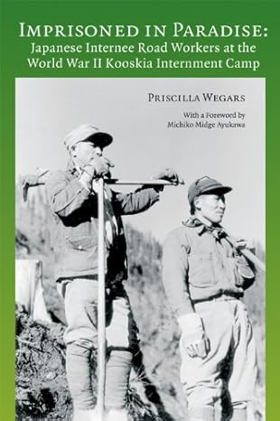
The Kooskia Internment Camp, a unique, virtually forgotten, World War II Detention and road building facility, was located on the remote, wild, and scenic Lochsa River in north central Idaho. Between mid-1943 and mid-1945 the Kooskia camp held an all-male contingent of some 265 so-called "enemy aliens" of Japanese ancestry. Most came from 21 states and 2 territories, but others were from Mexico; some were even kidnapped from Panama and Peru. Two alien internee doctors, an Italian and later a German, provided medical services; 25 Caucasian employees included several women; and a Japanese American man censored the mail. Despite having committed no crimes, but suspected of potential sabotage, these noncitizen U.S. residents of Japanese descent had been interend elsewhere in the U.S. following Japan's attack on Pearl Harbor in December 1941. They volunteered for transfer to the Kooskia Internment Camp and received wages for helping construct the Lewis-Clark Highway, now Highway 12, supervised by U.S. Bureau of Public Roads employees. Knowledge of their rights under the 1929 Geneva Convention empowered the Kooskia internees to successfully challenge administrative mistreatment, thereby regaining much of the self-respect they had lost by being so unjustly interned. Here, finally, is their story. --back cover xxxiv, 323 pages : illustrations, maps, portraits ; 23 cm CIRC [ 0 ]
|
2010 |
|
A force for change Beatrice Morrow Cannady & the struggle for civil rights in Oregon, 1912-1936 by Kimberley Mangun 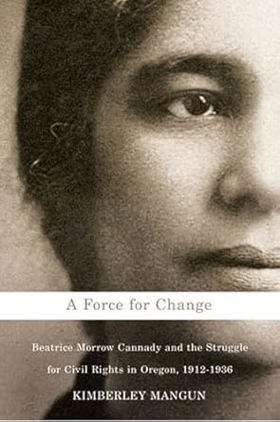
"A Force for Change is the first full-length study of the life and work of one of Oregon's most dynamic civil rights activists, Beatrice Morrow Cannady." "Between 1912 and 1936, Cannady tirelessly promoted interracial goodwill and fought segregation and discrimination. She gave hundreds of lectures to high school and college students and shared her message with radio listeners across the Pacific Northwest. She was assistant editor, and later publisher, of The Advocate, Oregon's largest African American newspaper. Cannady was the first black woman to graduate from law school in Oregon, and the first to run for state representative. She held interracial teas in her home in Northeast Portland and protested repeated showings of the racist film The Birth of a Nation. And when the Ku Klux Klan swept into Oregon, she urged the governor to act quickly to protect black Oregonians' right to live and work without fear. Despite these accomplishments, Beatrice Cannady fell into obscurity when she left Oregon in the late 1930s." "A Force for Change illuminates Cannady's key role in advocating for better race relations in Oregon in the early decades of the twentieth century. It describes her encounters with the period's leading black artists, editors, politicians, and intellectuals, including W. E. B. Du Bois, Langston Hughes, Oscar De Priest, Roland Hayes, and James Weldon Johnson. It dispels the myth that African Americans played little part in Oregon's history and it enriches our understanding of the black experience in Oregon and the civil rights movement across the country."--BOOK JACKET [vii], 344 pages : illustrations, portraits ; 23 cm CIRC [ 0 ]
|
2010 |
|
Atlas of Oregon wilderness by William L. Sullivan 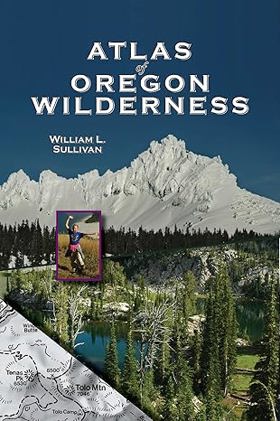
With the addition of 200,000 more acres designated by Congress as Oregon wilderness in 2009, use this as a planning guide to explore new areas and old favorites from The Three Sisters and Mount Hood to Eagle Cap and Steens Mountain. This is a complete guide to Oregon's backcountry. This complete guide to Oregon's backcountry includes the new wilderness areas designated by Congress in March 2009 as well as old favorites from Mt. Hood and the Three Sisters to Steens Mountain and the Wallowas. The atlas features 70 pages of detailed, shaded-relief maps, 40 pages of color photographs, 146 recommended backpacking trips, 500 featured hikes, and tips for mountain climbers, whitewater rafters, kayakers, Nordic skiers, and snowshoers. 384 pages : illustrations (some color), maps, plates ; 23 cm CIRC [ 0 ]
|
2010 |
|
The lumberman's frontier three centuries of land use, society, and change in America's forests by Thomas R. Cox 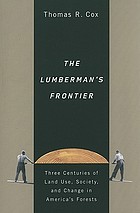
With The Lumberman’s Frontier, Thomas Cox has reconstructed a groundbreaking history that stands apart from all previous studies of American forests. Forests were ubiquitous in early America, but it was only in selected areas that trees, rather than farming, ranching, or mining, attracted settlement. These areas constitute the lumberman’s frontier, which appeared first in northern New England in the seventeenth century, followed by upstate New York, the Allegheny Plateau, the upper Great Lakes states, the Gulf South, and the Far West. The forest frontiers generated capital and building materials important in the nation’s development, but they also left a legacy of environmental problems, class and urban-rural divisions, and economic frictions. The 1930s marked the end of the lumberman’s frontier, but these consequences continue to shape attitudes and policies toward forests, most notably the questions “Whose forests are they?” and “How and by whom should forests be used?” Drawing upon recent work in social and economic history, as well as a wealth of historical data on forest industries and individuals, The Lumberman’s Frontier neither glorifies economic development nor falls into the maw of ecological gloom-and-doom. It puts individual actors at center stage, allowing the points of view of the workers and lumbermen to emerge. xi, 531 pages : illustrations, maps ; 23 cm CIRC [ 0 ]
|
2010 |
|
A river without banks place and belonging in the Inland Northwest by William C. Johnson 
A River Without Banks chronicles one family’s journey to Idaho, with all of its uncertainties, promises, and hopes. The book explores their encounters with a place still partly wild, whose communities and landscapes teach them how to respect the earth and each other. William Johnson’s essays move from a family vacation spent observing moose, to a comparison of the creation myths from Genesis and the Nez Perce, to watching a raptor seeking prey. Johnson meditates on how places, animals, and people teach us “how to see, and how we do, and don’t, belong.” In prose that reveals a poet’s eye, Johnson examines how family relationships affect how we see the natural world. He explores the power of words to divide and to heal. He illuminates the challenges of sustaining a vital relationship with a home place. A River Without Banks will appeal to readers interested in the literature of place, ecology, natural history, indigenous culture, and conservation. 160 pages ; 22 cm CIRC [ 0 ]
|
2010 |
|
To the woods sinking roots, living lightly, and finding true home by Evelyn Searle Hess 
To the Woods is a tale of adventure, inspiration, and living life in concert with nature. It is the true story of Evelyn Searle Hess, who, in her late fifties, walks away from the world of modern conveniences to build a new life with her husband on twenty acres of wild land in the foothills of Oregon's Coast Range. To the Woods tracks the natural history of place through the seasons. It describes Hess's day-to-day challenges, from living in a trailer without electricity or indoor plumbing to excavating a pond to dealing with health crises. It explores the joys of living simply, building a relationship with the natural world, and awakening to the interconnectedness of all life. Hess's careful attention to detail, her extensive knowledge of local flora and fauna, and her thoughtful philosophical meditations add richness to her engaging prose. To the Woods will appeal to readers interested in the environment and sustainable living, and to anyone who has ever considered fleeing the city for a life closer to nature. xvi, 175 pages ; 23 cm CIRC [ 0 ]
|
2010 |
|
Discovering Main Street travel adventures in small towns of the Northwest by Foster Church 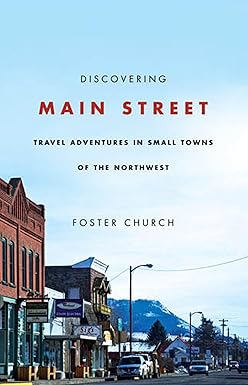
Small towns punctuate the landscape of Oregon and Washington. They burrow in crinkles of hills, sit alongside mighty rivers, survive in desert canyons and sagebrush plains, dot the fertile Willamette Valley, and perch at the edge of the Pacific Ocean. In Discovering Main Street, Foster Church reveals the unexpected and unique pleasures of exploring small towns, what he calls “the last frontier of American tourism.” Organized by region—Willamette Valley, Oregon Coast, Southern Oregon, Eastern Oregon, and Southern Washington—the profiles in Discovering Main Street begin with route tips and end with comments on where to stay and eat. Church’s engaging narratives provide history, highlights, and insights into each of the nearly fifty profiled communities. A useful introduction summarizes Church’s recommendations for a small town visit, which include hanging out at the local cafe, attending a school sports event, and hiking the surroundings—because without exception, small towns in the Northwest are set in hauntingly beautiful environments, from stark deserts to deep, mossy forests. Discovering Main Street provides an alternative to the outdoor adventure guides that dominate bookshelves in the Northwest. It will appeal to armchair travelers, to Northwest enthusiasts, and to any curious explorers seeking adventure in hidden—and unexpected—places. 192 pages : maps ; 22 cm CIRC [ 0 ]
|
2010 |
|
Where the Crooked River rises a high desert home by Ellen Waterston 
There is an otherness to the high desert, something momentous and sacred in the purity of the silence. In this compelling collection of personal essays, award-winning poet and author Ellen Waterston illuminates the people, places, and landscape of Central Oregon’s vast high desert. In Where the Crooked River Rises, Waterston reveals the blessings and challenges of decades spent as a rancher and town resident in a place that “has been, and remains,” her touchstone and crucible. The high desert is Waterston’s teacher, and she describes its lessons with grace and care, inviting readers to look at their own lives through a lens of wide-open spaces, sagebrush and juniper, pumice and rabbit brush. 142 pages : illustrations ; 22 cm CIRC [ 0 ]
|
2010 |
|
Shadow tribe the making of Columbia River Indian identity by Andrew H. Fisher 
Shadow Tribe offers the first in-depth history of the Pacific Northwest’s Columbia River Indians -- the defiant River People whose ancestors refused to settle on the reservations established for them in central Oregon and Washington. Largely overlooked in traditional accounts of tribal dispossession and confinement, their story illuminates the persistence of off-reservation Native communities and the fluidity of their identities over time. Cast in the imperfect light of federal policy and dimly perceived by non-Indian eyes, the flickering presence of the Columbia River Indians has followed the treaty tribes down the difficult path marked out by the forces of American colonization. Based on more than a decade of archival research and conversations with Native people, Andrew Fisher’s groundbreaking book traces the waxing and waning of Columbia River Indian identity from the mid-nineteenth through the late twentieth centuries. Fisher explains how, despite policies designed to destroy them, the shared experience of being off the reservation and at odds with recognized tribes forged far-flung river communities into a loose confederation called the Columbia River Tribe. Environmental changes and political pressures eroded their autonomy during the second half of the twentieth century, yet many River People continued to honor a common heritage of ancestral connection to the Columbia, resistance to the reservation system, devotion to cultural traditions, and detachment from the institutions of federal control and tribal governance. At times, their independent and uncompromising attitude has challenged the sovereignty of the recognized tribes, earning Columbia River Indians a reputation as radicals and troublemakers even among their own people. Shadow Tribe is part of a new wave of historical scholarship that shows Native American identities to be socially constructed, layered, and contested rather than fixed, singular, and unchanging. From his vantage point on the Columbia, Fisher has written a pioneering study that uses regional history to broaden our understanding of how Indians thwarted efforts to confine and define their existence within narrow reservation boundaries. xi, 337 pages, 16 unnumbered pages of plates : illustrations, maps ; 23 cm. CIRC [ 1 ]
|
2010 |
|
Massacred for gold the Chinese in Hells Canyon by R. Gregory Nokes 
In 1887, more than 30 Chinese gold miners were massacred on the Oregon side of Hells Canyon, the deepest canyon in North America. Massacred for Gold, the first authoritative account of the unsolved crime—one of the worst of the many crimes committed by whites against Chinese laborers in the American West—unearths the evidence that points to an improbable gang of rustlers and schoolboys, one only 15, as the killers. The crime was discovered weeks after it happened, but no charges were brought for nearly a year, when gang member Frank Vaughan, son of a well-known settler family, confessed and turned state’s evidence. Six men and boys, all from northeastern Oregon’s remote Wallowa country, were charged—but three fled, and the others were found innocent by a jury that a witness admitted had little interest in convicting anyone. A cover-up followed, and the crime was all but forgotten for the next 100 years, until a county clerk found hidden records in an unused safe. In bringing this story out of the shadows, Nokes examines the once-substantial presence of Chinese laborers in the interior Pacific Northwest, describing why they came, how their efforts contributed to the region’s development, and how too often mistreatment and abuse were their only reward. 208 pages : illustrations, map, portraits ; 23 cm CIRC [ 1 ]
|
2009 |
|
Roche Harbor by Richard Walker 
Working with Roche Harbor archivists as well as owners of private photo collections, Walker has selected more than 200 images and written text to illustrate the visual history of Roche Harbor and the people who have lived there 127 pages : chiefly illustrations ; 24 cm. CIRC [ 1 ]
|
2009 |
|
Friday Harbor by Mike Vouri , Julia Vouri , San Juan Historical Society 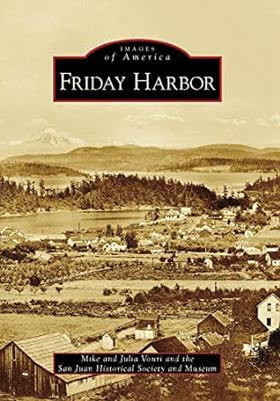
Friday Harbor, Washington was incorporated in 1909. As with many of the young state's small port towns, timber, salmon fishing, and farming fueled Friday Harbor's early economy. Life slowed and some left, but in being passed--until tourism caught on in the late 1970s--the town (and island) developed a unique sense of community that survives to this day 127 pages : illustrations, maps, portraits ; 24 cm. CIRC [ 1 ]
|
2009 |
|
The encyclopedia of raincoast place names a complete reference to coastal British Columbia by Andrew Scott 
In 1909 Captain John T. Walbran published one of the most beloved and enduring of all BC books, British Columbia Coast Names. Harbour Publishing celebrates the hundredth anniversary of that landmark work by presenting the first book to update Walbran's classic, Andrew Scott's Raincoast Place Names. Like its progenitor, Raincoast Place Names is much more than simply a catalogue of name origins because it tells the often fascinating stories behind the names and in so doing serves as a history of the region in capsule form. It is also a monumental work, twice the size of Walbran's and including more than three times as many places. Four thousand entries consider, in intriguing detail, the stories behind over five thousand place names: how they were discovered, who named them and why, and what the names reveal. It describes the original First Nations cultures, the heroics of the 18th-century explorers and fur traders, the gruelling survey and settlement efforts of the 19th century, the lives of colonial officials, missionaries, gold seekers and homesteaders, and the histories of nearly every important vessel to sail or cruise the coast. 661 pages : illustrations (some color), maps, portraits ; 26 cm CIRC [ 1 ]
|
2009 |
|
The Cowichan Duncan, Chemainus, Ladysmith and region : including Cobble Hill, Cowichan Bay, Cowichan Lake and communities, Crofton, Glenora, Maple Bay, Mill Bay and Shawnigan Lake by Georgina Montgomery, Kevin Oke 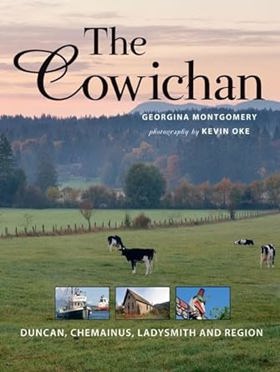
The Cowichan Region is the large area that lies between the cities of Victoria and Nanaimo on Vancouver Island, reaching from the protected eastern shores of the island nearly all the way west to the Pacific Ocean. Its cornucopia-like shape is fitting for a place of such remarkable bounty, and this area is home to a growing number of newcomers seeking its pleasant climate, recreational activities and culinary delights. Sometimes referred to as Canada's Provence, the name Cowichan is derived from a Coast Salish word meaning "warm land" or "basking in the sun." 143 pages : illustrations (chiefly color), maps, portraits ; 29 cm CIRC [ 1 ]
|
2009 |
|
Day hiking. Central Cascades by Craig Romano, Alan Bauer 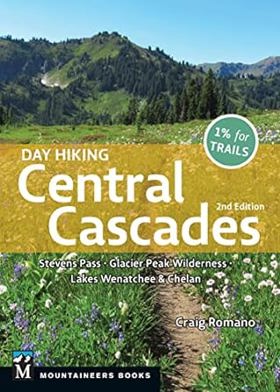
Describes 125 hiking trails in the Central Cascades in Washington state, including detailed route descriptions, information on camping options, flora, fauna, historical trails, photographs, and maps. With some of the largest tracts of wilderness to be found in the Pacific Northwest, the Central Cascades are packed with wildlife, geological diversity, and opportunity for adventure. Using US Highway 2 as its primary organizing principle, this second edition of Day Hiking Central Cascades focuses on the best day hikes to be found between the Sultan Basin and Wenatchee, and around Blewett Pass, Chelan, and the Stehekin and Entiat River Valleys. 355 pages : illustrations (some color), maps (some color) ; 18 cm CIRC [ 1 ]
|
2009 |
|
A bridge back the early days of Florence, Oregon by Ellen Traylor 
A Bridge Back, The Early Days of Florence, Oregon is an entertaining romp into the early history of a rollicking town, at once "wild west" and "gentle natured." It was a small town with a big heart and many colorful characters. They followed in the footsteps of greatness, on the trail of Lewis and Clark, Jedediah Smith and in the shadow of railroad barons and spruce-winged airplanes. Meet the adventuresome dreamer-founder and his bandito-turned-poet brother; meet the bold editor of the town paper, who went on to be a senator; meet the brave settler who saved a wagon master from mob attack; meet the lovely Rhododendron Queen who married the founder's nephew; meet the fishermen who blew up bombs in the river and the young man who sauntered nude down the beach; meet the greedy publisher who sided with grasping barons to his own downfall; and meet the bumbling Romeo who snapped a photo of his girl as she sank in quicksand. If you know Florence, you will never see her the same way again. If you do not know Florence, prepare to fall in love. A project of Merchants of Old Town Florence for the 150th Anniversary of Oregon. 110 pages : illustrations ; 28 cm CIRC [ 1 ]
|
2009 |
|
Whidbey Island's special places and the people who love them by Dan Pedersen 
Through ten people, Pedersen tells the stories of 10 different places. The names are recognizable to many: Ranger Rick Blank at Deception Pass State Park, Roger Sherman on Central Whidbey, and Elliott Menasche, an authority on South Whidbey State Park, for example. In simple feature stories he smoothly describes the places and the people who treasure them. It’s an easy read, but surprisingly informative even for long-time islanders. You may not have known, for example, that the oldest tree on the island, located in Deception Pass State Park, recently celebrated its 860th birthday. 63 pages : color illustrations, color map ; 22 x 28 cm CIRC [ 1 ]
|
2009 |
|
The remarkable world of Frances Barkley, 1769-1845 by Beth Hill, Cathy Converse 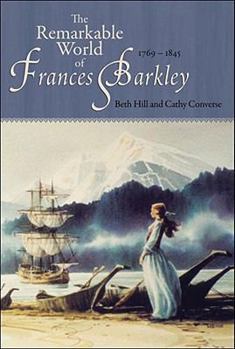
Frances Barkley was the first European woman to set foot on the coast of B.C. In 1786, she embarked from Europe on a trade and exploration voyage with her husband, Captain Charles W. Barkley. Her reminiscences contain her descriptions of their life at sea, and visits to S. American, India, China, and what is now known as Alaska and B.C xv, 207 p. : ill., ports., maps ; 23 cm. CIRC [ 1 ]
|
2009 |
|
The HBC fur brigade-First Nations trail of 1848-49 by Charles Hou 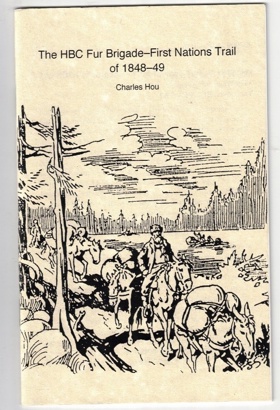
Published in 2009, Charles Hou’s The HBC Fur Brigade-First Nations Trail of 1848-49 examines the historic development and geography of the Hudson's Bay Company's vital trade route connecting the interior of British Columbia to the Pacific coast. The illustrated account details how chief trader Alexander Caulfield Anderson and company men mapped out new pathways between Fort Kamloops and Fort Langley to bypass the treacherous, impassable canyons of the lower Fraser River. Drawing heavily on archival records, the book maps the physical layout of these pack-horse routes and the immense logistical challenges required to sustain them. A keen insight drawn from the text is how it powerfully subverts the traditional corporate narrative of the fur trade; by foregrounding the indispensable geographic knowledge and guidance provided by local First Nations, Hou reveals that the survival and success of these imperial commercial arteries relied entirely on indigenous expertise rather than autonomous European exploration. 32 p. : ill. (some col.), maps ; 22 cm. CIRC [ 0 ]
|
2009 |
|
Backcountry roads--Idaho by Lynna Howard, Leland Howard 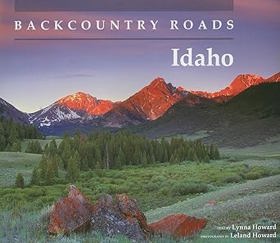
Backcountry Roads- Idaho is a beautiful, informative and practical guide to the Gem State's hidden treasure of roadways. Enhanced by 140 photos from award-winning photographer Leland Howard, Backcountry Roads-Idaho is a rarity, a guidebook that is also a work of art. Award-winning outdoor writer Lynna Howard provides GPS coordinates, expedition maps, and detailed descriptions for would be explorers. Her creative flair brings backcountry travel to life with an immediacy that engages all the senses. This is an indispensable tool for anyone who wishes to experience firsthand the rugged beauty of scenic Idaho 240 pages : color illustrations, color maps ; 22 x 28 cm CIRC [ 0 ]
|
2009 |
|
Murder, morality and madness women criminals in early Oregon by Diane L. Goeres-Gardner 
The Victorians who settled the Oregon Territory were adept at keeping immoral or bad behavior a secret. Goeres-Gardner uncovers the secret past of abuse, neglect, and double standards that existed for women criminals. Discover what drove proper Victorian women to murder. You ll learn about women s trials and their all-male jurors and the horrid conditions they faced in all-male prisons. xix, 199 pages : illustrations ; 23 cm CIRC [ 0 ]
|
2009 |
|
Charles Wilkes and the exploration of inland Washington waters journals from the expedition of 1841 by Richard W. Blumenthal 
"Follows the Wilkes Expedition in 1841. Includes the journals of Charles Wilkes and ten of his crewmen, eighteen of the Wilkes Expedition's charts (the quality of which reflects the crew's careful attention to accuracy), and a complete muster list of the officers and crewmen (name, title, and a brief synopsis of his activity within the expedition"--Provided by publisher v, 314 pages : maps ; 23 cm CIRC [ 0 ]
|
2009 |
|
Calamity the Heppner flood of 1903 by Joann Green Byrd 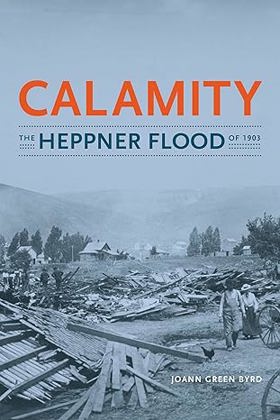
June 14, 1903, was a typical, hot Sunday in Heppner, a small farm town in northeastern Oregon. People went to church, ate dinner, and relaxed with family and friends. But late that afternoon, calamity struck when a violent thunderstorm brought heavy rain and hail to the mountains and bare hills south of town. When the fierce downpour reached Heppner, people gathered their children and hurried inside. Most everyone closed their doors and windows against the racket. The thunder and pounding hail masked the sound of something they likely could not have imagined: a roaring, two-story wall of water raging toward town. Within an hour, one of every five people in the prosperous town of 1,300 would lose their lives as the floodwaters pulled apart and carried away nearly everything in their path. The center of town was devastated. Enormous drifts of debris, tangled around bodies, snaked down the valley. The telegraph was down, the railroads were out, and the mayor was in Portland. Stunned survivors bent immediately to the dreadful tasks of searching for loved ones and carrying bodies to a makeshift morgue in the bank. By the next afternoon, thousands of individuals and communities had rushed to the town's aid, an outpouring of generosity that enabled the self-reliant citizens of Heppner to undertake the town's recovery. In Calamity, Joann Green Byrd, a native of eastern Oregon, carefully documents this poignant story, illustrating that even the smallest acts have consequences - good or bad. She draws on a wealth of primary sources, including a moving collection of photographs, to paint a rare picture of how a small town in the West coped with disaster at the turn of the twentieth century. xviii, 202 pages : illustrations, maps ; 23 cm CIRC [ 0 ]
|
2009 |
|
The good times are all gone now life, death, and rebirth in an Idaho mining town by Julie W. Weston 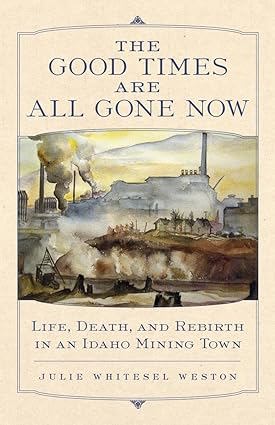
Julie Whitesel Weston left her hometown of Kellogg, Idaho, but eventually it pulled her back. Only when she returned to this mining community in the Idaho Panhandle did she begin to see the paradoxes of the place where she grew up. Her book combines oral history, journalistic investigation, and personal reminiscence to take a fond but hard look at life in Kellogg during "the good times." Kellogg in the late 1940s and fifties was a typical American small town complete with high school football and basketball teams, marching band, and anti-Communist clubs; yet its bars, gambling dens, and brothels were entrenched holdovers from a rowdier frontier past. The Bunker Hill Mining Company, the largest employer, paid miners good wages for difficult, dangerous work, while the quest for lead, silver, and zinc denuded the mountainsides and laced the soil and water with contaminants. Weston researched the late-nineteenth-century founding of Kellogg and her family's five generations in Idaho. She interviewed friends she grew up with, their parents, and her own parents' friends--miners mostly, but also businesspeople, housewives, and professionals. Much of this memoir of place set during the Cold War and post-McCarthyism is told through their voices. But Weston also considers how certain people made a difference in her life, especially her band director, her ski coach, and an attorney she worked for during a major strike. She also explores her charged relationship with her father, a hardworking doctor revered in the community for his dedication but feared at home for his drinking and rages. The Good Times Are All Gone Now begins the day the smokestacks came down, and it reaches far back into collective and personal memory to understand a way of life now gone. The company town Weston knew is a different place, where "Uncle Bunker" is a Superfund site, and where the townspeople, as in previous hard times, have endured to reinvent Kellogg--not once, but twice xv, 231 pages : illustrations, photographs ; 22 cm CIRC [ 0 ]
|
2009 |