Catalog of British Columbiana and Pacific Northwest Americana
Encyclopedia Cascadia Catalog contains book titles of mostly non-fiction Pacific Northwest Coast of North America Titles (primarially British Columbia, Idaho, Oregon and Washington State) in an easy-to-understand title catalog. If you see a link with this badge ONLINE CIRC it means that there is an online institution that provides free access to that title. In some cases there may be more than one institution hosting the title digitally.
| Catalog Title | Published |
|---|---|
|
Mushrooms of Idaho and the Pacific Northwest by Edmund E. Tylutki 
This volume is the culmination of over two decades of study of Pacific Northwest mushrooms. You will find this guide an essential for your mushroom collection kit. Mushroom enthusiasts are advised on when and where to collect, how to distinguish from toadstools and on the development and parts of the mushroom. Valuable and complete information is provided for 354 species of non-gilled mushrooms in the Northwest, including 119 species of boletes, 119 coral fungi, 12 chanterelles, 121 polypores, and 50 spine fungi. Field and technical keys for the determination of species, along with descriptions and black & white photographs. --Publisher volumes <1-2> : illustrations (some color) ; 21 cm. CIRC [ 0 ]
|
1987 |
|
Murders on the Skeena true crime in the old Canadian West, 1884-1914 by Geoff Mynett 
"Part history, part true crime, Murders on the Skeena: True Crime in the Old Canadian West, 1884-1914 contains the true accounts of murders, crimes, and scandals--some of which remain unsolved to this day--in small-town northern British Columbia. With a focus on the victims as much as the cases themselves, award-winning author Geoff Mynett relates untold stories of BC's deadly history while providing both the natural and social history of the region. Hazelton, situated where the Bulkley River joins the Skeena River, was one of the most important sites in the interior of northern BC from 1870-1913. The gold rush, the arrival of the telegraph, and the ability for steam boats to journey upriver increased outside interest in the region. As new modes of transport were built, more non-Indigenous people arrived, and as colonial law and governance increased, so did tensions between Indigenous and non-Indigenous people. One such case was that of the murder of Amos "Charley" Youmans in 1884--the escalation of a clash between the laws and customs of the Gitxsan and those of the encroaching traders and settlers. Mynett also recounts the stories of the so-called Skeena River Uprising of 1888, a bank robbery shoot-out, and a deadly dispute between two prospectors. Peeling back historical, social, political, and geographical layers, Murders on the Skeena draws almost exclusively from documents from the time to reveal the fascinating secrets and surprising consequences of these captivating true crime tales.-- Provided by publisher 255 pages : illustrations, map ; 23 cm CIRC [ 0 ]
|
2021 |
|
Murderland crime and bloodlust in the time of serial killers by Caroline Fraser 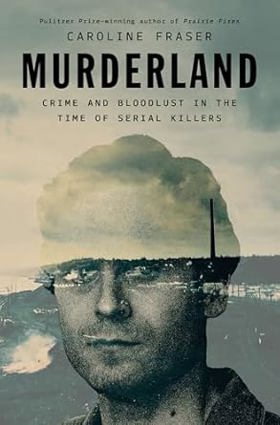
"From the Pulitzer Prize-winning author of Prairie Fires comes a terrifying true-crime history of serial killers in the Pacific Northwest and beyond-a gripping investigation of how a new strain of psychopath emerged out of a toxic landscape of deadly industrial violence Caroline Fraser grew up in the shadow of Ted Bundy, the most notorious serial murderer of women in American history, surrounded by his hunting grounds and mountain body dumps, in the brooding landscape of the Pacific Northwest. But in the 1970s and '80s, Bundy was just one perpetrator amid an uncanny explosion of serial rape and murder across the region. Why so many? Why so weirdly and nightmarishly gruesome? Why the senseless rise and then sudden fall of an epidemic of serial killing? As Murderland indelibly maps the lives and careers of Bundy and his infamous peers in mayhem-the Green River Killer, the I-5 Killer, the Night Stalker, the Hillside Strangler, even Charles Manson-Fraser's Northwestern death trip begins to uncover a deeper mystery and an overlapping pattern of environmental destruction. At ground zero in Ted Bundy's Tacoma stood one of the most poisonous lead, copper, and arsenic smelters in the world, but it was hardly unique in the West. As Fraser's investigation inexorably proceeds, evidence mounts that the plumes of these smelters not only sickened and blighted millions of lives but also warped young minds, including some who grew up to become serial killers. A propulsive nonfiction thriller, Murderland transcends true-crime voyeurism and noir mythology, taking readers on a profound quest into the dark heart of the real American berserk"-- Provided by publisher 466 pages, 16 unnumbered pages of plates : illustrations (some color), maps (some color) ; 25 cm CIRC [ 0 ]
|
2025 |
|
Murder, morality and madness women criminals in early Oregon by Diane L. Goeres-Gardner 
The Victorians who settled the Oregon Territory were adept at keeping immoral or bad behavior a secret. Goeres-Gardner uncovers the secret past of abuse, neglect, and double standards that existed for women criminals. Discover what drove proper Victorian women to murder. You ll learn about women s trials and their all-male jurors and the horrid conditions they faced in all-male prisons. xix, 199 pages : illustrations ; 23 cm CIRC [ 0 ]
|
2009 |
|
Murder at the mission a frontier killing, its legacy of lies, and the taking of the American West by Blaine Harden , Jeffrey L. Ward (Cartographer) 
"The New York Times bestselling author of Escape From Camp 14 returns with the riveting and revealing story of one of the most persistent "alternative facts" in American history: the story of a missionary, a tribe, a massacre, and a myth that shaped the American West In 1836, two missionaries and their wives were among the first Americans to cross the Rockies by covered wagon on what would become the Oregon Trail. Dr. Marcus Whitman and Reverend Henry Spalding were headed to present-day Washington state and Idaho, where they aimed to convert members of the Cayuse and Nez Perce tribes. Both would fail spectacularly as missionaries. But Spalding would succeed as a propagandist, inventing a story that recast his friend as a hero, and helped to fuel the massive westward migration that would eventually lead to the devastation of those they had purportedly set out to save. As Spalding told it, after uncovering a British and Catholic plot to steal the Oregon Territory from the United States, Whitman undertook a heroic solo ride across the country to alert the President. In fact, he had traveled to Washington to save his own job. Soon after his return, Whitman, his wife, and eleven others were massacred by a group of Cayuse. Though they had ample reason--Whitman supported the explosion of white migration that was encroaching on their territory, and seemed to blame for a deadly measles outbreak--the Cayuse were portrayed as murderous savages. Five were executed. This fascinating, impeccably researched narrative traces the ripple effect of these events across the century that followed. While the Cayuse eventually lost the vast majority of their territory, thanks to the efforts of Spalding and others who turned the story to their own purposes, Whitman was celebrated well into the middle of the 20th century for having "saved Oregon." Accounts of his heroic exploits appeared in congressional documents, The New York Times, and Life magazine, and became a central founding myth of the Pacific Northwest. Exposing the hucksterism and self-interest at the root of American myth-making, Murder at the Mission reminds us of the cost of American expansion, and of the problems that can arise when history is told only by the victors"-- Provided by publisher xxxi, 432 pages : illustrations, map ; 24 cm CIRC [ 0 ]
|
2021 |
|
Murder at Hogans Corner, Washington an American destiny by Wallace Louis Exum 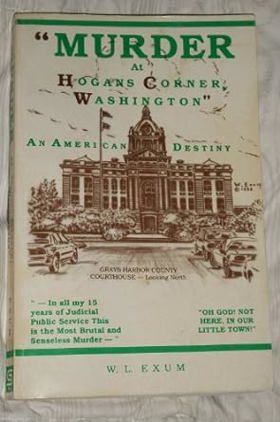
Authored by Wallace Louis Exum, Murder at Hogans Corner, Washington: An American Destiny investigates a dark, sensationalized 1930s homicide that sent shockwaves through a rural Grays Harbor County crossroads community. The book reconstructs the chilling details of the crime, the subsequent manhunt, and the local judicial proceedings that riveted the Pacific Northwest during the height of the Great Depression. Through meticulous archival research, the author uses the lens of a single sensational murder to expose the raw underbelly of an isolated frontier region wrestling with sudden economic despair. A keen insight drawn from the work is how true-crime narratives function as mirrors for societal anxiety; by probing a localized act of violence against the backdrop of economic collapse, the text reveals that the true horror of the era was not merely an isolated murder, but the pervasive social unraveling of a forgotten rural populace pushed to the brink by structural poverty. xiii, 227 pages : portrait ; 21 cm CIRC [ 1 ]
|
1992 |
|
Murder & mayhem in Boise by Mark Iverson , Jeff Wade 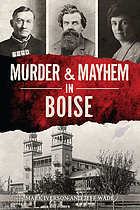
Cemetery stories : where'd Dr. McIteeny get to and the Sad tale of Sergeant Peter Vogel; Ezekiel Litell's axe to grind; Grove Street gutting; H.B. Lane orders a drink, is served a shot; The wheels of justice begin to turn; Simeon Walters's short drop; A bad year in the life of T. Burmester, Esquire; Never let your guard down at Goodwin's mill 127 pages : illustrations ; 23 cm CIRC [ 0 ]
|
2022 |
|
Multnomah the tumultuous story of Oregon's most populous county by Jewel Beck Lansing, Fred Leeson 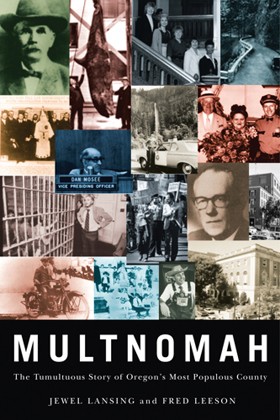
Covering people and events from 1854 to the present day, this definitive reference on the history, politics, and policy of Multnomah County provides compelling details about public works undertakings and political scandals. Oregon’s tiniest county geographically quickly grew to be the state’s most populous. Through nearly sixteen decades, Multnomah County’s history seldom has been calm and peaceful. From hangings that turned into grim public spectacles in the nineteenth century to a glaring failure to deal with urban growth in the middle of the twentieth, the county has survived frequent home rule charter changes and several attempts to revamp its structure or merge with Portland’s better-known municipal government. Highlighted episodes include the construction of the iconic Columbia River Highway between 1914 and 1918, the tragic flooding of Vanport City in 1948, the employee strike of 1980, the library scandal of 1989- 1990, and the same-sex marriage license debacle of 2004. Historian Jewel Lansing and journalist Fred Leeson make effective use of archival sources, oral histories, newspaper articles, and personal interviews. History buffs and informed Portland citizens will be particularly engaged by the regional trivia and narrative details. x, 326 pages : illustrations, maps ; 23 cm CIRC [ 0 ]
|
2012 |
|
Muggins the life and afterlife of a Canadian canine war hero by Grant Hayter-Menzies , Mark Zuehlke 
"The unusual and moving tale of Muggins, a famed fundraising dog who became a mascot of the Canadian Red Cross during the First World War. Born in 1913 in the home of a millionaire philanthropist, Muggins was a purebred Spitz, a sharp-eared, sharp-nosed, fluffy-tailed sort of dog most often seen in the lap of a lady of leisure. But Muggins defied the odds, rising to unlikely fame during the First World War, when he became Victoria, BC's most diminutive fundraiser. He was taught to wander through downtown during the war with two change donation boxes tied to his back, and ultimately collected the equivalent of $400,000 for charities and causes including the Red Cross, the Blue Cross, food for poor children and prisoners of war, victims of Jewish pogroms, to name a few. During his short life, Muggins visited ferries and freight liners stopping in Victoria. He appeared in photos with the Prince of Wales and with famous Canadian general Sir Arthur Currie, among other celebrated admirers. He was also a favourite of the rank and file, helping cheer up wounded soldiers at Esquimalt Military Hospital. Muggins was made an honourary first lieutenant by the United States military for his service raising funds in Seattle. And he was so loved by departing soldiers he was more than once nearly taken along to the theatre of war. Based on valuable documents, memorabilia, newspaper and newsreel accounts of Muggins's brief but brilliant career, this book tackles the difficult question of human use of animals in war, at home and on the battlefield. It explores how crucial animals, specifically dogs, have been to wounded veterans recovering from physical and emotional damage--both in Muggins's lifetime and now."-- Provided by publisher xv, 199 pages, 24 unnumbered pages of plates : illustrations, portraits ; 22 cm CIRC [ 0 ]
|
2021 |
|
Moving Washington timeline the first century of the Washington State Department of Transportation, 1905-2005 by Walt Crowley, Kit Oldham , HistoryLink (Firm) (Publisher), Washington (State). Department of Transportation 
"This book retraces how the leaders and employees of the Washington State Department of Transportation and their predecessors helped to shape Washington's transportation system during a century of technological revolution and dramatic transformation of its communities and landscapes." "Moving Washington Timeline was prepared for the Washington State Department of Transportation with the support of private donors and a Federal Highway Administration grant to commemorate the creation of the 127, [1] pages : illustrations (some color), maps (some color), portraits (some color) ; 22 cm CIRC [ 1 ]
|
2005 |
|
Mountain camp fires by Edmond S. Meany 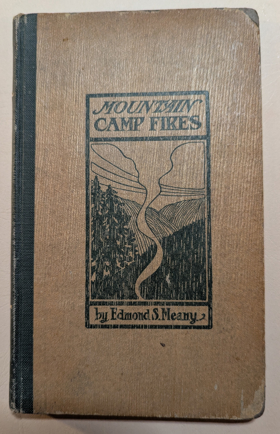
Authored by prominent Pacific Northwest historian and avid outdoorsman Edmond S. Meany, Mountain Camp Fires is a 1911 collection of evocative poetry celebrating the rugged, untamed wilderness of Washington State. The volume captures the spirit of the nascent "Mountaineers" club, translating the physical exhaustion and spiritual triumphs of alpine climbing, forest treks, and starlit encampments into romantic verse. Rather than detailing regional economic conquests, Meany uses rhythmic tributes to local geography, flora, and the camaraderie of the campfire to document the emerging conservationist ethos of the early 20th century. A keen insight drawn from the work is how the popularization of wilderness poetry signaled a profound regional shift in the cultural conception of nature; by framing the harsh, mountainous frontier as a sanctuary for spiritual renewal and recreation, Meany's verse captures the exact historical moment when the Pacific Northwest landscape transitioned from a hostile adversary to be conquered into a curated playground for the urban middle class. viii, 90 pages, 1 unnumbered leaf of plates frontispiece (illustration) 19 cm CIRC [ 1 ]
|
1911 |
|
Mount Rainier National Park an artist's tour by Molly Hashimoto (Author, Illustrator) 
"Illustrated with Molly Hashimoto's color sketches and watercolors, 'Mount Rainier National Park: An Artist's Tour' is a personal account of some of the human and natural history and flora and fauna found in the areas that are accessible via the main roads that encircle Mount Rainier National Park"-- Provided by publisher 131 pages : color illustrations ; 17 x 21 cm CIRC [ 0 ]
|
2021 |
|
Mount Multnomah, ancient ancestor of the Three Sisters by Edwin T. Hodge, University of Oregon (Publisher) 
Mount Multnomah is an invalidated hypothetical ancient volcano postulated in a 1925 publication by geologist Edwin T. Hodge. It was proposed to exist in central Oregon at the present day location of the Three Sisters region. It was estimated to have been around 16,000-foot (4,900 m) tall, and was believed destroyed in a fashion similar to Mount Mazama's eruption resulting in what is now Crater Lake in southern Oregon. 1 preliminary leaf, v, [1], 158, [2] pages, 1 unnumbered leaf of plates : illustrations, folded color map (in pocket) ; 26 cm CIRC [ 1 ]
|
1925 |
|
|
1975 |
|
Mount Baker a chronicle of its historic eruptions and first ascent by Harry M. Majors
|
1978 |
|
Mosquito fleet of South Puget Sound by Jean Cammon Findlay, Robin Paterson 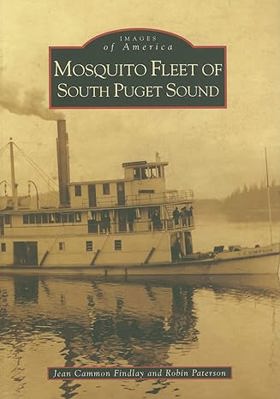
"Before the advent of roads in western Washington, steamboats of the Mosquito Fleet swarmed all over Puget Sound. Sidewheelers, stern-wheelers, and propeller-driven, they ranged from the tiny 40-foot Marie to the huge 282-foot Yosemite, and from the famous Flyer to the unknown Leota. Floating stores like the Vaughn and shrimpers like the Violet sailed the same waters as the elegant Great Lakes lady, the Chippewa, and the homely Willie. A few, like the Bob Irving and Blue Star, died spectacularly or, like Major Tompkins, shipwrecked after a short time, while others began new lives as tugboats or auto ferries; some even survive today as excursion boats like the Virginia V. From 1853 to modern car ferries in the 1920s, this volume chronicles the heyday of steamboating a unique segment of maritime history from modest launch to sleek liner."--Back cover 127 pages : illustrations, maps ; 24 cm. CIRC [ 1 ]
|
2008 |
|
Moscow's centennial, 1887-1987 a century smiles by Idahonian
|
1987 |
|
Moscow at the turn of the century by Homer David
|
1979 |
|
Moscow by Julie R. Monroe 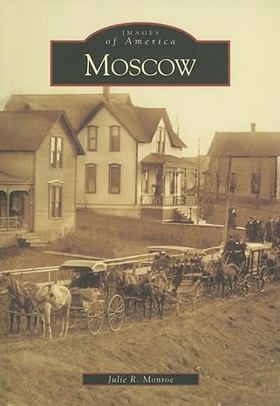
Each spring for centuries, the Nez Perce Indians visited the area they called Taxt-hinma (place of the spotted deer) to harvest the camas root. Today Taxt-hinma is Moscow, Idaho, a forward-looking university community dedicated to preserving the spirit of place that attracted the area's first permanent settlers in 1871. Originally known as Paradise, Moscow started out as a trading center serving homesteaders settling the prodigiously fertile Palouse. Since its incorporation as a city in 1887, Moscow has grown steadily upon a foundation of education and agriculture. From its central core of notable commercial and public buildings to the splendid houses that once sheltered its founders to the scenic University of Idaho campus, Moscow is clearly a community that values its cultural, economic, architectural, and natural heritage 127 pages : chiefly illustrations ; 24 cm. CIRC [ 0 ]
|
2006 |
|
Moscow living and learning on the Palouse by Julie R. Monroe 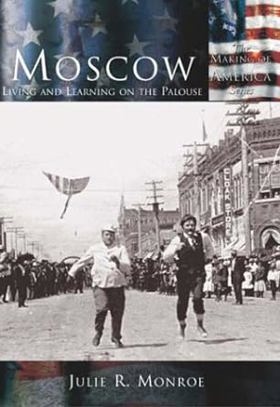
Published in local editions by Julie R. Monroe, Moscow: Living and Learning on the Palouse explores the unique cultural and historical evolution of this iconic north-central Idaho college town. The book chronicles Moscow's transition from a nascent pioneer settlement into the intellectual hub of the rolling Palouse hills, deeply shaped by the establishment of the University of Idaho in 1889. Through archival photographs and engaging community narratives, the text highlights the enduring interplay between agricultural grit and academic ambition. A keen insight drawn from the work is how isolated university towns create distinct cultural islands; by placing a major institution of higher learning in the middle of a vast, conservative farming economy, Moscow fostered a rare hybrid society where agrarian pragmatism and progressive intellectualism perpetually collide and shape each other. 160 pages : illustrations ; 25 cm. CIRC [ 0 ]
|
2003 |
|
More than a thousand points of light by Herbert A. Pfiffner, Seattle's Union Gospel Mission
Celebrates and commemorates sixty years of Seattle's Union Gospel Mission 90 pages : illustrations ; 22 cm CIRC [ 1 ]
|
1992 |
|
More than a store Frederick & Nelson, 1890 to 1990 by Robert Spector
|
1990 |
|
Monte Cristo by Philip R. Woodhouse, Robert L. Wood
|
1979 |
|
Money trees the Douglas fir and American forestry, 1900-1944 by Emily K. Brock 
"Around the start of the last century, the forests of the Pacific Northwest were viewed as dynamic sites of industrial production, and also as natural landscapes of ecological integrity. These competing visions arose as the nation's professional foresters faced conflicting demands from lumber companies and government regulators. External pressures converged with internal scientific debates within the profession, leading foresters to question the proper scope of their work. Money Trees is an interdisciplinary history of the crucial decades that shaped the modern American conception of the value of the forest. It begins with early twentieth century environmental changes in the Douglas Fir forests of the Pacific Northwest, which led to increasing divisiveness and controversy among foresters. Brock balances this regional story with a national view of the intellectual and political currents that governed forest management, marshaling archival evidence from industry, government, and scientific sources. An important contribution to environmental scholarship, Money Trees offers a nuanced vision of forestry's history and its past relationship to both wilderness activism and scientific ecology. With fresh perspectives on well-known environmental figures such as Bob Marshall and Gifford Pinchot, it will add to the conversation among scholars in environmental history, history of science, and the history of the American West. It will be welcomed as a key resource across the spectrum of environmental studies, and by anyone interested in natural resources, land management, the role of science in environmentalism, and the modern wilderness movement."-- Back cover 272 pages : illustrations, map ; 23 cm CIRC [ 0 ]
|
2015 |
|
Modoc the tribe that wouldn't die by Cheewa James 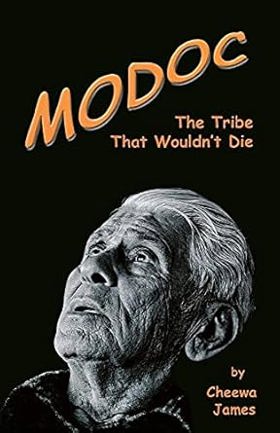
In Modoc: The Tribe That Wouldn't Die, Cheewa James, a direct descendent Modoc War hero Shkeitko, aka "Shacknasty Jim", recounts the explosive and personal story of her ancestors in a richly documented, non-fiction narrative that occasionally incorporates fictionalized inserts to help bring the story to life-an asset for school and family reading. Covering Modoc history from ancestral times to the present, this unique book includes over 100 rare black and white photographs of the Modoc War, historic Modoc men, women and children--many handed down through Cheewa's family--and life from times past. There are 40 color photographs of Modocs and their activities in current times. The book contains accounts from the letters of soldiers and eye-witnesses never before published. The six-month long Modoc War, fought in 1872-73, pitted some fifty-five Modoc warriors against 1,000 U.S. soldiers in the jagged, hostile terrain of today's Lava Beds National Monument, where both warriors and families held out in Captain Jack's Stronghold, a massive lava-cave maze named after the Modoc leader. The surviving Modocs were exiled to Oklahoma Indian Territory, where they faced the added trauma of disease and corrupt officials. Some later returned to the Klamath Reservation in Oregon, where Cheewa was born. x, 335 pages, 8 unnumbered pages of plates : illustrations (some color), maps, portraits ; 22 cm CIRC [ 0 ]
|
2008 |