Catalog of British Columbiana and Pacific Northwest Americana
Encyclopedia Cascadia Catalog contains book titles of mostly non-fiction Pacific Northwest Coast of North America Titles (primarially British Columbia, Idaho, Oregon and Washington State) in an easy-to-understand title catalog. If you see a link with this badge ONLINE CIRC it means that there is an online institution that provides free access to that title. In some cases there may be more than one institution hosting the title digitally.
| Catalog Title | Published |
|---|---|
|
Chinook resilience heritage and cultural revitalization on the lower Columbia River by Jon Darin Daehnke 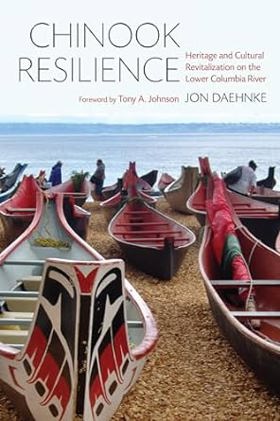
The Chinook Indian Nation--whose ancestors lived along both shores of the lower Columbia River, as well as north and south along the Pacific coast at the river's mouth--continue to reside near traditional lands. Because of its nonrecognized status, the Chinook Indian Nation often faces challenges in its efforts to claim and control cultural heritage and its own history and to assert a right to place on the Columbia River. Chinook Resilience is a collaborative ethnography of how the Chinook Indian Nation, whose land and heritage are under assault, continues to move forward and remain culturally strong and resilient. Jon Daehnke focuses on Chinook participation in archaeological projects and sites of public history as well as the tribe's role in the revitalization of canoe culture in the Pacific Northwest. This lived and embodied enactment of heritage, one steeped in reciprocity and protocol rather than documentation and preservation of material objects, offers a tribally relevant, forward-looking, and decolonized approach for the cultural resilience and survival of the Chinook Indian Nation, even in the face of federal nonrecognition xix, 233 pages : illustrations, maps ; 24 cm. CIRC [ 1 ]
|
2017 |
|
Chinook a history and dictionary by Edward Harper Thomas
|
1970 |
|
Chinese opium in America, 1850-1920 by Bennet Bronson , Chuimei Ho 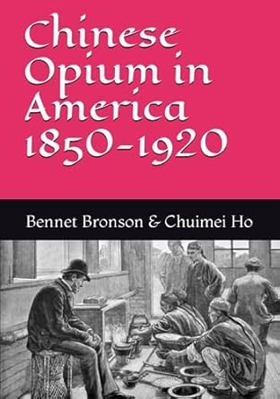
"Many Chinese-American historians have tended to shy away from the subject of Chinese opium use in 19th century North America entirely and so have their counterparts in Asia. Opium use among Chinese immigrants was widespread, economically important, and -- until 1908-9 -- perfectly legal in most parts of the United States and Canada. Opium made hard lives more bearable and, perhaps due to easy availability and modest prices, seems not to have caused nearly as much violent crime as alcohol did then or as opioid drugs like heroin and fentanyl do nowadays. Our discussion focused on the abundant texts and artifacts relating to opium found at Chinese sites on this continent. As of now, more hard data on Chinese opium use is available at those sites than anywhere else in the world, including China itself. We have made several important discoveries when summarizing that data. For one thing, opium was not a profitable commodity in the U.S. and Canada during the 19th century. For another, as has not been previously recognized, the containers and equipment associated with the drug can quite easily be traced to their sources. Historians and archaeologists will find such information essential to their work"-- Provided by publisher xiv, 199 pages : illustrations, maps ; 26 cm CIRC [ 0 ]
|
2023 |
|
Chinatown, Boise, Idaho, 1870-1970 by Arthur A. Hart 
Boise's Chinatown was a rich and colorful part of community life for more than a century. Arthur A. Hart has devoted more than thirty years to researching Chinese people in Idaho, including Boise s Chinatown. You will learn why the Chinese came here, the prejudice and hardships they faced, and their important contributions to the city and the state. xiv, 144 pages : illustrations, maps, portraits ; 28 cm CIRC [ 0 ]
|
2002 |
|
China doctor of John Day by Jeffrey G. Barlow, Christine Richardson 
The remarkable story of Ing Hay, the "China Doctor" who became the most famous and capable frontier physician in the John Day country of Eastern Oregon. Serving patients from the late 19th century to 1948, he was a traditional Chinese physician who, with his herbal medicines, worked more cures than the laboratory-oriented doctors of the area. Illustrated. 160 pages. ix, 118 pages : illustrations ; 22 cm CIRC [ 0 ]
|
1979 |
|
Chimacum In the valley near the water by Nancy L. McDaniel 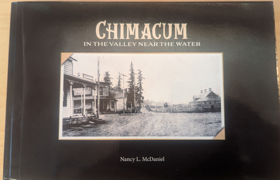
"In the Valley, Near the Water" are the first words of Chimacum High School's Alma Mater song. Written by Duane Montgomery, cherished music director, those words have a special meaning for Chimacum residents. Published in 2023 by local historian Nancy L. McDaniel, Chimacum: In the Valley Near the Water provides an intimate local history of the Chimacum Valley and its surrounding agricultural communities on Washington's Olympic Peninsula. The narrative chronicles the area's transition from ancestral indigenous homelands to a bustling hub of pioneer farming, timber harvesting, and dairy production driven by 19th-century homesteaders. Drawing on extensive family archives, oral histories, and photographs, the book meticulously reconstructs the daily lives, schoolhouses, and community networks of early settlers. A keen insight drawn from the text is how its granular, bottom-up preservation of rural genealogy reveals the quiet, persistent labor required to carve an agrarian society out of a heavily forested frontier, offering a localized counterweight to grand narratives of Pacific Northwest expansion. 277 pages CIRC [ 1 ]
|
2023 |
|
Children of the stars indigenous science education in a reservation classroom by Ed Galindo , Lorelei A. Lambert 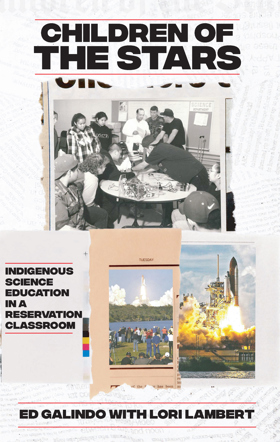
"In the 1990s, Ed Galindo (Yaqui), a high school science teacher on the Fort Hall Reservation in Idaho, took a team of Shoshone-Bannock students first to Johnson Space Center in Texas and then to Kennedy Space Center in Florida. These students had entered a project in a competitive NASA program that was usually intended for college students-and they earned a spot to see NASA astronauts test out their experiment in space. The students designed and built the project themselves: a system to mix phosphate and water in space to create a fertilizer that would aid explorers in growing food on other planets. In Children of the Stars, Galindo narrates his experience with this first team and with successive student teams, who continued to participate in NASA programs over the course of a decade. This is a story indelibly grounded in place and Indigenous communities: students chose a project influenced by their local knowledge of and easy access to phosphate fertilizer (mined on the reservation); found creative ways to build their project with cheap materials, often donated by local businesses; raised funds in the tribe and community to cover travel expenses; asked questions about space exploration and agriculture based on their own understanding of the colonization of North America; and involved their families at every step. Galindo discusses the challenges of teaching Indigenous students: understanding the practical limits of a rural reservation school, the importance of community and family support, respecting and incorporating Indigenous knowledge systems, and meeting students where they are in order to help them succeed. In describing how he had to earn the trust of his students to truly be successful as their teacher, Galindo also touches on the complexities of community belonging and understanding; although Indigenous himself, Galindo is not a member of the Shoshone-Bannock Tribes and was still an outsider who had as much to learn as the students. Written in a conversational style, Children of the Stars is an accessible story of success, of students who were supported and educated in culturally relevant ways and so overcame the limitations of an underfunded reservation school to reach (literal) great heights"-- Provided by publisher xii, 155 pages : illustrations ; 23 cm CIRC [ 0 ]
|
2022 |
|
Children of the fur trade forgotten Métis of the Pacific Northwest by John C. Jackson 
A riveting glimpse into a unique heritage, Children of the Fur Trade recovers a vital part of Northwest history. During the first half of the 19th century, a unique subculture built around hunting and mobility existed quietly in the Pacific Northwest. Descendants of European or Canadian fur trapper fathers and Native American mothers, these mixed-blood settlers--called Metis--were pivotal to the development of the Oregon Country, but have been generally neglected in its written history. Today we know them by the names they left on the land and the waters: The Dalles, Deschutes, Grand Ronde, Portneuf, Payette; and on the peoples who lived there: Pend Oreille, Coeur d'Alene, Nez Perce. John C. Jackson's Children of the Fur Trade gives readers a vivid and memorable portrait of Metis life at the western edge of North America. This informal account shows the Metis as explorers and mapmakers, as fur trappers and traders, and as boatmen and travelers in a vanishing landscape. Because of their mixed race, they were forced into the margin between cultures in collision. Often disparaged as half-breeds, they became links between the dispossessed native peoples and the new order of pioneer settlement. 326 pages : illustrations, maps ; 23 cm. CIRC [ 0 ]
|
2007 |
|
Child of Steens Mountain by Eileen O'Keeffe McVicker, Barbara J. Scot 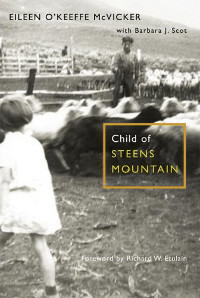
"For Eileen O'Keeffe McVicker, born in 1927 to an Irish immigrant sheep rancher and a schoolteacher, growing up on a homestead made for "a hard, happy life with layers of riches." In her memoir of a childhood spent on the southern slope of Steens Mountain, McVicker offers an appealing, personal account of eastern Oregon history." "An "outdoor child" who never knew boredom, McVicker recounts the everyday adventures of life on the high desert. Images of Steens country-rugged vistas of startling beauty in every direction - are woven throughout her recollections. While vividly describing ranch life, Child of Steens Mountain also explores universal issues of parenting, making a living, and coming of age. The homesteading life built a child's character and confidence, and as she reaches adulthood, McVicker, raised to be independent and responsible, ultimately defies her parents to follow her own path." "In an afterword, McVicker's friend and neighbor, author Barbara J. Scot, who edited and organized the narration, describes the collaborative process - including a visit to the old homestead site - that led to this book. Historian Richard Etulain, whose own childhood was spent on a sheep ranch in the West, provides an overview of ranching and homesteading in Steens country in his foreword."--Jacket xix, 139 pages : illustrations ; 23 cm CIRC [ 0 ]
|
2008 |
|
Chiefs & chief traders Indian relations at Fort Nez Percés, 1818-1855 by Theodore Stern 
A ground-breaking study of the relations between the fur traders of Fort Nez Perce's and the Indians of the region, primarily Cayuse, Wallawalla, Umatilla, and Nez Perce. Existing literature on this region has focused on the white explorers, the fur traders, and the settlers; Chiefs and Chief Traders offers a new perspective, exploring both white and Indian cultures and their interactions. Chiefs and Chief Taders represents the culmination of 25 years of research, utilizing an extensive variety of primary sources - some used here for the first time - as well as oral interviews conducted in the course of ethnographic research on the Umatilla Indian Reservation. Stern weaves together anthropology and history in a way that few are qualified to do. He brings important new information to the story of the relations between Indians and whites in the Pacific Northwest xii, 272 pages : illustrations, maps ; 24 cm CIRC [ 1 ]
|
1993 |
|
Chiefs & change in the Oregon country Indian relations at Fort Nez Percés, 1818-1855 by Theodore Stern 
Theodore Stern's critically acclaimed 1993 book Chiefs and Chief Traders explored early encounters between the fur traders of Fort Nez Perces and the Indians of the eastern Columbia Plateau, principally the Cayuse, Nez Perces, Wallawalla, and Umatilla. Drawing on 25 years of research, Stern recreated the dynamic relationships between Indians and whites at the small but strategic trading post near the confluence of the Columbia and Snake rivers. He offered a new perspective on interactions at the fort, one that encompassed the voices and lives of Indians as well as whites. In a remarkable new companion volume, Chiefs and Change in the Oregon Country, Stern again focuses on the Plateau Indians, and particularly on the changes they underwent as first the Hudson's Bay Company traders, then missionaries, and later settlers, Indian agents, and the military entered their world. Stern traces these forces of change as they swept through to the Willamette Valley and details their tremendous impact on the Indians tied by residency and trade to Fort Nez Perces. He concludes his history with the fall of the fort during the Indian wars of the 1850s and the end, shortly thereafter, of independent tribal government. Like its predecessor Chiefs and Change in the Oregon Country is a skillful weaving of history and anthropology. This major work brings important new topics and insights to the story of Indian-white relations in the Pacific Northwest. xx, 428 pages : maps, portraits ; 24 cm CIRC [ 1 ]
|
1996 |
|
Chiefly feasts the enduring Kwakiutl potlatch by Aldona Jonaitis (Editor, Author), Douglas Cole , Ira Jacknis , Wayne P. Suttles , Gloria Cranmer Webster , Ellen J. Lehman (Donor), American Museum of Natural History 
The magnificent collection of art made by the Kwakiutl Indians of northern Vancouver Island and the nearby mainland, assembled in the late nineteenth and early twentieth centuries for the American Museum of Natural History, lies at the heart of 'Chiefly Feasts.' More than one hundred objects from the American Museum and other collections are illustrated in full color, and extended captions incorporating information provided by many members of the Kwakiutl community describe their history and acquisition. 300 pages : illustrations (some color) ; 26 x 27 cm CIRC [ 1 ]
|
1991 |
|
Chief Seattle, man of vision by Florence Westover Bond 
Published in regional biographical editions by Florence Westover Bond, Chief Seattle, Man of Vision explores the life, diplomacy, and complex legacy of the mid-19th-century Duwamish and Suquamish leader whose name became synonymous with the city of Seattle. The book details his strategic efforts to navigate the turbulent arrival of European-American settlers, maintain peace during the devastating conflicts of the 1850s, and protect the sovereign interests of his people amidst aggressive territorial displacement. Drawing on historical records and regional oral traditions, the text contrasts the popular, romanticized myth of the tragic vanishing Indian with the reality of a pragmatic political strategist. A keen insight drawn from the work is how Chief Seattle’s famous, oft-romanticized speech was not a surrender to inevitability, but a brilliant act of long-term rhetorical positioning; by binding the spiritual destiny of the white settlers to the sacred ancestral land of the tribes, he sought to morally obligate the colonizers to respect native memory even as their physical presence was being dismantled. xiv, 139 pages ; 21 cm CIRC [ 0 ]
|
2001 |
|
Chief Seattle's unanswered challenge spoken on the wild forest threshold of the city that bears his name by John Martin Rich, Seattle 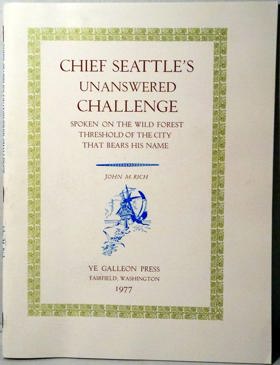
A fragment of Chief Seattle's speech, delivered at Seattle, Washington in the fall of 1854 in response to address of Hon. Isaac Stevens, commissioner of Indian affairs for Washington Territory, from the notes of Dr. Henry A. Smith; published in the Seattle Sunday Star on October 29, 1887: p. 32-42Listed in: The Washington 89 / by George H. Tweney 60 pages : illustrations ; 29 cm CIRC [ 1 ]
|
1991 |
|
Chief Seattle and the town that took his name the change of worlds for the native people and settlers on Puget Sound by David M. Buerge 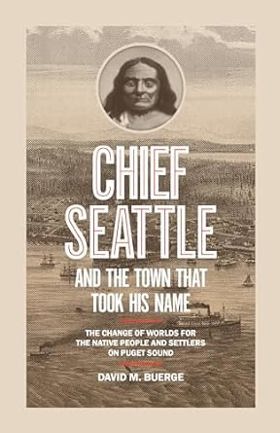
"When the British, Spanish, and then Americans arrived in the Pacific Northwest, it may have appeared to them as an untamed wilderness. In fact, it was a fully settled and populated land. Chief Seattle was a powerful representative from this very ancient world. Historian David Buerge has been researching and writing this book about the world of Chief Seattle for the past 20 years. Buerge has threaded together disparate accounts of the time from the 1780s to the 1860s--including native oral histories, Hudson Bay Company records, pioneer diaries, French Catholic church records, and historic newspaper reporting. Chief Seattle had gained power and prominence on Puget Sound as a war leader, but the arrival of American settlers caused him to reconsider his actions. He came to embrace white settlement and, following traditional native practice, encouraged intermarriage between native people and the settlers, offering his own daughter and granddaughters as brides, in the hopes that both peoples would prosper. Included in this account are the treaty signings that would remove the natives from their historic lands, the roles of such figures as Governor Isaac Stevens, Chiefs Leschi and Patkanim, the Battle at Seattle that threatened the existence of the settlement, and the controversial Chief Seattle speech that haunts to this day the city that bears his name."--Provided by publisher xxv, 325 pages : illustrations, maps ; 23 cm CIRC [ 1 ]
|
2017 |
|
Chief Seattle by Eva Greenslit Anderson, Fern Cousineau Duncan (Illustrator) 
390 pages, 3 unnumbered leaves of plates : illustrations (some color), genealogical tables, maps, portraits ; 24 cm CIRC [ 1 ]
|
1943 |
|
Chief Pocatello, the "White Plume" by Brigham D. Madsen 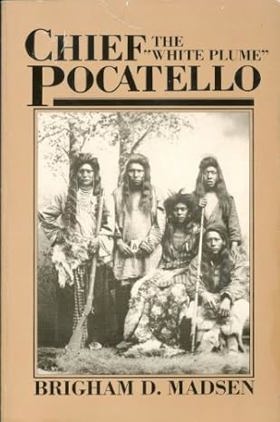
Dedicated to a people who faced starvation and destitution as white emigrating settlers continued to flock through his homeland, Pocatello was committed to preserving the life of his people. Even as game and land resources were severely depleted, he sought little other than to provide for his Shoshoni tribe. x, 142 pages : illustrations, maps, portraits ; 22 cm. CIRC [ 0 ]
|
1986 |
|
Chief Joseph's allies by Clifford E. Trafzer, Richard D. Scheuerman 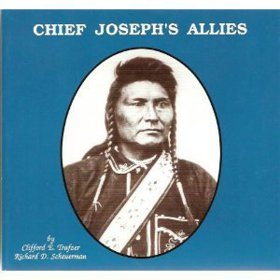
Authored by historians Clifford E. Trafzer and Richard D. Scheuerman, Chief Joseph's Allies chronicles the complex and often overlooked role of the Palus, or Palouse, people during the tragic Nez Perce War of 1877. The book details how these indigenous communities bravely navigated escalating colonial pressures, offered vital sanctuary and alliance to Chief Joseph's band across the Columbia Plateau, and subsequently suffered devastating displacement and military retribution. Through rich archival documentation and tribal oral histories, the text restores the voices of a sovereign people whose historical narrative was long suppressed by dominant frontier myths. A keen insight drawn from the work is how regional military histories deliberately erase peripheral indigenous actors; by centering the strategic sacrifices of the Palouse, the authors reveal that the tragic outcome of 1877 was not just a bilateral conflict between the U.S. Army and the Nez Perce, but a multi-tribal resistance effort against an overwhelming imperial enclosure of the entire Columbia River basin. vii, 112 pages : illustrations ; 21 x 22 cm CIRC [ 1 ]
|
1992 |
|
Chief Joseph country land of the Nez Perce by Bill Gulick 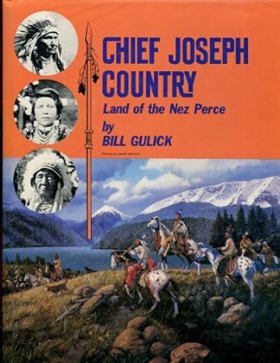
The relationship between Westering Americans and the Nez Perce Indians covers a time-span of one hundred years, from the meeting of the Lewis and Clark party with the Indians in 1805 to the death of Chief Joseph in 1904. It is epic drama, taking place on a vast stage during a critical period in the development of the United States. Certainly no setting could be more spectacular than the rugged, beautiful homeland of this tribe. No story can equal in historical importance the long-standing friendship given by the Nez Perces to the white newcomers in their country. And no event is more poignant, bitter, and tragic than the Nez Perce War. Before acquiring the horse around 1730, the Nez Perces occupied approximately 27,000 square miles of what is now north-central Idaho, northeastern Oregon, and southeastern Washington. After becoming a mounted people, they ranged over a much larger area, traveling east to the buffalo country claimed by Blackfeet, Crow, and Sioux, west to the great fishing and trading station on the lower Columbia, Celilo Falls. Uniquely situated as they were between the Plains and Coastal Indian cultures, they would play a key role in the struggle between Great Britain and the United States as to which nation would take title to the Pacific Northwest. In Chief Joseph Country: Land of the Nez Perce, author Bill Gulick lets the participants in the developing drama tell the story in their own words by excerpting diaries, letters, and statements made in contemporary accounts. Beginning with the prehistory of the Nez Perces, he relates how, after being pedestrians for eight thousand years, acquisition of the horse drastically altered their way of life. Then, in rapid succession, came firearms, American explorers, British fur traders, the Manifest Destiny struggle, missionaries, Oregon Trail emigrants, settlers, gold miners, farmers, and finally war. "If there is a bias in this book, it is that I have given more credence to statements made by Indians than to words written by white men," the author says. "Time and again in my research I have come across references to the importance the Indian placed on telling the plain, simple truth when relating any event in which he was involved. To the contrary, time and again I have found statements made by white leaders so contradictory and at variance with the truth that I began to question everything they wrote." In selecting the many historical photographs and sketches used to illustrate the book, the author examined the holdings of some twenty institutions from coast to coast, some of which dated back to the 1850s. As he did in Snake River Country, Bill Gulick applies skills learned as a novelist and dramatist to the non-fiction field of history, using the twin tools of dramatic narrative and sound research to bring history alive to the layman reader. He writes: "As in all epic dramas, forces beyond the understanding or control of the people involved were at work as the Nez Perces and the whites confronted one another, driving them toward a fate neither could forsee. "Here, I have recorded that confrontation from the Indian point of view." xiv, 316 pages : illustrations ; 29 cm CIRC [ 1 ]
|
1981 |
|
Cheese war conflict and courage in Tillamook County, Oregon by Marilyn Milne , Linda Kirk 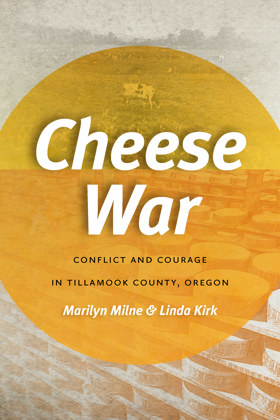
"In the 1960s, Tillamook County was at war with itself. As the regional dairy industry shifted from small local factories to larger consolidated factories, as food safety and factory conditions became more important, as the profit margins between milk and cheese collapsed, Tillamook farmers found themselves at a crossroads. How should the producers work with distributors, and how could they advocate for their businesses without pricing themselves out of the market? On one side of the debate was Beale Dixon, head of the County Creamery Association, the co-op that represented the county's farmers and packaged their products for the big dairy distributors in the Willamette Valley. Dixon set up a scheme to offer low-interest, low-collateral loans to the supermarkets that stocked CCA products; he argued it was a cheap, easy way to ensure good will-and continued purchases-in a tight market. On the other side was George Milne, a respected farmer and board member of Tillamook Cheese and Dairy Association, the largest producer in the CCA. Milne believed that Dixon's loan program amounted to fraud and embezzlement, and cheated the farmers out of money they were due. The question of loans soon spiraled out into a community-wide dispute, exacerbated by a complex web of family and business relationships that made conflicts of interest hard to avoid. Dixon worked for both CCA and Cheese and Dairy; he was fired from one but not the other. The Cheese War raged for the better part of a decade, across board meetings and courtrooms and the community itself. Co-op members traded recall petitions and rival factions distributed misleading petitions and letters. While largely unknown outside of Tillamook County, the Cheese War was so divisive that some families remain fractured today. Sisters Marilyn Milne and Linda Kirk were children of the Cheese War. In elementary school, they saw how it absorbed their parents, Barbara and George Milne. As adults, they realized they actually knew very little about it and set out to learn the real story. The authors have conducted years of research through the archives and newspapers of Tillamook County and conducted numerous interviews and oral histories of key players in the Cheese War and their families. As Americans become ever more interested in food supply chains and ethical consumption, here is a story of the very human factors behind one of Oregon's most famous brands"-- Provided by publisher xiii, 220 pages : illustrations ; 23 cm CIRC [ 0 ]
|
2022 |
|
Chechacos all the pioneering of Skagit by Skagit County Historical Society, Margaret Willis
|
1973 |
|
Chasing Clayoquot a wilderness almanac by David Pitt-Brooke 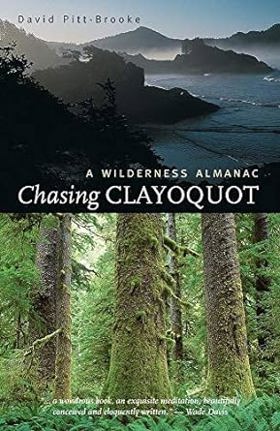
In the manner of Thoreau, naturalist David Pitt-Brooke meditates on one of Earth’s last untouched places Vancouver Island’s fabled Clayoquot Sound. This area came to prominence during Clayoquot Summer,” a 1993 protest that resulted in 800 arrests but also halted the region's destruction by logging. Clayoquot Sound encompasses every imaginable landscape, from alpine tundra to old-growth temperate rain forest. Like Barry Lopez did with the north inArctic Dreams, Pitt-Brooke approaches this wild, magical place by taking readers on an unforgettable journey for each month of the year.Chasing Clayoquot is a profound and political trip through an extraordinary environment 287 pages : illustrations, maps, portrait ; 23 cm CIRC [ 1 ]
|
2004 |
|
Charles Wilkes and the exploration of inland Washington waters journals from the expedition of 1841 by Richard W. Blumenthal 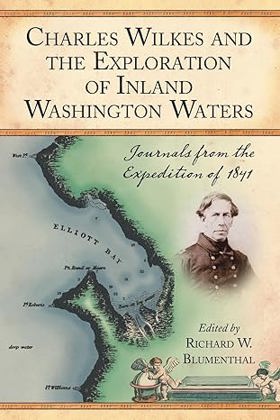
"Follows the Wilkes Expedition in 1841. Includes the journals of Charles Wilkes and ten of his crewmen, eighteen of the Wilkes Expedition's charts (the quality of which reflects the crew's careful attention to accuracy), and a complete muster list of the officers and crewmen (name, title, and a brief synopsis of his activity within the expedition"--Provided by publisher v, 314 pages : maps ; 23 cm CIRC [ 0 ]
|
2009 |
|
Champoeg place of transition; a disputed history by John A. Hussey, Oregon State Highway Commission, United States National Park Service
|
1967 |
|
Centralia, the first fifty years, 1845-1900 by Herndon Smith (Compiler), Centralia High School (Wash)
|
1975 |