Catalog of British Columbiana and Pacific Northwest Americana
Encyclopedia Cascadia Catalog contains book titles of mostly non-fiction Pacific Northwest Coast of North America Titles (primarially British Columbia, Idaho, Oregon and Washington State) in an easy-to-understand title catalog. If you see a link with this badge ONLINE CIRC it means that there is an online institution that provides free access to that title. In some cases there may be more than one institution hosting the title digitally.
| Catalog Title | Published |
|---|---|
|
Time, tide, and timber a century of Pope & Talbot by Edwin T. Coman, Helen M. Gibbs 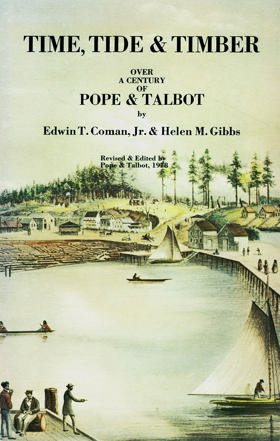
Published in 1949 by Stanford University Press and authored by business historians Edwin T. Coman Jr. and Helen M. Gibbs, Time, Tide, and Timber: A Century of Pope & Talbot is an authorized corporate history chronicling the first hundred years of one of the Pacific Northwest’s most influential timber and shipping conglomerates. Commissioned by the company to commemorate its centennial, the volume traces the enterprise from its modest origins in 1849, when founders Andrew J. Pope and Captain William C. Talbot arrived in Gold Rush San Francisco from East Machias, Maine, to launch a lumber and lighterage business. The text details the firm's subsequent expansion into the Puget Sound region, its establishment of massive sawmills at Port Gamble, its extensive fleet of coastal and transoceanic sailing ships, and its eventual evolution into a sprawling modern corporate empire spanning forestry, real estate, and global maritime trade. 73 pages : illustrations ; 23 cm CIRC [ 1 ]
|
1978 |
|
Tillamook Light a true narrative of Oregon's Tillamook Rock Lighthouse by Jim Gibbs 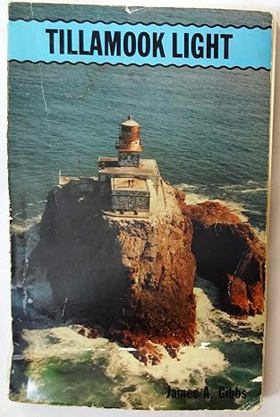
The lighthouse keeper has gone the way of the iceman and blacksmith, but in the case of Tillamook Rock Lighthouse, the story remains--a complete history of :Terrible Tilly,: seasoned with salty drama and some hilarious adventure. Gibbs, a former Coastguardsman stationed at the infamous rock off Oregon's northwest shores, knows that wild crag from the inside out, and he has supplemented his account with what happened before he arrived on the scene, and since closure of the light in 1957. Many fine photos keep pace with the action. 145 pages. xi, 145 pages : illustrations ; 22 cm CIRC [ 1 ]
|
1979 |
|
Tillamook Indians of the Oregon coast by John Sauter, Bruce Johnson
|
1974 |
|
Tillamook Burn Country a pictorial history by Ellis Lucia
|
1983 |
|
Tillamook land of many waters by Ada M. Orcutt
|
1951 |
|
Tidewater Valley a story of the Swiss in Oregon by Jo Evalin Lundy, Margaret Ayer (Illustrator) 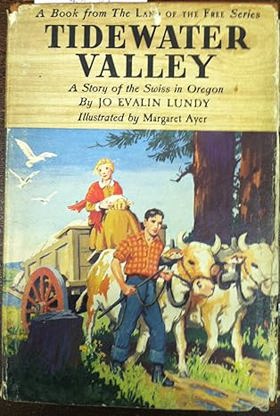
From the Alps of Europe to America's green Northwest: that is the background for this heart-warming tale of the Swiss who, in the 1800's, brought their ancient arts and industries to a fertile valley on the Pacific Coast. To the dairy farm of stubborn, practical Uncle Karl and jolly, lovable Aunt Rosa, come orphaned Lisi Naegli and her crippled brother Chris from their home in Lucerne Canton. Sixteen-year-old Lisi's efforts to keep peace between Uncle Karl and young Chris, and her struggle to learn the ways of America make an endearing story, but behind her adventures and triumphs moves the larger story of the settlers' problems in finding markets for their dairy products and their attempts to make good cheese in a locality where popular opinion agreed it could not be done. 246 pages : illustrations ; 22 cm. CIRC [ 1 ]
|
1949 |
|
Thurston County water, woods & prairies: essays on the history of Washington's capital county by Sandra A. Crowell , Shirley A. Stirling , Thurston County Historic Commission (Wash) (Issuing body) 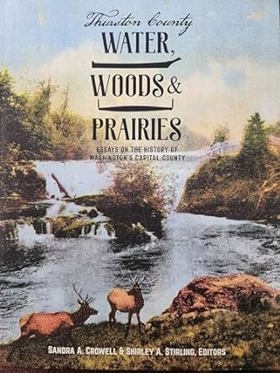
"From time immemorial, people have walked on the land of the present-day Thurston County, Washington. Its waters provided sustenance and a way of life for Native inhabitants, and maritime explorers sought out its shores. Rich prairies attracted hearty pioneers who developed productive farms; its woods supplied a growing nation with timber products. At the center of the Thurston County story is the spirit of its Native heritage, enduring communities, and the capital of Washington State. Local authors have pooled their expertise to bring to life the history of this lovely capital county on Puget Sound"--Back cover 290 pages : illustrations (some color), maps (some color) ; 29 cm CIRC [ 1 ]
|
2019 |
|
Thunder in the Mountains Chief Joseph, Oliver Otis Howard, and the Nez Perce War by Daniel J. Sharfstein 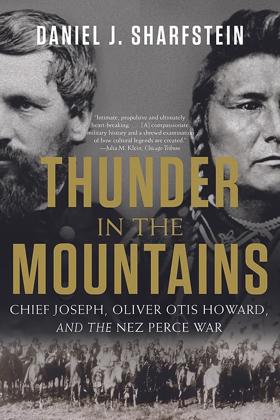
"Oliver Otis Howard thought he was a man of destiny. Chosen to lead the Freedmen's Bureau after the Civil War, the Union Army general was entrusted with the era's most crucial task: helping millions of former slaves claim the rights of citizens. He was energized by the belief that abolition and Reconstruction, the country's great struggles for liberty and equality, were God's plan for himself and the nation. To honor his righteous commitment to a new American freedom, Howard University was named for him. But as the nation's politics curdled in the 1870s, General Howard exiled himself from Washington, D.C., rejoined the army, and was sent across the continent to command forces in the Pacific Northwest. Shattered by Reconstruction's collapse, he assumed a new mission: forcing Native Americans to become Christian farmers on government reservations. Howard's plans for redemption in the West ran headlong into the resistance of Chief Joseph, a young Nez Perce leader in northeastern Oregon who refused to leave his ancestral land. Claiming equal rights for Native Americans, Joseph was determined to find his way to the center of American power and convince the government to acknowledge his people's humanity and capacity for citizenship. Although his words echoed the very ideas about liberty and equality that Howard had championed during Reconstruction, in the summer of 1877 the general and his troops ruthlessly pursued hundreds of Nez Perce families through the stark and unforgiving Northern Rockies. An odyssey and a tragedy, their devastating war transfixed the nation and immortalized Chief Joseph as a hero to generations of Americans. Re-creating the Nez Perce War through the voices of its survivors, Daniel J. Sharfstein's visionary history of the West casts Howard's turn away from civil rights alongside the nation's rejection of racial equality and embrace of empire. The conflict becomes a pivotal struggle over who gets to claim the American dream: a battle of ideas about the meaning of freedom and equality, the mechanics of American power, and the limits of what the government can and should do for its people. The war that Howard and Joseph fought is one that Americans continue to fight today."--Jacket xvii, 613 pages : maps ; 25 cm CIRC [ 0 ]
|
2017 |
|
Thumbpapers sketches of pioneer days by Leonore Gale Barette 
Published in local editions, Leonore Gale Barette’s Thumbpapers: Sketches of Pioneer Days offers a charming and intimate collection of vignettes capturing the daily struggles, simple pleasures, and quiet resilience of early settlers in the Pacific Northwest. The book weaves together personal reminiscences and local folklore to illustrate how isolated frontier communities banded together to build homes, schools, and civic life amidst vast wilderness. Through its evocative, unpretentious prose, the text preserves the texture of a bygone era before industrialization reshaped the rural landscape. A keen insight drawn from the work is how domestic and everyday details—rather than grand political milestones—serve as the true bedrock of historical memory; by focusing on the small, routine friction of pioneer housekeeping and community socializing, the narrative reveals that civilization on the frontier was sustained just as much by ordinary human connection as it was by physical survival. xi, 67 pages : illustrations ; 23 cm CIRC [ 1 ]
|
2001 |

Jonathan Carver, who was born in Massachusetts, served in the colonial militia during the French and Indian War rising to the rank of Captain and mastering the techniques of surveying and map making. He left the army in 1763 with the intention of exploring the new territories acquired by the British as a result of the war. In 1766 Robert Rogers appointed Carver to lead a semi-official expedition to find a route via lakes and rivers to the Pacific Ocean and the East Indies. Carver left Fort Michilimackinac at Mackinack Island in the spring of 1766, travelling along the northern coast of Lake Michigan, before cutting across to what is now the Door County peninsula in Wisconsin and continuing along the western edge of the bay until reaching what is now Green Bay, Wisconsin. From here he traveled up the Fox River to the Winnebago Indian village at the north end of Lake Winnebago. He continued up the Fox River until he arrived at the "Grand Portage" (a well used portage between the Fox River and the Wisconsin River). Carver then crossed to the Wisconsin River and traveled down to the Mississippi emerging at the great trade encampment at Prairie du Chien. He then turned north into what is now Minnesota. By the late summer he had reached the Saint Anthony Falls (Minneapolis). He spent some time near the falls but turned south, down the Mississippi to find a more suitable place to spend the winter, setting camp in a tribal village in what is now eastern Iowa. The next spring he continued exploring and mapping the Mississippi River through what is now Minnesota and Wisconsin before eventually returning in 1768 to the British fort at Mackinack. In pursuit of a claim for compensation from the British Government for the work he had put into the expedition, Carver travelled to London and it was here that the present work was published. "Carver's book was an immediate success when first published in 1778, and a second London edition followed the next year; over thirty editions and versions have been published since in several languages. A very important book in the history of the exploration of the American West as Carver was the first English-speaking explorer to venture west of the upper Mississippi River. He anticipated the idea of a continental divide as he was the first to mention a large mountain range to the west (presumably the Rocky Mountains) that blocks the westward passage. Further, the name 'Oregon' appears in print here for the first time, both in the text, and on one of the maps. Carver penetrated farther into the West than any other English explorer before the Revolution and stimulated curiosity concerning routes to the Pacific, later satisfied by Mackenzie and Lewis and Clark." xvi, vii, [2], 10-282, [2] p. ; 17 cm. (12mo) ONLINE CIRC [ 1 ]
|
1796 |
|
Those island people by Lynne Bowen 
Those Island People,began with a series of articles in the Times-Colonist about interesting and often unknown Islanders: gold seekers and gamblers, former slaves and veteran soldiers, missionaries and rabble rousers. Some of their forebears had been on the Island for thousands of years, but most of them came from somewhere else to make their lives on Vancouver Island. Those Island People involved more than the usual amount of detective work. I was determined to have a photograph for every chapter, but photographs of some subjects had eluded me for years. x, 118 pages : illustrations, map, portraits ; 23 cm. CIRC [ 1 ]
|
2013 |
|
Thompson River Salish dictionary nł̳e?̳kepmxcín by Laurence C. Thompson, M. Terry Thompson 
Authored by linguists Laurence C. Thompson and M. Terry Thompson, the Thompson River Salish Dictionary (nł̳e?̳kepmxcín) stands as a comprehensive lexical documentation of the Interior Salish language spoken by the Nlaka'pamux people of British Columbia. The volume meticulously records thousands of word stems, grammatical structures, and cultural terms, preserving the intricate phonetic nuances of a language deeply rooted in the river valleys and plateaus of the Pacific Northwest. Through decades of rigorous fieldwork and collaboration with native speakers, the text provides an invaluable linguistic archive designed to rescue an endangered indigenous tongue from colonial erasure. A keen insight drawn from the work is how comprehensive dictionary-making transcends academic compilation to become an act of political and cultural reclamation; by encoding the hyper-specific ecological, botanical, and spiritual vocabulary of the Nlaka'pamux into a permanent written record, the lexicon arms future generations with the native linguistic tools required to fully reclaim their ancestral sovereignty and relationship to the land. xxvii, 1412 pages ; 29 cm. CIRC [ 0 ]
|
1996 |
|
This was seafaring a sea chest of salty memories by Ralph W. Andrews, Harry A. Kirwin
|
1955 |
|
This was sawmilling by Ralph W. Andrews 
History about the sawmill industry in the Pacific Northwest is rich in memories. Here is the vital and true story of the triumphant growth and its undying promise, shown with superb photography and told with exciting text. The utilitarian waterwheel, the great days of the steam sawmill, and the epic courage of the schooner masters are told in all their glory. Ralph Andrews augments his careful and thorough research with anecdotes of the men who transformed logs into the building materials of a nation. The reader takes a step back in time, as the history of the industry which has gone on continuously since 1825 is brought to life. 176 pages : illustrations ; 23 cm CIRC [ 0 ]
|
1957 |
|
This was railroading by George B. Abdill 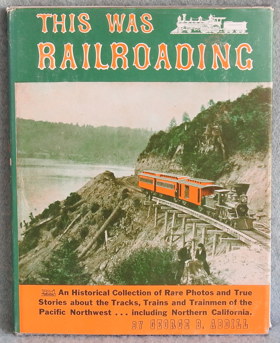
An Historical Collection of Rare Photos and True Stories about the Tracks, Trains and Trainmen of the Pacific Northwest including Northern California. 1958 First Edition. 192 pages : illustrations ; 28 cm CIRC [ 1 ]
|
1958 |
|
This valley (Wallowa Valley) by Lola Hopkins 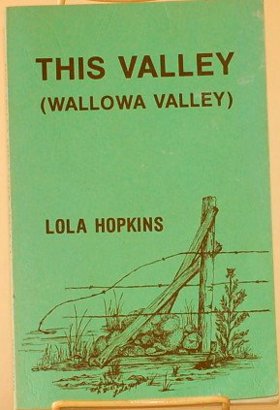
Lola Hopkins, the "Grandma Moses" of Wallowa County, and now historian of Wallowa Valley advises. "Don't start writing a history when you're seventy-seven." Perhaps others shouldn't, but we are grateful that she did. She probably said something similar at sixty-five when she taught herself ink drawing. An accurate account of the history of one of Oregon's most beautiful areas. Surrounds the pioneer beginnings in this county. 174 pages : illustrations ; 22 cm CIRC [ 1 ]
|
1978 |
|
This place is who we are stories of Indigenous leadership, resilience, and connection to homelands by Katherine Gordon , Dallas Smith 
"This Place Is Who We Are profiles Indigenous communities in central and northern coastal BC that are reconnecting to their lands and waters--and growing and thriving through this reconnection. Indigenous peoples and cultures are integrally connected to the land. Well-being in every sense--physical, social, environmental, economic, spiritual and cultural--depends on that relationship, which is based on a fundamental concept: when the land is well, so are the people. With increasing strength, Indigenous peoples in this vast region of BC--which spans the homelands of more than two dozen First Nations and one of the largest remaining coastal temperate rainforests in the world--are restoring what has been lost through environmental depredation and healing what has been devastated by colonization. This volume is a collection of ten of these inspiring stories. X̱aayda voices explain how their Rediscovery camps are healing and empowering their youth; Dzawada̱'enuxw Hereditary Chief Maxwiyalidizi K'odi Nelson shares the story of building a healing centre and ecolodge; Wei Wai Kum Chief Christopher Roberts describes the challenges and opportunities for an urban First Nation looking to prosper while protecting the environment and ancient Ligʷiłdaxʷ history and living cultural values; and many more Indigenous leaders share their own experiences of growth, strength and reconnection. Thoughtful and inspiring, This Place Is Who We Are illustrates what can be accomplished when conservation and stewardship are inextricably intertwined with the prosperity and well-being of communities."-- Provided by publisher 245 pages : color illustrations, color map, color portraits ; 26 cm CIRC [ 0 ]
|
2023 |
|
This old town city of Victoria central area heritage conservation report by Victoria (B.C.)., Les D. Mazer, Martin Segger, Brian Murray Sikstrom
|
1983 |
|
This isle of Guemes by Helen Troy Elmore, Community Club of Guemes Island
|
1973 |
|
This is Washington by Bob Spring, Ira Spring, Byron Fish
|
1957 |
|
This is Portland by Alexander Barrett 
A firsthand look at one of the world’s most livable cities, this fun take on the guidebook genre explores the atmosphere of Portland, Oregon, versus detailing its landmarks and restaurants. It both explains and embraces how beautiful and ridiculous Portland life can be, and includes essays on everything from the rain and bicycling to beards and tater tots. With its approachable and often hilarious tone, this book is perfect for anyone who wants to learn more about the city that is earning its way onto more and more top cities lists each year. 62 pages : illustrations, map CIRC [ 1 ]
|
2014 |
|
This is not for you an activist's journey of resistance and resilience by Richard J. Brown , Brian Benson 
"This is Not For You: An Activist's Journey of Resistance and Resilience is the memoir of activist and photographer Richard Brown, an eighty-year-old Black Portlander who has worked to bridge the divide between police and the Black community. Originally from Harlem, Brown served in the Air Force for twenty years before landing in Portland. As he recalls his childhood in the 1940s, his radicalization in the newly desegregated Air Force, and his decades of activism in one of America's whitest cities, he questions whether he's got the strength to continue doing this work, and he wonders who, if anyone, will take his place"-- Provided by publisher 1 online resource (258 pages) : illustrations, portraits CIRC [ 0 ]
|
2021 |
|
This far-off sunset land a pictorial history of Washington County, Oregon by Carolyn M. Buan 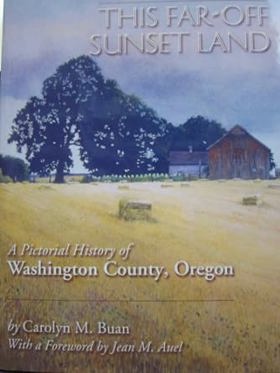
Authored by regional historian Carolyn M. Buan, This Far-Off Sunset Land: A Pictorial History of Washington County, Oregon offers a richly illustrated chronicle of one of the Pacific Northwest’s oldest agricultural and settlement regions west of Portland. The book compiles rare historic photographs, maps, and archival documents to trace the area's evolution from Donation Land Claim homesteads and early pioneer trails into a bustling network of farming communities and suburban outposts. Through its curated visual narrative, the text highlights the enduring legacy of the Tualatin Valley’s farming families, immigrant laborers, and small-town merchants. A keen insight drawn from the work is how pictorial histories of the Willamette Valley reveal the rapid spatial erasure of agrarian landscapes; the stark transition captured across the photo spreads from open orchards and wooden barns to sprawling paved infrastructure underscores how swiftly post-war modernization consumed the physical markers of pioneer settlement. 192 pages : illustrations ; 29 cm CIRC [ 1 ]
|
1999 |
|
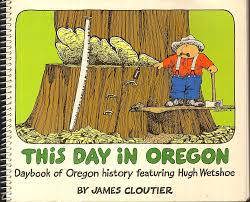
This day in Oregon daybook of Oregon history featuring Hugh Wetshoe by James Cloutier, Image West Press
|
1982 |
|
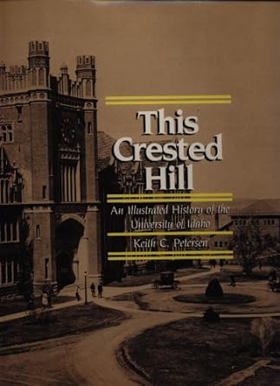
This crested hill an illustrated history of the University of Idaho by Keith Petersen
|
1987 |