Catalog of British Columbiana and Pacific Northwest Americana
Encyclopedia Cascadia Catalog contains book titles of mostly non-fiction Pacific Northwest Coast of North America Titles (primarially British Columbia, Idaho, Oregon and Washington State) in an easy-to-understand title catalog. If you see a link with this badge ONLINE CIRC it means that there is an online institution that provides free access to that title. In some cases there may be more than one institution hosting the title digitally.
| Catalog Title | Published |
|---|---|
|
The Spokane River by Paul J. Lindholdt 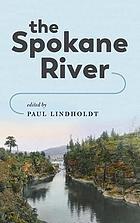
"From Lake Coeur d Alene to its confluence with the Columbia, the Spokane River travels 111 miles of varied and often spectacular terrain rural, urban, in places wild. The river has been a trading and gathering place for Native peoples for thousands of years. With bountiful trout, accessible swimming holes, and challenging rapids it is a recreational mecca for residents and tourists alike. The Spokane also bears the legacy of industrial growth and remains caught amid interests competing over natural resources."--Google books viewed Jan. 14, 2021 1 online resource (283 pages) CIRC [ 0 ]
|
2018 |
|
The Spokane Indians children of the sun by Robert H. Ruby , John A. Brown , Robert L. Bennett 
A history of the Spokane tribe, demonstrating their changing relationship and their present role in American society xx, 346 pages : illustrations, maps, portraits ; 24 cm CIRC [ 1 ]
|
1970 |
|
The sound of steamers by Roland Carey
|
1965 |
|
The sound and the mountain by Roland Carey
|
1970 |
|
The Sooke story the history and the heartbeat by Elida Peers , Sooke Region Museum 
This history tells of the native people and of the first settlers - and with some anecdotal quotes, condenses the years of development of community, industry and culture into these pages. Anyone who has lived for any length of time in the Sooke area or whose family were participants in the early years of its growth will find this book of great interest." - Introduction 433 pages : illustrations ; 23 cm CIRC [ 1 ]
|
1999 |
|
The Soo Line's famous trains to Canada by Terry Gainer 
"A brief history of a small and unique Class 1 railway and its famous Canada-USA tourist trains. Initially chartered in 1883 to serve the needs of local millers in Minneapolis, the Soo would eventually come to join the Canadian Pacific line at Sault Ste. Marie, Ontario, with service to Montreal. In 1888, Canadian Pacific assumed controlling interest in the Soo Line, providing entry into the lucrative US market and levelling the playing field for the CPR to face the onslaught of ferocious competition from James J. Hill, the infamous American railway baron. The 'little railway that could' grew to attain giant-killer status, launching famous passenger trains from Minneapolis and St. Paul, meeting head-on the western expansion of the Great Northern Railway and viable, competitive routes to the Atlantic seaboard. Over the years, the Soo Line introduced thousands of Americans to Montreal and Quebec City, the famous Canadian Rockies resorts, and the city of Vancouver, the home port for CP's Pacific steamship services. The Soo also successfully competed on the Spokane and Portland routes from Minneapolis to the Pacific Northwest. In 1923 the 'Soo Mountaineer' was launched, becoming the most famous and longest 'two-nation' train journey in North America."-- Publisher xviii, 87 pages : illustrations (some color), color maps ; 23 cm CIRC [ 0 ]
|
2023 |
|
The Snake River-Palouse and the invasion of the inland Northwest by Clifford E. Trafzer , Richard D. Scheuerman 
Originally released in 1986 as Renegade Tribe, this award-winning title sensitively retells the compelling saga of western expansion and Indian-white conflict from a Native American perspective. The Snake River-Palouse resisted immigrant encroachment and fought a losing battle to retain their way of life. The Whitman Massacre, as well as a refusal to enter into U.S. government treaties, left them with a hostile reputation among the newcomers. With settlers increasingly demanding their removal and no reservation of their own, these Inland Northwest Indians faced extermination by the end of the nineteenth century. Examining written and oral evidence left by both indigenous and white cultures, this book presents the Snake River-Palouse as important actors in events and demonstrates how their initiative and decisions influenced the course of history. This revised edition offers a new introduction by the authors and a new foreword by Chief Tilcoax's descendent Wilson Wewah. xxiv, 271 pages : illustrations, maps ; 23 cm CIRC [ 0 ]
|
2016 |
|
The smiling country a history of the Methow Valley by Sally Portman
Published by local presses, Sally Portman’s The Smiling Country: A History of the Methow Valley chronicles the colorful evolution of north-central Washington's dramatic river valley from its indigenous roots to its modern incarnation as a recreational haven. The book details the arduous lives of early homesteaders, gold miners, stockmen, and orchardists who carved a living out of a geographically isolated landscape defined by scorching summers and brutal winters. Through extensive oral histories and rich archival imagery, the text preserves the rugged character of communities like Winthrop and Twisp as they transitioned from extractive resource economies to tourism. A keen insight drawn from the work is how the valley's iconic moniker, "the smiling country," serves as a historical mask for the harsh economic realities of frontier survival; it reflects an enduring human impulse to romanticize an unforgiving high-desert ecosystem that frequently tested the limits of those who tried to tame it. 381 pages : illustrations ; 22 cm CIRC [ 1 ]
|
2002 |
|
The Sky Valley. Volume 2 a photographic history by Buddie Williams
Authored by local historian Buddie Williams, The Sky Valley, Volume 2: A Photographic History continues the visual documentation of Washington's rugged Skykomish River corridor through a rich collection of historic photographs and archival ephemera. The volume captures the dramatic transformation of towns like Index, Sultan, and Startup as they evolved from raw logging camps and mining outposts into established, tight-knit communities framed by the Cascade Mountains. Through vintage images of steam locomotives, timber mills, high-water floods, and local school children, the text portrays the relentless daily labor required to carve civilization out of a steep, flood-prone river valley. A keen insight drawn from the work is how visual archives of mountain valleys expose the inherent fragility of industrial frontier settlements; the recurring imagery of swollen rivers and swept-away bridges reminds readers that human infrastructure in the Pacific Northwest was always engaged in a precarious, high-stakes negotiation with an overwhelmingly powerful natural topography. 28 pages : illustrations ; 26 cm CIRC [ 1 ]
|
1999 |
|
The Skagit collection first views : an early history of Skagit County, 1850-1899, vol. 2 by Theresa Trebon , Skagit Valley Herald
Published in local editions by archivist Theresa Trebon in cooperation with the Skagit Valley Herald, The Skagit Collection: First Views: An Early History of Skagit County, 1850-1899, Vol. 2 compiles rare historical photographs and local narratives documenting the formative decades of Washington's Skagit Valley. The volume captures the arduous daily lives of early homesteaders, loggers, and commercial fishermen who wrestled a tamed agricultural and industrial landscape out of dense river deltas and dense timberlands. Drawing heavily from archival images and early newspaper columns, the text preserves the visual and social fabric of communities navigating rapid frontier expansion. A keen insight drawn from the work is how late 19th-century local journalism and photography served as deliberate acts of community-building; by visually documenting fledgling settlements before they were fully established, pioneers used the camera to legitimize their presence and carve a permanent sense of permanence out of a fluid, flood-prone wilderness. xxiv, 143 pages : illustrations, portraits ; 20 cm CIRC [ 1 ]
|
2002 |
|
The Siwash their life, legends and tales; Puget Sound and Pacific Northwest by Joseph A. Costello
Published in 1895, Joseph A. Costello’s The Siwash: Their Life, Legends and Tales is an early ethnographic compilation documenting the oral traditions, daily customs, and folklore of the Coast Salish peoples across the Puget Sound region. A keen insight drawn from the text is how the author's reliance on the Chinook Jargon term "Siwash"—derived from the French word for "savage"—exposes the inherent paradox of late 19th-century settler literature, which eagerly commodified and preserved Indigenous heritage while viewing the people themselves through a deeply paternalistic, colonial lens. The narrative compiles regional creation myths, spiritual practices, and historical anecdotes, filtering complex indigenous histories through the perspective of the incoming white pioneers. Ultimately, the volume stands as both a foundational, albeit flawed, archive of Pacific Northwest Native American legends and a revealing historical artifact of the era's complex attitudes toward indigenous displacement. vii, [3], 169 pages : frontispiece, plates, portraits ; 24 cm ONLINE CIRC [ 1 ]
|
1895 |
|
The Siwash their life, legends, and tales : Puget Sound and Pacific Northwest by Joseph A. Costello
|
1986 |
|
The Siuslaw storybook the first storybook of Siuslaw Indian fables by B. J. Berrykeeper 
Published under the name B. J. Berrykeeper, The Siuslaw Storybook: The First Storybook of Siuslaw Indian Fables preserves the traditional oral literature, cultural values, and ancestral narratives of the Indigenous Siuslaw people of the central Oregon coast. The volume collects traditional fables and moral teachings passed down through generations, offering readers a rare window into a worldview deeply rooted in the coastal rivers, forests, and marine ecosystems of the Pacific Northwest. Through these timeless stories, the text honors an ancient literary heritage that predates European-American settlement by millennia. A keen insight drawn from the work is how Indigenous fables function as ecological instruction manuals disguised as folklore; by embedding practical ecological wisdom and behavioral ethics into animal and landscape stories, the oral tradition ensured that generations of youth learned sustainable stewardship of their fragile coastal environment long before modern conservation laws existed. 73 pages : illustrations ; 22 cm CIRC [ 1 ]
|
1999 |
|
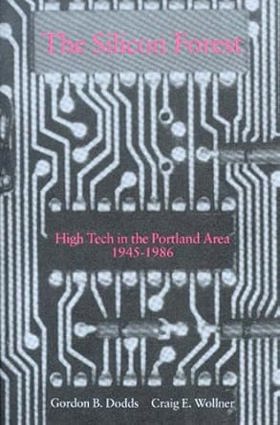
The silicon forest High Tech in the Portland Area 1945-1986 by Gordon B. Dodds, Craig Wollner, Marshall M. Lee
|
1990 |
|
The Siletz Indian Reservation, 1855-1900 by William Eugene Kent, Lincoln County Historical Society (Lincoln County, Or)
|
1977 |
|
The shuswap country by Erskine Burnett, Jim Cooperman 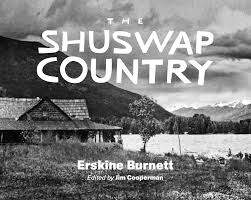
A transplanted Scotsman, Erskine was smitten by the Shuswap where he tended a fruit orchard and with his wife Alice, raised a family. Over the decades he explored every nook and cranny, with the keen eye of a newcomer. He motored, camped and trekked, following every conceivable route in the 1930s and 1940s. The Shuswap Country is his travelogue of observations, characters, anecdotes, puns, tall tales with a smattering of corny humour. It’s also bursting with crisp, clear photographs snapped by the author, making this a priceless document of pioneers, community halls, “auto camps,” train stations, sawmills, Main streets and pristine mountain meadows. Some of those meadows are now preserved inside provincial park boundaries like the Monashee. Erskine had the heart of a poet. He was captured by the shifting quality of light as it tracked across the landscape, or the “sombre green” of fir trees contrasted against the “bright green of birch.” A storm moving down Adams Lake, “has its own moods like temperamental humans.” He revels in flora and fauna – lupines, swallowtail butterflies, or a porcupine that made the mistake of munching into a packsack. His hand-drawn map at the beginning of the book is handy to help understand where we’re travelling next over these twelve journeys. Whether it’s high in the mountains to chat up sheep herders, or down into lush valleys with sweet alfalfa and Herefords dotting the countryside. A gregarious traveller, Erskine was usually certain to make a new friend, or break bread with an old one. He travelled on a road network that was still under development. “The best thing that can be said for the roads at present is there is room for improvement,” he sputters while motoring in the Eagle Valley near Malakwa. He loved to fish the region’s lakes and streams, with dreams of landing a trout for dinner. “A Sugar Lake trout cooked alfresco over a campfire is something to be remembered.” He seems to know every fishing lodge intimately, and where to buy worms at 10 cents a dozen. One is startled to read that canned “red” salmon was so plentiful that local people grew tired of it. Today, as we watch sockeye stocks crash it’s shocking to think that a bounty that has sustained Indigenous peoples for thousands of years can no longer be counted on. A devastation that has occurred within two or three lifetimes. The Shuswap Country might hook you into exploring this underappreciated region, it’s much more than a rest stop on the way to elsewhere. There is an honouring and celebration of the rural existence that is now mostly a memory. We should all visit and take Erskine’s scrapbook along to help see what’s been lost, and what may still be found. 114 pages : illustrations ; 21 x 26 cm CIRC [ 0 ]
|
2022 |
|
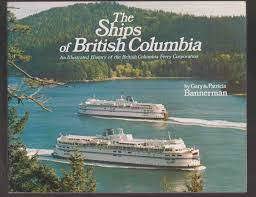
The ships of British Columbia an illustrated history of the British Columbia Ferry Corporation by Gary Bannerman, Patricia Bannerman
|
1985 |
|
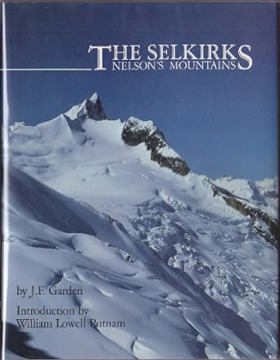
The Selkirks Nelson's Mountains by J. F. Garden, William Lowell Putnam, Footprint Publishing (Publisher)
|
1984 |
|
The Selkirk Range by A. O. Wheeler, Canada Department of the Interior
An "account of a topographical survey of a portion of the Selkirk Mountains adjacent to the line of the Canadian Pacific Railway ... accompanied by a brief review of travel and exploration, of previous surveys and of mountaineering in these regions." xvii, 459 pages, 92 unnumbered leaves of plates : illustrations ; 25 cm + 1 case ([14] folded leaves of plates : illustrations, maps ; 25 cm) ONLINE CIRC [ 1 ]
|
1905 |
|
The Seattle bungalow people and houses, 1900-1940 by Janet Ore 
In the early twentieth century, the appearance of new houses across the United States shifted dramatically. Rejecting the elaborate decoration and complexity of Victorian homes, these new houses featured open, parlorless interiors and a minimalist aesthetic, radiating an aura of warmth, coziness, and naturalness. Nowhere were such residences more evident than in West Coast cities, especially Seattle, where explosive growth generated entire neighborhoods of this new house type--the bungalow. It was the nation's first modern home, and it established the essential characteristics of popular housing for the rest of the twentieth century. In The Seattle Bungalow, Janet Ore modifies the common notion that architectural change flows only from the design elite--the architects, domestic reformers, and planners who advocate for changes in domestic architecture--and argues that ordinary people played a crucial role in creating the bungalow. Through their growing power as consumers, modest-income families influenced the physical form of early twentieth-century houses and suburban landscapes. Still operating within a nineteenth-century labor and contracting system, small home builders responded to rising consumer demand for new conveniences such as electricity and central heating by simplifying their structures. Ambitious salespeople-real estate agents, plan book purveyors, and builders--created a new market for affordable small houses through astute advertising and financing. And once families acquired their homes, they used them flexibly, adapting their lives to their domestic spaces and refashioning their homes when necessary. From such efforts sprang the Seattle bungalow, an artifact of ordinary people's part in creating modern culture. xviii, 202 pages : illustrations, map ; 26 cm CIRC [ 0 ]
|
2007 |
|
The sea among us the amazing Strait of Georgia by R. J. Beamish (Author, Editor), G. A McFarlane (Author, Editor) 
The Strait of Georgia is a one of the world's great inland seas, a 6,900 sq km body of water lying between the British Columbia mainland and Vancouver Island. Rich in history, teeming with wildlife and marine traffic, it is essential to British Columbians for food, jobs, travel and recreation. The sheltered waters of the strait are home to Canada's largest seaport and over two-thirds of the province's population. The Sea Among Us is the first book to present a comprehensive study of the Strait of Georgia in all its aspects with chapters on geology, First Nations, history, oceanography, fish, birds, mammals,invertebrates and plants. Covering everything from tsunami modelling to First Nations history to barnacle reproduction, the book is a sweeping overview of the waterway. It describes how fjords formed, what the seafloor is made of, and why coastal BC is so prone to earthquakes; it advises on which jellyfish sting, how to tell the difference between Dall's and harbour porpoises, and where to find whales; and it addresses how climate change and human impacts could affect the strait, noting that though marine ecosystems are tough and adaptable, there are limits to this resiliency. As editor Dr. Richard Beamish says, "It is the function of this book to inform British Columbians about the Strait of Georgia. All authors hope that the readers will use the information to ask questions about how the Strait of Georgia is coping with change and how they can provide more of the information that is needed to maintain a healthy Strait of Georgia." Informative, descriptive, cautionary and entertaining, The Sea Among Us is illustrated with attractive colour photographs, figures and drawings. It fills a place on the shelf of essential BC reference books beside The Encyclopedia of British Columbia and Marine Life of the Pacific Northwest. xiv, 384 pages : illustrations (chiefly colour), maps, portraits ; 29 cm. CIRC [ 0 ]
|
2014 |
|
The sandal & the cave the Indians of Oregon by Luther S. Cressman 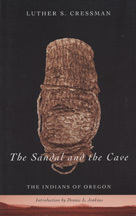
Luther Cressman's 1938 discovery of a 9,000-year-old sandal in Fort Rock Cave revolutionized accepted theories of western prehistory. The recovery of the woven sagebrush-bark sandal, found buried under a layer of volcanic ash from the eruption of Mount Mazama, established a human presence in the Oregon Country much earlier than previously thought. Through six decades of scientific investigation, Cressman worked to uncover the history of the first Oregonians. In The Sandal and the Cave, he offers a brief, lucid introduction to the prehistory of Oregon Indians. Cressman describes their diverse cultures, highlighting similarities and differences between the peoples of various regions: the Oregon Coast, the Klamath Highland, the Northern Great Basin, and the Columbia Plateau. In a new introduction to Cressman's classic work, Dennis Jenkins provides a short biographical profile of the "father of Oregon archaeology" and discusses the importance of Cressman's excavation results and interpretations. Jenkins also offers a concise summary of recent archaeological research in the Northern Great Basin, bringing readers the most up-to-date information about the oldest known sites in Oregon. About the author: Luther S. Cressman (1897-1994) joined the University of Oregon faculty in 1929 and, in addition to his pioneering work as a field archaeologist, was instrumental in establishing the Department of Anthropology and the UO Museum of Natural History. His other books are Prehistory of the Far West: Homes of Vanished Peoples and A Golden Journey: Memoirs of an Archaeologist. xxxiii, 142 pages : illustrations, maps ; 22 cm. CIRC [ 0 ]
|
2005 |
|
The salmon people the story of Canada's West Coast salmon fishing industry by Hugh W. McKervill
|
1967 |
|
The Salmon King of Oregon R.D. Hume and The Pacific fisheries by Gordon B. Dodds 
Robert D. Hume, capitalist, pioneer in the development of the salmon-canning industry of the Pacific Coast, and one of America's first conservationists, was an entrepreneur whose activities illustrate much about the economy, politics, and society of the Northwest. 257 pages illustrations 23 cm CIRC [ 1 ]
|
1959 |
|
The Salish Sea jewel of the Pacific Northwest by Audrey D. Benedict, Joseph K. Gaydos 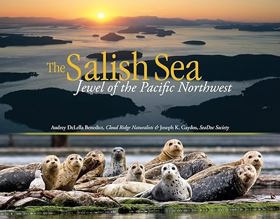
In stunning color photographs, and compelling stories, this keepsake book reveals the the Salish Sea, a unique ecosystem home to thousands of different species of mammals, birds, fish, reptiles, and macro-invertebrates. The Salish Sea region is an ecological jewel straddling the western border between Canada and the United States, connected to the Pacific Ocean primarily through the Strait of Juan de Fuca. There, lush and mossy old-growth forests meet waters with dazzlingly-colored anemones and majestic orcas. This is the first book of its kind to describe the Salish Sea, whose name was not even officially recognized until 2008. One of the world’s largest inland seas, the Salish Sea contains 6,535 square miles of sea surface area and 4,642 miles of coastline. This fascinating visual journey through the Salish Sea combines a scientist’s inquiring mind, dazzling full-color photographs, and a lively narrative of fascinating stories, all of which impart a sense of connection with this intricate marine ecosystem and the life that it sustains. xi, 147 pages : color illustrations ; 22 x 28 cm CIRC [ 0 ]
|
2015 |