Catalog of British Columbiana and Pacific Northwest Americana
Encyclopedia Cascadia Catalog contains book titles of mostly non-fiction Pacific Northwest Coast of North America Titles (primarially British Columbia, Idaho, Oregon and Washington State) in an easy-to-understand title catalog. If you see a link with this badge ONLINE CIRC it means that there is an online institution that provides free access to that title. In some cases there may be more than one institution hosting the title digitally.
| Catalog Title | Published |
|---|---|
|
The Portland Black Panthers empowering Albina and remaking a city by Lucas N. N. Burke , J. L. Jeffries 
Portland, Oregon, though widely regarded as a liberal bastion, also has struggled historically with ethnic diversity; indeed, the 2010 census found it to be “America’s whitest major city.” In early recognition of such disparate realities, a group of African American activists in the 1960s formed a local branch of the Black Panther Party in the city’s Albina District to rally their community and be heard by city leaders. And as Lucas Burke and Judson Jeffries reveal, the Portland branch was quite different from the more famous—and infamous—Oakland headquarters. Instead of parading through the streets wearing black berets and ammunition belts, Portland’s Panthers were more concerned with opening a health clinic and starting free breakfast programs for neighborhood kids. Though the group had been squeezed out of local politics by the early 1980s, its legacy lives on through the various activist groups in Portland that are still fighting many of the same battles. Combining histories of the city and its African American community with interviews with former Portland Panthers and other key players, this long-overdue account adds complexity to our understanding of the protracted civil rights movement throughout the Pacific Northwest. 283 pages, 16 unnumbered pages of plates : illustrations, maps ; 24 cm CIRC [ 0 ]
|
2016 |
|
The port of missing men Billy Gohl, labor, and brutal times in the Pacific Northwest by Aaron Goings 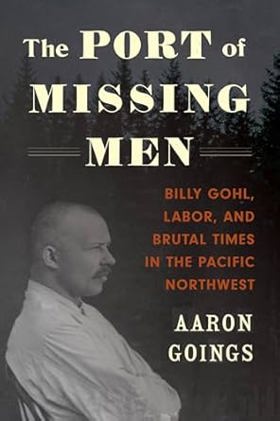
"The true story behind a labor leader reputed to be a serial killer. Aaron Goings offers a vivid biography of Billy Gohl (1873-1927), a prominent union official in Grays Harbor, Washington who came to be known for killing dozens of people, maybe even more than one hundred. In a cruel twist, many victims were his union members. "These anonymous dead men, culled from the hordes of migrant laborers who had flocked to Grays Harbor to cut trees, came to be known as the floater fleet. Billy Gohl was credited with launching most of them," Murray Morgan wrote in The Last Wilderness: A History of the Olympic Peninsula. "If he was responsible for even half of the floaters found in the harbor during his day, Gohl was America's most prolific murderer. Over a ten-year period the fleet numbered 124." A union leader turned serial killer? As a labor historian, author Aaron Goings felt compelled to get to the bottom of the story. So he dug into the archives. In this popular biography, Goings uses Gohl's life to illuminate the brutal nature of everyday life in that era: the Yukon gold rush, the brutally dehumanizing lives of sailors and loggers, and the heated clashes between pro- and anti-union forces in Grays Harbor, the world's busiest lumber shipyard, where millions of dollars were at stake. Goings carefully examines court records and other archival sources to sort through the lore and legends surrounding Gohl, painting the story of a violent man in a violent time who did kill someone-maybe even more than one-but comes almost comically short of his storied reputation. Why did people believe such outrageous things about Gohl, then and now? And where did all those dead bodies come from? Goings shows how powerful economic players help build the myth of "Gohl the Ghoul" to undercut the credibility of union advocates. By pinning all these deaths on one man and building up the story of an extreme pathology, no one had to confront the structural violence of capitalism. The resulting book is not a grisly true crime tale; but an equally intriguing mystery about the creation of myth and the cost in human bodies in the making of the Pacific Northwest"-- Provided by publisher xiv, 277 pages : illustrations ; 24 cm CIRC [ 0 ]
|
2020 |
|
The politics of righteousness Idaho Christian patriotism by James A. Aho 
From their home bases in Idaho and neighboring areas of the Northwest, organizations such as the Order, the Aryan Nations Church, the Posse Comitatus, and the Golden Mean Society have drawn national attention and spread the gospel of a “constitutionally pure, Christian homeland.” For the reader who knows these groups only from a selection of inflammatory quotes and violent deeds, this compelling work presents the first disciplined exploration of the backgrounds and belief systems of the Christian patriot movement. Using information gathered from interviews and direct observation of patriot gatherings, Aho replaces the stereotype of solitary crazies from the fringes of society with more complex and disturbing realities. x, 323 pages : illustrations ; 25 cm CIRC [ 0 ]
|
1995 |
|
The pioneers of Lake View a guide to Seattle's early settlers and their cemetery by Robert L. Ferguson 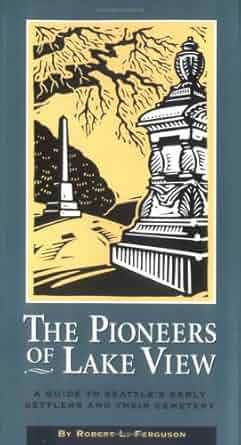
Authored by regional historian Robert L. Ferguson, The Pioneers of Lake View: A Guide to Seattle's Early Founders and Their Cemetery provides a compelling biographical and historical tour of Lake View Cemetery, the final resting place for many of the Emerald City's most prominent 19th-century figures. The book connects the physical monuments and headstones to the turbulent lives of the lumber barons, politicians, and ordinary settlers who laid the foundational infrastructure of frontier Seattle. Through meticulous research into pioneer genealogies, the text unearths the personal triumphs and tragedies hidden beneath manicured urban turf. A keen insight drawn from the work is how historic urban cemeteries function as subterranean archives of class stratification and civic myth-making; by examining who was granted prominent burial plots versus who was relegated to unmarked ground, the book reveals how city founders carefully engineered their own posthumous legacies to sanitize the brutal corporate ruthlessness of early Pacific Northwest capitalism. 119 pages : illustrations ; 20 cm CIRC [ 1 ]
|
1995 |
|
The pioneering life of Peter Kirk from Derbyshire to the Pacific Northwest by Saundra Middleton 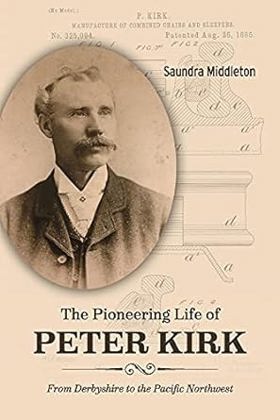
Peter Kirk, Esq. tracked the world iron markets diligently. He had to. Kirk employed 1000 men and boys in his integrated iron and steel works in Workington, England. Britain's market share was losing ground to America's burgeoning steel industry. In 1886, he sailed from Workington flush with decades of success in Britain's Victorian era rail expansion. - from the publisher ix, 293 pages : illustrations ; 23 cm CIRC [ 1 ]
|
2021 |
|
The Pig War and other experiences of William Peck soldier 1858-1862, U.S. Army Corps of Engineers : the journal of William A. Peck, Jr. by William A. Peck, C. Brewster Coulter, Bert Webber 
Edited by C. Brewster Coulter and Bert Webber, The Pig War and Other Experiences of William Peck, Soldier 1858-1862 presents the remarkable personal journal of a U.S. Army engineer stationed in the Pacific Northwest during a tense geopolitical standoff. The book chronicles Private William A. Peck's daily life, military duties, and keen observations surrounding the infamous 1859 San Juan Island boundary dispute between the United States and Great Britain. Through these rare primary documents, the text captures the stark isolation, raw camp conditions, and quiet diplomacy that characterized an uneasy international borderlands garrison. A keen insight drawn from the work is how military journals humanize imperial brinkmanship; by filtering an international crisis through the mundane daily chores and reflective musings of an ordinary soldier, the narrative reveals that historical flashpoints are often lived not as grand historical dramas, but as tedious, freezing waits in remote wilderness outposts. x, 236 pages : illustrations, maps ; 21 cm CIRC [ 1 ]
|
1993 |
|
The Pig War the last Canada-US border conflict by Rosemary Neering 
On May 15, 1859, an American settler on San Juan Island shot a pig belonging to the Hudsons Bay Company. This seemingly insignificant act was the spark that almost set aflame the strangest of many confrontations between Britain and the United States on the northwest coast of North America. On one side of the border dispute over the strategically located San Juan Islands was Governor James Douglas, determined to protect the interests of the Hudsons Bay Company and prove the military superiority of Britain. On the other side was General William Selby Harney, spoiling for a fight and believing in Americas manifest destiny to rule the continent. In this lively account of the conflict that became known as the Pig War, Rosemary Neering traces the events that led to the standoff in the San Juans and brings to life the memorable characters who played leading roles in the drama. The book is an excellent travel companion to anyone visiting the San Juans and the original American and British camps that are open to the public. 142 p. : ill., maps, ports. ; 22 cm. CIRC [ 1 ]
|
2011 |
|
The Pierce chronicle personal reminiscences of E.D. Pierce as transcribed by Lou A. Larrick by E. D. Pierce, Lou A. Larrick, Gary Williams , Ronald W. Stark , Idaho Research Foundation (Publisher)
|
1975 |
|
The people's school a history of Oregon State University by William G. Robbins 
"The People's School is a comprehensive history of Oregon State University, placing the institution's story in the context of state, regional, national, and international history. Rather than organizing the narrative around presidencies, historian William Robbins examines the broader context of events, such as wars and economic depressions, that affected life on the Corvallis campus. Agrarian revolts in the last quarter of the nineteenth century affected every Western state, including Oregon. The Spanish-American War, the First World War, the Great Depression of the 1930s, and the Second World War disrupted institutional life, influencing enrollment, curricular strategies, and the number of faculty and staff. Peacetime events, such as Oregon's tax policies, also circumscribed course offerings, hiring and firing, and the allocation of funds to departments, schools, and colleges. This contextual approach is not to suggest that university presidents are unimportant. Benjamin Arnold (1872-1892), appointed president of Corvallis College by the Methodist Episcopal Church, South, served well beyond the date (1885) when the State of Oregon assumed control of the agricultural college. Robbins uses central administration records and grassroots sources--local and state newspapers, student publications (The Barometer, The Beaver), and multiple and wide-ranging materials published in the university's digitized ScholarsArchive@OSU, a source for the scholarly work of faculty, students, and materials related to the institution's mission and research activities. Other voices--extracurricular developments, local and state politics, campus reactions to national crises--provide intriguing and striking addendums to the university's rich history"-- Provided by publisher x, 414 pages ; 23 cm CIRC [ 0 ]
|
2017 |
|
The people of the Harrison by Daphne Sleigh
|
1990 |
|
The people are dancing again the history of the Siletz tribe of western Oregon by Charles F. Wilkinson 
The history of the Siletz is in many ways the history of all Indian tribes in America: a story of heartache, perseverance, survival, and revival. It began in a resource-rich homeland thousands of years ago and today finds a vibrant, modern community with a deeply held commitment to tradition. The Confederated Tribes of Siletz Indians—twenty-seven tribes speaking at least ten languages—were brought together on the Oregon Coast through treaties with the federal government in 1853–55. For decades after, the Siletz people lost many traditional customs, saw their languages almost wiped out, and experienced poverty, killing diseases, and humiliation. Again and again, the federal government took great chunks of the magnificent, timber-rich tribal homeland, a reservation of 1.1 million acres reaching a full 100 miles north to south on the Oregon Coast. By 1956, the tribe had been “terminated” under the Western Oregon Indian Termination Act, selling off the remaining land, cutting off federal health and education benefits, and denying tribal status. Poverty worsened, and the sense of cultural loss deepened. The Siletz people refused to give in. In 1977, after years of work and appeals to Congress, they became the second tribe in the nation to have its federal status, its treaty rights, and its sovereignty restored. Hand-in-glove with this federal recognition of the tribe has come a recovery of some land--several hundred acres near Siletz and 9,000 acres of forest--and a profound cultural revival. This remarkable account, written by one of the nation’s most respected experts in tribal law and history, is rich in Indian voices and grounded in extensive research that includes oral tradition and personal interviews. It is a book that not only provides a deep and beautifully written account of the history of the Siletz, but reaches beyond region and tribe to tell a story that will inform the way all of us think about the past. xvi, 564 pages : illustrations, maps ; 26 cm CIRC [ 0 ]
|
2010 |
|
The pathfinder A.C. Anderson's journeys in the West by Nancy Marguerite Anderson 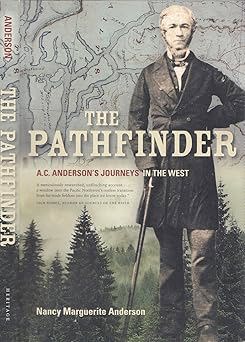
Fifteen years before the 1858 Fraser River gold rush, a Hudsons Bay Company clerk named Alexander Caulfield Anderson threaded his way through mountain passes and down rapids-filled rivers in search of a safe all-British route through the mountains that separated the HBC fort at Kamloops from Fort Langley on the Pacific coast. Eventually, Anderson discovered four routes, succeeding where Alexander Mackenzie and Simon Fraser before him had failed. Without his explorations, historian Derek Pethick once wrote, British Columbia may never have come into being or become a part of the Dominion of Canada. For Anderson, the cross-country expeditions he undertook were welcome antidotes to a fur-trade life that wasnt quite what hed expected it to be. By the time he joined, in 1831, the fur trade was in fact a tightly controlled business that was very different from the adventurous trade that had inspired him. But though he may not have had his dream life, his spirit of adventure kept him going. As explorer, map-maker, artist and writer, he created a wealth of information to guide those of his time and far beyond, and his work—first in the fur trade, then in the communities in which he lived, and finally as Fisheries Inspector and Indian Reserve Commissioner for British Columbia—was always aimed at improving the future of the people he lived among. 239 pages, [8] pages of plates : illustrations, facsimiles, maps, portraits ; 23 cm CIRC [ 0 ]
|
2011 |
|
The Past remembered a Vashon-Maury Island student-community project by Marj Watkins , Garland Norin
|
1978 |
|
The past at present in Issaquah, Washington by Edwards R. Fish
|
1981 |
|
The park builders a history of state parks in the Pacific Northwest by Thomas R. Cox 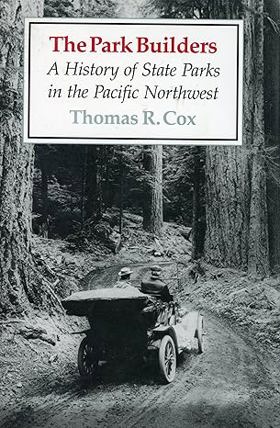
Among the greatest attractions of the Pacific Northwest are its state parks, campgrounds and tree-lined highways. From Idaho hot springs to the Oregon coast, millions of people enjoy this priceless legacy every year but few stop to think about the source of this bounty. The Park Builders profiles the men who provided the parks, and the times that shaped them. From its beginnings as part of the progressive crusades to its evolution into an expected function of state government, the state parks movement in the Northwest is a window onto the political and social developments of the twentieth century. The states of Washington, Idaho, and Oregon were generally in the mainstream of the parks movement, but each of their histories is unique. Taken together, they help to define the nature and limitations of regionalism in the Northwest. Especially in the early years, the story of state parks was largely the story of individuals. Drawing extensively from interviews and personal papers, Thomas Cox creates memorable pictures of parks activists in each state. Robert Moran, creator of the battleship, Nebraska, spent a decade lobbying the state of Washington to accept his magnificent acreage on Orcas Island. Sam Boardman went from a road crew to the head of Oregon’s park system, and took up his mission with a zeal that was literally religious: “To me a park is a pulpit,” he wrote. “The more you keep it as He made it, the closer you are to Him.” In Idaho, Senator Weldon Heyburn, no proponent of state expenditures, set out to create a national park, and ended up with a premier state park, named for him. State parks serve more people at far less expense than do those in the National Park System. Since their fates are determined largely at the state level, they are an ideal venue for the study of grassroots activism and regional trends. This book is the first to collect these themes into a coherent whole. It will serve as a model for further regional studies of its kind. xiii, 248 pages, 20 unnumbered pages of plates : illustrations, map, portraits ; 24 cm CIRC [ 1 ]
|
1988 |
|
The panic of 1893 the untold story of Washington State's first depression by Bruce A. Ramsey 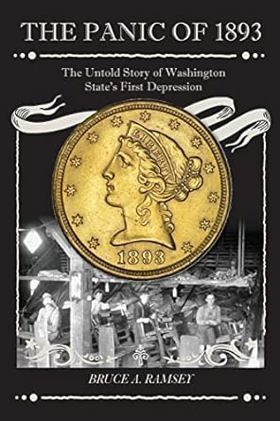
"In 1893 Washington, a new state with new people, plunged into the last depression of the 19th century. Banks failed. Railroad building stopped. Money became so scarce that Port Angeles and Bellingham made their own. Jobless men sawed wood, picked blackberries, and dug clams. In Spokane, the town's richest man was wiped out, and from Tacoma and Seattle protesters set off for Washington, D.C., on foot and by stealing rides on trains. In The Panic of 1893, former Seattle newspaper columnist Bruce A. Ramsey tells the story of how people survived and how their resilience defined their new state."-- Back cover 324 pages : illustrations, maps ; 23 cm CIRC [ 1 ]
|
2018 |
|
|
1977 |
|
The Pacific Northwest past, present, and future by Dale A. Lambert 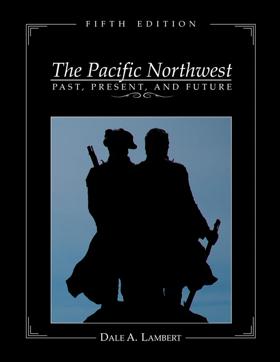
The updated textbook is presented in a regional format, discussing the history of Washington, Oregon and Idaho. The Pacific Northwest: Past, Present and Future, 5th Edition - Textbook, emphasizes the major geologic events, geographic aspects, historical trends, demographic patterns, cultural diversity, governmental organization, socioeconomic development, recreational opportunities, and environmental concerns for the Pacific Northwest region. xii, 499 pages : illustrations (some color), color maps ; 29 cm CIRC [ 1 ]
|
2006 |
|
The Pacific Northwest a syllabus by Edmond S. Meany 
Compiled in the early twentieth century by University of Washington professor Edmond S. Meany—the premier institutional architect of the state's historical canon—The Pacific Northwest: A Syllabus operated as a formal pedagogical framework designed to standardize the teaching of regional history in higher education. Functioning as a strict curriculum guide, the text organized the region’s past into a rigid, highly structured taxonomy of chronological eras: maritime discovery, the fur trade, missionary settlement, the pioneer migrations, and the triumphant march to statehood. By dictating the precise historical milestones, key figures, and required readings for university students, Meany’s syllabus built the foundational academic infrastructure that determined exactly how the next generation of teachers, politicians, and civic leaders would learn and transmit their region's origins. A keen insight drawn from the work is how the seemingly neutral, objective format of a university syllabus functioned as a profound instrument of epistemological erasure; by plotting the region’s history strictly along a timeline of Anglo-American achievements, treaties, and legal milestones, Meany conceptually banished millennia of Indigenous civilization to the static realm of "pre-history" or mere environmental obstacles to be overcome. The syllabus weaponized the authority of the university to institutionalize a teleological narrative of colonial progress, ensuring that the violent displacement of Native peoples was academically processed by future civic leaders not as an ongoing injustice, but as a concluded, natural phase in the inevitable maturation of the American state. 18 unnumbered pages ; 22 cm ONLINE CIRC [ 1 ]
|
1927 |
|
The Pacific coast ranges by Roderick Peattie , Donald Culross Peattie (Contributor), Archie Binns (Contributor), John Walton Caughey (Contributor), Lois Crisler (Contributor), Aubrey Drury (Contributor), Idwal Jones (Contributor), Judy Van der Veer (Contributor), Thomas Emerson Ripley (Contributor), Daniel E. Willard (Contribu
A now-historical look at the people, culture, and geography of the US Pacific Coast ranges from California to Washington State xviii, 402 pages, frontispiece, 16 unnumbered pages of plates : illustrations, maps ; 24 cm CIRC [ 1 ]
|
1946 |
|
The Ox Team or, The Old Oregon Trail, 1852-1906 by Ezra Meeker 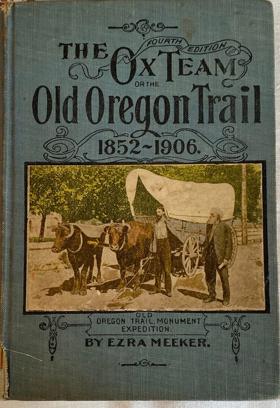
An account of the author's trip across the plains, from the Missouri River to Puget Sound, at the age of twenty-two, with an ox and cow team in 1852, and of his return with an ox team in the year 1906, at the age of seventy-six : with copious excerpts from his journal and other reliable sources of information, a narrative of events and descriptive of present and past conditions [4], 248, [5] pages : illustrations, maps, portrait ; 19 cm CIRC [ 0 ]
|
1907 |
|
The other side of Oregon by Ralph Friedman 
A collection of history, biographies and tales of what makes the eastern side of Oregon unique. The Other Side of Oregon is filled with stories about people and places that make the state special, spiced with philosophical tidbits from the author. xii, 425 pages : illustrations ; 23 cm CIRC [ 1 ]
|
1993 |
|
The other Oregon people, environment, and history east of the Cascades by Thomas R. Cox 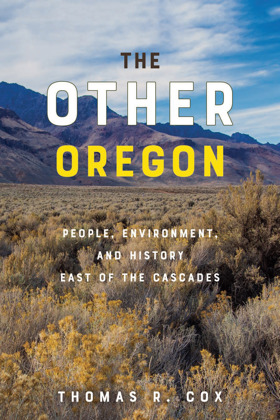
"The Other Oregon: People, Environment, and History East of the Cascades is a multidisciplinary work that ranges widely through a diverse and often under-appreciated land, drawing on the fields of environmental history, cultural and physical geography, and natural resource management to tell a comprehensive and compelling story. With a staggering variety of landscapes, from high desert to alpine peaks, Oregon east of the Cascades encompasses seventeen counties and two time zones. Although this vast region defies generalization, its history is distinct from the rest of Oregon. The interrelationship between its people and the land has always been central, but that relationship has evolved and changed over time. Regional economies that were once largely exploitive and dedicated to commodity exports have slowly moved toward the husbanding of resources and to broader and deeper appreciations. Historian Thomas Cox reveals the complexity of interactions between the people of Eastern Oregon, the land, natural resources, and one another, demonstrating how the region's history speaks to larger American issues. The 2016 occupation of the Malheur National Wildlife Refuge, covered in detail within these pages, further reveals the relevance of Eastern Oregon to the larger world. Written in clear and engaging prose and informed by extensive research, The Other Oregon will be a valuable resource for anyone interested in the environment, social change, and the relationships among the diverse people who make up Oregon society east of the Cascades. It will appeal to area residents and visitors, students of the American West, environmental historians, biologists, land managers, and anyone with an abiding interest in the region"-- Provided by publisher xvii, 398 pages : illustrations, maps ; 24 cm CIRC [ 0 ]
|
2019 |
|
The other Idahoans forgotten stories of the Boise Valley by Todd Shallat 
Fallen angels in the bawdy houses. Migrants barred from Main Street. Homesteaders driven from homesteads when August rained black storms of dust. The Other Idahoans recovers their hard-luck stories. Volume 7 of Boise State University's prizewinning research series, the book closes with a driving tour of storied places from history's underside. 139 pages : illustrations (some color), color maps ; 23 cm. CIRC [ 0 ]
|
2016 |
|
The origin and distribution of birds in coastal Alaska and British Columbia the lost manuscript of ornithologist Harry S. Swarth by Christopher W. Swarth 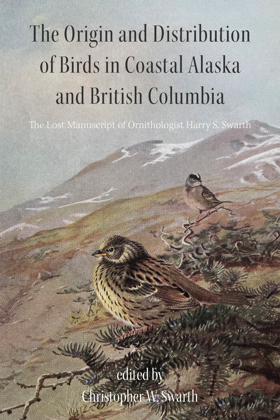
"At the time of his death in 1935, Harry S. Swarth, head of the Mammalogy and Ornithology Departments at the California Academy of Sciences in San Francisco, had been preparing a manuscript reflecting on twenty-five years of research in Alaska and British Columbia. "The Distribution and Migrations of Birds in Adjacent Alaska and British Columbia" summarized Swarth's research, ideas, and conjectures on bird life in the region, including theories on when and how birds populated this vast territory after the retreat of glaciers near the end of the Pleistocene. Drawing on his field experiences and the forty scientific papers on the region he published from 1908 on, Swarth's manuscript represented state-of-the-art science for the time. And it holds up; his work is still cited by ornithologists today. In 2019, Christopher Swarth, Harry's grandson and a scientist in his own right, discovered the forgotten manuscript. The edition he proposes here will include the original unpublished manuscript, accompanied by contextual essays from contemporary scientists, including Steven Heinl (Alaska Fish & Wildlife) and Philip Unitt (San Diego Natural History Museum). He has also included excerpts from Harry Swarth's field notes to bring additional color and insight to the project. Appendices include expedition locations, a comprehensive list of Harry Swarth's publications, and a glossary with historic and contemporary bird names"-- Provided by publisher xviii, 152 pages : illustrations, maps ; 23 cm CIRC [ 0 ]
|
2022 |