Catalog of British Columbiana and Pacific Northwest Americana
Encyclopedia Cascadia Catalog contains book titles of mostly non-fiction Pacific Northwest Coast of North America Titles (primarially British Columbia, Idaho, Oregon and Washington State) in an easy-to-understand title catalog. If you see a link with this badge ONLINE CIRC it means that there is an online institution that provides free access to that title. In some cases there may be more than one institution hosting the title digitally.
| Catalog Title | Published |
|---|---|
|
Always on call adventures in nursing, ranching, and rural life by Marion Crook 
"In the long-awaited sequel to Always Pack a Candle, intrepid public health nurse Marion Crook juggles marriage, children, and a vast array of patients and cases in rural British Columbia in the 1970s. It has been over a decade since Marion Crook arrived in the Cariboo for her first job out of nursing school. The vast rural territory that once left her awestruck now feels like home, as she embraces life on the ranch with her husband, Carl, three young children, and numerous farm animals. But things are far from idyllic. Overseeing a small staff of irrepressible nurses serving a public health district the size of a small country brings new challenges every day. From runaway patients and needle-phobic hockey players to cultural misunderstandings and heartbreaking cases of abuse and neglect, Marion never knows what is coming next. The 1970s bring signs of social progress as women gain more autonomy and the region grows more culturally diverse. Yet, old prejudices persist, and Marion must fight for her patients, as well as for her adopted son. Recounted with warmth, compassion, and riveting detail, Always On Call is a fascinating portrait of the hectic life of a rural nurse and highlights the importance of the helping professions."-- Provided by publisher 259 pages ; 23 cm CIRC [ 0 ]
|
2024 |
|
Boxing the compass a life of seafaring, music, and pilgrimage by Michael L. Hadley 
"An award-winning historian and mariner takes readers on an engrossing international journey of self-discovery that explores timely themes of human conflict, ethics, and reconciliation. A member of the so-called Silent Generation, Michael Hadley has a great deal to say in his twilight years. Opening with his Depression-era childhood on a lonely lighthouse on the west coast of Vancouver Island, this remarkably nuanced memoir spans decades, countries, and oceans. Hadley's reflections move through his years growing up in wartime Vancouver in the 1940s, his concert tours on the British vaudeville stage in the 1950s, and his early teaching career in Manitoba in the 1960s. He shares his naval service on both coasts and on the Great Lakes, and his professional experience in Germany, where unexpected friendships with former submariners trigger an interest in how countries deal with difficult wartime pasts. Human conflict, ethics, and multi-faith engagement in criminal justice reform and Restorative Justice shape Hadley's understandings of reconciliation, taking him on prison visits across Canada, the UK, and Uganda. Whether examining ancient historical sites and battlegrounds, navigating at sea, or riding camels in the desert, he seeks universal patterns of human experience. At once a deeply personal chronicle of a fascinating life and a measured, mature reflection on some of the most cataclysmic events of the past century, Boxing the Compass is an unforgettable journey that will leave readers reflecting on the experiences that affect us all."-- Provided by publisher 306 pages, 16 unnumbered pages of plates : illustrations ; 22 cm CIRC [ 0 ]
|
2024 |
|
The City of Rainbows a colourful history of Prince Rupert by Blair Mirau 
"A vivid and comprehensive history of the City of Prince Rupert, from its ancient roots as a rich, multicultural trading hub between different Indigenous Nations to its current state as an ethnically diverse community set against the stunning natural backdrop of the Great Bear Rainforest. Since time immemorial, rain has defined life on Kaien Island, now known as the townsite of Prince Rupert. As the rainiest and cloudiest city in Canada, Prince Rupert is the perfect environment for rainbows--and the rainbow is an apt metaphor for the city: a symbol of diversity and inclusion, a supernatural gateway between worlds, and a universal sign of hope and calm after a storm. From its original Ts'mysen inhabitants to the first European explorers and fur traders, the building of dozens of salmon canneries to the construction of the transcontinental railway, the global upheaval of two World Wars to decades of industrial boom and bust, Kaien Island, and Prince Rupert, has always been a rich, multicultural trading hub that has weathered countless storms. By weaving together historical events illustrated by compelling archival photographs, The City of Rainbows strives to tell the story of Prince Rupert from a modern perspective, one that confronts the impact of colonization head-on and moves away from a romanticized account of the development of a "pioneer" town. Balancing the histories of Indigenous Peoples, European and Asian settlers, and recent immigrants, this book reveals powerful, intriguing, uncomfortable, and beautiful truths about an undoubtedly colourful city."-- Provided by publisher vi, 251 pages, 14 unnumbered pages of plates : illustrations, map ; 22 cm CIRC [ 0 ]
|
2024 |
|
Escape to Clayoquot Sound finding home in a wild place by John Dowd , Bea Dowd 
Twenty years ago, two empty-nesters with a love of the outdoors stumbled upon a vacant beach house on a small island in Clayoquot Sound, part of an off-grid, ten-acre stretch nestled within a provincial park reserve. Our Stolen Years in Clayoquot Sound is an extended love letter to this place, chronicling the decade John and Bea Dowd spent as year-round caretakers of the property. Told with humour and heart in alternating voices, and lavishly illustrated throughout with stunning natural photography, this book a story of joyful solitude, of living in harmony with wildlife and respecting the forces of nature. It is about the fleeting definition of home and family, and about creating community in the wilderness. Above all, it is a tribute to an achingly beautiful, fragile place. 309 pages : color illustrations ; 26 cm CIRC [ 0 ]
|
2024 |
|
Hand drawn Victoria an illustrated tour in and around BC's capital city by Emma FitzGerald (Author, Illustrator) 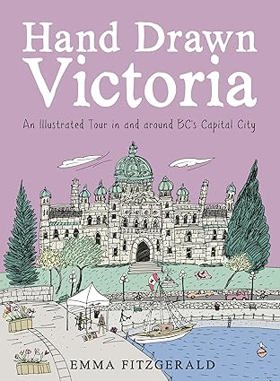
"For locals and visitors alike, these sketches and stories highlight both the historic monuments and everyday moments that make Victoria shine. You never know quite what you'll come across in British Columbia's capital city. With its unmissable landmarks that attract people from around the world, Victoria is also rich in forested beauty, charming houses, and curious people, and is steeped in local history. Following the charm of her previous book, Hand Drawn Vancouver, in this memorable book, Emma FitzGerald captures the coastal city of Victoria and its surrounding communities in over 100 sketches of: iconic landmarks: It wouldn't be a visit to Victoria without stopping by the Empress, Munro's, or Butchart Gardens ; local favourites: the longstanding Beacon Drive In and James Bay's Birdcage Confectionary are some beloved spots honoured within these pages ; beautiful architecture: journey back in time by admiring historic buildings, like Queen Anne-style homes and the spiraling Belfry Theatre ; stunning west coast landscape: explore natural wonders, from culturally significant fields of camas flowers to Mystic Beach's stunning shoreline ; overheard conversations: what really makes a city are the people who live there--Emma documents snippets of passersby's conversations as she sketches. Structured by neighbourhood, Hand Drawn Victoria is a beautiful keepsake for both locals and visitors, and a lovely way to celebrate the city--its buildings, its people, and its essence"--Amazon.com 151 pages : color illustrations ; 21 cm CIRC [ 0 ]
|
2024 |
|
The last logging show a forestry family at the end of an era by Aaron Williams 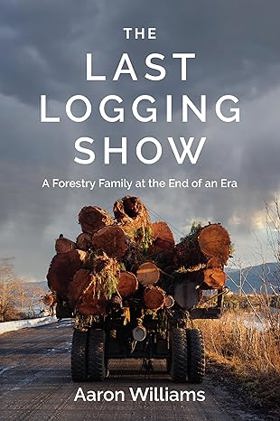
A third-generation Pacific Northwest logger returns to the forests of Haida Gwaii, to witness a way of life in the grip of change. By the time Aaron Williams began learning how to fall a tree, his family had been making clear cuts on BC hillsides for nearly a century. During his father’s generation, the industry started to crumble, and by the time Williams arrived, he knew his future lay elsewhere. But his father continued in the trade, his work taking him into the forests of Haida Gwaii. There, Williams follows him into a season at Collison Point, where the loggers are increasingly unwelcome visitors to the ancient forests. The Last Logging Show captures the spectacular setting of Haida Gwaii and the people who call it home. It unravels the lives and dreams of those who log the forests for a living, who have coexisted with the Haida for generations—but while one way of life is in the twilight of existence, the other is being reborn. Thoughtful and compelling, this is a story of connection, community, and the force of fundamental change. 1 online resource (xv, 207 pages) : illustrations, map CIRC [ 0 ]
|
2024 |
|
Past the end of the road a North Island boyhood by Michel Drouin 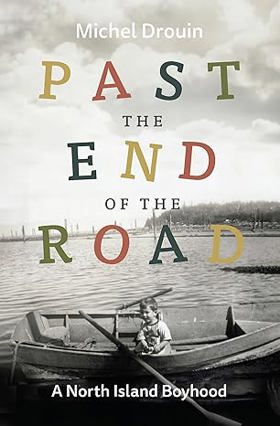
"Past the End of the Road recounts a free-range adolescence in mid-century Port Hardy on northern Vancouver Island, at a time when, with no roads south, the town was only connected to the rest of the island by air and sea and the Union steamship was the main mode of travel to and from the sleepy logging village. Michel Drouin's frank and humorous memoir recounts the freedom of his childhood in midcentury Port Hardy. When he was twelve, Drouin and his friend rowed a small boat from town ten kilometres across the Goletas Channel for a day trip to the Gordon Group of islands, without even bringing water to drink, as neither he or his friend owned a canteen and "plastic water bottles hadn't been invented yet." Drouin's adolescence encompassed hunting, fishing, firewood cutting, and more activities that although common at the time are probably foreign to most Canadian children. Although he ultimately prospered, the wildness of Drouin's youth led to some close calls, such as when the young man accidentally lit himself on fire and he was only able to extinguish himself by running to the beach--"fortunately, the tide was in"--and flinging himself into the ocean."-- Provided by publisher x, 230 pages : illustrations, map ; 22 cm CIRC [ 0 ]
|
2024 |
|
Points of Interest In Search of the Places, People, and Stories of BC by David Beers, Andrea Bennett 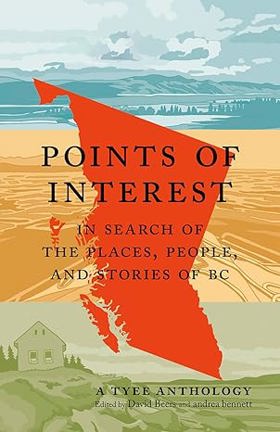
Take a trip across British Columbia with this enchanting collection of essays from thirty local writers. What makes wandering the vibrant land called British Columbia really special? Encounters with locals who are ready to share, over a coffee or a beer, quirky tales and powerful truths rooted in place and time. Consider this book a meet-up with 30 such storytellers, the perfect road companion for your journey real or imagined. The Tyee is the province’s oldest and most-read independent source of online news and ideas, renowned for its range of voices on politics, culture and nature. This anthology marking The Tyee’s 20th anniversary includes pieces published over the last two decades and includes the distinct perspectives of some of the region’s most celebrated writers, including J.B. MacKinnon, Alisa Smith, Cúagilákv (Jess H̓áust̓i), Arno Kopecky, Harrison Mooney, Michelle Cyca, Christopher Cheung, Andrew Nikiforuk, and many more, as well as illustrations by Nora Kelly. Pull up a chair and get their inside scoops on the places they call home. 288 p. CIRC [ 0 ]
|
2024 |
|
Surviving Vancouver by Michael Kluckner (Author, Artist) 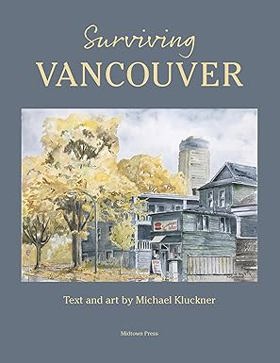
"This book is about "surviving" and is divided into three sections: an introduction that looks back to my 1996 book and reproduces some of the images and thoughts from that tranquil time nearly 30 years ago; a second section about "surviving" as an adjective--what has survived of its fine buildings and beautiful neighbourhoods; and a third one of "surviving" as a verb--how people are surviving in Vancouver. I have used "Vancouver" both as a term for the city itself and sometimes for Metro Vancouver--the region which includes Burnaby, New Westminster, the North and West Vancouvers, Surrey, Richmond, Delta, Port Moody, White Rock, the Coquitlams and the Langleys. The final section of the book considers that geography, and the "great escapes" further afield."-- Provided by publisher 126 pages : illustrations ; 28 cm CIRC [ 0 ]
|
2024 |
|
They called him a radical the memoirs of Pete Maloff and the making of a Doukhobor pacifist by Pete Maloff , Vera Maloff 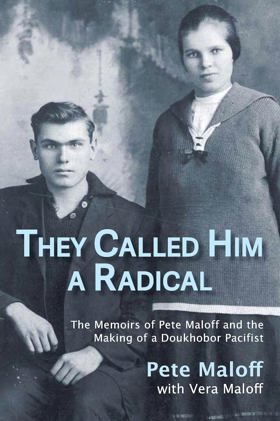
"Peter "Pete" Maloff was born in Saskatchewan in 1900, the year after the first Doukhobors, including his parents, immigrated to Canada. Living through the eras of WWI and WWII in a Doukhobor community strengthened his deep-rooted belief in pacifism and, at a young age, he dedicated himself completely to the idea that there must be another way to solve conflicts. This quest, as well as Maloff's status as an 'outsider,' was not always welcomed--judges and wardens considered him a radical and his influence a threat, and his outspokenness and peaceful protests resulted in house arrest and years in Canadian jails. Maloff was not deterred, and his perseverance garnered him many followers, including some who had formerly worked against him or had helped to incarcerate him. Today, his granddaughter Vera Maloff remembers Pete as a tall, strong, charismatic man. Growing up, she worked beside him in the family's gardens, and at the local markets where they sold produce, she recalls that he would be regularly surrounded by people wanting to hear him speak. He was a kind, caring man, and the time spent incarcerated, forced away from his family, did not seem to have dulled his spirit. He was an avid reader, who taught his family to consider all aspects and perspectives, instilling an awareness of other people and cultures and an eagerness to learn. In They Called Him a Radical: The Memoirs of Pete Maloff and The Making of a Doukhobor Pacifist, Vera revisits her grandfather's memoirs, written while under house arrest and covering the formative years from his birth to his late twenties, during which Pete's resolve to live as a pacifist was cemented. Here, Pete writes of growing up in the new Canadian Doukhobor community at the turn of the century, meeting influential figures in the pacifist movement in California, his time in a cooperative freedom colony in Oregon, and his turning to writing, as he truly believed that the pen could be mightier than the sword."-- Provided by publisher 226 pages : illustrations ; 23 cm CIRC [ 0 ]
|
2024 |
|
On island time a traveler's atlas : illustrated adventures on & around the islands of Washington & British Columbia by Chandler O'Leary 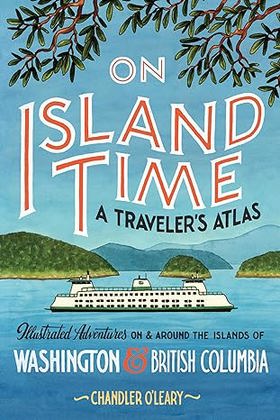
Dream of escaping to an island, for the slower pace and stunning views? An illustrated love letter to the Pacific Northwest's iconic islands--focusing on Puget Sound, the San Juans, and Canada's Gulf Islands and Vancouver Island--this guide charms and educates travelers, locals, and armchair adventurers alike. Kick back, relax, and get On Island Time! This quirky illustrated travel guide showcases the hidden delights, natural wonders, and singular history of Washington and British Columbia's islands, from the author of bestselling The Best Coast, Illustrated Adventures Along the West Coast Historic Highways xi, 195 pages : color illustrations, color maps ; 27 cm CIRC [ 1 ]
|
2023 |
|
Chimacum In the valley near the water by Nancy L. McDaniel 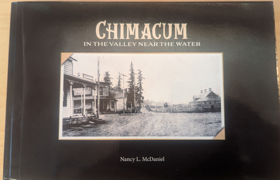
"In the Valley, Near the Water" are the first words of Chimacum High School's Alma Mater song. Written by Duane Montgomery, cherished music director, those words have a special meaning for Chimacum residents. Published in 2023 by local historian Nancy L. McDaniel, Chimacum: In the Valley Near the Water provides an intimate local history of the Chimacum Valley and its surrounding agricultural communities on Washington's Olympic Peninsula. The narrative chronicles the area's transition from ancestral indigenous homelands to a bustling hub of pioneer farming, timber harvesting, and dairy production driven by 19th-century homesteaders. Drawing on extensive family archives, oral histories, and photographs, the book meticulously reconstructs the daily lives, schoolhouses, and community networks of early settlers. A keen insight drawn from the text is how its granular, bottom-up preservation of rural genealogy reveals the quiet, persistent labor required to carve an agrarian society out of a heavily forested frontier, offering a localized counterweight to grand narratives of Pacific Northwest expansion. 277 pages CIRC [ 1 ]
|
2023 |
|
Printer's devils a feisty pioneer newspaper shaped the history of British Columbia, 1895-1925 by Ron Verzuh 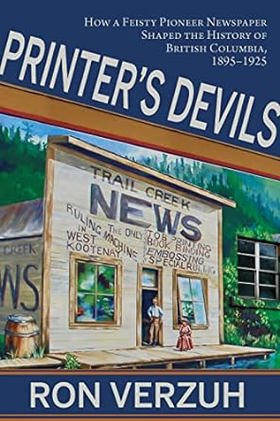
"The grisly murder of a nurse, a crippling 1917 strike, death on the wartime battlefield, the 1918–19 flu pandemic, life on the home front—these are just some of the historic events covered in the early days of the Trail Creek News. In Printer’s Devils, historian Ron Verzuh offers both a study of pioneer journalism and a social history of the smelter city of Trail as it grew into a small but prosperous community. He traces the stories of residents and their evolving attitudes, pastimes and opinions as they respond in times of economic crisis, war, labour strife and life-threatening disease against the backdrop of one of Canada’s pioneer industrial centres. Beneath these stories is a revealing exploration into the lives of six Trail News editors—Trail’s printer’s devils—in which we see firsthand how their editorial choices were honed by their education, business priorities and experience as tramp printers in the early days of newspaper publishing in the region. Delving back through layers of history, Printer’s Devils: The Feisty Pioneer Newspaper That Shaped the History of British Columbia’s Smelter City is a tribute to the lasting impact of journalism in Canadian society, as chronicled in one single-industry town."-- Provided by publisher pages cm CIRC [ 0 ]
|
2023 |
|
Capturing the summit Hamilton Mack Laing and the Mount Logan expedition of 1925 by Trevor Marc Hughes 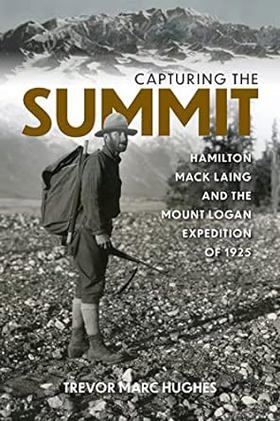
"A remarkable account of the grueling journey to the summit of Mount Logan. Naturalist and cinematographer, Hamilton Mack Laing, marched into the Alaskan wilderness alongside weathered guides and hardened, experienced mountaineers. From Laing's diaries, we learn how capturing the summit pits the daring adventurers in a struggle with nature, changing them irrevocably as they became part of the environment that tested them."-- Provided by publisher 268 pages : illustrations ; 23 cm CIRC [ 0 ]
|
2023 |
|
My paddle's keen and bright summer camp stories by Rika Ruebsaat 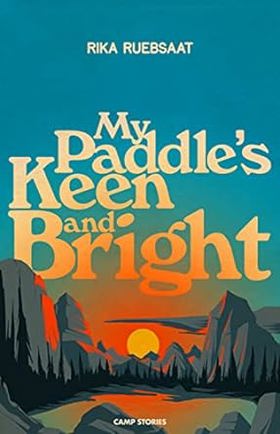
"Parents began sending their kids off to summer camp more than a century ago, a tradition that continues strong in the face of transformative changes to society, and childhood. The history of summer camping, with its roots in Boy Scouts and other Victorian-era social movements, is beginning to be written. But until now, less has been said about the experiences of the generations of young men and women whose outlook has been shaped by their summer vacations. In My Paddle's Keen and Bright, Rika Ruebsaat allows the camp veterans of all ages and backgrounds to reflect on their experiences, and the indelible lifelong impressions these have left on them. Every facet of camp experience is described, from the bus or boat that takes you away from the familiars into a new world of strangers, to the bittersweet partings and memories lasting a lifetime. Campers describe the terror, and exhilaration, of learning about new people and different lives outside of their own families; the food, strange rituals, and exciting new adventures involving boats, or horses, or hikes, chores, even practical jokes. Here are the vivid recollections of passionate friendships made in the course of a few days; of crushes on counsellors; the campfires and songs; the first fumbling sexual explorations; the skinned knees and overcome fears; the lessons learned and carried for the rest of their lives. Grown-ups from all social classes and outloooks established summer camps. The storytellers reflect on their experiences in the more traditional summer camps organized by Boy Scouts or Girl Guides; the camps organized by religious organizations or around political viewpoints. The differences - and, more often, the continuities - provide a fascinating and unique perspective into a world that continues to leave an indelible mark on society, even as the world of summer camp slips into history."-- Provided by publisher xii, 287 pages ; 22 cm CIRC [ 0 ]
|
2023 |
|
The curious passage of Richard Blanshard first governor of Vancouver Island by Barry M. Gough 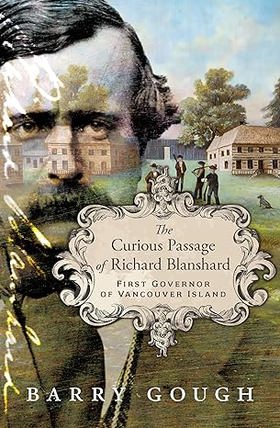
"Celebrated historian Barry Gough brings a defining era of Pacific Northwest history into focus in this biography of Richard Blanshard, the first governor of Vancouver Island--illuminating with intriguing detail the genesis and early days of Canada’s westernmost province. Early one wintry day in March 1850, after seven weary weeks out of sight of land, a well-dressed Londoner, a bachelor aged thirty-two, stood at the ship’s rail taking in the immensity of the unfolding scene. From Her Britannic Majesty’s paddlewheel sloop-of-war Driver, steadily thumping forth on Imperial purpose, all that Richard Blanshard could make out to port, in reflected purple light upon the northern side, was a forested, rock-clad island rising to considerable height. Vancouver’s Island they called it in those far-off days. This was his destination. Richard Blanshard was governor of the young colony for three short, unhappy years--only one and a half of which were spent in the colony itself. From the very beginning he was at odds with the vastly influential Hudson’s Bay Company, run by its Chief Factor James Douglas, who succeeded Blanshard as governor of the colony of Vancouver Island and later became the first governor of the colony of British Columbia. While James Douglas is remembered, for better or worse, as a founding father of British Columbia, Richard Blanshard’s name is now largely forgotten, despite his vitally important role in warning London of American cross-border aggressions, including a planned takeover of Haida Gwaii. However, his failures highlight the fascinating struggles of the time--the supreme influence of commerce, the disparity between expectations and reality, and the bewildering collision of European and Pacific Northwest culture."-- Provided by publisher 368 p. CIRC [ 0 ]
|
2023 |
|
The wild horses of the Chilcotin their history and future by Wayne McCrory 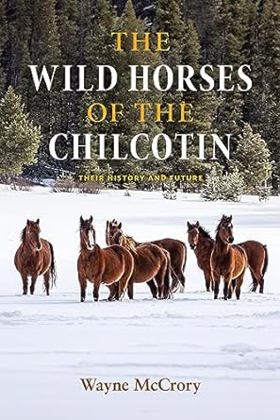
"The Chilcotin's wild horses are are romantic and beautiful, but they are also controversial: they are seen by government policy as intruders competing for range land with native species and domestic cattle and, as a result, they have been subject to culls and are not officially protected. In this compelling book, wildlife biologist Wayne McCrory draws upon two decades of research to make a case for considering these wonderful creatures, called qiyus in traditional Tŝilhqot'in culture, a resilient part of the area's balanced prey-predator ecosystem. McCrory also chronicles the Chilcotin wild horses' genetic history and significance to the Tŝilhqot'in, juxtaposing their efforts to protect qiyus against movements to cull them."-- Provided by publisher 332 pages, xxxii pages of plates : illustrations (some colour) ; 24 cm CIRC [ 0 ]
|
2023 |
|
The last lookout on Dunn Peak fire spotting in Idaho's St. Joe National Forest by Nancy Sule Hammond 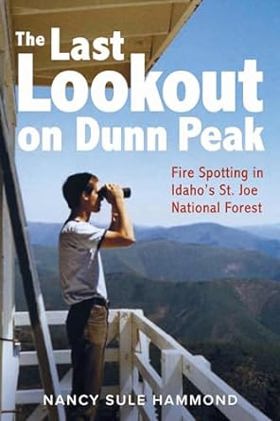
"Don and Nancy Hammond spent two seasons spotting fires in Idaho's St. Joe National Forest. Interspersing personal stories, history, and details of the work, Nancy journeys back to that exciting time"-- Provided by publisher xi, 271 pages illustrations (some color), maps ; 23 cm CIRC [ 0 ]
|
2023 |
|
Man of treacherous charm territorial justice Edmund C. Fitzhugh by Candace Wellman 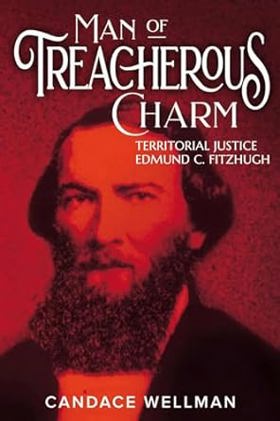
"Appointed to Washington Territory's District and Supreme Courts in 1857 despite being under indictment for murder, Edmund C. Fitzhugh's biography offers unique insights into the territory and 19th century American West"-- Provided by publisher xvii, 319 pages : illustrations ; 23 cm. CIRC [ 0 ]
|
2023 |
|
Frances Barkley eighteenth-century seafarer by Cathy Converse , Frances Barkley 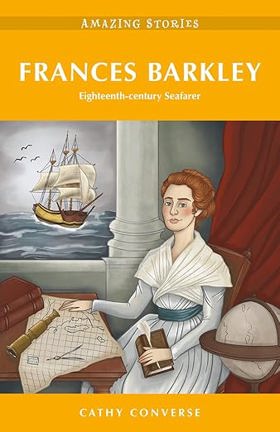
"A rivetingly imagined re-telling of the voyages of Frances Barkley (1769–1845), who as a young woman travelled the world on a trading mission with her sea captain husband. Over two hundred years ago, Frances Barkley, a seventeen-year-old girl fresh out of a convent school in France, met twenty-six-year-old sea captain, fell deeply in love, and married him after a six-week courtship. Five weeks later, she stepped aboard his ship, the Imperial Eagle, to set sail on an eight-year voyage that would take them around the world twice. Frances Barkley’s story is a remarkable one. It is a story born of discovery, of firsts, of hardship, of disease, of illness, and of death. Relying on her strength of character and wit, this young woman survived fierce seas, shipwreck, and capture by pirates. When Frances was approaching her seventh decade, at the behest of her daughter, she put pen to paper and wrote down what she could remember of her life with her husband in the merchant sea trade. Frances Barkley: Eighteenth-century Seafarer is not simply a re-issue of Frances’s own reminiscences, but a work of creative non-fiction—an extensive reimagining of her time at sea, supplemented through extensive historical, geographic, and nautical research."-- Provided by publisher 137 pages : illustrations, maps ; 22 cm. CIRC [ 0 ]
|
2023 |
|
East Side story growing up at the PNE by Nick Marino 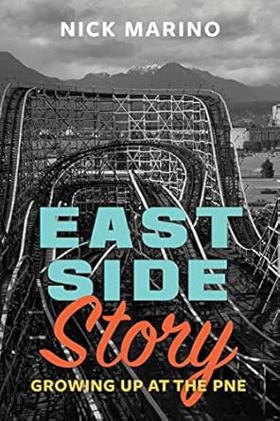
"A sly, sentimental, and wickedly funny memoir about growing up at the local fair. The PNE (Pacific National Exhibition) is a Vancouver tradition, an annual fair started in 1910 that is famous for its farm animals, dog trick shows, and amusement park - highlighted by Canada's oldest wooden roller coaster still in existence. In 1980, when Nick Marino was twelve years old, he started working at the PNE and quickly learned that there was more to the fair than winning stuffed animals and eating mini donuts. He had to contend with belligerent bosses, unhinged carnies, and teenage hustlers. In this funny, charming memoir of fair life, Marino revisits the "Wild West" of the city's East Side, home to the PNE, sharing stories from his six summers working at the fair, where arcade bouncers went on midnight roller coaster rides, riots broke out at concerts, and local kids helped themselves to everything. With beguiling and at times poignant humour, he pulls back the curtain on the culture of carnivals and fairs, an unpredictable and eternally young world of players, scammers, and dreamers."-- Provided by publisher 235 pages : illustrations ; 23 cm CIRC [ 0 ]
|
2023 |
|
JAJ a Haida manga by Michael Nicoll Yahgulanaas (Artist, Author) 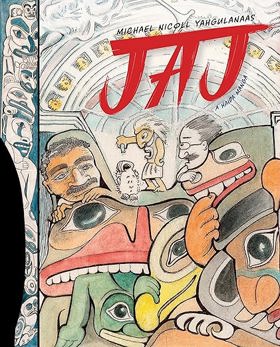
"With gorgeous imagery, visual artist Michael Nicoll Yahgulanaas brings to life the tumultuous history of first contact between Europeans and Indigenous peoples and the early colonization by the Europeans of the northern West Coast. Yahgulanaas uses a blend of traditional and modern art, eschewing the traditional boxes of comic books for the flowing shapes of North Pacific iconography. The panels are filled with colourful and expressive watercolour paintings. The panels of each page, if removed and assembled into one whole image, form a large image reminiscent of a woven robe. The story follows several historical figures, including Johan Adrian Jacobsen (JAJ), who comes to the Haida village of Masset to collect specimens for a German museum, through a time span that includes first contact, the devastation of the smallpox epidemic, and the mass resettlement of disenfranchised peoples, both Indigenous and European."-- Provided by the Publisher 116 pages : chiefly color illustrations ; 27 cm CIRC [ 0 ]
|
2023 |
|
White riot the 1907 anti-Asian riots in Vancouver by Henry Tsang 
"Essays and photographs that document the anti-Asian riots of 1907 in the context of contemporary anti-Asian sentiment. White Riot: The 1907 Anti-Asian Riots in Vancouver explores the conditions leading up to and the impact of a demonstration and parade in Vancouver, Canada, organized by the Asiatic Exclusion League and the ensuing mob attack on the city's Chinese Canadian and Japanese Canadian communities. Emblematic of a systemically racist era, White Riot reveals the social and political environment of the time, when racialized communities were targeted through legislated as well as physical acts of exclusion and violence. Based on 360 Riot Walk, a 360-degree video walking tour by artist and author Henry Tsang, White Riot offers an intersectional approach to this pivotal moment in the history of racialized communities and a cultural and social context for understanding for the current wave of anti-Asian sentiment. It features photographs of the riots colourized by Tsang as well as those of contemporary Vancouver where the riots took place. Essays by Tsang and others speak to the colonial times that preceded and followed the 1907 riots, as well as issues that Chinese and Japanese communities (and other racialized communities) in North America are facing today. White Riot poses the question: in the current ethos of anti-racism and decolonization, what does it take to reconcile our collective histories within the legacy of white supremacy? Includes essays by the Asian Canadian Labour Alliance, Paul Englesberg, Melody Ma, Angela May and Nicole Yakashiro, Jeffery R. Masuda, Aaron Franks, Audrey Kobayashi and Trevor Wideman, and Andy Yan, with an introduction by Patricia E. Roy."-- Provided by publisher 191 pages : illustrations (chiefly color), color maps ; 21 x 26 cm CIRC [ 0 ]
|
2023 |
|
American burial ground a new history of the Overland Trail by Sarah Keyes 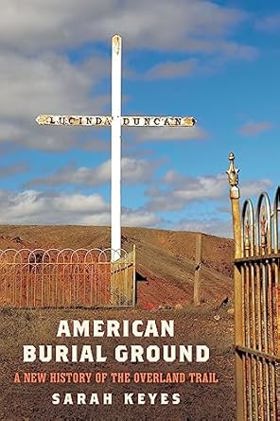
"This book reinterprets the historic touchstone of the Overland Trail as a story of death and Native activism. Emigrant graves became seeds of U.S. possession across the West. In response Native peoples defended their homelands by pointing to their graves as proofs of Indigenous persistence and enduring territorial claims"-- Provided by publisher 262 pages : illustrations, maps ; 24 cm. CIRC [ 0 ]
|
2023 |
|
Agents of empire the First Oregon Cavalry and the opening of the interior Pacific Northwest during the Civil War by James Robbins Jewell 
Agents of Empire expands the historiographical scope of Civil War studies to include the war’s intersection with the history of the American West, demonstrating how the war was transcontinental in scope. Much more than a traditional Civil War regimental history, James Robbins Jewell’s work delves into the operational and social conditions under which the First Oregon Cavalry Regiment was formed. In response to ongoing tensions and violent interactions with Native peoples determined to protect their way of life and lands, Colonel George Wright, head of the military’s District of Oregon, asked the governor of Oregon to form a voluntary cavalry unit to protect white settlers and farmers. By using local volunteers, and later two additional regiments of infantry from the region, the federal government was able to draw from the majority of Regular Army troops stationed in the Pacific Northwest, who were eventually sent to fight Confederate forces east of the Mississippi River. Had the First Oregon Cavalry failed to fulfill its responsibilities, the federal government would have had to recall Union forces from other threatened areas and send them to Oregon and Washington Territory to quell secessionist unrest and Indigenous resistance to land theft, resource appropriation, and murder. The First Oregon Cavalry ensured settlers’ security in the Union’s farthest northwest corner, thereby contributing to the Union cause. xxvi, 326 pages : illustrations, maps ; 24 cm CIRC [ 0 ]
|
2023 |