Catalog of British Columbiana and Pacific Northwest Americana
Encyclopedia Cascadia Catalog contains book titles of mostly non-fiction Pacific Northwest Coast of North America Titles (primarially British Columbia, Idaho, Oregon and Washington State) in an easy-to-understand title catalog. If you see a link with this badge ONLINE CIRC it means that there is an online institution that provides free access to that title. In some cases there may be more than one institution hosting the title digitally.
| Catalog Title | Published |
|---|---|
|
Shipwrecks of the San Juans A History of Maritime Disaster in the San Juan Islands : A History of Maritime Disaster in the San JuanIslands by Joseph Reigel 
Mariners have long dreaded the labyrinth of the San Juan Islands. Bounded by the howling straits of Georgia, Rosario, Haro, and Juan de Fuca, the islands have proved the resting place of many an unlucky ship. With the aid of period accounts and historical photographs, Shipwrecks of the San Juans brings to life harrowing tales such as the infamous Clallam tragedy, the Bahada mystery, and the unsolved disappearance of the yacht Prelude . . . along with many more. CIRC [ 0 ]
|
2024 |
|
Shipwrecks of the Pacific Coast by Jim Gibbs
|
1962 |
|
Ships of the inland sea the story of the Puget Sound steamboats by Gordon R. Newell
|
1951 |
|
Sheriffs, 1911-1989 a history of murders in the wilderness of Washington's last county by Tony Bamonte 
Authored by regional historian Tony Bamonte, Sheriffs, 1911-1989: A History of Murders in the Wilderness of Washington's Last County chronicles the grim true-crime history, law enforcement challenges, and violent frontier legacies of remote Pend Oreille County. The book investigates a series of harrowing homicide cases, missing persons mysteries, and complex investigations handled by local sheriffs operating across a sprawling, densely forested wilderness bordering Idaho and Canada. Through meticulous archival research, newspaper accounts, and police records, the text examines how rural law enforcement struggled to maintain order in an isolated landscape plagued by rugged terrain and transient populations. A keen insight drawn from the work is how regional crime reporting exposes the dark underbelly of wilderness escapism; by documenting how rugged isolation routinely attracted desperate outlaws and shielded violent criminals, the narrative shatters the romanticized myth of the peaceful frontier, revealing instead a lawless hinterland where justice was constantly undermined by vast geography. 251 pages : illustrations ; 24 cm CIRC [ 1 ]
|
1991 |
|
Sheltering in the backrush a history of Twin Islands by Jeanette Taylor 
"Coastal historian Jeanette Taylor unveils the unique past of Twin Islands. Twin Islands form part of the lacey fringe at the southern edge of the Discovery Islands archipelago, where it meets the north Salish Sea. This is the interface between wilderness and urban settlement. To the north, heavily treed slopes rise vertically from the sea and fast tides churn through the constricted passages of a maze of islands and inlets. Navigating these waters is a white-knuckle challenge many recreational boaters avoid, ending their travels to the east in Desolation Sound Marine Park. To the south, the topography relaxes into a more habitable environment of open waters, villages, towns and highways. Those who do find their way to Twin are richly rewarded by a beautiful and tranquil destination--with a fascinating past. Discovery of a trove of sepia-toned pictures of Twin Islands from the late 1930s drew Jeanette Taylor to research and document the history of the islands. She found a live-wire cast of characters typical of remote places, including a one-legged sheep farmer; an aristocratic Irish priest who was the victim of an unsolved murder; American tycoons fleeing Japan on the cusp of World War II; German royalty; and an anonymous heiress who rescued the islands from logging. Through it all, Taylor found a thread among Twin's people, passed from one generation to the next--like an invisible torch handed over with the deed: a love of nature and the place. Illustrated with historical photos and engagingly written, Sheltering in the Back Rush is an important addition to Harbour Publishing's catalogue of coastal BC history."-- Provided by publisher 160 pages : illustrations, maps ; 23 cm CIRC [ 0 ]
|
2023 |
|
She who watches by Willa Holmes, Anderson Benally 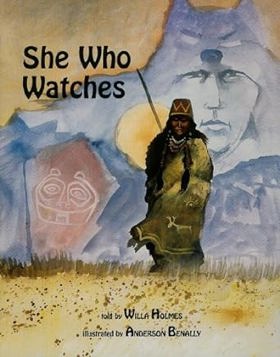
Stories of the Wishram chief Tsagaglalal and Coyote. Authored by Willa Holmes and Anderson Benally, She Who Watches explores the rich history, spiritual significance, and cultural legacy surrounding the famous Columbia River petroglyph known as Tsagaglalal, located near the Dalles. The book weaves together Native oral traditions, historical documentation, and Indigenous perspectives to illuminate the sacred rock art site that has overlooked the river valley for centuries. Through these collected narratives, the text honors the profound spiritual connection regional tribes maintain with ancestral sacred places despite the inundation of the landscape by modern dams. A keen insight drawn from the work is how ancient rock art functions as an eternal sentinel of tribal sovereignty; by enduring through eras of profound ecological and political displacement, figures like Tsagaglalal serve as silent legal and spiritual witnesses asserting an unbroken Indigenous title to the land that industrial modernization could never submerge. ix, 37 pages : color illustrations ; 28 cm CIRC [ 1 ]
|
1997 |
|
Shaw Island Earliest Known History to 1994 by Dorothy Powell, Fran Hilen 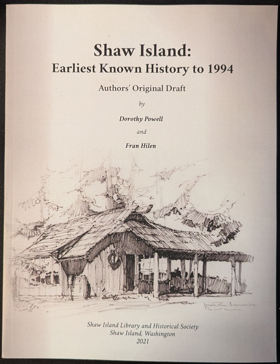
Shaw Island is the smallest of the ferry-served islands in the San Juan Archipelago of Washington State. It boasts a store, a school, a community building, and a wonderful, private, volunteer-run library and museum. The Shaw Island Library and Historical Society was founded in 1966. A year later, two one-acre lots were donated for a building site and the original logs of a homestead cabin were donated to serve as the future Shaw Island Museum. Many generous donations from island volunteers, families, friends, and institutions formed a collection that continues to grow, preserving the heritage of this unique island community.In 1994 Fran Hilen was serving as Curator when Dorothy Powell volunteered as Librarian for the Shaw Island Library and Historical Society. Quietly, they decided to collaborate, writing a remarkable book about the history of Shaw Island beginning in pre-history, through the time of the early settlers, to their present day in the mid-1990's. In the original introduction, the authors invite the community to "add to the history for present and future residents and friends of Shaw Island."The Historical Society, aided by a dedicated team of Shaw Island volunteers, have taken Dorothy and Fran at their word and have supplemented their text with more than 600 historic photos, maps, historic documents, and newspaper clippings. Biographies and quotes from past Shaw Islanders, some of whom left behind prolific daily journals, give us insight into events and a past way of life. 166 pages, photos CIRC [ 1 ]
|
2021 |
|
Shaping the public good women making history in the Pacific Northwest by Susan H. Armitage 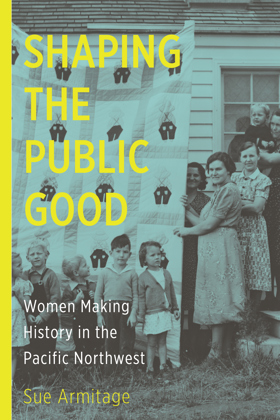
"Carved into a rock overlooking the Columbia River stands the arresting image of Tsagigla'lal, or "She Who Watches," an ancient female chief. As the Wishram people recount, when men replaced women in positions of power, Tsagigla'lal was turned to stone by Coyote so that she could forever guide her community and guard its development. Using the story of She Who Watches as her guide, Armitage shows that even though women were barred from positions of public authority until recently, they have always worked quietly and informally to assure the stability and security of their families and communities. Women's community-building and cooperative skills have been decisive in developing the societies of the Pacific Northwest--Washington, Oregon, Idaho, western Montana, and British Columbia. Like She Who Watches, women have never been mere observers, but watchful guardians and active shapers of the public good. Drawing on her three decades of research and teaching and based on hundreds of secondary sources, Armitage's account explores the varied ways in which, beginning in the earliest times and continuing to the present, women of all races and ethnicities have made the history of our region. An accessible introduction for general readers and scholars alike, Shaping the Public Good restores a missing piece of Pacific Northwest history by demonstrating the part that women--"the famous, the forgotten, and all the women in between"--have always played in establishing their families and building communities."-- Provided by publisher 349 pages : illustrations ; 23 cm CIRC [ 0 ]
|
2015 |
|
Shaniko people by Helen Guyton Rees 
Here you will recapture the Shaniko of pioneer days through the eyes of old-timers who have shared with the author their memories, records and photographs. There are interviews with more than fifty long-time residents, with colorful, firsthand accounts of living at the close of the pioneer period. It is written with folksy insights into the daily lives of the people whose town, for a few years, became a wool empire in the wilderness. Nearly one hundred fifty previously unpublished photos; map and chart locating homes and buildings; comprehensive index. 256 pages. ix, 245 pages : illustrations ; 23 cm CIRC [ 1 ]
|
1983 |
|
Shadows on the Klamath a woman in the woods by Louise Wagenknecht 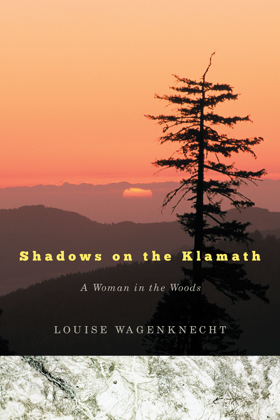
"In 1973, Louise Wagenknecht was just another college graduate, but unlike many, she wanted to go home, back to the Klamath Mountains where she was raised. When a job offer from the Klamath National Forest gave her that chance, she jumped at it. She landed in the logging town of Happy Camp, where she'd spent part of her childhood, as chronicled in her previous memoirs, White Poplar, Black Locust and Light on the Devils. With Shadows on the Klamath, Louise Wagenknecht completes her trilogy about life in remote northwestern California. In this new work, she recounts her years in the Forest Service, starting as a clerical worker on the Klamath National Forest before moving to a field position where she did everything from planting trees to fighting fires. Her story is about a Forest Service in transition, as forest management practices began to shift. Not least among these changes was the presence of women in the ranks-a change that many in the Forest Service resisted. Wagenknecht blends the personal and professional to describe land management in the West and the people who do it-their friendships, rivalries, and rural communities. Anyone with an interest in the Klamath-Siskiyou region, or the history of women in natural resource agencies, or the many issues associated with industrial forestry, should read this book for its valuable firsthand perspective. General readers interested in the rural West and personal memoir will also be richly rewarded"-- Provided by publisher xi, 242 pages : illustrations ; 23 cm CIRC [ 0 ]
|
2021 |
|
Shadow tribe the making of Columbia River Indian identity by Andrew H. Fisher 
Shadow Tribe offers the first in-depth history of the Pacific Northwest’s Columbia River Indians -- the defiant River People whose ancestors refused to settle on the reservations established for them in central Oregon and Washington. Largely overlooked in traditional accounts of tribal dispossession and confinement, their story illuminates the persistence of off-reservation Native communities and the fluidity of their identities over time. Cast in the imperfect light of federal policy and dimly perceived by non-Indian eyes, the flickering presence of the Columbia River Indians has followed the treaty tribes down the difficult path marked out by the forces of American colonization. Based on more than a decade of archival research and conversations with Native people, Andrew Fisher’s groundbreaking book traces the waxing and waning of Columbia River Indian identity from the mid-nineteenth through the late twentieth centuries. Fisher explains how, despite policies designed to destroy them, the shared experience of being off the reservation and at odds with recognized tribes forged far-flung river communities into a loose confederation called the Columbia River Tribe. Environmental changes and political pressures eroded their autonomy during the second half of the twentieth century, yet many River People continued to honor a common heritage of ancestral connection to the Columbia, resistance to the reservation system, devotion to cultural traditions, and detachment from the institutions of federal control and tribal governance. At times, their independent and uncompromising attitude has challenged the sovereignty of the recognized tribes, earning Columbia River Indians a reputation as radicals and troublemakers even among their own people. Shadow Tribe is part of a new wave of historical scholarship that shows Native American identities to be socially constructed, layered, and contested rather than fixed, singular, and unchanging. From his vantage point on the Columbia, Fisher has written a pioneering study that uses regional history to broaden our understanding of how Indians thwarted efforts to confine and define their existence within narrow reservation boundaries. xi, 337 pages, 16 unnumbered pages of plates : illustrations, maps ; 23 cm. CIRC [ 1 ]
|
2010 |
|
Seventy years of progress in Washington by Ezra Meeker 
Published in 1921 by the Pacific Northwest's most famous and self-promoted trailblazer, Ezra Meeker, Seventy Years of Progress in Washington is a deeply personal memoir that doubles as a triumphalist history of the territory's evolution. The text chronicles Meeker’s grueling 1852 overland migration via the Oregon Trail, his early homesteading struggles in the Puget Sound region, his highly lucrative tenure as the "Hop King of the World" in Puyallup, and the rapid industrial urbanization of Washington State. Serving as both an autobiographical adventure and a civic retrospective, the book captures the staggering velocity of change from remote wilderness to modern industrial state within a single human lifetime. A keen insight drawn from the work is how Meeker successfully weaponized his own longevity to elevate the pioneer generation into an untouchable moral aristocracy; by actively marketing himself as the living embodiment of westward expansion, Meeker transformed the ecologically and socially destructive realities of colonization into a nostalgic, heroic spectacle. His narrative effectively demanded that modern residents revere the pioneer struggle not merely as history, but as the state's sacred founding mythology, thereby insulating the colonial project from any critical moral scrutiny. 381, [2], 52 pages, 14 unnumbered leaves of plates : illustrations, portraits ; 24 cm ONLINE CIRC [ 1 ] CIRC [ 1 ]
|
1921 |
|
Seven shillings a year the history of Vancouver Island by Charles Lillard, Ellen J. Lehman (Donor) 
This is the first book to describe the history of Vancouver Island, beginning with the cultures of the Indians and ending with the Second World War. - Back cover viii, 248 pages : illustrations ; 22 cm CIRC [ 1 ]
|
1986 |
|
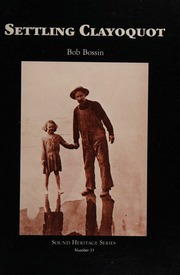
Settling Clayoquot by Bob Bossin
|
1981 |
|
Settlers as conquerors free land policy in Antebellum America by Julius Wilm , German Historical Institute (Washington, D.C.) 
In early America, the notion that settlers ought to receive undeveloped land for free was enormously popular among the rural poor and social reformers. Well into the Jacksonian era, however, Congress considered the demand fiscally and economically irresponsible. Increasingly, this led proponents to cast the idea as a military matter: Land grantees would supplant troops in the efforts to take the continent over from Indian nations and rival colonial powers. Julius Wilm's book examines the free land debates of the 1790s to 1850s and reconstructs the settlement experiences under the donation laws for Florida (1842) and the Oregon Territory (1850). Both laws promised to bring the interests of poorer whites and their government into a more harmonious relation - to the exclusion of African Americans and for the explicit purpose of displacing Native peoples. Drawing on new records, Wilm details the trajectory of settlements and shows how the settler-imperialist experiments fell apart and undermined the rationale of the donation laws. After home seekers fled Florida due to malaria and militias in Oregon triggered uncontrollable violence, settlers came to be seen as unreliable agents of government aims. "This is the single most detailed exploration of free land in antebellum America. Wilm does a marvelous job exploring the limits of settler colonialism as a framework for settlement in Florida, where it failed. For the case of Oregon, he shows that settler occupation was appealing to federal legislators because it would 'substitute the ax, the plow, and the hoe, for the gun, the sword, and the bayonet.' That the government knowingly held out a promise of free land in order to encourage squatter sovereignty is a most compelling argument." Amy S. Greenberg, Pennsylvania State University "This is a skillful study of American proposals for the distribution of free public lands that predated the Homestead Act of 1862. Tracing discussions of land policy in Congress, distribution schemes in Arkansas, Florida, and Oregon, and the actual consequences of these schemes on the ground, Settlers as Conquerors offers both political and social history, showing how 'free land' shaped Indian Removal, settler colonialism, and race in the antebellum American West." Christopher Clark, University of Connecticut 284 pages : illustrations ; 24 cm. CIRC [ 0 ]
|
2018 |
|
Sentinels of the North Pacific the story of Pacific coast lighthouses and lightships by Jim Gibbs, Binfords & Mort
Examines the history and purpose of lighthouses and describes notable examples around the world, including the building of St. George Reef in Tillamook, Lighthouses in San Diego, San Francisco, Puget Sound, Columbia Coast, and Alaska 232 pages illustrations 23 cm CIRC [ 1 ]
|
1955 |
|
Selling sex in the Silver Valley a business doing pleasure by Heather Branstetter 
"Once the largest silver producer in the world, Wallace became notorious for labor uprisings, hard drinking, gambling and prostitution. As late as 1991, illegal brothels openly flourished because locals believed that sex work prevented rape and bolstered the economy, so long as it was regulated and confined to a particular area of town. The madams enjoyed unprecedented status as influential businesswomen, community leaders and philanthropists, while elsewhere a growing aversion to the sex trade drove red-light districts underground."--Page 4 of cover 222 pages : illustrations, maps ; 23 cm CIRC [ 0 ]
|
2017 |
|
Selected Letters of A.M.A. Blanchet, Bishop of Walla Walla and Nesqualy (1846-1879) by Augustine Magloire Alexander Blanchet, Roberta Stringham Brown, Patricia O'Connell Killen 
"In 1846, French Canadian-born A.M.A. Blanchet was named the first Catholic bishop of Walla Walla in the area soon to become Washington Territory. He arrived at Fort Walla Walla in late September 1847, part of the largest movement over the Oregon Trail to date. During the thirty-two years of Blanchet's tenure in the Northwest, the region underwent profound social and political change as the Hudson's Bay Company moved headquarters and many operations north following the Oregon Treaty, U.S. government and institutions were established, and Native American inhabitants dealt with displacement and discrimination. Blanchet chronicled both his own pastoral and administrative life and his observations on the world around him in a voluminous correspondence-almost nine hundred letters-to religious superiors and colleagues in Montreal, Paris, and Rome; funding organizations; other missionaries; and U.S. officials. This selection of Blanchet's letters provides a fascinating view of Washington Territory as seen through the eyes of an intelligent, devout, energetic, perceptive, and occasionally irascible cleric and administrator. Almost all of Blanchet's correspondence was in French. Roberta Stringham Brown and Patricia O'Connell Killen have chosen forty-five of those letters to translate and annotate, creating a history of early Washington that provides new insights into relationships, events, and personalities. A number of the letters provide first-hand glimpses of familiar events, such as the Whitman tragedy, the California gold rush, Indian wars and land displacement, transportation advances, and the domestic material culture of a frontier borderland. Others voice the hardships of historically underrepresented groups, including Native Americans, Metis, and French Canadians, and the experiences of ordinary people in growing population centers such as Seattle, Walla Walla, and Vancouver, Wash-ington. Still others describe the struggle to bring social, medical, and educational institutions to the region, a struggle in which women religious workers played a key role. The letters-and the editors' fascinating annotations-provide an engaging and insightful look at an important period in the history of the Pacific Northwest and southwest Canada. Roberta Stringham Brown is professor of French at Pacific Lutheran University. Patricia O'Connell Killen is professor of religious studies and academic vice president at Gonzaga University"-- Provided by publisher xviii, 272 pages : illustrations, maps ; 24 cm CIRC [ 0 ]
|
2013 |
|
Seeking salaam Ethiopians, Eritreans, and Somalis in the Pacific Northwest by Sandra M. Chait 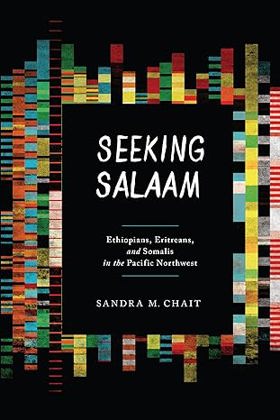
Prolonged violence in the Horn of Africa, the northeastern corner of the continent, has led growing numbers of Ethiopians, Eritreans, and Somalis to flee to the United States. Despite the enmity created by centuries of conflict, they often find themselves living as neighbors in their adopted cities, with their children as class-mates in school. In many ways, they are successfully navigating life in their new home; however, they continue to struggle to bridge old ethnic divisions and find salaam, or peace, with one another. News from home fuels historical grievances and perpetuates tensions within their communities, delaying acculturation, undermining attempts at reconciliation, and sabotaging the opportunity to reach the American Dream. In conversations with forty East African immigrants living in Seattle, Washington, and Portland, Oregon, Sandra Chait captures the immigrants' struggle for identity in the face of competing stories and documents how some individuals have been able to transcend the ghosts from the past and extend a tentative hand to their former enemies. xviii, 298 pages : map ; 24 cm CIRC [ 0 ]
|
2011 |
|
Seeing Seattle by Roger Sale, Mary Randlett 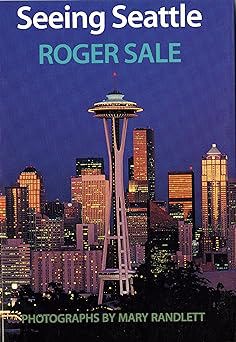
From the time that Roger Sale's interpretive history Seattle Past to Present was published in 1976 he has often served as an unofficial guide for friends and visitors to Seattle, and has also been asked by those who run professional tours for advice on how to view Seattle with fresh eyes. In Seeing Seattle he invites the reader to join him in walking tours of the city in a collaborative process of looking, asking, and forming opinions and judgments. The book starts near where Seattle itself started and works out to the city limits in layers. In the first walk, the Pioneer Square area reveals through its buildings - many of them handsomely rehabilitated - how the city re-established itself after the great fire of 1889. We are asked to observe and evaluate how new buildings and new uses have been combined with old ones, and how architects, builders, and planners have served this historical area. The same points are considered for the downtown business district, Pike Place Market, and other areas near the historic core of the city. We face the breathtaking downtown skyline from viewpoints on Seattle's many hills, from points across the bay at Duwamish Head, and from Seward Park, which has Seattle's largest stand of old-growth forest. What makes Seattle distinctively Seattle? Sale muses over this question as he walks through the older residential sections of Queen Anne Hill and Capitol Hill, with their mansions and near mansions. He traces the routes along Lake Washington Boulevard and the influence of the Olmsted brothers in shaping the social as well as the visual landscape of the city. He tours upscale neighborhoods with lake and sound views as well as working-class neighborhoods thatowe their history and early growth to nearby mills and streetcar transportation. He visits the Chinatown/International District and the University of Washington, and learns to identify trees in Washington Park Arboretum and to recognize those trees elsewhere. He finds the "enchanted house" where Mary McCarthy lived as a girl and the garden in which Theodore Roethke sought solitude among trees that "came closer with a denser shade". Sale and photographer Mary Randlett have worked together to integrate photographs closely with text and promote a view of Seattle in a context of new and old, landscapes and skyscrapers, neighborhood streets and remarkable vistas. Estimated times for each walk (or drive, in outlying areas) and bus route information are provided 255 pages : illustrations, map ; 19 cm CIRC [ 0 ]
|
1994 |
|
Secret beaches of the Salish Sea the southern Gulf Islands by Theo Dombrowski 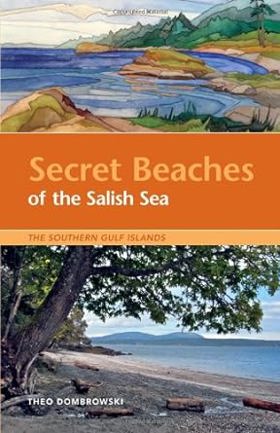
The fourth volume in the Secret Beaches series, one of two on the Salish Sea, covers 93 beaches in the southern Gulf Islands, including Salt Spring, Galiano, Saturna, Mayne, Thetis and Pender. At some locations, the selling point is a view of sandstone eroded into astounding curves and honeycombed lattices. At others, it's the chance of seeing the resident orcas of J1, K1 and L1 pods, whose summer home is the Gulf Islands. Theo's hand-drawn maps are indispensable, as each island marks its public beach access points differently, if they mark them at all. His detailed entries give comprehensive descriptions and an illustrative photo or painting for each beach. As usual, the charming paintings and photos are done by Theo himself. Whether seconds from the ferry or farther along a twisting, unsigned back road, the beach best suited to your adventure waits to be found in Secret Beaches of the Salish Sea. 236 p. : col. ill., maps, port. ; 22 cm. CIRC [ 1 ]
|
2012 |
|
Secret beaches of southern Vancouver Island Qualicum to the Malahat by Theo Dombrowski 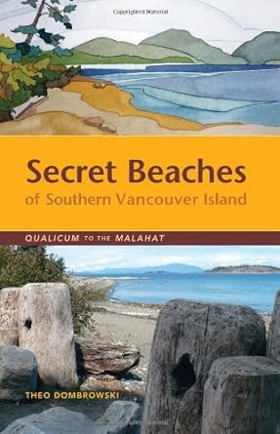
This is your guide to dozens of spectacular and often hidden beaches on the eastern coast of Vancouver Island between Qualicum and the Malahat. While some of them are well used by people living nearby, many are virtually impossible to find without combing through official maps and back-road guides. From tiny rocky coves to broad sandy beaches, these public-access spots are enormously diverse. Just as important as finding these spots is knowing what to expect. Thus each location is accompanied by detailed information that any beach explorer should know before setting out. Is the beach a few level steps from a vehicle or down a high, steep bank? Is the beach suitable for children? Large groups? Kayakers? 255 pages : illustrations (chiefly color), maps ; 22 cm CIRC [ 0 ]
|
2010 |
|
Sechelt dictionary by Ronald C. Beaumont, Sechelt Nation 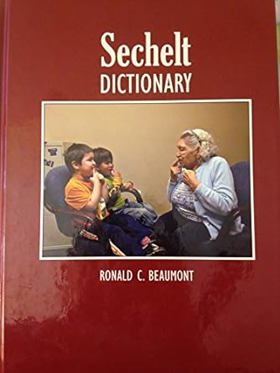
Sechelt (shashishalhem) is the ancestral language of the Sechelt people (shishalh), whose territory extends from Jervis Inlet to Howe Sound on the south coast of British Columbia. Like many other indigenous languages, Sechelt has been in decline for over a century and is now in peril of becoming extinct. The Sechelt Dictionary is part of an ongoing effort to preserve a knowledge of this language and to encourage a revival of its use by present and future generations of Sechelt people. Ronald C. Beaumont has been studying the Sechelt language since 1970. The Sechelt Dictionary and an earlier work, she shashishalhem: the Sechelt Language (1985), are based on information given to the author by more than thirty elders representing the last generations of speakers to learn Sechelt as their first language. NOTE: The material in this file is for personal information only. Any use of this material, for research or any other purpose that is intended for publication, must be approved by the Sechelt Indian Band. www.secheltnation.ca xv, 1005 p. ; 26 cm. ONLINE CIRC [ 1 ]
|
2011 |
|
Seattleness a cultural atlas by Tera Hatfield , Jenny Kempson , Natalie Ross , Timothy R. Wallace 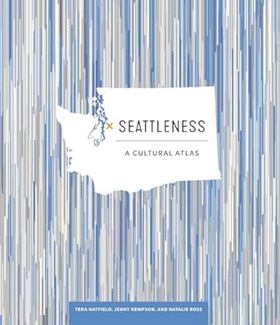
"This visually rich cultural atlas of Seattle explores the mercurial nature of place through the lens of one of the fastest growing cities in America. Through both experiential and data-driven cartography, Seattleness lends itself to longtime residents, newcomers to the city, and those curious about the moody borough that has brought us airplanes, grunge, gourmet coffee, and e-commerce. In the style of Infinite City and Portlandness, this illustrated book examines an expansive range of topics from UFO sightings to pinball legacies, gray skies to frontier psychology, strong women and strong coffee. Compelling infographic visuals emerge from deep dives into data, unraveling over 50 real and strange narratives about the green metropolis perched at the edge of the Salish Sea"-- Provided by publisher xi, 175 pages : illustrations (some color), maps ; 26 cm CIRC [ 1 ]
|
2018 |
|
Seattle, past to present by Roger Sale 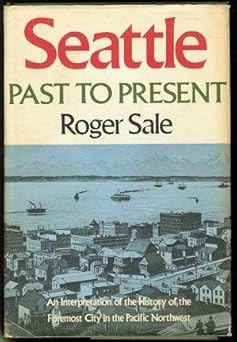
Seattle, Past to Present, interprets the history of the foremost city in the Northwest and traces the implications of that history for the city's present and future. In the process Seattle emerges not as a rough, half-formed frontier town but as a soft city of streets and houses, middle-class in aspiration and achievement; Roger Sale asks how it came to be that way. Roger Sale’s Seattle, Past to Present has become a beloved reflection of Seattle’s history and its possible futures as imagined in 1976, when the book was first published. Drawing on demographic analysis, residential surveys, portraiture, and personal observation and reflection, Sale provides his take on what was most important in each of Seattle’s main periods, from the city’s founding, when settlers built a city great enough that the railroads eventually had to come; down to the post-Boeing Seattle of the 1970s, when the city was coming to terms with itself based on lessons from its past. Along the way, Sale touches on the economic diversity of late nineteenth-century Seattle that allowed it to grow; describes the major achievements of the first boom years in parks, boulevards, and neighborhoods of quiet elegance; and draws portraits of people like Vernon Parrington, Nellie Cornish, and Mark Tobey, who came to Seattle and flourished. The result is a powerful assessment of Seattle’s vitality, the result of old-timers and newcomers mixing both in harmony and in antagonism. xx, 273 pages, 12 unnumbered leaves of plates : illustrations ; 24 cm CIRC [ 0 ]
|
1976 |