Catalog of British Columbiana and Pacific Northwest Americana
Encyclopedia Cascadia Catalog contains book titles of mostly non-fiction Pacific Northwest Coast of North America Titles (primarially British Columbia, Idaho, Oregon and Washington State) in an easy-to-understand title catalog. If you see a link with this badge ONLINE CIRC it means that there is an online institution that provides free access to that title. In some cases there may be more than one institution hosting the title digitally.
| Catalog Title | Published |
|---|---|
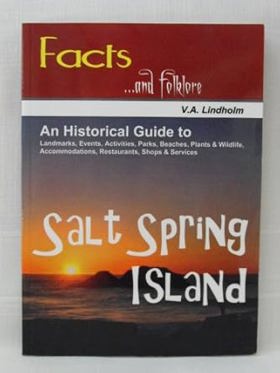
An historical guide to the landmarks, events, activities, parks, beaches, plants and wildlife, accommodations, restaurants, shops and services available on Salt Spring Island, British Columbia. This book features charming stories of the early pioneers and offers over 200 photographs, easy-to-read map, where to stay, shop, eat and explore, points of interest, how to get around, list of major island events and activities, as well as where to see plants and wildlife. This book presents Salt Spring Island in a way no other book has. Meet the postman of the 19th century and explore what Salt Spring has to offer today, while taking a trip back in time. 242 pages : illustrations ; 21 cm. CIRC [ 1 ]
|
2006 |
|
Captain Vancouver, North-West navigator by E. C. Coleman 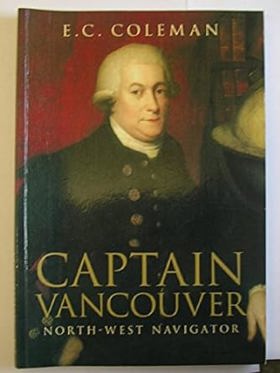
When Captain Cook set out to seek a western entrance to the fabled North West Passage, his instructions allowed him no more than the briefest contact with the coast of north-west America. Extraordinarily young crews, inexperienced officers and a doctor set on Vancouver's downfall, all combined to test Vancouver's leadership to the limit. 158 pages : illustrations, maps ; 26 cm CIRC [ 1 ]
|
2006 |
|
An historical guide to Pender Islands landmarks, events, activities, parks, beaches, plants & wildlife, accomodations, restaurants, shops & services by V. A. Lindholm 
Published in local editions by V. A. Lindholm, An Historical Guide to Pender Islands Landmarks, Events, Activities, Parks, Beaches, Plants & Wildlife... serves as a comprehensive regional compendium for navigating the natural and human history of the Southern Gulf Islands. The guide meticulously catalogs local heritage sites, indigenous place names, early pioneer settlements, and the diverse marine and terrestrial ecosystems that define the Pender Islands. By weaving practical travel logistics together with deep historical context, the book bridges the gap between a standard visitor directory and an environmental chronicle. A keen insight drawn from the text is how community-compiled island guidebooks often act as quiet acts of ecological and cultural preservation; by meticulously detailing the specific natural habitats and historical idiosyncrasies of a small archipelago, the text implicitly teaches visitors how to respectfully inhabit a fragile insular ecosystem without loving it to death. 111, [26] pages : illustrations ; 21 cm CIRC [ 1 ]
|
2006 |
|
The first nations of British Columbia an anthropological survey by Robert J. Muckle 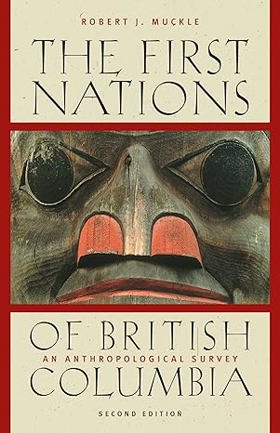
The First Nations of British Columbia, Second Edition, is a concise and accessible overview of First Nations peoples, cultures, and issues in the province. Robert Muckle familiarizes readers with the history, diversity, and complexity of First Nations to provide a context for contemporary concerns and initiatives. This fully revised edition explains the current treaty negotiation process and provides highlights of agreements between First Nations and governments. It also details past and present government policies, identifies the territories of major groups in the province, gives information on populations, reserves, bands, and language groups, and summarizes archaeological, ethnographic, historical, legal, and political issues. IX, 146 Seiten : Illustrationen, Karten CIRC [ 1 ]
|
2006 |
|
River of memory the everlasting Columbia by William D. Layman, Wenatchee Valley Museum and Cultural Center 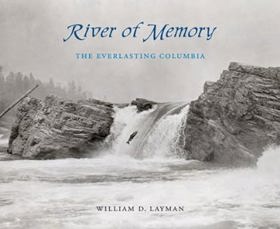
The Columbia River of today bears little resemblance to the river Native Americans, First Nations, and settlers knew in the early twentieth century. Engineering has transformed much of the river into a series of large reservoirs contained by fourteen hydroelectric dams. While many grieved the loss of the free-flowing river, others embraced a newly tamed waterway that could control floods, irrigate desert lands, and supply electrical power for the growing region. River of Memory honours a place and time now gone from view. It restores an unfettered Columbia through more than ninety historical photographs that capture the river as it once appeared. This extraordinary visual record is accompanied by the words of early explorers, surveyors, and naturalists who wrote about specific places along the river and by the work of contemporary Canadian and American writers and poets. Organized to carry the reader from the mouth of the Columbia where it enters the ocean to its source in eastern British Columbia, the narrative introduces the natural history of the river through the archetypal journey of salmon returning to the river’s headwaters in Columbia Lake. Introducing each section are colour illustrations of salmon and other indigenous fish by noted artist Joseph Tomelleri. River of Memory fosters connections between the river’s natural and human histories by encouraging readers to linger along the river’s shores and spend time reflecting on its dramatic mountain and plateau landscapes. xv, 150 pages : illustrations (some color), maps (some color) ; 24 x 29 cm CIRC [ 1 ]
|
2006 |
|
Oregon Indians voices from two centuries by Stephen Dow Beckham 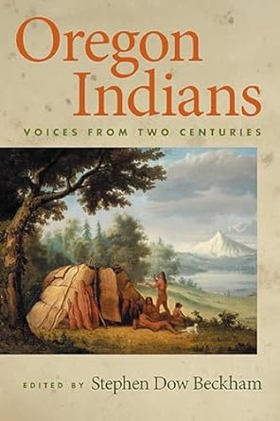
In this deeply researched volume, Stephen Dow Beckham brings together commentary by Native Americans about the events affecting their lives in Oregon. Now available in paperback for the first time, this volume presents first-person accounts of events threatening, changing, and shaping the lives of Oregon Indians, from “first encounters” in the late eighteenth century to modern tribal economies. The book's seven thematic sections are arranged chronologically and prefaced with introductory essays that provide the context of Indian relations with Euro-Americans and tightening federal policy. Each of the nearly seventy documents has a brief introduction that identifies the event and the speakers involved. Most of the book's selections are little known. Few have been previously published, including treaty council minutes, court and congressional testimonies, letters, and passages from travelers’ journals. Oregon Indians opens with the arrival of Euro-Americans and their introduction of new technology, weapons, and diseases. The role of treaties, machinations of the Oregon volunteers, efforts of the US Army to protect the Indians but also subdue and confine them, and the emergence of reservation programs to “civilize” them are recorded in a variety of documents that illuminate nineteenth-century Indian experiences. Twentieth-century documents include Tommy Thompson on the flooding of the Celilo Falls fishing grounds in 1942, as well as Indian voices challenging the "disastrous policy of termination," the state's prohibition on inter-racial marriage, and the final resting ground of Kennewick Man. Selections in the book's final section speak to the changing political atmosphere of the late twentieth century, and suggest that hope, rather than despair, became a possibility for Oregon tribes. xv, 583 pages : illustrations, map ; 25 cm CIRC [ 1 ]
|
2006 |
|
Major Granville Haller dismissed with malice by Guy Breshears 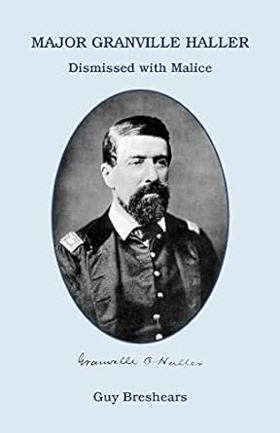
Here is the story of Major Granville Haller, a successful military officer before his sudden and unjust dismissal from the service, and his efforts to restore his name and rank. A native of York, Pennsylvania, Haller fought in the Second Seminole War, the war against Mexico (where he was twice brevetted for bravery), the Indian Wars of the Pacific Northwest, the San Juan Islands boundary dispute and the Civil War. He served on General McClellan's staff and later commanded the volunteers in the defense of York County during the Gettysburg Campaign. On July 29, 1863, Major Haller's twenty-three-year military career came to a halt when he learned that he had been dismissed for disloyal conduct and sentiments. His accuser, Lieutenant Clark Wells, was a naval officer who had spent several months in an insane asylum and had only met Haller during the Fredericksburg campaign. Inquiries to the War Department requesting a copy of his dismissal proceedings were returned unanswered. Unable to obtain a Court of Inquiry, Haller moved to Washington Territory where he spent the next sixteen years trying to restore his name. Haller's struggle is told here through his writings, official reports and court depositions so that all will recognize his contributions to the nation that dismissed him with malice. xi, 159 pages ; 22 cm CIRC [ 1 ]
|
2006 |
|
Wiyáx̣ayx̣t/Wiyáakaảawn = As days go by our history, our land, and our people--the Cayuse, Umatilla, and Walla Walla by Jennifer Karson, Confederated Tribes of the Umatilla Reservation, Oregon, Tamástslikt Cultural Institute 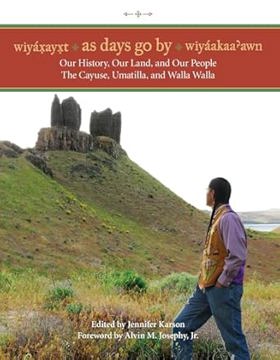
"This book represents a new vista, looking past the days when there were two distinct groups-those who were studied and those who studied them. This history of the Umatilla, Cayuse, and Walla Walla people had its beginnings in October 2000, when elders sat side by side with native students and native and non-native scholars to compare notes on tribal history and culture. Through this collaborative process, tribal members of the Confederated Tribes of the Umatilla Indian Reservation have taken on their own historical retellings, drawing on the scholarship of non-Indians as a useful tool and external resource. Primary to this history are native voices telling their own story. Beginning with ancient teachings and traditions, moving to the period of first contact with Euro-Americans, the Treaty council, war, and the reservation period, and then to today's modern tribal governance and the era of self-determination, the tribal perspective takes center stage. Throughout, readers will see continuity in the culture and in ways of life that have been present from the earliest times, all on the same landscape. Wiyaxayxt (Columbia River Sahaptin) and Wiyaakaa'awn (Nez Perce) can be interpreted to mean "as the days go by," "day by day," or "daily living." They represent the meaning of the English term "history" in two of the common languages still spoken on the Umatilla Indian Reservation."--Amazon.com viewed Mar. 16, 2023 xix, 263 pages : illustrations, maps ; 23 cm CIRC [ 0 ]
|
2006 |
|
City limits walking Portland's boundary by David Oates 
"I walked all the way around Portland, along the invisible line called the Urban Growth Boundary. Where the dotted line followed rivers--the Sandy, the Clackamas, the Willamette, the Columbia--I went in a kayak. But it was mostly just a long walk on city streets and rural two-lanes… I journeyed intermittently for two years and two months." Portland's Urban Growth Boundary (UGB) was designed to hold the bursting metropolitan area in check while protecting Willamette Valley orchards and fields from sprawling suburbia. Since the inception of growth boundaries as a key component of Oregon's progressive land-use system in the 1970s, Portland has evolved into one of the nation's most successful and distinctive cities. David Oates traveled the 260-mile boundary that defines Portland to discover how the UGB has contributed to that success. City Limits is his engaging and thought-provoking record of the journey. From conversations with the people he encounters on his walks, Oates comes to view the UGB as a long-running experiment in community control over development. But in recent years, the growth boundary has come under fire from developers, property rights advocates, and other critics. Just after Oates completed his walks, a statewide vote gutted Oregon's land-use laws. Oates explores these issues of community and conflict on the UGB in the company of various individuals he sometimes invites along for the day's walk--artists, writers, urban planners, environmentalists, developers, a politician, a wine grape grower. Reflecting Oates's belief in the power of community and collaboration, many of their thoughts and writings about the experience are included in the book. 125 pages : map ; 23 cm CIRC [ 0 ]
|
2006 |
|
Renewing Salmon Nation's food traditions a RAFT list of food species and heirloom varieties, with traditions at risk and in need of recovery in the greater Pacific Northwest by Gary Paul Nabhan, Renewing America's Food Traditions (Consortium), Ecotrust 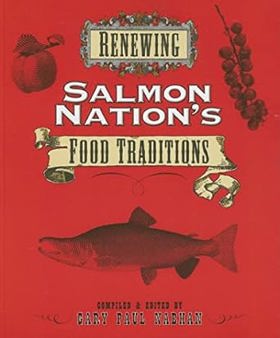
Among all the "food nations" of North America, ranging from Clambake Nation to Chile Pepper Nation, Salmon Nation is the richest in mushrooms, berries, wild roots, fish, and shellfish. Native American traditions are at its core, but other culinary accents — from Spanish to Japanese — have added to the mix. A project of the Renewing America's Food Traditions (RAFT) consortium, this book describes over 180 species of local plants and animals — many now at risk, others recovering, and all deserving of recognition — that have formed the basis of food traditions in the Pacific Northwest. To identify the traditional foods of Salmon Nation, RAFT brought together farmers, chefs, fisherfolk, food historians, orchardists, ethnobotanists, conservation activists, nutrition educators, and wild foragers in an unprecedented effort to assess the current state of foods unique to the Pacific Northwest. The result is, for the first ever, a comprehensive list of the foods that have nurtured the cultures of Salmon Nation over the centuries. Renewing Salmon Nation's Food Traditions encourages readers and eaters to familiarize themselves with the rich histories, ecologies, and recipes of these local foods. This beautifully illustrated handbook describes the appearance and taste of each species, as well as its origin and history, geographic range, and culinary uses. Foods on the list range from domesticated crops such as the Bing cherry, Hood strawberry, and Nez Perce bean to sea foods such as Chinook salmon, candlefish smelt, and geoduck, and wild foods such as Oregon black truffle, wapato, and blackcap raspberry. A resource list at the back of the book identifies nurseries, seed companies, and suppliers working to safeguard and revitalize the heritage foods of Salmon Nation. v, 66 pages : illustrations, color map ; 22 cm CIRC [ 0 ]
|
2006 |
|
The Oregon water handbook a guide to water and water management by Rick Bastasch 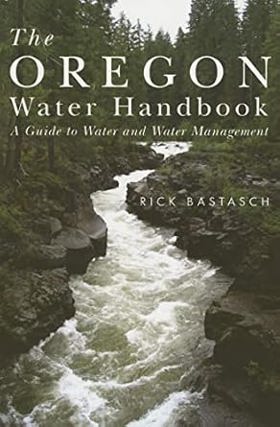
"To make a long story short, Oregon's out of easy water." So begins this timely look at how water is managed in Oregon. Rick Bastasch's in-depth examination of Oregon's water law and water issues provides a compelling perspective on a major environmental issue in the American West - the region's diminishing water supply. Starting with answers to the questions of where Oregon's water comes from and how much there really is, The Oregon Water Handbook explores how these water resources are used and what that has meant for Oregon - its people, environment, and economy. Bastasch offers thorough yet accessible explanations of a variety of water issues and controversies, bringing focus and clarity to a murky, complex subject. The book also features a comprehensive index to Oregon's water laws, a detailed listing of the state's water regulations cross-referenced to appropriate agencies, and a glossary of water terms. The handbook offers a key to understanding how we use this precious and scarce resource. It will be valuable to a range of readers, from Oregonians seeking interesting facts about their state's water riches to water specialists and users in need of a handy reference to Oregon's water law. viii, 352 pages : illustrations, maps ; 23 cm CIRC [ 0 ]
|
2006 |
|
Birds of Oregon a general reference by David B. Marshall, Matthew G. Hunter, Alan Contreras, Oregon Breeding Bird Atlas Project 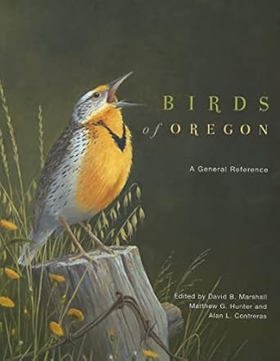
Birds of Oregon is the first complete reference work on Oregon's birds to be published since Gabrielson and Jewett's landmark book in 1940. This comprehensive volume includes individual accounts of the approximately 500 species now known to occur in Oregon (about 150 more than in 1940), including detailed accounts of the 353 species that regularly occur and briefer accounts of another 133 species that are considered vagrants. A separate chapter covers extirpated and questionable species as well as those which have been introduced but have not become established. Oregon is long overdue for a book of this kind. Although northern states generally support fewer species of birds than more southerly ones, Oregon ranks fifth behind only Florida, New Mexico, Texas, and California in terms of numbers of species. This is due to its varied climate, its wide range of habitats, and the mild winters over much of the state, which make it an important wintering area. Birds of Oregon is not a field guide for identifying birds, although it describes the appearance and any unique or special characteristics of each species, and approximately 100 species are illustrated with attractive line drawings. Instead, it compiles and presents in a single large volume what is known today about the population status and distribution of each species, as well as their habitat requirements and diet, their seasonal activities and behavior, where and how they might be found, and any conservation problems. It includes about 200 range maps that reflect the work of more than 700 volunteers who participated in the Oregon Breeding Bird Atlas project, as well as other sources. Subspecies--of which Oregon has many because of the variability of the state's avian habitats--are listed with their ranges, thus providing the first accounting of subspecies in the state since 1957. In addition to the species accounts, Birds of Oregon also includes a discussion of changes among Oregon's birds since 1940 and a description of the state's nine ecoregions and how they relate to bird species. Approximately 100 contributing authors volunteered their time and expertise to create Birds of Oregon, and numerous other individuals reviewed drafts of the species accounts to insure that they are as accurate and up-to-date as possible. Although heavily referenced with approximately 4,000 literature citations, Birds of Oregon is written in nontechnical language and will appeal to a broad audience, including birders, wildlife biologists, land managers, conservationists, naturalists, hunters, and wildlife enthusiasts in general. This new paperback edition includes an annotated list of species that have been added to the official state bird list since the book was first published in 2003. xvi, 752 pages : illustrations, maps ; 29 cm CIRC [ 0 ]
|
2006 |
|
Corvallis trails exploring the heart of the valley by Margie C. Powell 
Situated in the heart of the Willamette Valley and nestled against the rolling hills of the Coast Range, Corvallis is an outdoor enthusiast's paradise, renowned for its abundance of parks and natural areas, easily accessed within a few minutes from downtown. This informative, well-organized guide introduces nearly sixty trails, all either in Corvallis or within an hour's drive, and many suited for casual hikers and families with children. In Corvallis Trails, you'll discover close-in recreational opportunities, including walks and short hikes in Corvallis city parks and McDonald Forest. Most of these are easily accessible by foot, bicycle, or public transportation. trails outside of Corvallis but still within easy reach, including Marys Peak, four National Wildlife Refuges, two waterfall walks, and nearby Coast Range outings. The detailed trail descriptions include directions, maps, the length and difficulty of each trail, and a wealth of information on the plants, wildlife, and natural attractions to be found. Also included are accounts of area history and local conservation efforts. Walkers, hikers, runners, mountain bikers, equestrians, and outdoor enthusiasts of all kinds will find this comprehensive guidebook an essential companion as they explore the miles of well-known - and not so well-known - trails in Corvallis and environs. 161 pages : illustrations, maps ; 24 cm CIRC [ 0 ]
|
2006 |
|
The grail a year ambling & shambling through an Oregon vineyard in pursuit of the best pinot noir wine in the whole wild world by Brian Doyle 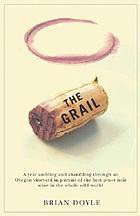
From the red clay hills of Dundee, Oregon, come increasingly world-renowned pinot noir wines. After being startled and delighted by one winery's elixir, and the shaggy humor of the father and son who made it, Brian Doyle set out to spend a year in one Willamette Valley vineyard, chronicling the creative and chaotic labor as the winemakers chase after the perfect pinot noir. A self-described "wine doofus," Doyle follows closely at the elbow of Jesse Lange, son of Lange Winery founder Don Lange, peppering the young winemaker with questions about the growing of grapes and making of wine. With dry wit and otherworldly patience, Jesse Lange offers his interlocutor a primer on pinot, describing how acres of tiny black grapes are turned into complex and superb wines. Doyle is absorbed in the real work of winemaking, "the sheer labor of it, the creativity, the dust, the bugs, the machinery, the botany, the chemistry, the wild nuttiness of trying to make a great wine." He records the rhythms and cycles of winemaking: the fallow times, the times of wild energy, and always the worry about the precious crop. Doyle serves as a cheerful tour guide through the world of wine, alert to the colorful and riveting stories that swirl around its creation and consumption. In The Grail, he collects and shares dozens of these stories about the natural history of the vineyard, the fussiness of the pinot vine, the boom in pinot noir around the world, the surprising buying habits of tasting room visitors, and the subtle craft of winemakers who know, as Jesse Lange says, grinning, "how to get out of the way of great grapes." In short, The Grail is a spirited and entertaining chase for a truly special wine. 208 pages : illustrations ; 22 cm CIRC [ 0 ]
|
2006 |
|
Saving Puget Sound a conservation strategy for the 21st Century by John Lombard, Washington (State). Department of Ecology 
No other developed area in the world matches the Puget Sound region's combination of beauty, wealth, natural resiliency, and history of environmental concern. Saving Puget Sound develops a practical proposal to conserve the Puget Sound region's most important ecosystems in the face of long-term population growth, drawing lessons that are relevant across the Northwest and in other parts of the country. It provides both a vision for conservation and a detailed review of the political and legal issues that must be at the core of any practical strategy to achieve it. xvii, 336 pages : illustrations (some color), maps (some color) ; 25 cm CIRC [ 0 ]
|
2006 |
|
Public power, private dams the Hells Canyon High Dam controversy by Karl Boyd Brooks, William Cronon 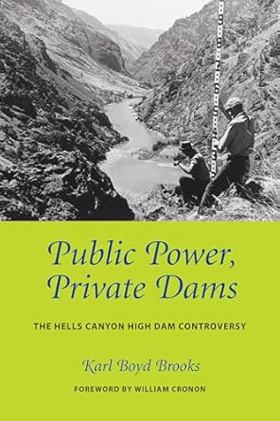
In the years following World War II, the world’s biggest dam was almost built in Hells Canyon on the Snake River in Idaho. Karl Boyd Brooks tells the story of the dam controversy, which became a referendum not only on public-power expansion but also on the environmental implications of the New Deal’s natural resources and economic policy. Private-power critics of the Hells Canyon High Dam posed difficult questions about the implications of damming rivers to create power and to grow crops. Activists, attorneys, and scientists pioneered legal tactics and political rhetoric that would help to define the environmental movement in the 1960s. The debate, however, was less about endangered salmon or threatened wild country and more about who would control land and water and whether state enterprise or private capital would oversee the supply of electricity. By thwarting the dam’s construction, Snake Basin irrigators retained control over water as well as economic and political power in Idaho, putting the state on a postwar path that diverged markedly from that of bordering states. In the end, the opponents of the dam were responsible for preserving high deserts and mountain rivers from radical change. With Public Power, Private Dams, Karl Brooks makes an important contribution not only to the history of the Pacific Northwest and the region’s anadromous fisheries but also to the environmental history of the United States in the period after World War II. xxvii, 290 pages, 16 unnumbered pages of plates : illustrations, map ; 24 cm. CIRC [ 0 ]
|
2006 |
|
Letters from Kik-I-allus a farmer's perspective by Glen Johnson 
Published in local editions by Glen Johnson, Letters from Kik-I-allus: A Farmer's Perspective collects insightful essays and correspondence reflecting on rural life, environmental stewardship, and local history near the Skagit River delta. Written from the perspective of a working farmer tied to the ancestral homeland known as Kik-I-allus, the book chronicles the daily rhythms of agriculture, the seasonal cycles of the Pacific Northwest, and the mounting pressures of modern development on traditional farmlands. Through evocative prose, Johnson bridges personal agronomic experience with a deep-seated reverence for the surrounding watershed and its indigenous legacy. A keen insight drawn from the text is how the traditional agrarian viewpoint acts as an acute ecological barometer; by documenting the subtle, creeping degradation of local soils and water tables firsthand, the author reveals that the survival of family farming is inextricably bound to the broader health of the regional ecosystem. 246 pages : illustrations, map ; 18 cm CIRC [ 1 ]
|
2005 |
|
Islands in the Salish Sea a community atlas by Sheila Harrington, Judi Stevenson 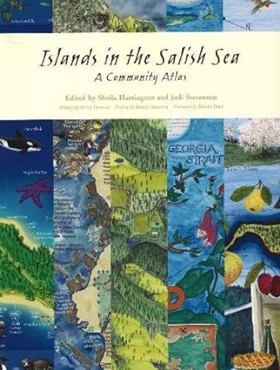
Gorgeous, fascinating and unconventional, the Islands in the Salish Sea show aspects of the Gulf Islands that are most beloved by the residents, from heritage orchards, fishing spots and patches of endangered wild orchids to ancient First Nations' sites and bird colonies. The community on each island decided what elements should be depicted, and local artists then created each of the magnificent and wildly different maps. This volume is a treasure-trove of cherished information that could have been lost, presented with imagination and great beauty. The Islands in the Salish Sea Community Mapping Project was coordinated by Sheila Harrington and Judi Stevenson, who live on Salt Spring Island 159 Seiten : zahlreiche Illustrationen und Karten CIRC [ 1 ]
|
2005 |
|
Isleward bound a Lummi Island reader by Meredith Moench 
Published in local editions by Meredith Moench, Isleward Bound: A Lummi Island Reader compiles a rich anthology of essays, oral histories, and reflections capturing the unique communal and ecological rhythm of life on one of Washington's most distinct Salish Sea islands. The book explores the quiet realities of island isolation, the challenges of ferry-dependent infrastructure, and the deep-seated bonds among residents who choose to live off the beaten path. Through diverse personal narratives, the text preserves the vanishing traditions of local fishermen, artists, and long-time homesteaders while grappling with the pressures of modern mainland encroachment. A keen insight drawn from the work is how insular community literature functions as a defensive cultural shield; by celebrating the hyper-local eccentricities and mutual interdependence required to sustain life on a small island, the text resists the homogenization of the modern Pacific Northwest. v, 142 p. : ill. ; 27 cm. CIRC [ 1 ]
|
2005 |
|
American Indians of the Pacific Northwest by Elizabeth Von Aderkas, Christa Hook 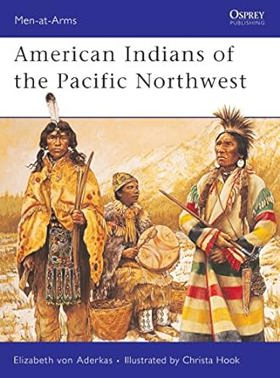
The Indian tribes of the Pacific Northwest, on both the Coast and the inland Plateau, were the last to encounter white traders and settlers. When contact occurred in the late 18th century the explorers and traders found two distinct cultures. The fairly recent adoption of the horse had opened up the Plateau tribes to influences from the peoples of the Plains; but the tribes of the Coast lived in a very different culture of rigid class hierarchies, an economy based on fishing and hunting 48 pages : illustrations (some color), maps, portraits (some color) ; 25 cm CIRC [ 1 ]
|
2005 |
|
What happened here? stories and legends based on the history of Coos and Curry counties, Oregon by Shirley Nelson 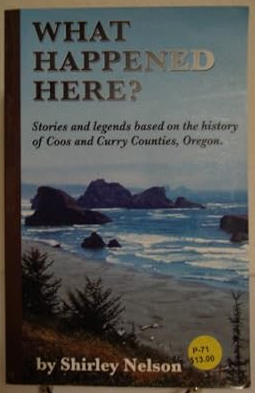
Published in local editions by Shirley Nelson, What Happened Here? Stories and Legends Based on the History of Coos and Curry Counties, Oregon weaves together local folklore, pioneer accounts, and historical research to chronicle the dramatic frontier past of Oregon's rugged southwestern coast. The book captures the dangerous realities of early coastal settlement, detailing shipwrecks along treacherous bars, gold-mining rushes in river canyons, and the often-tense interactions between Euro-American homesteaders and indigenous populations. Drawing on regional oral histories, Nelson preserves the vibrant, hard-scrabble legends that defined the daily existence of isolated coastal communities. A keen insight drawn from the text is how regional folklore functions as a vital psychological coping mechanism; by transforming the brutal isolation and constant tragedies of a perilous maritime frontier into enduring campfire legends, early settlers forged a resilient collective identity that helped them tame a deeply unforgiving landscape. 111 pages : illustrations, maps ; 22 cm CIRC [ 1 ]
|
2005 |
|
The state of Jefferson by Bernita Tickner, Gail L. Fiorini-Jenner 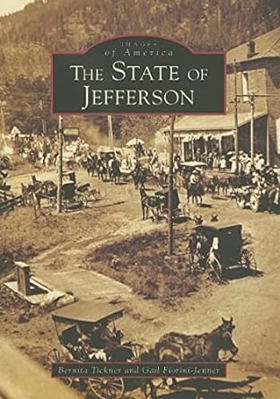
Published in 2017 by Bernita Tickner and Gail L. Fiorini-Jenner, The State of Jefferson explores the colorful, enduring political secession movement aimed at carving a new U.S. state out of the rugged rural counties of Northern California and Southern Oregon. Through a rich collection of vintage photographs and historical anecdotes, the book traces the movement from its 1941 theatrical launch—complete with gold-panning miners brandishing rifles—to its modern manifestations rooted in geographic isolation and anti-establishment sentiment. The text details how residents of this timber-and-mining corridor have long felt economically and politically abandoned by distant state capitals in Sacramento and Salem. A keen insight drawn from the work is how the persistent mythos of the "State of Jefferson" functions less as a viable legislative blueprint and more as a profound psychological safety valve; it provides rural populations with a shared, defiant regional identity that channels deep-seated economic grievances against metropolitan dominance into theatrical civic rebellion. 128 pages : chiefly illustrations, map ; 24 cm. CIRC [ 1 ]
|
2005 |
|
Necktie parties a history of legal executions in Oregon, 1851-1905 by Diane L. Goeres-Gardner 
Diane Goeres-Gardner makes readers eyewitnesses to frontier justice in Necktie Parties. This is the story of the men who climbed the gallows steps and faced the hangman's noose during the early years of settlement in Oregon. Today, capital punishment is a controversial topic, in the United States and around the world. That wasn?t the case during the 1800s on America's western frontier. Executions were public events drawing hundreds?sometimes thousands?of residents from miles around. The xxiv, 316 pages : illustrations, maps, portraits ; 23 cm CIRC [ 0 ]
|
2005 |
|
Governing Idaho politics, people, and power by James B. Weatherby, Randy Stapilus 
Idaho is a state with many varied interests vying for political control. Whether it be in the politically liberal north, the staunchly conservative southeast, or the rapidly changing southwest of the state, the social and political factors that determine who gains power in the Gem State often flies in the face of logic and makes for an interesting study in contrasts. xi, 237 pages : illustrations, map ; 23 cm CIRC [ 0 ]
|
2005 |
|
Elegant SOUL the life and music of Gene Harris by Janie Harris, Bob Evancho 
Gene Harris, the “Blues Man From Boise,” as the Wall Street Journal once called him, died at the start of a new millennium, but he left a legacy of music that will outlive us all. He played on more than 80 recordings and shared the stage or recording studio with many legends and luminaries. Gene's wife, Janie, and veteran writer Bob Evancho detail the career of this gifted entertainer. 279 pages : illustrations (some color), portraits (some color) ; 21 x 26 cm CIRC [ 0 ]
|
2005 |