Catalog of British Columbiana and Pacific Northwest Americana
Encyclopedia Cascadia Catalog contains book titles of mostly non-fiction Pacific Northwest Coast of North America Titles (primarially British Columbia, Idaho, Oregon and Washington State) in an easy-to-understand title catalog. If you see a link with this badge ONLINE CIRC it means that there is an online institution that provides free access to that title. In some cases there may be more than one institution hosting the title digitally.
| Catalog Title | Published |
|---|---|
|
Let right be done Aboriginal title, the Calder case, and the future of Indigenous rights by Hamar Foster, Jeremy H. A. Webber, Heather Raven 
"In the early 1970s, many questioned whether Aboriginal title existed in Canada and rejected the notion that Aboriginal peoples should have rights different from those of other citizens. But in 1973 the Supreme Court of Canada issued a landmark decision in the Calder case, confirming that Aboriginal title constituted a right within Canadian law. Let Right Be Done examines the doctrine of Aboriginal title thirty years later and puts the Calder case in its legal, historical, and political context, both nationally and internationally. With its innovative blend of scholarly analysis and input from many of those intimately involved in the case, this book should be essential reading for anyone interested in Aboriginal law, treaty negotiations. and the history of the "BC Indian land question.""--Jacket viii, 337 pages : illustrations, map ; 24 cm CIRC [ 0 ]
|
2007 |
|
The prairie keepers secrets of the Zumwalt by Marcy Cottrell Houle 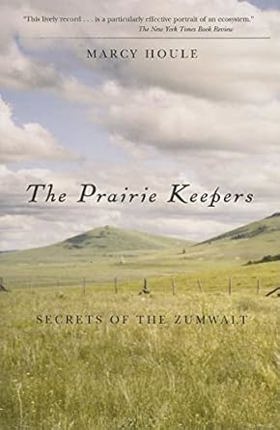
In the remote northeast corner of Oregon lies the ruggedly beautiful Zumwalt Prairie, one of the last native prairies in the United States. A wild expanse of untilled ground covering nearly two hundred square miles, the Zumwalt is almost entirely managed by cattle ranchers. It also is home to one of the highest concentrations of hawks in North America. Marcy Houle, a wildlife biologist and student, first went to the Zumwalt in 1979 to discover what attracts and sustains the hawks there in such startling abundance. Houle explores the vast prairie on foot and horseback, cataloging its hawks, studying its complex ecosystem, and meeting its people. Fueled by her youth, her spirit, her humor--and in part by her naivete--she bands birds, outruns a bull, and pulls together the factious community of ranchers, townspeople, and government employees. Her findings, eloquently reported, show that ranchers and wildlife not only can coexist, but in some instances must coexist if we are to save the last of the native prairies. In a new epilogue, Houle writes of the Zumwalt two decades later. Despite tremendous changes occurring in the American West, she finds reason for hope in the Zumwalt--in the hawks and ranchers still there, and also in new partnerships that encourage stewardship and sustainable cattle grazing. 274 pages ; 22 cm CIRC [ 0 ]
|
2007 |
|
Teaching Oregon native languages by Joan Gross 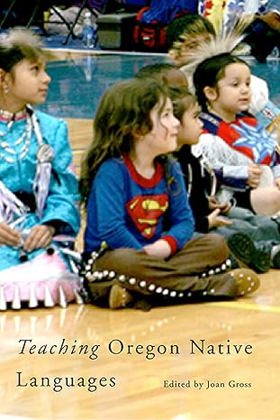
In a world where over half of the remaining 6000 languages will most likely disappear by the end of the century, attention has finally begun to focus on the struggles of indigenous people to save their languages. Lack of knowledge concerning the vast linguistic diversity of Oregon's languages has been a major obstacle to language revitalization in this state. Native peoples were subjected to disease, displacement, and forced linguistic assimilation, leaving many languages with only a few speakers. Some languages died out, but others prevailed in the privacy of homes and longhouses. This book tells the story of perseverance and survival against unbelievable odds, using the words of today's speakers and learners of Oregon's languages. Interviews with 52 native speakers provide valuable insights into how languages are lost and how a linguistic heritage can be brought to life. Teaching Oregon Native Languages discusses the role of state and federal language policies, explores how archival collections can be used in language revitalization, and describes strategies for creating a successful teaching environment. A timely and necessary resource, it will educate all readers about the important efforts underway to revitalize Oregon's first languages. viii, 168 pages : illustrations, maps ; 24 cm CIRC [ 0 ]
|
2007 |
|
To harvest, to hunt stories of resource use in the American West by Judy L. Li 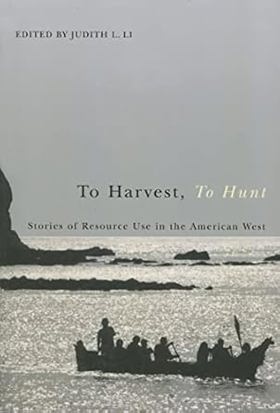
To Harvest, To Hunt reveals how diverse peoples have valued and used natural resources throughout the history of the American West. Drawing on family letters, oral traditions, historical records, and personal experience, the book's contributors offer readers new perspectives on the land they live on, the harvests they consume, and the natural resources they manage. Editor Judy Li weaves a tapestry of cultures and voices – from Pueblo tribes in the Southwest and Chinese fishermen in California to Mexican braceros in Oregon and Basque sheepherders in Idaho – as she details the region's historical dependence on the land and sea. Otter, walrus, abalone, grasslands, timber, and water are some of the vital resources discussed by writers, anthropologists, historians, and biologists in stories that tell how cultures struggle to adapt in changing environments. Spanning the last 200 years, To Harvest, To Hunt represents Native Americans, Native Alaskans, and Mexican, European, and Asian immigrants as varied in their perspectives as the landscapes the book describes. Readers will come to appreciate the region's once-abundant resources and find this book an illuminating overview of the dynamic between people and the land. Contributors: John Bieter, Dolly Garza, Erlinda Gonzales-Berry, Steven W. Hackel, David Hatch, Deanna Kingston, Jim LeMonds, Irene Martin, David Mas Masumoto, Margaret Mathewson, John Nichols, Patti Sakurai, and Charles Wilkinson. 192 pages : illustrations ; 23 cm CIRC [ 0 ]
|
2007 |
|
Forest of time a century of science at Wind River Experimental Forest by Margaret J. Herring, Sarah Greene 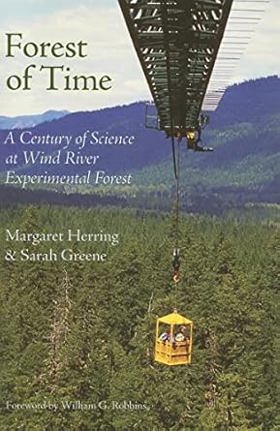
The Wind River Experimental Forest has been called the cradle of forestry in the Pacific Northwest, a place of groundbreaking discoveries in forest genetics and ecology. Forest of Time follows 100 years of forest science at Wind River, as social and scientific changes transformed the 20th century and the Pacific Northwest forest itself. It is a story of discovery and blindness, of opportunities taken and missed, in a forest dedicated to long-term research. The Forest Service began research at Wind River in 1908 to learn the secrets of the giant Douglas fir. During the course of the century, generations of scientists studied the forest, and their conclusions changed through time. Initially, Wind River scientists saw the region in need of protection from fire and careless logging. They saw scorched, cutover land that required replanting. Later they saw the forest in need of improvement, needing to be freed from pests and unprofitable species and replaced with thrifty, fast-growing plantations. Wind River soon became a laboratory where foresters from around the world came to learn how to grow the best possible lumber in the shortest amount of time. As plantations replaced natural stands, scientists came to Wind River to explore the complexity of old-growth forest ecosystems. And today, Wind River is the center of a 21st century exploration of forest canopies and the global connection between forests and atmosphere. In Forest of Time, Margaret Herring and Sarah Greene show readers how science grows and changes in unexpected ways, much like a forest through time. ix, 188 pages : illustrations, maps ; 23 cm CIRC [ 0 ]
|
2007 |
|
Here there nowhere paintings by Michael Brophy, Jonathan Raban, William L. Lang, Randy Gragg 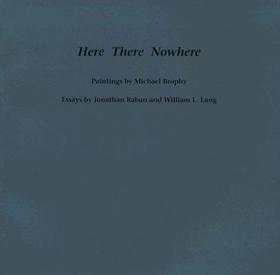
Michael Brophy has painted the Pacific Northwest landscape for over two decades, from sumptuously rendered panoramas of clearcuts and slag heaps to comic-book-scaled noir tableaus of the characters who reshaped the region 150 years ago. This large-scale monograph brings 15 of his most historically expansive paintings to date together with writings on the artistic and cultural history of the Northwest landscape by essayist Jonathan Raban and historian William L. Lang. The influences on Brophy’s painting stretch from Goya and Velasquez to Robert Colescott and George Baselitz. He has riffed on everything from obscure Wobbly songs to Chinook jargon dictionaries to the writings of Stewart Holbrook. But Here There Nowhere marks a bold new direction in Brophy’s work. More sweeping in scope and minimalist in style, the paintings portray what he calls the "Big Empty," the dramatic, vacant spaces of the Northwest's eastern deserts and western coast but with an eye toward the coming endgame of Manifest Destiny. Raban's essay, Battleground of the Eye, traces two centuries of artistic conflict between the verdant, people-free Northwest most painters chose to portray vs. the fully populated and exploited landscape that actually existed. Lang's essay, An Insatiable Hunger: The Consuming Myth of the Northwest, probes the changing mythology of Pacific Northwest landscape as it has progressed from an apparently infinite resource for extractive industries to a playground for an expanding consumer class. Designer John Laursen has translated the sweeping power of Brophy's work to the scale of a 12-by-12-inch book with the 200-line reproductions imaged direct to plate and printed by Portland’s award-winning Millcross Litho. 49 pages : color illustrations ; 30 x 31 cm CIRC [ 0 ]
|
2007 |
|
Recording their story James Teit and the Tahltan by Judy Thompson 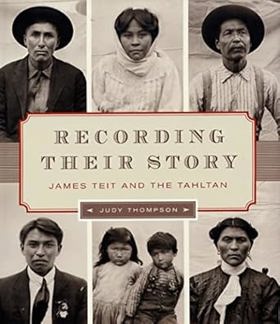
Recording Their Story describes the life of James Teit, one of Canada's earliest ethnographers, and his work among the Tahltan people of northern British Columbia almost a century ago. Teit's work collecting artifacts, taking photographs, recording songs, transcribing myths, and gathering information about social organization, ceremonial life, customs, and beliefs has proved invaluable. Today, this collection is the most important extant assemblage of the Tahltan's heritage. James Teit emigrated from the Shetland Islands to British Columbia in 1884, at the age of nineteen. He reveled in the outdoor life and became, among other things, a hunting guide, a linguist who spoke several aboriginal languages fluently, and an activist for Native rights. Teit's connection to the Canadian Museum of Civilization and his ethnographic work among the Tahltan began in 1911, when he was invited to join the staff of the new Anthropology Division of the Geological Survey of Canada. Teit then worked among the Tahltan, at their request and with the participation of many within the community, in both 1912 and 1915. Judy Thompson's examination of Teit's extensive correspondence, fieldwork notebooks, diaries, and manuscripts illustrates how James Teit's life and work impacted his major ethnographic studies. Recording Their Story is part biography and part catalog of the Tahltan ethnographic collection. The book is richly illustrated throughout with 71 rare historic photographs, 51 beautiful color images of ethnographic artifacts, six line drawings, and three maps. xi, 207 pages : illustrations (some color), maps (some color) ; 29 cm CIRC [ 0 ]
|
2007 |
|
Plowed under agriculture & environment in the Palouse by Andrew P. Duffin 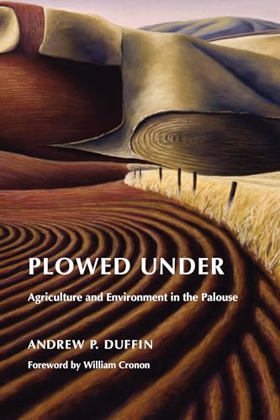
"In Plowed Under, Andrew P. Duffin traces the transformation of the Palouse region of Washington and Idaho from land thought unusable and unproductive to a wealth-generating agricultural paradise, weighing the consequences of what this progress has wrought. During the twentieth century, the Palouse became synonymous with wheat, and the landscape was irrevocably altered. At the dawn of the twenty-first century, native vegetation is almost nonexistent, stream water is so dirty that it is often unfit for even livestock, and 94 percent of all land has been converted to agriculture. Commercial agriculture also created a less noticeable ecological change: soil erosion." "Duffin argues for a candid look at the land, its people, their decisions, and the repercussions of those decisions in the hope of charting a better, more sustainable future. As he notes, the debate is not over whether to use the land, but over what that use will look like and its social and ecological results."--Jacket xv, 240 pages, 16 unnumbered pages of plates : illustrations, maps ; 24 cm. CIRC [ 0 ]
|
2007 |
|
Far west the story of British Columbia by Daniel Francis 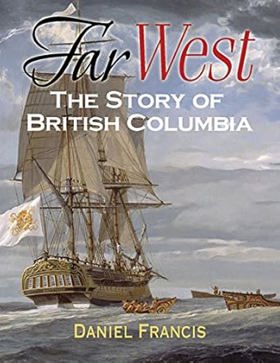
British Columbia's colourful story has been told many times, but until now no one has attempted to relate the chronicle specifically for young readers. From the gold rush to the Gumboot Navy and from "brideships" to W.A.C. Bennett, BC history comes alive in this highly illustrated and vivid account by award-winning writer and historian Daniel Francis. Starting with the story of BC's aboriginal people and their lives prior to the arrival of the Europeans, Far West recounts first contact with early explorers such as Captain James Cook and Captain George Vancouver and the changes the fur trade brought to the "New World." Francis then describes how BC was born, starting with the gold rush and Confederation eras, going through to modern times and speculating on BC's future. On the way we meet interesting characters from BC's history, people such as Frances Barkley, the first European woman to visit British Columbia in 1787; Joe Capilano, who travelled to London, England, in 1906 to explain to the British king how BC's aboriginal people were displaced by white settlers; and Rosemary Brown, a Vancouver social worker who was the first black woman elected to political office in Canada in 1972. Quotes from BC people--past and present--and anecdotal sidebars containing little-known BC facts spice up the text. Geared toward readers aged nine and up and richly illustrated with archival photographs, colourful paintings, maps and original illustrations, Far West is a must-have for every BC family. 175 p. : ill. (some col.), col. maps ; 29 cm. CIRC [ 0 ]
|
2006 |
|
The Pacific Northwest past, present, and future by Dale A. Lambert 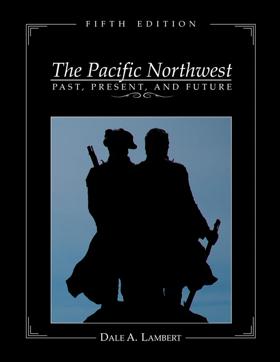
The updated textbook is presented in a regional format, discussing the history of Washington, Oregon and Idaho. The Pacific Northwest: Past, Present and Future, 5th Edition - Textbook, emphasizes the major geologic events, geographic aspects, historical trends, demographic patterns, cultural diversity, governmental organization, socioeconomic development, recreational opportunities, and environmental concerns for the Pacific Northwest region. xii, 499 pages : illustrations (some color), color maps ; 29 cm CIRC [ 1 ]
|
2006 |
|
The Comox Valley Courtenay, Comox, Cumberland and area by Paula Wild, Rick James, Boomer Jerritt 
From snowcapped mountains and delicate sub-alpine meadows to sandy beaches and secluded bays, The Comox Valley offers a fascinating look at one of the most popular regions on Vancouver Island--the area that stretches along the east coast of Vancouver Island from Fanny Bay to Black Creek, including the communities of Comox, Courtenay, Cumberland and Merville, as well as Denman and Hornby islands. The Comox Valley is known for its natural beauty, diverse recreational opportunities and as a vibrant centre of the arts. In a blend of stunning colour photographs and lighthearted, informative text, the book explores the mountains, rivers, beaches and sheltered waters of this unique geographic region. Journey to rural farms and lively urban centres, get a behind-the-scenes glimpse of a Canadian air force base and experience the laid back charm of Denman and Hornby islands. Discover a historic mining village, ancient sites of First Nations' battles and the fossilized remains of an 80 million-year-old elasmosaur. Learn why the Comox Valley has such a high concentration of artists and meet some genuine West Coast characters including a legend from the days of old-time logging. 143 pages : illustrations (chiefly color) ; 29 cm CIRC [ 1 ]
|
2006 |
|
Boise, Idaho, 1882-1910 prosperity in isolation by Carol Lynn MacGregor 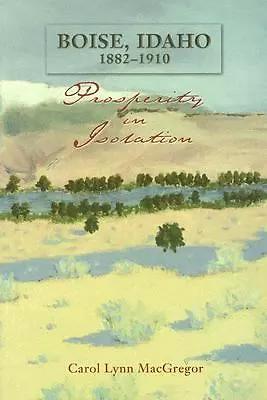
MacGregor's study of Boise begins with the removal of the Northern Shoshoni and follows the progress of government, infrastructure, business, and social institutions in the area. Along the way, MacGregor (history, Boise State) describes Boise's architecture, arts, culture and changing demographics. She creates in all its details the peculiar history of this unusually prosperous and progressive city. The text includes photographs and maps of the evolving city. Annotation ©2006 Book xiv, 306 pages : illustrations, maps ; 23 cm CIRC [ 1 ]
|
2006 |
|
De San Blas hasta la Alta California los viajes y diarios de Juan Joseph Pérez Hernández by María Luisa Rodríguez-Sala 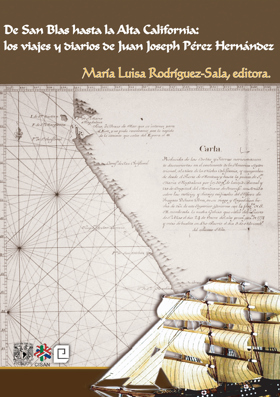
This book deals with the vicissitudes and feats of Juan Joseph Pérez Hernández, a Spanish Royal Navy seaman in charge of the maritime exploration of the northern part of the New World in the last quarter of the eighteenth century. The author explains that the ultimate reason for these travels was to be found in the policy and aspirations of two European empires, the Spanish and the Russian. The Spaniards wanted to consolidate and expand their territories in these northern latitudes in the face of the threat of the penetration through trade and settlement by the nascent Russian empire. | Esta obra narra los avatares y hazañas de Juan Joseph Pérez Hernández, navegante al servicio de la Real Armada española y encargado de la exploración marítima y descubrimiento de las tierras septentrionales del Nuevo Mundo durante el último cuarto del siglo XVIII. El motivo ulterior de dichas travesías, explica la autora, se hallaba en la política y las aspiraciones de dos imperios europeos, el español y el ruso; el primero debía afirmar y expandir sus territorios en aquellas latitudes septentrionales, ante la amenaza de una incursión comercial y poblacional del naciente imperio ruso. 294 pages ; 23 cm CIRC [ 1 ]
|
2006 |
|
Getting to the water's edge on Whidbey & Camano islands by Sarah Schmidt, Dan Pederson, Stacey Neumiller, WSU Beach Watchers, Washington State University Extension 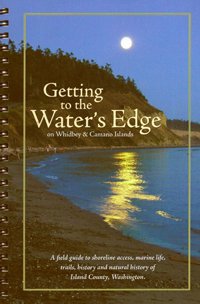
Published by Washington State University Extension and the WSU Beach Watchers, Getting to the Water’s Edge on Whidbey & Camano Islands serves as an exhaustive field guide to public shoreline access, marine life, and coastal trails across Island County. Compiled through extensive community research, the book details dozens of specific beaches, boat launches, and parks while weaving in rich context on local geology, natural history, and indigenous heritage. It bridges the gap between a practical recreational map and an environmental manual by emphasizing responsible stewardship of the fragile Salish Sea ecosystem. A keen insight drawn from the work is how citizen-science guidebooks function as powerful grassroots conservation tools; by meticulously cataloging public access points and educating visitors on local ecological sensitivities, the text transforms recreational day-trippers into active defenders of the regional shoreline. ix, 166 pages : color illustrations, color maps ; 22 cm CIRC [ 1 ]
|
2006 |
|
The Columbia River Highway from the sea to the wheatfields of eastern Oregon by Clarence E. Mershon 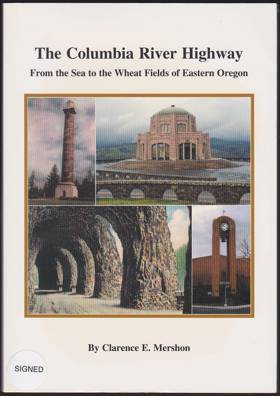
Published in 2007 by Clarence E. Mershon, The Columbia River Highway from the Sea to the Wheatfields of Eastern Oregon chronicles the grand engineering vision and historical evolution of one of America's most scenic roadways. The book details the monumental construction efforts led by Samuel C. Lancaster to carve a paved highway through the formidable cliffs of the Columbia River Gorge, connecting Portland's maritime climate to the vast agricultural interior. Through detailed historical narratives and vintage photographs, the text illustrates how the highway fundamentally transformed regional travel, commerce, and tourism by replacing precarious riverboats with a unified overland route. A keen insight drawn from the work is how the highway's pioneering design philosophy deliberately prioritized aesthetic wonder over pure utilitarian efficiency, transforming a piece of heavy civic infrastructure into a monumental landscape architecture project meant to romanticize the Pacific Northwest frontier for early motorists. x, 274 pages : illustrations, maps ; 26 cm CIRC [ 1 ]
|
2006 |
|
Moscow by Julie R. Monroe 
Each spring for centuries, the Nez Perce Indians visited the area they called Taxt-hinma (place of the spotted deer) to harvest the camas root. Today Taxt-hinma is Moscow, Idaho, a forward-looking university community dedicated to preserving the spirit of place that attracted the area's first permanent settlers in 1871. Originally known as Paradise, Moscow started out as a trading center serving homesteaders settling the prodigiously fertile Palouse. Since its incorporation as a city in 1887, Moscow has grown steadily upon a foundation of education and agriculture. From its central core of notable commercial and public buildings to the splendid houses that once sheltered its founders to the scenic University of Idaho campus, Moscow is clearly a community that values its cultural, economic, architectural, and natural heritage 127 pages : chiefly illustrations ; 24 cm. CIRC [ 0 ]
|
2006 |
|
Latah County by Julie R. Monroe 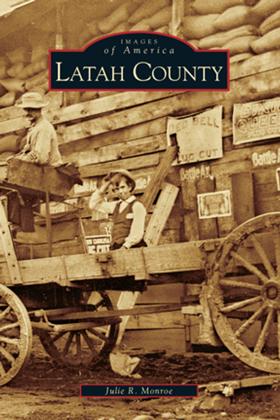
Its name derived from the Nez Perce language, Latah County is the only county in the United States to have been created by an Act of Congress. The abundance of its natural resources—from blue fields of camas to deep veins of gold, from great stands of white pine trees to vast green grasslands—attracted a diversity of dreamers seeking only the opportunity to build their own futures. Nestled in the heart of the Palouse, an agricultural area of extraordinary production, Latah County is a land of timber and, at Potlatch, was once the site of one of the largest sawmills in the world. At Moscow, it is also the home of the state’s land-grant institution, the University of Idaho. From the forests of Troy and the ridges of Juliaetta and Kendrick, from the homesteads of Genesee to Bovill’s hunting lodge and Deary’s town site, Latah County has had a rich and varied history. 127 pages : illustrations, maps ; 24 cm. CIRC [ 0 ]
|
2006 |
|
Sixty-four years as a writer by Bill Gulick 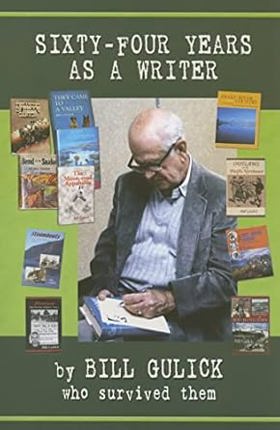
"Bill Gulick's writing career, spanning more than six decades, is truly remarkable. He has written twenty-seven novels, eight nonfiction books and several plays. He was a regular contributor to The Saturday Evening Post and other national magazines. His stories have become major motion pictures starring screen legends like Burt Lancaster, and Jimmy Stewart. A list of his literary friends reads like a whose who of western wrtiting. Gulick is considered one of the foremost authorities on Pacific Northwest history. In Sixty-four Years as a Writer, he details the journey from his Depression era Oklahoma roots to his position as one of the nation's premier western authors."--Publisher's description 344 pages : illustrations ; 23 cm CIRC [ 0 ]
|
2006 |
|
With our good will 30 years of Shakespeare in Idaho by Doug Copsey 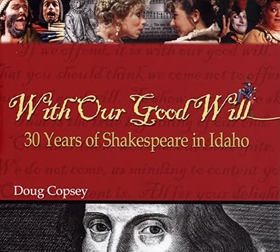
In 1977 a group of talented young artists came together with the hope of establishing a self-sustaining theater group in Boise, Idaho. Three decades later, the Idaho Shakespeare Festival has become a nationally recognized community happening. In this beautifully designed and written book, Doug Copsey, one of the founders, tells the story of how it evolved. 249 pages : illustrations ; 30 x 27 cm CIRC [ 0 ]
|
2006 |
|
Leaving paradise Indigenous Hawaiians in the Pacific Northwest, 1787-1898 by Jean Barman, Bruce McIntyre Watson 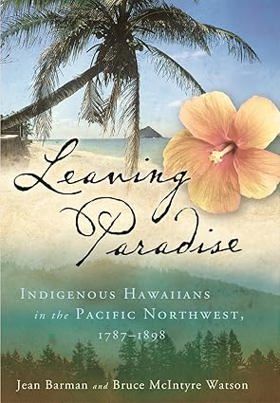
"Native Hawaiians arrived in the Pacific Northwest as early as 1787. Some went out of curiosity; many others were recruited as seamen or as workers in the fur trade. By the end of the nineteenth century more than a thousand men and women had journeyed across the Pacific, but the stories of these extraordinary individuals have gone largely unrecorded in Hawaiian or Western sources. Through archival work in British Columbia, Oregon, California, and Hawaii, Jean Barman and Bruce Watson pieced together what is known about these sailors, laborers, and settlers from 1787 to 1898, the year the Hawaiian Islands were annexed to the United States." "Scholars and others interested in a number of fields - Hawaiian history, Pacific Islander studies, Western U.S. and Western Canadian history, diaspora studies - will find Leaving Paradise an indispensable work."--BOOK JACKET xiii, 512 pages : illustrations, maps ; 24 cm CIRC [ 0 ]
|
2006 |
|
Red light neon a history of Vancouver's sex trade by Daniel Francis 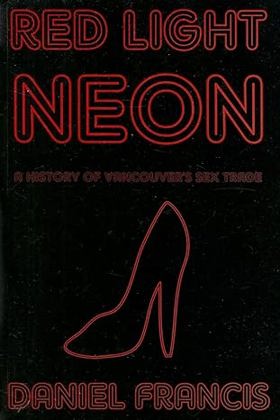
"This book is a history of hypocrisy." So begins Daniel Francis, BC's leading popular historian, as he explores the colourful and ultimately tragic story of prostitution in Vancouver. He writes: "The city's political and social leaders consistently have treated prostitutes as pariahs whose presence was tolerated, sometimes exploited, but never approved. All the while, the authorities collected millions of dollars in fines and licence fees from businesses that everyone knew were, and are, fronts for the sex trade." 192 pages, 8 unnumbered pages of plates : illustrations ; 23 cm CIRC [ 0 ]
|
2006 |
|
Following the Nez Perce trail a guide to the Nee-Me-Poo National Historic Trail, with eyewitness accounts by Cheryl Wilfong 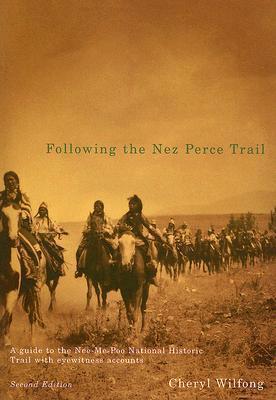
The 1877 flight of the Nez Perce from their homelands while pursued by U.S. soldiers and citizen volunteers is one of the most compelling and sorrowful events in American history. The Nez Perce (Nee-Me-Poo) National Historic Trail traces the route taken by the 800 Nez Perce men, women, and children from May to October 1877. Drawing on eyewitness accounts, this unique book chronicles the heartbreaking retreat of Chief Joseph and his people. It offers an essential guide for anyone who wishes to follow all or part of the Trail. The Nez Perce Trail stretches for 1,500 miles from Wallowa Lake, Oregon, through Idaho and Yellowstone Park, ending at the Bear Paw Battlefield, near Chinook, Montana. This historical guidebook splits the Trail into thirteen segments, each with its own historical chronology and travel plan, with alternative routes for "mainstream," "adventurous," and "intrepid" travelers. Each route includes maps, GPS coordinates, and recommendations for side trips. Period photographs and firsthand accounts from those who first traveled the trail--the Nez Perce, soldiers, settlers--bring history to life. For more than fifteen years, Following the Nez Perce Trail has led travelers and historians as they've retraced the flight of the Nez Perce from their homeland in the Pacific Northwest to their exile in Oklahoma and Canada. This new edition has been updated and expanded by author Cheryl Wilfong, and includes a new emphasis on the experiences of the Nez Perce women and children. Her detailed knowledge of the Nez Perce Trail informs every page of this indispensable guide. xiv, 493 pages : illustrations, maps ; 26 cm CIRC [ 0 ]
|
2006 |
|
Birds of Lane County, Oregon by Alan Contreras 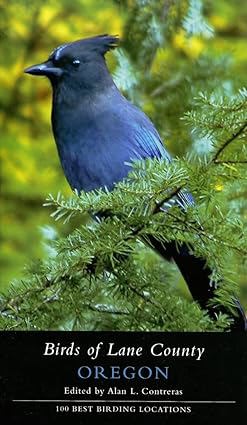
Birds of Lane County is the essential guide for anyone - backyard birder or serious observer - interested in the birds of western Oregon. Lane County's bird life is rich with variety; over three hundred bird species may be found in the county during the year. Within an hour's drive of Eugene, birders may encounter Black Oystercatchers, Pelagic Cormorants, and Snowy Plovers on the coast or Black-backed Woodpeckers, Northern Goshawks, and Mountain Bluebirds in the Cascades. With this comprehensive guide, birders at all levels can enjoy this incredible diversity. In Birds of Lane County, editor Alan Contreras and a team of expert contributors describe the one hundred best birding sites in the county, with detailed information on what may be found, and where and when to seek particular birds. All sites are publicly accessible with clear, easy-to-follow directions and maps, and many of the sites are at least partly wheelchair accessible, provide species accounts with basic information about the status, distribution, abundance, and movements of each species known to have occurred in Lane County. It also offers useful resources for birders including migrant arrival and departure tables, seasonal charts, a gazetteer, contact information for local birding and natural history organizations, and a species checklist. 366 pages : illustrations, maps ; 24 cm CIRC [ 0 ]
|
2006 |
|
National park, city playground Mount Rainier in the twentieth century by Theodore Catton 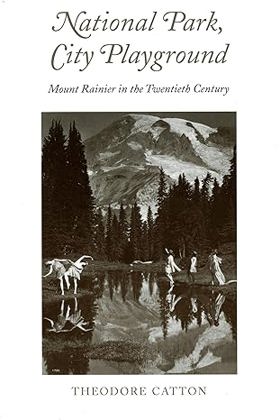
The majestic beauty of Mount Rainier, which dominates the Seattle and Tacoma skyscapes, has in many ways defined the Pacific Northwest. At the same time, those two major cities have strongly influenced the development of Rainier as a national park. From the late 1890s, when the Pacific Forest Reserve became Mount Rainier National Park, the evolving relationship between the mountain and its surrounding residents has told a history of the region itself. That story also describes the changing nature of our national park system. From the late nineteenth century to the present, park service representatives and other officials have created policies, built roads and hotels, and regulated public use of and access to Mount Rainier. Conflicting interests have shaped the decision-making process and characterized human interaction with the park. The Rainier National Park Company promoted Paradise Inn as a destination resort for East Coast tourists; Cooperative Campers of the Pacific Northwest developed backcountry camps for working-class recreationists; Asahel Curtis of the Good Roads Association wanted a road encircling the mountain; The Mountaineers promoted free public campgrounds and a roadless preserve; others focused on managing and protecting the upper mountain. The National Park Service mediated among the various parties while developing their own master plan for the park. In an engaging and accessible style, historian Theodore Catton tells the story of Mount Rainier, examining the controversies and compromises that have shaped one of America's most beautiful and beloved parks. National Park, City Playground reminds us that the way we manage our wilderness areas is a vital concern not only for the National Park Service, but for all citizens. ix, 236 pages, 16 unnumbered pages of plates : illustrations, maps ; 23 cm CIRC [ 0 ]
|
2006 |
|
Historic Friday Harbor on foot. Tour one, Historic downtown by San Juan Historical Society 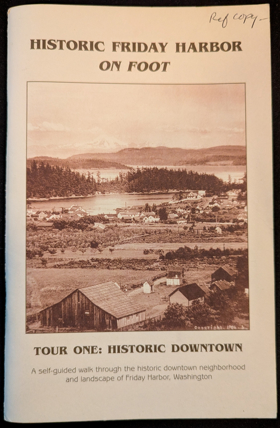
Published by the San Juan Historical Society, Historic Friday Harbor on Foot: Tour One, Historic Downtown serves as an engaging architectural and social walking guide through the core of San Juan Island's primary port town. The booklet outlines a structured route past surviving 19th- and early 20th-century commercial buildings, detailing their original uses as saloons, canneries, and mercantile shops that served the bustling maritime frontier. Through vintage photographs and concise structural histories, the text traces how a modest Coast Salish fishing camp and pioneer trading post evolved into a permanent island hub. A keen insight drawn from the guide is how localized historic walking tours function as physical acts of civic storytelling; by anchoring abstract regional heritage directly to surviving brick-and-mortar storefronts, the narrative transforms everyday streetscapes into tangible archives that invite modern visitors to inhabit the past. 40 unnumbered pages : illustrations, map ; 22 cm CIRC [ 1 ]
|
2006 |