Catalog of British Columbiana and Pacific Northwest Americana
The Encyclopedia Cascadia Catalog indexes mostly non-fiction literature covering the Pacific Northwest coast of North America, with an emphasis on British Columbia, Idaho, Oregon, and Washington State.
| Catalog Title | Published |
|---|---|
|
Mapping identity the creation of the Coeur d'Alene Indian Reservation, 1805-1902 by Laura Woodworth-Ney 
"Mapping Identity traces the formation of the Coeur d'Alene Indian Reservation in northern Idaho from the introduction of the Jesuit notion of "reduction" in the 1840s to the finalization of reservation boundaries in the 1890s. Using Indian Agency records, congressional documents, Bureau of Indian Affairs (BIA) records, Jesuit missionary reports, and tribal accounts, historian Laura Woodworth-Ney argues that the reservation-making process for the Coeur d'Alene reflected more than just BIA policy objectives. It was also the result of a complex interplay of Jesuit mission goals, the Schitsu'umsh chief Andrew Seltice's assimilationist policy, and political pressure from local non-Indians x, 234 pages : illustrations, maps ; 24 cm Non-circulating [ 1 ]
|
2004 |
|
The whole dam story the drowning and rising of a river city in the West by Ella Marie Rast 
The primary focus of the book is the happenings during the past two hundred years at the water fall on the Snake River, the American Falls. This includes the European influence on the natural Western wilderness by explorers, fur trappers, gold miners, pioneers, cattle barons, sheep men, farmers, engineers and politicians.Southern Idaho's story is about mountains, rivers, the Snake River Plain and the harsh reality of drought in the desert. The natives had learned it was essential to preserve the fragile environment for their own survival. The newcomers lacked this awareness.Speculators and promoters found no value in the sagebrush forest. However, the soil was exceptionally fertile; all it needed was water. Water represented economic potential and that possibility encouraged entrepreneurs to descend with irrigation schemes. Few succeeded. Settlers found themselves caught in a web of broken promises, promoters, speculators, and failed banks.Probably the most publicized town in the nation in the twenties is American Falls! This is the story of hydroelectricity, railroad, a city, a dam and includes greed, power, intrigue, determination and commitment. It is a story our nation should know and not forget. vi, 175 pages : illustrations ; 23 cm Non-circulating [ 1 ]
|
2004 |
|
Wenatchee Valley images of North Central Washington. Volume II by Nancy Barnhart 
This is a photographic history of North Central Washington. Hundreds of people from the region brought photographs and the history behind the photograph. The best photos were compiled to represent the history of the region. The photographs start in the 1880s and continue until about 1969 iv, 155 pages : illustrations ; 19 x 26 cm Non-circulating [ 1 ]
|
2004 |
|
The best of Chief Dan George by Dan George, Helmut Hirnschall 
This book combines the two best sellers My Heart Soars & My Spirit Soars in one volume, 63 poems fully illustrated, eloquently illustrated throughout by Helmut Hirnschall. Included in this edition is the Lament for Confederation by Chief Dan George. Poetic and spiritual, this book has a universal message to all people. Chief Dan George was an accomplished performer, poet, philosopher, champion of Native peoples and loving patriarch of a large family. Chief Dan George was an accomplished performer, poet, philosopher, champion of first Nations peoples, loving patriarch of a large family, was born in 1899 on a Salish Band reserve on Burrard Inlet, in North Vancouver, one of twelve children of the chief. His given name was Teswahno, meaning thunder coming up over the land from the water. Like most native children at that time, under the influence of the Catholic Church, and in need of white culture's education, he went to a residential school at the age of five, so as not to be separated from his cherished older brother Harry. The next eleven years were difficult ones, being distanced from family, culture, language and customs. Schooling ended at sixteen, and he went immediately into the forest to harvest trees. At nineteen, in an arranged marriage, he and sixteen year old Squamish girl, Amy, entered into a devoted union of fifty-two years duration. They had eight children, six of whom survived into adulthood. Dan worked as a long-shoreman off and on for the next twenty-seven years, during frequent strikes supplementing his income with hunting and lumbering, until he had a serious accident on the docks in 1947, which damaged a hip and leg. In the forties, with his children and a cousin, who billed themselves as Dan George and His Indian Entertainers, he played for dances three or four nights a week throughout British Columbia. Traveling and sleeping in a covered truck, they would spend the summers picking hops and performing country and western music, with the kids doing special requests for extra money. Dan's instrument was the bass fiddle. He always remembered those years as the happiest times in his life. During the fifties, he was occupied with the duties of chief for his band. In the early 1960s, CBC TV was producing a series called Caribou Country. When an actor fell ill, the search was on to find a replacement for a character called Ol' Antoine. Through a fateful series of connections, Chief Dan tested for, and won, the part. With no formal training, he slipped into an instinctive way of acting that won him much acclaim, though initially he had to overcome a measure of hesitation and doubt. Having his two sons in the acting world was a major support, as was Amy's whole-hearted encouragement. Chief Dan gained further national recognition in 1967 with his now famous speech, The Lament for Confederation, which he read at the Centennial celebration in Vancouver. That same year, he came to the attention of the playwright, George Ryga, who was working on his powerful drama, The Ecstasy of Rita Joe. Their meeting resulted in the full development of the character of Rita Joe's father, which Chief Dan played, first at the Playhouse in Vancouver, and then two years later at the National Arts Centre in Ottawa, to glowing reviews. He also appeared in the Royal Winnipeg Ballet production based on the play. In 1973, he would recreate the part in Washington, D.C. for overflow audiences. When an episode of Paul St. Pierre's Caribou Country was brought by a Hollywood studio, Chief Dan got a call to test for the character Ol' Antoine in the Walt Disney movie, Smith. He easily got the part, and so began a film career that reached its peak with his legendary performance of the role of Old Lodgeskins, in Arthur Penn's film Little Big Man, with Dustin Hoffman, in 1970. For the first time, natives were seen without the stereotypical bias that the film industry had reflected for the first seventy years of its history. Chief Dan received the New York Film Critic's Award and the National Society of Film Critic's Award, as well as an Oscar nomination for the depth and sincerity of that characterization. For the last ten years of his life, he was in demand as a spokesperson for native people, and as an actor, musician, writer, speechmaker. He even toured for a year with the rock bank, Fireweed. Many awards came to him, including an honorary Doctor of Laws from Simon Fraser University. His highest aim was always for better understanding by white people of his culture and his people, and he pursued this with determination, wisdom and courage. He died in Vancouver in 1981. 126 pages : illustrations ; 22 cm Desiderata
|
2004 |
|
Troubled intimacies a life in the interior West by David Axelrod 
Having grown up amid the ravaged coalfields of Ohio, David Axelrod felt oddly at home when, twenty years ago, he moved west and saw his first clear-cut forest. In Troubled Intimacies, Axelrod explores his life in the rural interior West and the way in which surroundings, visible and invisible, shape our emotional and intellectual lives. In describing his life and the lives of his neighbors in eastern Oregon's Grande Ronde Valley, Axelrod raises hard questions about the relationship between humans and the western landscape-a relationship too often predicated on disastrous violence. Axelrod reveals the dissonance that exists between the mythical American West and the far more complex, troubled relations we actually experience as individuals and communities in the western U.S. In these powerful and provocative essays, he shows the challenges and rewards of piecing together a meaningful life in the rural West. 186 pages ; 22 cm Desiderata
|
2004 |
|
Eva Emery Dye romance with the West by Sheri Bartlett Browne 
Writing in the early years of the 20th century, novelist Eva Emery Dye captured the imagination of American readers with her epic accounts of the Lewis and Clark Expedition, the Oregon Trail, and the conquest of the American West. Brimming with adventure, drama, and romance, her books helped to shape an entire generation's understanding of American history and Manifest Destiny. In this first biography of Dye, Sheri Bartlett Browne chronicles the life of one of Oregon's most successful early writers. Drawing on previously unknown letters and diaries, Browne examines Dye's determination to write historical fiction, the history of her involvement in the suffrage movement, and her lifelong promotion of education through the Chautauqua movement. Dye is best remembered for The Conquest, one of the first fictional works to popularize (and romanticize) the Lewis and Clark Expedition, in which she introduced a new American heroine, Sacagawea. Although the book's portrayal enhanced the young Shoshone's role, it was Dye's later efforts to memorialize her with statues and speeches that turned Sacagawea into an American icon. Dye's most extensive project was a historical novel recounting the achievements of 19th century American missionaries in Hawaii. Completed in the 1920s but never published, her manuscript promoted a controversial view of American influence in Hawaii. Dye wrote one last book, The Soul of America, which examined the accomplishments and perseverance of pioneer women. Eva Emery Dye: Romance with the West offers a fascinating look at a figure once prominent in literary and suffrage circles in the Pacific Northwest, and highlights the significance of family and education in women's lives at the turn of the twentieth century. vi, 186 pages ; 23 cm Desiderata
|
2004 |
|
In the middle and on the edge the Twin Falls region of Idaho by James R. Gentry, College of Southern Idaho, Twin Falls Centennial Commission 
Dr. Jim Gentry arrived in Twin Falls in 1969 at the age of 23 to begin teaching history at the College of Southern Idaho. Having lived in five other states, Jim was glad to have found "his home". That love encouraged historical research and an ongoing fastination with local history. This book illustrates a concept that took shape early in Jim's study; that this region was in the middle and on the edge even before Twin Falls was founded in 1904 xvi, 413 pages : illustrations, maps ; 23 cm Non-circulating [ 1 ]
|
2003 |
|
Twin Falls centurybook, 1904-2004 by Mary J. Inman 
Published to commemorate the city's centennial, Twin Falls Centurybook, 1904–2004 by Mary J. Inman chronicles the dramatic transformation of a windswept southern Idaho sagebrush desert into a thriving agricultural oasis. The book details the monumental irrigation engineering projects spearheaded by visionary developers like Stanley Milner and I.B. Perrine, who harnessed the Snake River to turn thousands of arid acres into fertile farmland. Through archival photographs, local biographies, and municipal records, the text captures the tenacity of early homesteaders who built a bustling community from the ground up. A keen insight drawn from the work is how planned irrigation settlements inverted the traditional timeline of frontier town-building; rather than organic towns gradually attracting infrastructure, Twin Falls was deliberately engineered into existence on paper before the water even arrived, proving that modern high-desert agriculture is an artifact of sheer corporate and hydraulic will. v, 226 pages : illustrations, maps ; 22 cm Non-circulating [ 1 ]
|
2003 |
|
The history of Montpelier, Idaho from 1864 to 1925 by McKay A. Rich 
There have been many histories written on the great movements of American History and most states have had their histories, but almost endless localities have been neglected. Yet it is in the localities that we find the great stories and problems of the states, nations, and world in their embryonic stages. There is no better place to begin a realization of the heritage of America than in the story of one's own locality. It is for these reasons that I have chosen to write this paper upon the history of Montpelier, Idaho. i, 187 pages : illustrations ; 23 cm Non-circulating [ 1 ]
|
2003 |
|
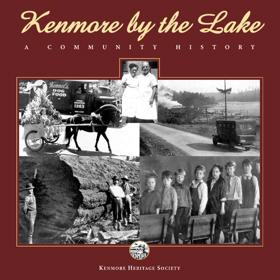
Kenmore by the lake a community history by Priscilla Droge, Terri Malinowski, Kenmore Heritage Society (Kenmore, Wash)
|
2003 |
|
The journals of Lewis and Clark by Meriwether Lewis , William Clark , Frank Bergon
In 1803, when the United States purchased Louisiana from France, the great expanse of this new American territory was a blank-not only on the map but in our knowledge. President Thomas Jefferson keenly understood that the course of the nation's destiny lay westward and that a national "Voyage of Discovery" must be mounted to determine the nature and accessibility of the frontier. He commissioned his young secretary, Meriwether Lewis, to lead an intelligence-gathering expedition from the Missouri River to the northern Pacific coast and back. From 1804 to 1806, Lewis, accompanied by co-captain William Clark, the Shoshone guide Sacajawea, and thirty-two men, made the first trek across the Louisiana Purchase, mapping the rivers as he went, tracing the principal waterways to the sea, and establishing the American claim to the territories of Idaho, Washington, and Oregon. Together the captains kept a journal, a richly detailed record of the flora and fauna they sighted, the Indian tribes they encountered, and the awe-inspiring landscape they traversed, from their base camp near present-day St. Louis to the mouth of the Columbia River. In keeping this record they made an incomparable contribution to the literature of exploration and the writing of natural history. With 2003 marking the beginning of the Lewis and Clark expedition bicentennial celebration, this journal is now reissued in a beautiful new Penguin Classics package xlvi, 505 pages : illustrations, maps ; 20 cm Non-circulating [ 1 ]
|
2003 |
|
Oregon's promise an interpretive history by David Peterson del Mar 
A concise and compelling general history, Oregon's Promise explores familiar and neglected people and movements in the state's history, while challenging readers to view Oregon's past, present, and future in a new way. The words "Oregon history" conjure up images of Lewis and Clark and rugged pioneers. In Oregon's Promise, David Peterson del Mar shows that the explorers' impact was both different from and less significant than commonly assumed, and that the state's settlers were much more varied, contentious, complicated, and interesting than conventional heroic stereotypes would suggest. The book's many themes revolve around Peterson del Mar's consideration of how Oregonians have attempted to build a prosperous and just society. He examines both the traditional center of Oregon history and its often overlooked margins-the people who have struggled to be included in Oregon's promise. The author is both a respected historian and an engaging writer, with a talent for explaining Oregon's past in a way that will appeal to all readers, from natives to newcomers, from students to scholars. 314 pages : illustrations, maps ; 23 cm Non-circulating [ 1 ]
|
2003 |
|
Moscow living and learning on the Palouse by Julie R. Monroe 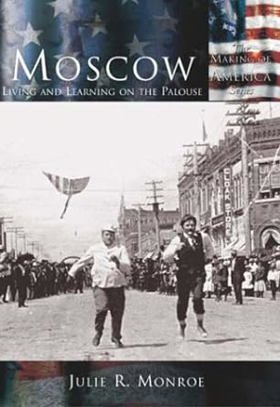
Published in local editions by Julie R. Monroe, Moscow: Living and Learning on the Palouse explores the unique cultural and historical evolution of this iconic north-central Idaho college town. The book chronicles Moscow's transition from a nascent pioneer settlement into the intellectual hub of the rolling Palouse hills, deeply shaped by the establishment of the University of Idaho in 1889. Through archival photographs and engaging community narratives, the text highlights the enduring interplay between agricultural grit and academic ambition. A keen insight drawn from the work is how isolated university towns create distinct cultural islands; by placing a major institution of higher learning in the middle of a vast, conservative farming economy, Moscow fostered a rare hybrid society where agrarian pragmatism and progressive intellectualism perpetually collide and shape each other. 160 pages : illustrations ; 25 cm. Desiderata
|
2003 |
|
Black Diamond mining the memories by Diane Olson, Cory Olson, Black Diamond Historical Society 
Published by Diane Olson, Cory Olson, and the Black Diamond Historical Society, Black Diamond: Mining the Memories chronicles the rich, coal-fuelled history of a historic Washington company town situated in the shadow of the Cascade foothills. The book draws on extensive archival photographs, oral histories, and company records to detail the dangerous underground labor, multi-ethnic immigrant communities, and daily hardships of families who worked the rich seams for the Pacific Coast Company. Through these intimate vignettes, the text preserves the vanishing social fabric of a bustling industrial hub that once supplied coal across the entire Puget Sound. A keen insight drawn from the work is how company-owned mining towns functioned as isolated, corporate-feudal microcosms; by controlling everything from housing to currency, the coal company engineered a fragile social stability that ultimately fractured the moment laborers sought independent political and economic autonomy. xvi, 274 pages : illustrations, map ; 28 cm Non-circulating [ 1 ]
|
2003 |
|
Coos Bay Plundertown, USA by Al Sandine 
Published in local editions by Al Sandine, Coos Bay Plundertown, USA is a blistering polemical history examining the corporate exploitation and environmental degradation of Oregon’s largest coastal port. The book chronicles how powerful timber and industrial interests, in collusion with local political figures, systematically gutted the region's natural resources and bypassed community oversight to maximize short-term profits. Through sharp critique and detailed local documentation, the text exposes the severe economic and ecological fallout left in the wake of unchecked industrial ambition. A keen insight drawn from the work is how resource-dependent towns are frequently treated by outside corporate forces as disposable sacrifice zones; the narrative reveals that "plundertown" status is not an accidental policy failure, but the predictable end-result of an extractive economic model that privatizes public wealth while socializing long-term environmental ruin. 175 pages : illustrations, maps, portraits ; 22 cm Non-circulating [ 1 ]
|
2003 |
|
When coal was king Ladysmith and the coal-mining industry on Vancouver Island by John Roderick Hinde 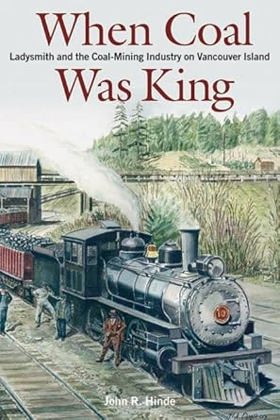
"When Coal Was King illuminates the origins of the 1912-14 strike by examining the development of the coal industry on Vancouver Island, the founding of Ladysmith the experience of work and safety in the mines, the process of political and economic mobilization, and how these factors contributed to the development of identity and community. While the Vancouver Island coal industry and the strike have been the focus of a number of popular histories, this book goes beyond to emphasize the importance of class, ethnicity, gender, and community in creating the conditions for the emergence and mobilization of the working-class population. Informed by current academic debates on the matter and within the discipline, this readable history takes into account extensive archival research, and will appeal to historians and others interested in the history of Vancouver Island."--Jacket viii, 276 pages : illustrations, maps ; 24 cm Desiderata
|
2003 |
|
West Coast adventures shipwrecks, lighthouses, and rescues along Canada's west coast by Adrienne Mason 
The stories of the sailors, lighthouse keepers, and linemen who have weathered the infamous west coast storms. The southwest coast of Vancouver Island is a reef-studded stretch, notorious for dramatic winter storms and thick cloaks of summer fog. Many ships have found themselves well off course, even lost, during sudden storms. This book tells the stories of the sailors, lighthouse keepers, and linemen who have weathered these west coast storms. 107 pages : illustrations, map ; 22 cm. Desiderata
|
2003 |
|
Dreaming in the rain how Vancouver became Hollywood North by Northwest by David Spaner 
Vancouver is now North America’s third largest center for film and television production, recently witnessing the filming of Halle Berry’s Catwoman and Will Smith’s I, Robot, among others. But Vancouver has been hosting filmmakers for years, coming into its own in the early 1970s when Robert Altman, Warren Beatty and Julie Christie made McCabe and Mrs. Miller and Mike Nichols, Jack Nicholson and Candice Bergen filmed Carnal Knowledge. Dreaming in the Rain tells the story of how Vancouver became North by Northwest, from its early days as a Hollywood studio backlot to its becoming home to a vibrant indigenous scene that is among the most acclaimed, provocative, independent filmmaking communities anywhere. 236 pages : portraits ; 23 cm Desiderata
|
2003 |
|
Potlatch people Indian lives & legends of British Columbia by Mildred Valley Thornton 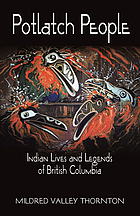
"Mildred Valley Thornton had an abiding passion which she pursued with almost missionary fervor throughout her life - the preservation of Canada's Native culture. For over fifty years she dedicated herself to that purpose through the medium of her paintings, writings and lectures. During the course of her career, Mildred not only painted the portraits of many prominent and historical Native Canadians, but she assembled an accompanying catalogue of anecdotes, folklore and legends, which today provide a unique chronicle of a vanished age. This publication is a collection of both Thornton's colorful portraits and the fascinating story behind each one."--pub. desc 317 pages : illustrations (some color) ; 22 cm Desiderata
|
2003 |
|
Idaho's historic trails from Lewis & Clark to railroads by Martin Potucek 
This is the story of trails blazed by early explorers, miners, and soldiers and provides travel tips for modern-day explorers. Idaho s Historic Trails includes modern maps of roads and trails and information about interesting side trips. Includes Lewis & Clark's route and the Oregon Trail (and South Alternate.) xx, 166 pages : illustrations, maps ; 23 cm Desiderata
|
2003 |
|
Shoshoni pony by Carol Lynn MacGregor, Dick Lee (Illustrator) 
An overview of how horses came to be used by various peoples in the American West, particularly the Shoshoni Indians, discussing the difference that horses made in their lives 32 pages : illustrations (some color) ; 22 cm Desiderata
|
2003 |
|
Carlton Stone's Hillcrest a history of Vancouver Island's Hillcrest Lumber Company by Ian MacInnes 
Carlton Stone left his Essex home to follow the sea when he was fourteen and two decades later found a life’s work amid the trees of Vancouver Island, British Columbia. From his little four-man Doupe Road sawmill near Duncan grew an enterprise that once employed 500 men and ranked third among the Island’s lumber producers. 132 p. : ill., ports. ; 22 cm. Desiderata
|
2003 |
|
Restoration of Puget Sound rivers by David R. Montgomery, University of Washington Center for Water and Watershed Studies, Society for Ecological Restoration Northwest Chapter Spring Meeting (2000 : Seattle, Wash) 
The recent listing of Pacific salmon under the Endangered Species Act has led to substantial interest in the scientific basis for river restoration in the Pacific Northwest. Millions of dollars in state and federal funding have been programmed for habitat restoration efforts to stem the decline of salmon populations in the region. This volume addresses the need for a solid understanding of fluvial processes and aquatic ecology in order to predict both river and salmonid response to restoration projects. In the Pacific Northwest, as in most regions of the United States, we are still learning about the processes that create habitat and river structure, how those processes influence aquatic ecosystems, and how to gauge the response of river systems to both land-use changes and restoration efforts. River systems are still responding to historic changes, and degraded habitat may not be restored successfully if natural conditions are not well understood, particularly if massive changes in watershed hydrology or other processes are the root cause. These issues faced in the development of regional river restoration programs are by no means unique to the Northwest, and so the initiation of a regional program of river restoration provides an opportunity to evaluate the state of river restoration in general. The eighteen chapters of Restoration of Puget Sound Rivers--presented by the region’s experts at a symposium of the Society for Ecological Restoration--examine geological and geomorphological controls on river and stream characteristics and dynamics, biological aspects of river systems in the region, and the application of fluvial geomorphology, civil engineering, riparian ecology, and aquatic ecology in efforts to restore Puget Sound Rivers. This volume will be of interest to geomorphologists, aquatic biologists, civil engineers, planners, and all those interested in the interface of science and policy in addressing one of the fundamental environmental challenges of the twenty-first century. v, 505 pages : illustrations, maps ; 23 cm Desiderata
|
2003 |
|
Distant corner Seattle architects and the legacy of H.H. Richardson by Jeffrey Karl Ochsner, Dennis Alan Andersen 
On the afternoon of 6 June 1889, a fire in a cabinet shop in downtown Seattle spread to destroy more than thirty downtown blocks covering 116 acres. Disaster soon became opportunity as Seattle’s citizens turned their full energies to rebuilding: widening and regrading streets, laying new water pipes and sewer lines, promulgating a new building ordinance requiring construction in the commercial core, and creating a new professional fire department. A remarkable number of buildings, most located in Seattle’s present-day Pioneer Square Historic District, were permitted within a few months and constructed within a few years of the Great Seattle Fire. As a result, the post-fire rebuilding of Seattle offers an extraordinarily focused case study of late-nineteenth-century American urban architecture. Seattle’s architects, seeking design solutions that would meet the new requirements, most often found them in the Romanesque Revival mode of the country’s most famous architect, Henry Hobson Richardson. In October 1889, Elmer Fisher, Seattle's most prolific post-fire architect, specifically cited the example of H. H. Richardson in describing the city's new buildings. In contrast to Victorian Gothic, Second Empire, and other mid-nineteenth-century architectural styles, Richardson’s Romanesque Revival vocabulary of relatively unadorned stone and brick with round-arched openings conveyed strength and stability without elaborate decorative treatment. For Seattle’s fire-conscious architects it offered a clear architectural system that could be applied to a variety of building types - including office blocks, warehouses, and hotels - and ensure a safer, progressive, and more visually coherent metropolitan center. Distant Corner examines the brief but powerful influence of H. H. Richardson on the building of America’s cities, and his specific influence on the architects charged with rebuilding the post-fire city of Seattle. Chapters on the pre-fire city and its architecture, the technologies and tools available to designers and builders, and the rise of Richardson and his role in defining a new American architecture provide a context for examining the work of the city’s architects. Seattle's leading pre- and post-fire architects - William Boone, Elmer Fisher, John Parkinson, Charles Saunders and Edwin Houghton, Willis Ritchie, Emil DeNeuf, Warren Skillings, and Arthur Chamberlin - are profiled. Distant Corner describes the new post-fire commercial core and the emerging network of schools, firehouses, and other public institutions that helped define Seattle’s neighborhoods. It closes with the sudden collapse of Seattle’s economy in the Panic of 1893 and the ensuing depression that halted the city’s building boom, saw the closing of a number of architects’ offices, and forever ended the dominance of Romanesque Revival in American architecture. With more than 200 illustrations, detailed endnotes, and an appendix listing the major works of the city's leading architects, Distant Corner offers an analysis of both local and national influences that shaped the architecture of the city in the 1880s and 1890s. It has much to offer those interested in Seattle’s early history, the building of the city, and the preservation of its architecture. Because this period of American architecture has received only limited study, it is also of importance for those interested in the influence of Boston-based H. H. Richardson and his contemporaries on American architecture at the end of the nineteenth century. xii, 409 pages : illustrations ; 29 cm Desiderata
|
2003 |
|
"Another day in paradise" island memories from the thirties and forties by James K. Long 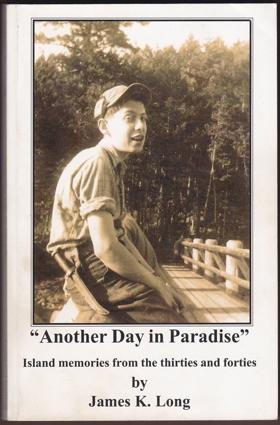
Childhood memories of Orcas Island in the 1930's and 1940s. Published in local editions, James K. Long’s “Another Day in Paradise”: Island Memories from the Thirties and Forties captures the nostalgic, slower-paced rhythms of rural island life during an era defined by isolation and self-reliance. Drawing on personal reminiscences and local lore, the book details the distinct daily routines of farming, community gatherings, and maritime travel in the Pacific Northwest before the arrival of modern bridges and high-speed ferries. Through vivid anecdotal storytelling, the author preserves a vanishing world where neighbors depended entirely on one another to weather economic hardship and geographic seclusion. A keen insight drawn from the work is how the ironic title reframes historical isolation; by contrasting the physical hardships of Depression-era island existence with the deep sense of communal belonging it forged, the narrative reveals that true paradise on the frontier was never about untouched luxury, but rather the profound human connection born from shared vulnerability. 62 p. : ill. ; 25 cm. Non-circulating [ 1 ]
|
2003 |